

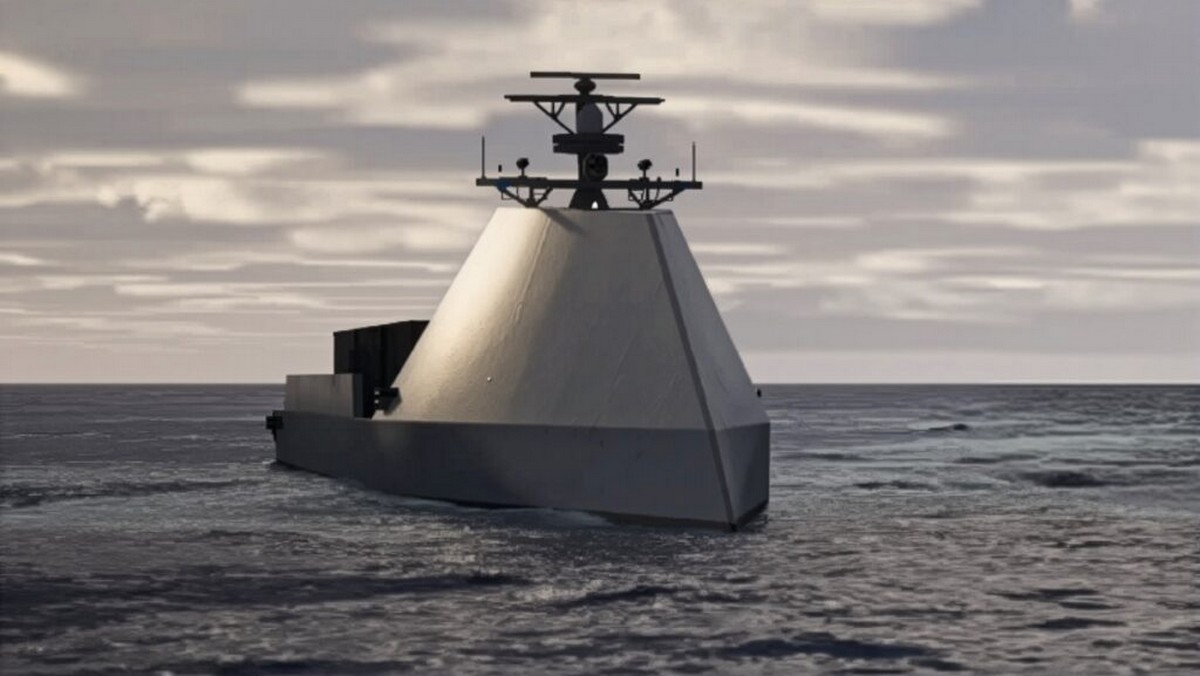
Five HII ROMULUS 151 uncrewed surface vessels are now under construction in Louisiana, with the first hull completing its structural build and being turned over ahead of deck and pilothouse work, according to HII.
Four of the vessels are being built by Breaux Brothers Enterprises in New Iberia, while a fifth is under construction at Halimar Shipyard in Morgan City. HII said the first ROMULUS 151 hull at Breaux Brothers has now completed its main structural build and undergone the hull-flip process, allowing construction to move on to the upper parts of the vessel.
The programme is intended to produce a family of modular, AI-enabled uncrewed surface vessels for missions ranging from surveillance and mine countermeasures to strike and the operation of other robotic systems. ROMULUS is built around HII’s Odyssey Advanced Autonomy architecture, an open system intended to allow different mission payloads and software to be integrated as requirements change. The company says the vessels are being developed for potential use by the US Navy, US Marine Corps, other joint forces and allied customers.
Mission roles identified by HII include intelligence, surveillance and reconnaissance, mine countermeasures, strike operations and counter-uncrewed systems missions. The vessels are also intended to act as motherships for other autonomous platforms, with the ability to launch and recover uncrewed underwater and aerial vehicles.
The ROMULUS 151 is one member of a wider family rather than a single-purpose craft, with HII seeking to use common autonomy and open architecture across different sizes and mission configurations. The current production effort is split between two commercial Louisiana yards, with HII providing the autonomy technology and programme integration while the shipbuilders carry out construction.
HII said the arrangement was intended to combine conventional shipyard production methods with autonomous maritime technology, allowing vessels to be built in numbers without relying on a single yard. The first hull reaching the flip stage is an important construction milestone because it marks the point at which work can move from the principal hull structure towards the deck, pilothouse and subsequent outfitting.
HII describes ROMULUS as part of a broader move towards scalable autonomous maritime forces, where comparatively lower-cost uncrewed vessels can carry sensors, weapons or other systems alongside conventional warships. The company is already heavily involved in US Navy uncrewed systems, particularly underwater vehicles, and is using ROMULUS to expand that work into larger surface vessels.
With five ROMULUS 151s now being built simultaneously, the programme has moved beyond individual demonstrators towards a small production run intended to prove both the vessel design and the industrial approach needed to manufacture autonomous ships at greater scale.



I thought for a moment that I had missed an actual order for all this AI/drone vapour ware that the MOD has been talking about
No it’s American and all a bit Heath Robinson in my view. I am sure the UK will do it’s own thing and it will probably be quite good.
Likely but not until an actual order is placed. We are rapidly becoming a real paper navy, lots of concepts not a lot of delivery.
Vessels have to be actually designed for the requirement before firm orders are placed. Thats completely normal. Would you order a new car based on a artists impression. No.
Yeah I know, it’s just we have been having concept of how they will be used after concept including project names but no actual order for a design phase.
These are going to be extremely complex vessels and a whole new way of naval warefare. It’s been made very clear they would like the first of class the T91 in the water for around 2030. 4 years away. For highly complex defence projects that’s a very ambitious timeline. They are not going to place production orders for something that doesn’t exist yet. Its like ordering 140 Tempest when the technology demonstrator hasn’t even flown yet. Procurement doesn’t work that way
If they don’t start a tender process of what they want, then there is no chance of a 2030 timeframe.
It feels like AI at work. Drone drone drone but no idea how to implement.
I fear they arent ready for drones at that scale and should be instead building traditional ships this time around and focus on sorting out the thinking around drones for the time after.
I think experts in the RN and industry have far better handle on this than a bunch of random middle age blokes chatting on a defence site.
I would hope so, but history would indicate otherwise. Look at basic drone warfare. Anyone with a vague understanding of how they worked, knew they had changed warfare when the Nagorno-Karabakh conflict occured in 2020, and yet 6 years on and the British armed forces still only have a handful of drones and still debating how to use them and what should the approach be etc.
History is full of such problems just look at horses in ww1. Battle of Mogadishu and the need for armoured vehicles when fighting in urban environment
There is something very wrong about how the MOD plan for future wars and therefore gear for them.
The Army has a hell of a lot more drones than we realise. The hybrid navy, loyal wingman for Typhoon & F35 and Apache. A lot of progress has been made in this area. But the technology is rapidly developing. And we have to purchase capability that isn’t going to be out of date after 6 months. Pointless ordering 200,000 drones just to sit on a shelf not being used. But we do have the industrial capacity to do so if/when we do need them. And we are providing drones in numbers to Ukraine who will use them.
Depends on your view on how much heads up we have for the next war. If we don’t have hundreds of thousands of drones in stores, they would need to be built and people trained to use them, neither of them are something that happens over night. It’s taken years for Ukraine to ramp up both and same with Russia
Buying an unbuilt vehicle entirely from an early visual concept is standard practice for hundreds of ultra-wealthy individuals in the hyper-exclusive luxury car market. The MOD falls into the bracket of ultra wealthy. Many defence contracts start off as concepts to satisfy a specification.
Where’s the money going to come from?
The 298Bn defence budget over the next 4 years.
Movement on getting this type of drone up and active.
Build a few quick review and then go again?
Watch the embedded video in the “according to HII” link above.
It is definitely a striking contrast, a cutting-edge, AI-enabled robotic drone ship being built in what looks like a gritty, traditional “mom n’ pop” Gulf Coast shipyard, two different centuries colliding …
Flipping that hull 180° looked ‘stressful’. Structural elasticity will no doubt give way to torsional stiffness as as the deck plating, bulkheads, and upper superstructure are fabricated … but, very flexile hulls.
Aren’t these part of the Babcock pitch?