

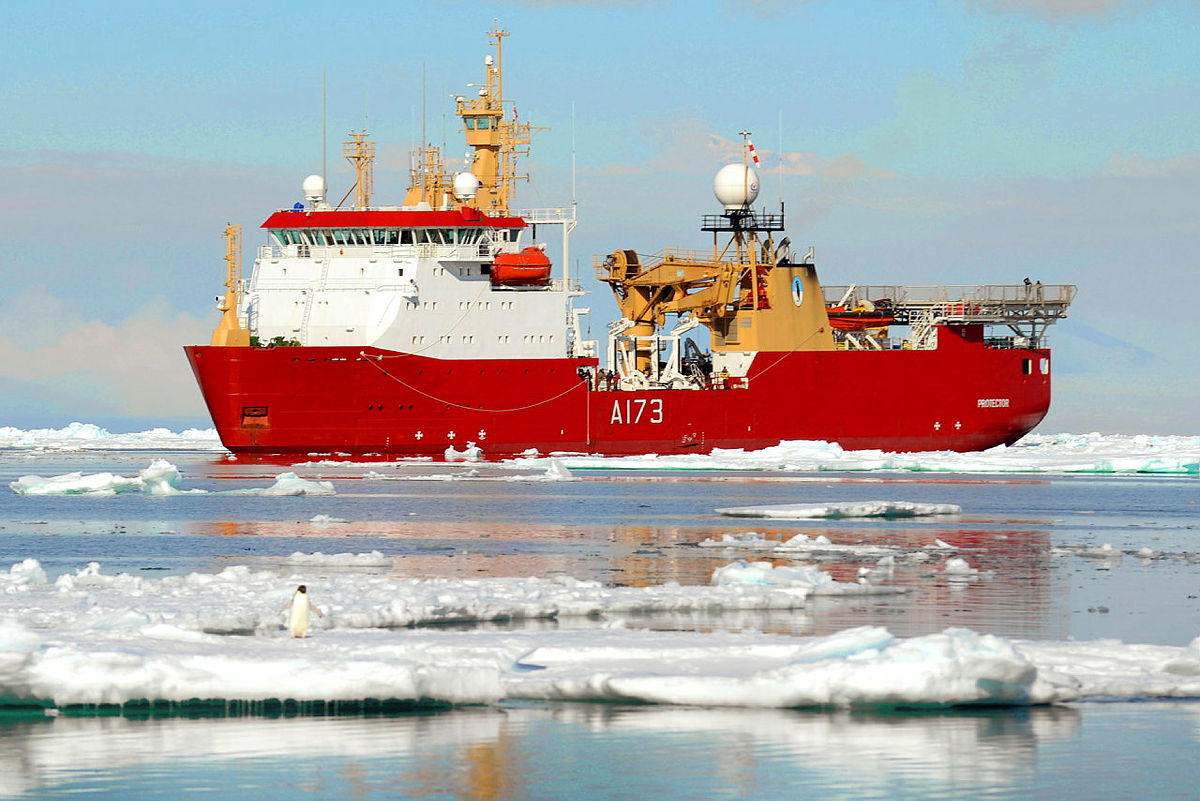
Work on replacing HMS Protector is being run under Project Shackleton, and the Defence Investment Plan has allocated funding for a successor to the Royal Navy’s ice patrol ship, according to an answer given in Parliament.
Ben Obese-Jecty, the Conservative member for Huntingdon, asked what steps the Secretary of State is taking to reach a decision on the method of procurement and on the replacement timeline, following an answer given on 15 September.
Luke Pollard, the Minister of State for Defence, said: “The previous Government’s plan was for HMS Protector to remain in service into the late 2030s and did not provide for a replacement vessel. We judged this approach to be unsustainable and therefore allocated funding within the Defence Investment Plan to deliver a successor capability.
“The Defence Investment Plan includes provision for the replacement of HMS Protector with a more modern vessel. Through Project Shackleton, the Ministry of Defence is undertaking the necessary technical, commercial and delivery analysis to inform decisions on the preferred procurement approach and replacement timeline. Decisions will be taken once this work has concluded.”
Protector came into Royal Navy service in 2011, bought from Norwegian owners as the civilian ice-strengthened vessel Polarbjørn and taken on charter before purchase, and she has carried Britain’s Antarctic presence ever since, running survey work, supporting the British Antarctic Survey and upholding obligations under the Antarctic Treaty.
Protector has now been removed from service.





“The previous government’s approach was unsustainable, so we retired her straight away just after starting the programme”
What is it about HMG that always results in conflating process with progress?
They are paid to do things not necessarily progress things. They are never fired. They are moved around, may never see a single project from concept consideration to completion and later post implementation effectiveness review, only portions thereof of many projects. At all times political considerations unrelated to their work may & can overturn detailed study of actions to take. They are detached from results and their role is to apply process
I’m so glad that a delivery analysis to inform decisions is taking place. I was getting worried for a while that decisions weren’t being informed and no deeper understandings reached..
🙄
Watching “Yes Minister” allows us to be familiar with the jargon that politicians use.
Another bit of our armed forces drops off with no immediate replacement. I read on X the scoreboard is 12 vessels for the RN since Labour came to power.
All is well, one day they’ll be replaced, maybe, perhaps.
I’ll give them their dues, we can’t exactly blame this government for RN vessels dropping like flies; we can certainly blame them for the lack of action on ordering replacements though.
Agreed, it’s why the Tories no longer have any right to bitch.
By the time all the blether has finished there wont be any ice so job done.
Now it makes sense…..
So, The Royal Navy is phasing out Ice Patrol ship capabilities in line with the declining level of sea ice, thus showing the RN is reacting in step with changing requirements.
So it’s a positive story!
I was getting worried for a minute.
At least they are planing a replacement that’s a step in the right direction I suppose, but it is another gapped capability which is actually a rather important one in geopolitical terms.
Namaste 🙏 All,
Another case of the MoD and the Once Great Royal Navy, caught out, by Defence Under Spending or Defence Cuts, causing patch and repair to keep going, or buying second hand old vessels from commercial shipping too.
How many Ice Patrol ships has the Royal Navy gone through in the lats since 1990 years, is it 3 vessels now, the first of these served from 1967 until 1990, serving 23 near 24 years, but was built in 1956 and purchase second hand and aquired from commercial shipping operator again too.
Then her replacement again purchased second hand from commercial shipping operator, in 1991 and served to 2008, just 17 years for a vessel that was only one year old when the MoD purchases this Ice Patrol Ship.
Then we come to the last Ice Patrol Vessel, purchases by the MoD in 2011 and it seems only served to 2026 just 15 years, but was built in 2001 again a second hand vessel acquired from a commercial shipping operator too.
There a clear fact here, each of the second hand purchased MoD Royal Navy Ice Patrol Vessels, have served less years than the ship before them, dropping from 23/24 years service down to just 15 years service.
Which asks are British Taxpayers getting value for their money being spent on second hand ships, is it about time the Royal Navy actually are providedwith a brand new custom designed Arctica / Antarctica Ice Class Naval “Armed” Offshore Patrol Corvette, also not just buying one of them too.
Instead buying a minimum of two new Arctica / Antarctica Ice Class Naval “Armed” (57mm and 40mm Bofors guns, plus missiles, torpedoes and sea mines too) Offshore Patrol Corvettes, each with their own built-in Vertical Launch tude Systems (VLS, for Anti-Ship Missiles, Surface to Air Missiles, Land-attack Cruise Missiles and Anti-Submarine Rockets), plus built-in helicopter hangar and flight deck, as well as Special Mission Hangar for manned RIB’s and Landing Craft Personnel Vehicle (LCPV), or Autonomous Surface Unmanned Craft (ASUVs) and Underwater Autonomous Unmanned Vehicles (UAUV’s) too.
Also carrying either a pair of Lightweight Anti-Submarine/ Anti-Surface Warfare / Combat Search and Recuse Helicopters, or one LwAS/ASW/CSAR helicopter plus two Vertical take-off and landing Armed Reconnaissance Drones, with accommodation for Royal Marines too.
If not the British Government agreeing to buy three of these new Arctic and Antarctica Ice Class Naval “Armed” Offshore Patrol Corvettes in place of Type 32 Frigates,. So one of these Ice Class Naval “Armed” Offshore Patrol Corvettes, could be permanently stationed in the Falkland’s on 12 months rotation, assigned to Falkland’s and British Antarctica Territoriesand South Altantic and Southern Oceans Patrol Areas duties.
While a second and third Ice Class Naval “Armed” Offshore Patrol Corvettes could permanently stationed in Scotland, on 12 months rotation again. With one assigned to Norwegian Sea, Greenland Sea and Arctic Ocean Patrol Nato Areas, plus secondary Eastern North Altantic Ocean, Irish Sea, North Sea and Baltic Sea and English Channel Nato duties too.
While the third Arctic and Antarctica Ice Class Naval “Armed” Offshore Patrol Corvette, is the Reserved, Support and Training, which is used to replace the other two Corvettes on rotational basis when needed.
While the other two Corvettes are individually and inturn going through their routine maintenance and servings periods, or when the other two Corvettes are under going required med-lift refits, modifications, updates, improvement and upgrades too, or the third Corvette is there as backup incase of one of the other two Corvettes breakdown too.
Or the third Corvette is used as a training vessel for new Naval personnel, before being posted to the other two Corvettes, as well as if necessary the third Corvette, is on standby to deploy in an emergency to either the Arctic Ocean or South Altantic / Southern Oceans in protection of UK and Nato interests too.
Why then cannot the UK Government, MoD and Royal Navy, buy new Ice Class “Naval / Coast Guard” Offshore Patrol Vessels, like the Royal Canadian Navy 6 Harry DeWolf Class 6,615 tonns and 103.6 metres long Ice Offshore Patrol Vessels.
Which the apCanadain Coast Guard also has 2 Harry DeWolf Class Ice Offshore Patrol Vessels of their own, all 8 Harry DeWolf vessels have or is costing the Canadian Government 7.1 Billion Canadian Dollars (3.774076 Billion Pounds Sterling) to build them all.
Which the UK Government could buy maybe three similar Ice Class Offshore Patrol Vessels, for around 1.8 Billion Pounds Sterling or for under 2 Billion Pounds Sterling, that is based on Canadian Government 2023 / 2024 costings, allow for UK Government ordering in 2027.
With the Canadian Shipyards starting and building all the hulls, starting with the first in late 2027 early 2028 and British Shipyards fitting them all out afterwards too. With a target date for the first delivery by 2030/31, then the second vessel being delivered in 2032/33 and last vessel delivered in 2034/35 too.
The cost to the UK Government and Taxpayers, could grew to around 2.5 to 2.8 Billion Pounds Sterling, though with a designed Service Life of 30 years minimum to 40 years maximum for each vessel.
Would give the Royal Navy a Squadron of Ice Class Naval ‘Armed” Offshore Patrol Vessels, that could or would serving up to 2060 or until 2075, which would give both the UK better Naval defence capability, as well as much better value for money to UK Taxpayers too.
Though the Labour Defence Ministers, will more than likely go cheap again trying to save money,.
Only making false saving and landing up costing more in the long run, on buying another second hand old Ice Class commercially shipping operated vessel.
Just like the US Government and the US Coast Guard have, over them buying not that long ago a second hand vessel, to become the USCG New Medium Class Ice Breaker vessel. Which has already broken down it seems, having to return to its home port for repairs, before becoming fully operational and going on its first Arctic Ocean Patrol too!
As repeatedly stated the Antarctic is a weapons free area whereas the Arctic is not.
Agree that the UK should buy new vessels.
1. Contract Camell Laid to build another RSS David Attenborough for the Antarctic – £260 million? The moon pool would be an asset in itself for USV and subsea infrastructure monitoring. 4-5 year build time.
2. Piggy back onto the Canadian order for new MPI and benefit from bulk building?
Ghurkamum, while it would be right and proper to have 3 ice patrol ships, the idea of finding a spare £3bn to pay for them is fantasy land I’m afraid.
The fleet has been run down, particularly over the last 14 years, because the money has not been there to replace ships on a one-for-one basis. As a result of the tears of parsimony, 29 ships and subs were overdue for replacement in 2024, that’s about half the fleet. It will take unaffordable billions to repair the damage done.
It is actually worse than it looks: the nuclea subs and indeed the entire nuclear enterprise has been neglected and run down and now requires colossal funding to get back on an even keel. £124 bn to be precise, I.e. £16bn pa every year up to 2034/5 – and that’s before the main costs of SSN AUKUS kick in. That is about 50% of the three services’ equipment budgets combined.
Which means that all three services are going to be on short commons for the next decade, forced to gap various equipments and cut operating costs. That is the price to pay for having a holiday on defence spending over the last 14 years.
I’m surprised and relieved that there are moves to replace Protector and Scott, I thought both would likely be scrapped and gapped.
Re Protector replacement, what we really need is a proper icebreaker, rather than an ice patrol ship which is restricted to operating in thin ice in summer and autumn. But the cost of procuring an icebreaker is considerable, due to much larger displacement, thicker hull, powerful engine, more watertight bulkheads, rudder and propeller protection etc, etc. It is sadly not going to be on the menu any time soon. If we can get a second-hand commercial ice patrol ship that will have to do us for now.
It is easy to forget that the naval budget is already at full stretch building 13 new frigates, 3 new FSS, the last Astute, and the Norwegian MHC OSVs and now replacements for Protector and Scott, promptly followed by the 4 Bay ATS replacements and one day the CCV frigates. Plus the 4 classes of T9X unmanned vessels. That is a heap big naval construction programme and the Protector replacement is not at the top of the priority list.
As stated the Antarctica is demilitarised and no armed vessels can enter the Antarctic.. military can only use military personnel and equipment for scientific research and logistics as well as security checks.
This means that although HMS protectors has HMGs, long arms and side arms.. when it enters the Antarctic these must be formally locked away and secured and essentially this has to be agreed by all treaty members.
Endurance carried AShMs for her Wasps
Everything had to be very specificity locked away and secured so it was not accessible in the Antarctic and the treaty organisation has to agree every weapon that enters and how it’s been removed from service in the treaty area.
The treaty organisation would never allow an “armed” military vessel in the area and even unarmed military vessels are only allowed in the area for purposes of scientific and treaty support.
The Antarctic Patrol Ship tasking has been in the same vicious circle since the 1960’s and the cancelled HMS Terra Nova. It’s “suddenly” discovered that the existing ship is worn out and unserviceable. The Foreign Office points out the extreme danger to UK sovereignty claims in the region of no regular naval presence (if only to avoid making the same error as in 1981!). As a stop gap the MOD hastily charters the most suitable civilian ship it can find, usually massively over paying. Studies continue on the long term solution, it eventually becomes clear that the ideal ship will cost twice the available budget so the project is cancelled and the stop gap vessel is purchased outright and becomes the permanent fix.