

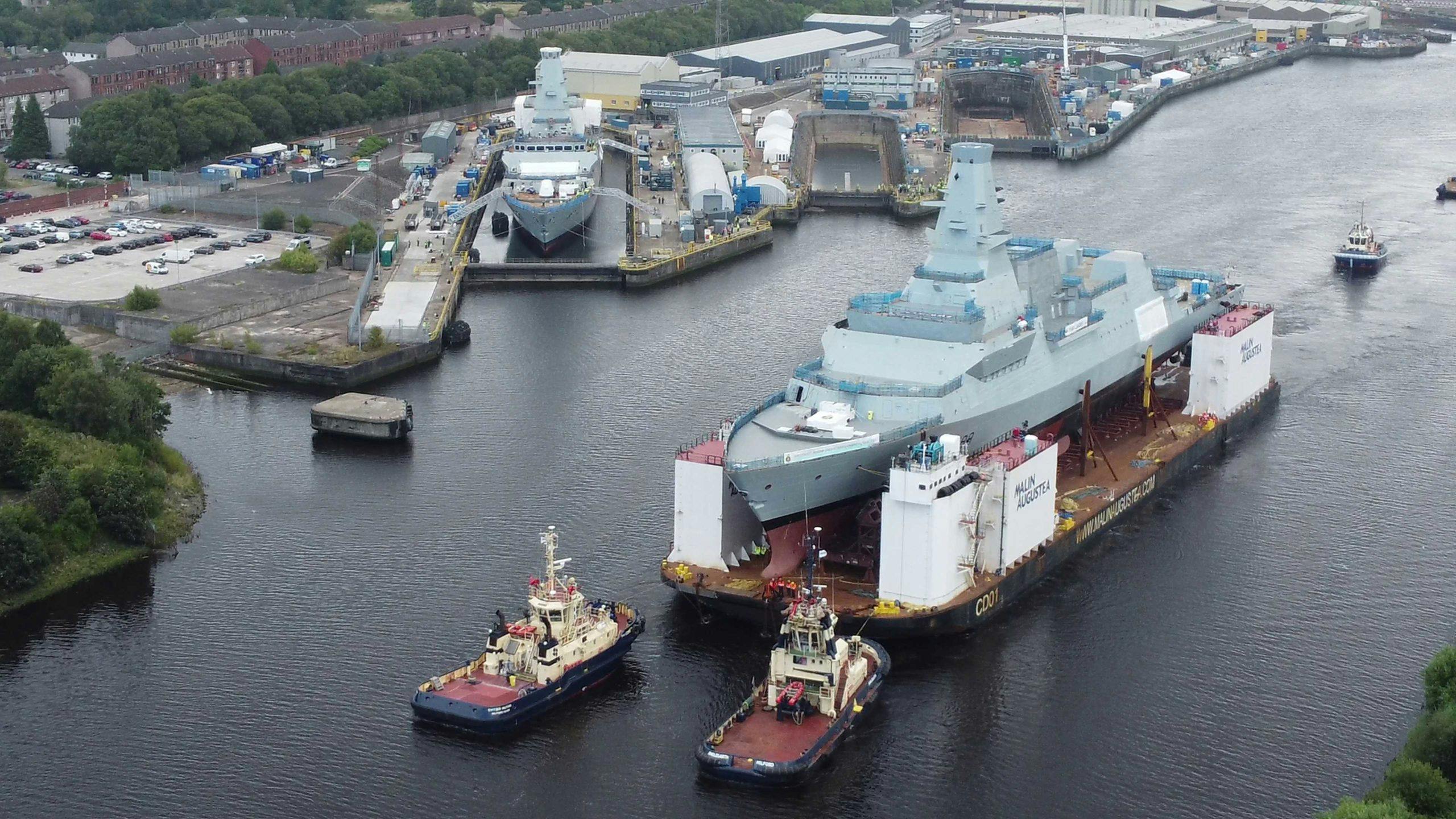
The workforce needed to build the Type 26 and Type 31 frigates and to prepare for the Dreadnought-class submarines will struggle to meet projected demand at current training levels, according to a report by the Scottish Affairs Committee.
The report describes the two frigate programmes as central to Scotland’s naval shipbuilding sector and expected to provide long-term opportunities for export-led growth, while warning that the skills pipeline behind them is not keeping pace.
It states that those major programmes “require a sustained pipeline of highly skilled workers which, at current levels, will struggle to meet projected demand”.
Mark Stead, Senior Vice President for Radar and Advanced Targeting at Leonardo, told the committee: “We are not getting enough people into those planned training programmes.”
The committee sets out what is at stake in the frigate orders now on the books.
The £10 billion agreement to supply Norway with Type 26 frigates, announced in August 2025, is expected to support 2,000 jobs at BAE Systems’ shipyards in Glasgow and a further 2,000 roles across the United Kingdom maritime supply chain until the late 2030s, along with 103 Scottish businesses including 54 small and medium-sized enterprises.
Neil Holm, Chief Operating Officer at BAE Systems, drew attention to the Type 26 securing orders from Australia and Canada, and said he hoped a Norwegian order would “sustain shipbuilding and defence on the Clyde well into the next decade”.
The committee’s own conclusion attaches a condition to that prospect, stating that meeting rising demand for defence capability, particularly in shipbuilding, aerospace and advanced technologies, “offers the prospect of expanding the number of highly skilled, well-paid jobs in Scotland”, while warning that “inconsistent funding and stop-start procurement weaken sovereign capability, workforce retention and the longer-term value that the Scottish defence sector can provide”.
The report records doubts raised during the inquiry about whether planned spending is sufficient.
Chief of the Defence Staff Air Chief Marshal Sir Richard Knighton has said the armed forces are currently “forecasting to spend more than the budget we have”, in evidence to the Defence Committee cited by the Scottish Affairs Committee.
Lord Robertson of Port Ellen, co-author of the Strategic Defence Review, warned in April that the government is “not willing to make the necessary investment” in defence, saying defence spending must take priority over other public expenditure because the threat to British liberty is “no longer theoretical”.
The report also records that the Defence Investment Plan followed the resignations of Defence Secretary John Healey and Armed Forces Minister Al Carns in June, amid concerns funding was insufficient to deliver the review, and that while the plan allocated £298 billion over four years, military chiefs reportedly sought an additional £28 billion.
The committee heard evidence on the consequences of uncertainty for firms waiting on decisions.
Aeralis, a British aerospace start-up with planned operations in Ayrshire, told the committee that delay directly undermined its financial position by creating prolonged uncertainty over future defence spending decisions and programme commitments, making it harder to secure and sustain investment. The company entered administration on 14 May 2026, attributing its collapse to sustained pressure on cashflow caused by those delays alongside wider geopolitical factors.
Witnesses also warned that a lack of certainty signals to global defence firms that they should invest somewhere else, with the United Kingdom in strong competition with other markets.
Patricia Ferguson, chair of the committee, said Scotland has a world-leading defence sector and is well placed to benefit from increased spending, “however, unless long-standing skills shortages are addressed, this opportunity could be missed”.










Lessons must be learned! We’ve seen the damage of delays and austerity have caused across industry.
Austerity, haha. Can you tell me how you are under austerity while spending more than you produce?
Austerity lasted about 6 months,…,
We never had austerity. The British government ran a deficit each and every year since 2001. Thats the very opposite of austerity. Its the very reason are a hairs breadth away from a collossal financial crisis.
Yes, lesson need to be learned, we are now in the exact same passion as what happened between the 2 world wars. They also then cut back on defence spending and were ill prepared for the impending second World wat, when it came and then had to rely on the USA which cost the cou try millions more on the lease lend repayments for nearly 5 decades
Skilled people are still the bedrock of industry and reindustrialisation is the bedrock of rearmament. According to the UKDJ article,”Scotland risks missing out on defence spending boost”, investment in defence related training is doing better south of the boarder, but my reading is that it is nowhere good enough as there is reportedly still a shortage of suitably skilled people.
Sometimes doing things on the cheap can be the mother of innovation, but trying to everything on the cheap is simply the mother of missed opportunities.
When will we learn?
Cheers CR
Easing the tuition fees burden on Engineering graduates or even providing university scholarships sponsored by firms like Babcock & Rolls-Royce to British national students would help improve access to the higher education. Plenty of young people who would happily go to university to do Engineering degrees but for the fact that incurring £thousands of debt before they’re 21 puts them off.
If a company like BAe approached 18-year olds and said go to university and do Engineering and we’ll cover your tuition fees, then when you graduate you have a job lined up with us, it would make the prospect a lot more viable for young people.
Degree level apprenticeships are increasingly common these days as are adult apprenticeships, but as usual people are the bottle neck as you need the trainers to educate the apprentices and they in turn need to be experienced and trained to teach! As the military put it in their contracts, train the trainers.
Rebuilding our industry will take decades. During the last two world wars we had a huge industrial base with millions of skilled workers. True automation helps and AI has still to generate the much of the promised benefits outside of online search engines, social media tools and some military applications, so people are still needed and rebuilding the workforce will take time. Worse the skills shortage stretch across every industry, including construction so building and fitting out factories isn’t going to be easy either. Then there is the energy issues, and…
What we really need is political consensus so that we can develop and deliver an effective reindustrialisation program. In that regard Defence is playing key role, but other Government departments need develop their own Strategies that dovetail into the Defence industrial Strategy to create a pan government effort. The Government is making progress in this regard as there is supposed to be moves to extend the Defence Industrial Strategy across all Government Dept. but I think they should go further so Health and Defence, for example, should industrial strategies focused on their own areas of responsibility but where they overlap they should work to integrate their efforts. The strategies would have to consider a range of scenarios from peace to all out war and the former would need to generate significant improvements in inward investment growth while the latter would have to consider attacks on our home land…
Chances of a proper political consensus..? Not good.
Cheers CR
So the SNP is big on how great Scotland would be if it was independent… let itgive a lead by showing it can train the people needed. Wait a minute… they don’t like defence do they? And they aren’t all that good with ferries either… Well, perhaps Westminster could arrange something? These are the sort of problems governments are elected to solve – basically the lack of a trained workforce is mostly due to lack of job opportunities due to lack of RN ship orders, if we hadn’t fallen behind that trained force would be here.
So whether it’s Westminster or the Scottish parliament… you don’t have time, do something now!
Doom, gloom, some else fault, blame the last lot, delays more money needed, etc etc, same old crap day in day out, taking longer too build but thats the makers fault they took the contract. Now time find reasons to excuse the delays and hide things with politics. What sorry state the Armed forces and MOD are in, but its never any oner in governments fault ever.
Too true
Move production to where more people who want to are available.
The Scots Government want more investment from UK Government yet are reluctant to recognise that they would benefit from putting some money into the pot.
Why would two major Projects well into production be suffering from Skilled Worker Shortage.?..
Sounds like an excuse coming on…!
Precisely.
In 2017 the first T26 was laid down. It has been almost 10 years in the shipyard being build.
I can think of several answers….
Pay older folk enough that they come back into the workforce and do the job, yes, I understand the boss might get a smaller bonus by paying a decent wage
Get people without skills and train them, yes, I understand this takes a bit of effort and time and they might not be as profitable therefore the bossmans bonus might sbe smaller
Finally of course they can talk to the government, the school I am at is stopping the engineering courses, wood and metal work because the trust has decided the machine maintenance, the raw material, the training and insurance all reduce profit more than sitting kids in a classroom. They are slightly slower than most other school trusts who have already done this. The government could perhaps change the funding model from per pupil to per grade pass with different amounts for different grades and different subjects allowing government to push towards certain subjects. This would work long term but not right now
Defence is one of many engineering based industries who need skilled personnel. Technical training is a UK weakness that needs addressing and pushing at school and college. A degree is important but an apprenticeship is essential. I have 5 children and all have and are making their way in different industries, 3 have a university degree and two via apprenticeship, two are engineers ( air engineer and an electro mechanical engineer) one a Chemist, one a business developer and one a chief. I may be lucky but all were encouraged at home and schools informed early by each what they were looking to do. For my wife and I, we encouraged and discussed a way ahead and pushed their schooling potential. What we never did was to expect the state or social media to dive their decision making!!
Run into these Degree types..All Talk and little Practical skills or Knowledge…!
Not always so my eldest had plenty of practical skills before university as did all my children. They were lucky as I trained as a control engineer and their Grandfather was an HV engineer who learnt his skill at sea as I did. Don’t be quick to judge you may be surprised sometimes.
As I said my Experience… There are obviously many Exeptions and good luck to your family who Enter the Industry..!
Free tuition at Scottish universities for anyone regardless of where they come from for specific engineering degrees with incentives in place to stay and live in Glasgow after completion. The government also seriously need to do something about the CSCS card ponzi scheme. Its becoming a barrier to work for the very experienced that never went to college. The older guys that done a traditional trade. Coulport is also not going to be ready before the new boats are due to guys just not wanting to move to the area. 22 years in construction and I have never seen it so bad.
Can’t wait to see how this Hybrid Navy is going to Work and pan out..Can’t build a manned vessel..?
Burnham just is not listening and that jackal Healey who most likely only pulled that resignation stunt to nobble Starmer is now part of the unwilling and unable. Time for the defence chiefs to act because MOD and Burnham do not seem to care if the CDS gives interviews to Sky in which it is clear what he thinks of his political masters
The Budget ain’t far away …we’ll soon know the Truth about Healey…!