

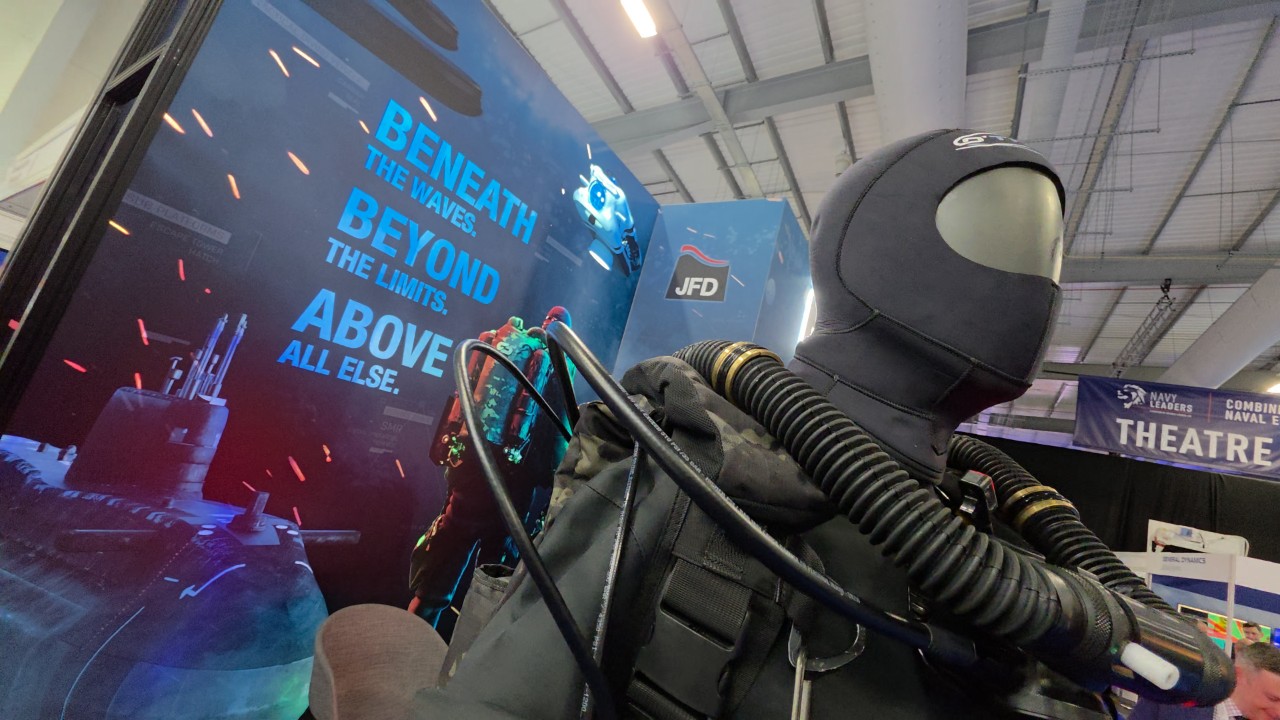
Pete Laughton, Head of Military Diving at JFD and a former Royal Navy Commander with 32 years of operational experience including command of the 12-nation International Maritime Security Construct and Coalition Task Force Sentinel, spoke to the UK Defence Journal at the Combined Naval Event in Farnborough about how military diving requirements are changing and the thinking behind JFD’s Stealth Multi-Role rebreather system.
The operational context for diving has shifted considerably, Laughton said, pointing to the resurgence of the mine threat and the increasing focus on critical underwater infrastructure as drivers of change. “Even a cursory look at international events — if we go to the Middle East and the Strait of Hormuz — you can very much see that the maritime domain is very much in focus, and dare I say, even the mine threat has suddenly made a resurgence. The tasks that are required of divers are far more extreme. If we think about critical underwater infrastructure, strategic sensors, the very latest mine threat and the ability to use divers to counter that threat, you can have a very extreme mission set.”
The physical demands on divers have not changed in their nature, Laughton said, but they have intensified considerably. “Having been a diver for 30 years, even three decades ago there are some natural extremes like depth, endurance and cold, and nothing’s different today, except that we need to go deeper and we need to have even greater endurance. Why? Because you need to be able to get in and out of particular areas undetected. That diver needs to be as stealthy as possible. It may need to use some form of propulsion device, so there are real extremes at which they’ve now got to operate, notably depth and endurance.”
Interoperability in the underwater domain goes well beyond the diver themselves, he argued. “A diver is a person, but usually they’re in the water column for a reason, to get them from A to B, but that’s part of a much bigger contribution to the maritime warfare domain. The diver has to be able to talk electronically to other command nodes, needs to be able to sit in a tactical dive vehicle, use propulsion devices, all sorts of other autonomous devices as well, and be interoperable within that very congested and challenging operational domain.”
Those requirements informed the design of JFD’s Stealth Multi-Role rebreather, which Laughton described as built from the outset to be adaptable rather than fixed to a single mission profile. “What we’ve long recognised is the operational requirement is evolving, and it’s evolving fast, and it’s actually quite difficult to understand what’s even next week, never mind in a year or two. So that’s how we’ve designed Stealth Multi-Role to be upgradeable for the future. It’s got an open architecture, it’s software driven.”
Laughton reached for an analogy to explain the thinking behind the design. “It’s a bit like the character and nature of warfare. The nature doesn’t really change, the character can, and it’s the same with Stealth Multi-Role. The nature is cylinders, a lung, breathe in and breathe out, but the character of the set and the mission sets it can be applied to, and the decompression algorithms — these can all be updated and changed. So we’ve made it so it’s configurable, it’s adaptable to the mission set that you’ve got. No longer do you have to have one size set that can only be adapted to one particular mission. Out of the box comes one set, but it can be configured and adapted to whatever the mission set is, and that could be varied — you may go on a mission that requires all sorts of different dive profiles.”
JFD has recently achieved CE certification for the Stealth Multi-Role rebreather, a milestone Laughton described with evident pride. “In the last couple of weeks, we’ve finally reached the milestone of CE certification, which means that we can take this to market to a European recognised standard. That’s come on the back of years of trials, testing and validation, including practical demonstrations of diving, literally hundreds and hundreds of hours, and also externally validated — this is not JFD marking their own homework. This is an external body coming in and saying your dive set is fit for the market.”
The system was first unveiled as a concept at DSEI in 2025, with CNE marking the first time the production kit has been shown publicly on a stand. Since its unveiling, development and operational testing have been conducted across a broad range of dive conditions, and the system is now ready for release to market.









I’ve gained $17,240 only within four weeks by comfortably working part-time from home. Immediately when I had lost my last business, I was very troubled and thankfully I’ve located this project now in this way I’m in a position to receive thousand USD directly from home. Each individual certainly can do this easy work & make more greenbacks online by visiting
following website—.,.,.,.,.—>>> JobatHome1.Com