

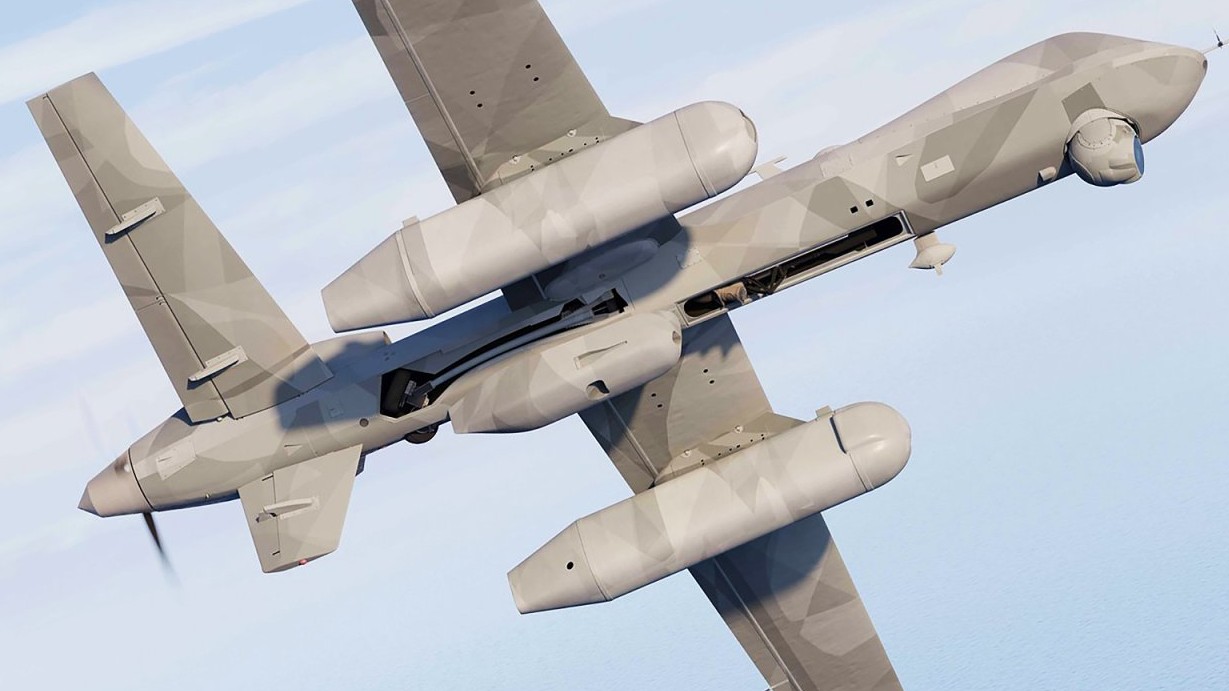
General Atomics Aeronautical Systems has completed the first flight of an MQ-9B remotely piloted aircraft fitted with airborne early warning pods, in a development that could bring persistent air surveillance capability to uncrewed platforms for the first time, the company stated.
The validation flight took place on 19 May from GA-ASI’s Desert Horizon facility in Southern California using a company-owned aircraft. The flight is described as the first step in a development process expected to take several months, culminating in a full-capability demonstration later this year. The AEW sensor, named LoyalEye, is being provided through a partnership with Saab, announced last year.
GA-ASI President David Alexander said the capability would address a genuine operational gap. “AEW for MQ-9B will offer critical aloft sensing to defend against tactical air munitions, guided missiles, drones, fighter and bomber aircraft, and other threats. Operational availability for a medium-altitude, long-endurance UAS is the highest of any military aircraft, and as an unmanned platform, its aircrews are not put into harm’s way.”
Carl-Johan Bergholm, Senior Vice President and Head of Business Area Surveillance at Saab, said LoyalEye extended the capabilities of manned systems rather than replacing them. “This partnership integrates MQ-9B with LoyalEye, equipping operators with vital information for critical decision-making. It offers persistent surveillance and greater operational flexibility, enhancing situational awareness and boosting mission success.”
The AEW capability is intended to span early detection and warning, long-range detection and tracking, and simultaneous target tracking, operating over both line-of-sight and satellite communications links. MQ-9B variants include the SkyGuardian, SeaGuardian, the UK’s Protector variant, and a short takeoff and landing configuration currently in development for carrier operations.
The UK operates the MQ-9B as Protector, with the RAF having begun receiving the platform to replace its ageing fleet of Reaper aircraft. The addition of an AEW capability to the platform would, if pursued, be a big expansion of what Protector could offer the RAF, potentially providing persistent wide-area air surveillance.
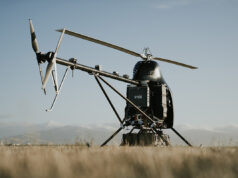



Could leonardo offer radar pods for these too, be good to get more of these for the carriers to replace the baggers.
No. Too big footprint.
I’ve gained $17,240 only within four weeks by comfortably working part-time from home. Immediately when I had lost my last business, I was very troubled and thankfully I’ve located this project now in this way I’m in a position to receive thousand USD directly from home. Each individual certainly can do this easy work & make more greenbacks online by visiting
following website—.,.,.,.,.—>>> JobatHome1.Com
I’ve gained $17,240 only within four weeks by comfortably working part-time from home. Immediately when I had lost my last business, I was very troubled and thankfully I’ve located this project now in this way I’m in a position to receive thousand USD directly from home. Each individual certainly can do this easy work & make more greenbacks online by visiting
following website—.,.,.,.,.,.,.,.,—>>> PayAtHome1.Com
There is a STOVL conversion kit to give folding wings and other changers to allow for shorter take offs.
There is expected to be a STOVL conversion kit, but it doesn’t exist yet. When it does, we’ll find out how much weight a converted aircraft can loft against the size of the runway available. Until then, perhaps we should remember that MQ-9B without the STOL can stay aloft fully-laden for over 24 hours and can fly over 5000 nmi. Perhaps the way to service the carrier group is from land.
Besides, do we really need to wait for an organic carrier version before trialling a couple of the Saab pods?
I reckon Saab’s current system would be a benefit to the Royal Navy and RAF.
Particularly for the former, work it out with the STOL Wing Kit and then this payload, we’ve got ourselves a very good measure for protecting the carriers and indeed single ships ahead or behind the carrier group
I doubt it would be economically worthwhile to develop a competing system. Let’s learn the lesson and not reinvent the wheel for a change. Let’s get the pod mounted on Grey Eagle and place an order ASAP. Apart from anything else the FAA needs those Merlins for their proper jobs.
It has a name! LoyalEye is a bit weak, not great work from SAAB.
Just in time for the DIP, perhaps?
Its a great name. The Eye is a nod to the EriEye radar and the “loyal” shows it is a compliment to crewed AEW or even crewed platforms
I’ve gained $17,240 only within four weeks by comfortably working part-time from home. Immediately when I had lost my last business, I was very troubled and thankfully I’ve located this project now in this way I’m in a position to receive thousand USD directly from home. Each individual certainly can do this easy work & make more greenbacks online by visiting
following website—.,.,.,.,.—>>> JobatHome1.Com
Not very catchy though, is it? Not up to British standards anyway. Erieye has its own meaning which made it cleverer while Globaleye was simply it’s upgrade.
Could have had BullsEye, or GoldenEye, or CatsEye, or HawkEye.
Aye aye.
LazyEye?
och aye the noo
BeadyEye
Eyebright
good job it is not a Japanese pod
I’m saying nothing.
So the RAF could supplement the ridiculous low numbers of E-7s? Or replace them if it really is a flying Ajax.
The RN if Sea Guardian is viable from QE and POW could provide persistent coverage with 2 or 3 per carrier.
Wonder if the pods could be carried on either side of a Merlin?
They could, Lockheed Martin proposed something similar with vigilant AESA pods for the Crowsnest requirement. Then we spent a decade and hundreds of millions just to move over the old radars.
From what I’ve read, following the Mojave trial, the plan is to use the mq9b to replace the Merlin AEW capability so that they can be used for their other missions. This protectors, fitted with the naval kit, would then fly from the carriers. The Merlin’s don’t fly high enough or loiter long enough to be nearly as effective as this will be.
These have goo big footprint with those non folding large wings, need also landing gear and strengthening for carrier landings.
The STOL kit includes both those features.
Is there any STOL kit version operational?
Not operational but the US Marines have shown interest too which means it’s likely to happen.
The STOL intention was announced in 2022 with still no sign it has ever been tested in flight. The AEW was announced as a possibility in 2023 at CNE, and as an intent last year in Paris, and is flying right now. Why would the technically harder project have progressed quickly, whereas the ostensibly easier job of creating a wing and tail kit has stalled? I suspect they did the work digitally and didn’t like the stats they came up with. The web page is still up, but I’m not holding my breath.
What makes you think STOL is easier? SAAB are good enough at radar that the new kit shouldn’t have taken long and MQ9B has open integration too. The aerodynamics of the STOL kit will be more difficult but they began wind tunnel tests in November; presumably GA were waiting to see if they got any funding from governments before committing to development themselves.
With folding wings these are smaller in footprint than an E-2D, might be the same with wings unfolded, I’m not sure. France operates the E-2D from the CdG, which is smaller in both length and width on the flight deck. So definitely workable.
It’s the takeoff and landing that needs the most thought, I think- those AESA pods look quite heavy…
Cats and traps are a different ballgame. You aren’t comparing like with like. Let’s see what it’s like from a long runway first.
Hi Jon, I was responding to Alex’ point about the aircraft being too much footprint to operate from the QE deck; not just take off and landing, but being moved around by crew, getting in the way of other flight ops, going on the lifts, etc. My point was that France manages to move and store a larger footprint aircraft (E-2D, same wingspan but 6 m longer and a wider fuselage) on a smaller deck than the QEs, so the argument against having Protector as an AEW platform due to its size isn’t really there. In this instance, I am comparing like with like in terms of the characteristic I’m discussing.
Moving on, I did point out that the challenge would be around whether Protector with the AEW pods would be able to get off the deck and back on it without assistance (CATOBAR or STOBAR). That is where the big difference lies between the carriers.
Potentially, depends on the radar range. The lighter the radar module the lower the range is likely to be and marine operations really need pretty long range to give time to deal with supersonic missiles.
Easily solved by having several airborne at any time.
They are still pricey pieces of kit, cheaper than wedgetail but far from cheap to have on mass.
Everything military is 🤷🏻♂️
Yep but does the number of the drones combined to cover the area cost less than one wedgetail, I suspect not.
You’re not comparing like for like, there are other variables to factor in:
• Wedgetail requires 12 to 21 crew onboard, whereas this…?
• Availability as maintenance for a manned aircraft of this size will be more complex and time consuming than for a drone.
• Time on station plus the transit time.
• Air-to-air refuelling options for each (if any).
• Availability of airfields each can operate from (6 to 7,000ft runway for Wedgetail, but 3,500ft for MQ-9B).
etc
Fair but still requires it’s own mainatance trial. For sure cheaper but not free. The way the US tech is designed is individual pilots Vs Ukraine where one takes dozens. Cost still adds up.
In Ukraine the majority of drones are kamikaze strike drones or anti-drone drones, not high-end AEW drones. Completely different.
Yes but for a airborne command and control to be effective it needs to cover a huge area either through having a big radar or lots of smaller ones. The issue with lots of smaller ones is the price builds up and also there is a risk that the radar won’t out range the missiles attacking it.
“The issue with lots of smaller ones is the price builds up and also there is a risk that the radar won’t out range the missiles attacking it.”
Well there’s another reason for using drones rather than Wedgetails. If you lose a drone it’s cheap to replace. You wouldn’t probably have an ‘hot spare’ flying around that could be sent to cover any gap from a drone being shot-down.
Lose a Wedgetail and lose an expensive aircraft that will take years to replace, not to mention 20 highly trained servicemen dead.
This is true but in theory the wedgetail radar out ranges any missiles in service and so can direct interceptors in before the attacker becomes an issue. In theory anyway as stealth is likely to complicate that equation, at which point multiple smaller ones might be better. Altough not sure we can afford the number required to be able to treat them as disposable.
“Altough not sure we can afford the number required to be able to treat them as disposable.”
And that’s the thing. Our most sophisticated high-end assets (Wedetails, destroyers, SSNs, etc) are so expensive and take so long to build that in any war we cannot afford to lose them because we won’t be able to replace them. So to these few high-end platforms we need to add mass through many low-end cheap disposable systems. Which is where drones come in.
Not as good as high-end, but cheaper, more numerous, expendable and replaceable.
Will we buy any? for the carrires and because just now we have NO working AWACs and only 3 to do every where when they finally do enter service.
2025 SDR recommended increasing Wedgetail numbers.
Yes but its gone a bit quite on that i knowwe have 5 sets of its radar, would make sens to increase back aircraft 5 , but sense is not some thing the MOD is known for.
That’s because it’s dependent, like so much, on the mythical DIP being published…
It is, and that will be the thing that decides every thing, winners and loosers, but I feel it on the whole will be fine, of course not every thing will be on it. Any thing is better than shambles we have now, improvements are starting come through but its a very long road ahead but getting there.
Well HMG agreed to everything recommended in SDR 2025, dependent upon funding… which is why everyone is twiddling thumbs over DIP.
It’s a real shame it wasn’t published before Operation Epstein Fury. Because right now every government is looking anxiously at the oncoming financial tsunami caused by that folly…
Yeah, that will effect spending, or at best be used as an excuse,
‘Tanking the global economy’ would be a better description of what effect it will have. People are purely thinking about energy, maybe fertiliser too, but the impacts are way beyond that, stretching from pharmaceutical production to semiconductor manufacturing. By closing the Straits, Iran might have ‘detonated’ the most destructive weapon in history.
That’s well beyond my pay band, 3
I wonder how easy/difficult it is to handle these light, large winged aircraft in windy weather on a flight deck?
I suspect that F35 will be flying in conditions that we stop these aircraft.
Only on nice long cruises to China !
They will almost certainly have worse weather performance than F35, though supposedly STOVL is more resilient than CATOBAR to sea state etc so that would be a very high bar to match.
Operating very long endurance but low-performance aircraft like this would dramatically change the flight deck tempo, it’s something we will have to work out.
But with a 40 hours flight duration, once airborne these may well be able to wait it out until weather gets good enough to land safely.
Having read enough about Atlantic and Arctic convoys, I very much doubt that 40 hours will be anywhere near enough.
Fortunately weather forecasting beyond 40 hours is quite accurate these days.
Agreed.
But it could mean having the carrier forward for its air group or shifting away for a couple of days to keep AEW.
Some of those storms were severe for over three days.
The RN will manage it. Just like in the past when weather prevented the launching of AEW aircraft or even any aircraft whatsoever.
During the Falklands campaign there were times when conventional carrier aircraft would not have taken off from any carrier.
There is no magic.
Exactly my point – though as demonstrated in the Falklands STOVL aircraft can take-off and land in sea states beyond cat and trap operations.
So, how do you think they will handle these large, low weight, high lift machines in those conditions?
In the same way that we handle F35s or Merlis in conditions where they can’t fly, or handled the Phantoms, Buccaneers, Swordfishes etc etc when the weather conditions were too extreme to fly… you don’t fly.
So this would be significant for the UK..
1) carriers.. putting the Merlin’s back doing what Merlin’s do best..
2) covering the gaps for the UK
3) supporting our sovereign bases and wider EEZ.. a couple of these for the Falklands and Cyprus would be significant.
Please please please let this be in the DIP. SeaGuardian upgrade was name-checked in the SDR so that is (as far as anything with the DIP can be) a given, but I’m hoping against hope we decide to reinforce AEW as well.
I had though that meant getting an inline radar to bulk out the P-8s in maritime patrol. However, getting some AEW pods as well would be really nice. It shows the technology has arrived and whether Saab is what we go with or some other manufacturer, I’d hope to see us move quickly to at least do tests this financial year with a view to roll out next.
The SeaGuardian uses the SeaSpray 7500e radar, which is a larger version of the one fitted to Wildcat. Its main role is ASW using 2 or 4 sonobuoy dispensers.
SDR also recommended increasing Wedgetail numbers.
Yes, but given the huge cost per unit of Wedgetail MQ9B at approximately the same cost as an F35B is a pretty good deal.
Meeting in the middle with LoyalEye doing early warning for Falklands and Cyprus until the STOL kit becomes available is an attractive proposition and helps with the political “hybrid” shenanigans.
This MQ-9B AEW trial is surely focused on the UK as offering a replacement for Crowsnest, although India might also be interested. But the reality is that the Crowsnest replacement project has been in stasis for 2 years whilst awaiting funding in the DIP. It’s now impossible to see an order being placed before 2028. The RN seems resigned to that fact that CSG29 will be last swansong of Crowsnest, and then (at best) there will be a 2 or 3 year capability gap before a replacement enters IOC c.2032/33. It’s a good job that the UK is now on a “war footing”, otherwise the gap would probably be nearer a decade!
Incidentally, the estimated budget for the Crowsnest replacement project is £0.5 – £1.5 bn. Germany’s order for 8 MQ-9B’s cost €1.9 bn (£1.7 bn) including infrastructure, training, spares, support, etc.
I don’t know about the costs but the RAF could just buy the AEW and STOL kits for our existing Protector fleet if they wanted to keep the costs down.
Yes.
It isn’t like they are going to be doing much else, the Iranian proxies have been cut off and air defence systems are getting ever cheaper. Over the ocean where they can see things coming from a long way away is a good place for them.
You’re not wrong there. The Americans lost a lot of MQ9s over Iran. However if you’re escorting a CSG with a Type 45 and a few F35s you should be a bit safer.
There are now a few nations with f35b style carriers, including Italy and Japan. I suspect just designed to see if any of them will bite.
Have you watched the videos of the Mojave trials? You need a BIG flight deck to safely launch and land a mid-to-large UAV without a catapult and arresting gear. I suspect that Japanese’s, Italian and Spanish carriers are just too small. Even the QEC will have a major problem in that all other flying ops will have to cease and the flight deck largely cleared when a MQ-9B is being launched or recovered. So basically reverting to 1930’s style carrier ops. Fitting at least a short (c.30m) EMALS to starboard of the ski-jump for UAV launches would make so much sense.
Mojave (which is quite a bit smaller than MQ9B) has taken off from the Korean helicopter carriers which are only 14000t lightship, so the Japanese and Italian vessels would be no problem. MQ9B would be harder but it will have more advanced landing aids which would help.
There is a huge difference between trials (conducted by the best of the best!) and operational service where the risks are much greater. The RN’s failure to move F-35B SRVL from simulators (early 2010’s) to actual trials (2018) to operational use (as of 2026) is a good example of this.
Mojave has taken off from the Dokdo, yes, almost unladen, but not landed. What does that suggest are the chances of a larger aircraft of a similar type (even partially laden) landing on the Dokdo, safely and repeatably?
Ok, before anyone gets ahead of themselves and thinks that this is the UK’s answer to the massive AEW capability gap and the next best thing since sliced bread. Time to use a little bit of logic and be realistic about what the MQ9 can provide, but also what it can’t.
As a replacement for the Wedgetail, no not even close! Radar performance is governed not only by the software and signal processing, but also by the frequency being used. However, the antenna plays a massive part in how far the signal can be propagated, but crucially how small a signal it can detect when receiving. If we are only talking about electronically beamed forming antenna arrays, the main factor that determines the performance is the array’s cross sectional area. As this determines the number of individual transmitter-receiver modules (TRMs) that are fitted in the given array area. Each TRM is a radar in its own right, but when combined the sum of the parts produces significantly better performance.
The image of the MQ9 shows a pod fitted under each wing, presumably the radar. I am assuming that the pods contain a flat panel active electronically scanned array (AESA) radar. Which then gives the MQ9 a field of regard of at least 240 (2 x 120) degrees in the horizontal plane to cover port and starboard views. Normally this will include a 60 degree blind spot in front and another 60 degree blind spot to the rear of the aircraft. An AESA panel can be used past +/- 60 degrees, but you start dropping in range/sensitivity due to less TRMS being used to generate the beam. There are other issues such as feedback that also need to be considered, but a lot can be overcome with software. Think of it like the positive wave of a sine wave, where either side of the peak of the wave, the signal drops off rapidly. A MQ-9 is 11m long, judging by the image the under wing pods look to be about 3m long, with the antenna array being approximately 2m long. The MQ-9 uses a mid-mounted wing, where a “standard height” person has to duck to walk under the wing. The electro-optical turret sits about 1m off the ground. So the depth of the pod is likely to be about 1 to 1.5m, thereby making sure there is enough clearance from the ground when taxying. So as a guess I’d say the AESA panel is around 2m x 1m in area.
The next question is what frequency will be used. I would definitely say its not an X-band (8 to 12GHz), as used by the Crowsnest’s Searchwater radar. Yes you can make larger X-band arrays. But due to the way the atmosphere absorbs (attenuates) the signal as its being propagated. You need a shed load of power to make it go past 200 miles (320km). Due to the power the amps need to draw, you’ll also need an active cooling system, which needs radiators, pumps etc, so adds weight and complication. You get better range performance when using lower frequencies, as the attenuation decreases with a decrease in frequency. Saab have a history of producing X band (8 to 12GHz), C band (4 to 8GHz) and S band (2 to 4GHz) radars. But I believe SAAB have only (publicly) produced S band and X band AESA radars. Therefore at a guess, I’d say the radar arrays are based on the TRMs used in Giraffe AESA 4A/8A radars.
The ground based Giraffe 4A antenna array weigh 640kg, the external “payload” weight of the MQ-9 is 1400kg to 2150kg depending on the variant, so it could lift the array. The 8A is at least twice the height of the 4A array. But the 4A array is about 3m squared, so too big to fit under the wing. Dividing the panel in half could be doable. But I suspect at 3m long, the array would interfere with the MQ-9’s take-off and landing angle. So it must be made smaller. Plus there’s the input power question. Saab, don’t say what the power requirement are for the 4A or 8A radars. But the radar sits on a large diesel genset fitted on the back of 6×6 or 8×8 truck. Which might explain what the third pod fitted under the fuselage is for. The MQ-9 is powered by a 900hp Honeywell turboprop, I doubt this would be sufficient for a pair of AESA arrays, as AESAs are very power hungry. So I suspect the centre pod contains an auxiliary power unit (APU), purely to generate additional electrical power.
Saab quote the 4A has an instrumented range of 280 (173 miles) against a fighter sized target. But don’t say what the target’s radar cross section (RCS) is obviously, as you’d be able to determine when it could see you. If the MQ-9 is carrying smaller half sized antenna arrays, then the performance won’t be as good as the larger ground based version. The Searchwater used by Crowsnest has a slightly worse performance than this. It could definitely detect something like a loaded up F15 near to these distances.
Wedgetail uses the L band (1 to 2GHz) MESA radar, which has a huge cross sectional area of 7.3m x 2.7m per side. Along with a much smaller array in the nose and tail of the “top hat” part of the antenna. Thereby giving it a 360 degrees field of regard. Its instrumented range against a “fighter” size target is 370 km (230 miles). Although the RAAF were quoted as saying they could detect Su-35s operating over Syria much further than this, as well as tracking the Su-57s further than expected.
The MQ-9 could be used as supplement to the Wedgetail, but definitely not as a replacement. As a Crowsnest replacement it would be good enough, better certainly than Crowsnest, but not ideal! Think of it as a bronze medal standard, especially when you compare it to the E2D Hawkeye 600km (400 mile) instrumented range. For example you would need at least 3 MQ-9s to cover the same area as a single E2D.
Unfortunately to carry a long range radar that is needed by our carrier strike group (CSG), you need a large aircraft, that not only can carry the necessary antenna array size/weight, but also provide enough electrical power to give it the required range. Otherwise you are not maximizing the capabilities of the F35.
Thanks Davey.
Invaluable detail and reality checks, as always.
Sadly, despite the drawbacks, I think it’s the only realistic option to get AEW for our carriers.
2 more E-7 is needed regardless so we have a constant surveillance and a few extra AEW wouldn’t hurt so many some LoyalEye’s to supplement in other areas.
For the carrier there is no other STOVL aircraft available, and despite the issues with the radar used, the MQ-9B does have a 40 hour loiter time so we should be able to maintain a high availability rate flying on the carrier, maybe 50% airborne at anytime. 4 or 6 would make a massive difference to our operations.
And personally I’d also support a purchase of some SeaGuardian. Both to supplement the P-8’s, particularly in long range where we can’t refuel the Poseidon without allies, but the SeaGuardian can manage long ranges. But also to have 2 on a carrier to give fixed wing ASW capability. Not the radar power of a P-8 or the dipping sonar of a Merlin, but incredible range and loiter time, and the ability to carry 40/80 A or G type sonar buoys / 4 Stingrays or any mixture.
The MQ-9B I would say is limited to supplementary roles when UK based though still a way to increase presence where the Treasury will not fun anymore expensive surveillance aircraft. But for the navy, potentially the only chance we have of getting any decent surveillance aircraft for the carriers and so buying some STOVL variants of LoyalEye and SeaGuardian is a must.
I come at this from a different angle. LoyalEye is a convenient side effect of the really useful capability offered by SeaGuardian. As DaveyB says LoyalEye is going to be no more than adequate for CSG work, it’s not much of an improvement over Crowsnest. But SeaGuardian would give the RN the world’s most capable shipborne MPA, not even the USN could match it since they retired the S-3 Viking. If the carriers are part of the Atlantic navy then MQ9B would allow them to contribute to the Bastion as well as Strike and Shield and even in the strike role would allow missile attacks on targets truly crazy distances away.
So my ideal air wing for Atlantic work would become 12 F35B, 8 SeaGuardian, 4 LoyalEye and 4-6 Merlin for shorter ranged ASW. The wartime surge would be to 24 F35B for extra strike capacity as more than that would nearly max out the carrier.
Sadly, despite the drawbacks, I think it’s the only realistic option to get AEW for our carriers.
2 more E-7 is needed regardless so we have a constant surveillance and a few extra AEW wouldn’t hurt so many some LoyalEye’s to supplement in other areas.
For the carrier there is no other STOVL aircraft available, and despite the issues with the radar used, the MQ-9B does have a 40 hour loiter time so we should be able to maintain a high availability rate flying on the carrier, maybe 50% airborne at anytime. 4 or 6 would make a massive difference to our operations.
And personally I’d also support a purchase of some SeaGuardian. Both to supplement the P-8’s, particularly in long range where we can’t refuel the Poseidon without allies, but the SeaGuardian can manage long ranges. But also to have 2 on a carrier to give fixed wing ASW capability. Not the radar power of a P-8 or the dipping sonar of a Merlin, but incredible range and loiter time, and the ability to carry 40/80 A or G type sonar buoys / 4 Stingrays or any mixture.
The MQ-9B I would say is limited to supplementary roles when UK based though still a way to increase presence where the Treasury will not fun anymore expensive surveillance aircraft. But for the navy, potentially the only chance we have of getting any decent surveillance aircraft for the carriers and so buying some STOVL variants of LoyalEye and SeaGuardian is a must.
Davy, as you were told last time you post a similar diatribe (when MQ-9B with SAAB AEW was announced), Loyalyeye uses technology and components from Globaleye. Essentially it is a repackaging exercise. And as such it is an S band radar.
Yes power is a problem, the initial testing will only have one pod powered.
As a Crowsnest replacement, this will have the potential to have an order of magnitude greater capability. Potential – a lot left has to be proved.
I wouldn’t call what Davey writes a ‘diatribe’- he knows a lot more than the rest of us about radar so it’s all valid.
But the lower performance relative to full AWACS is acceptable given that the limitations of STOVL/STOL mean nothing better is even in the pipeline yet and that MQ9B also has huge usefulness in ASW and long range strike.
The current Iran conflict has shown the limitations of MQ-9 strike. 24 shot down I believe.
GA are planning to integrate JSM, JASSM and LRASM on MQ9B, so it wouldn’t be the low altitude loitering that killed the drones over Iran.
If we got JSM for both F35 and MQ9 it would give the CSG a 4000km strike radius.
Dream on
Got anything more to say?
The platform has potential, we will have to wait and see if anyone is willing to commit.