

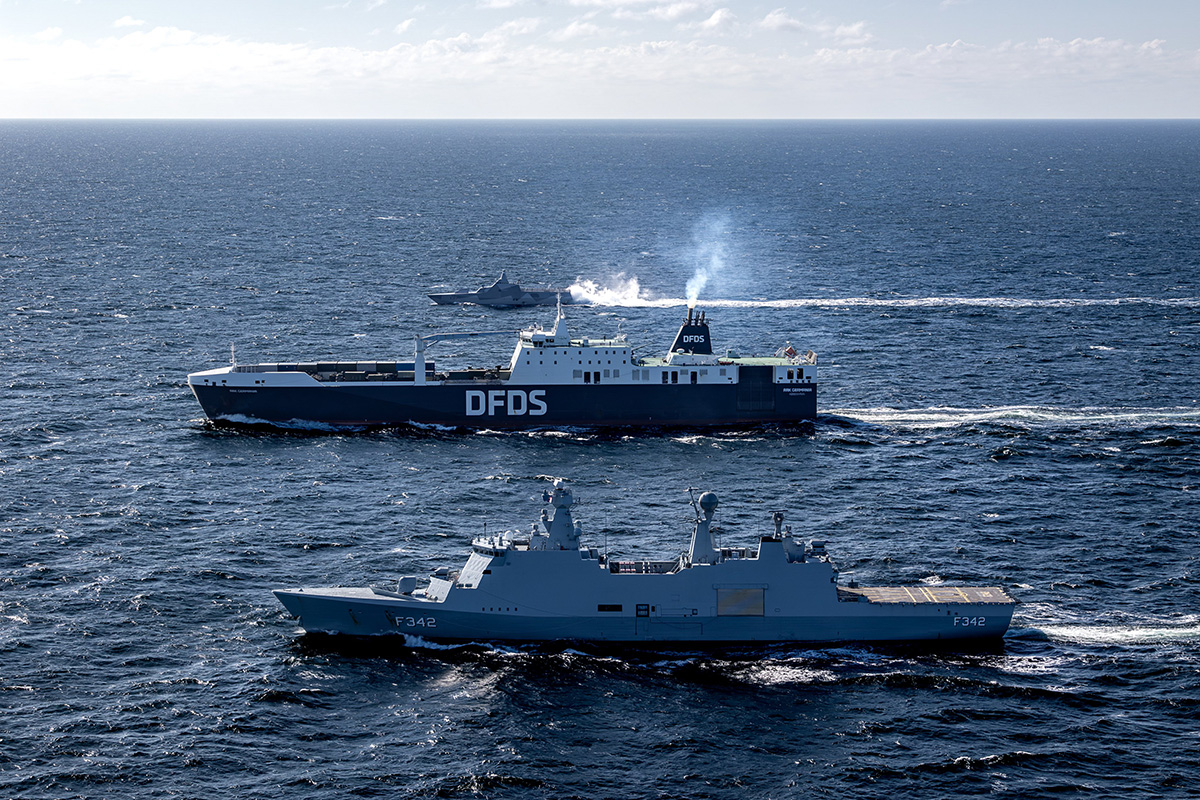
NATO can no longer assume that commercial ships will be available to move forces and equipment during a major conflict, with declining merchant fleets, shortages of qualified seafarers and limited integration with commercial shipping leaving reinforcement plans exposed, according to the Council on Geostrategy.
In its new Primer, Strategic sealift and maritime resilience: Assuring access in an era of contested logistics, authors William Freer and Charlotte Kleberg argue that the largely permissive maritime logistics environment which followed the Cold War has ended. They point to attacks on shipping, sabotage of critical infrastructure, sub-threshold activity, market disruption and the growth of the so-called shadow fleet as evidence that the logistics networks supporting NATO operations can no longer be treated as secure.
The authors write: “There has long been an assumption that commercial shipping will be available as and when required. The return of contested logistics and the nature of global shipping have rendered this assumption obsolete.”
The report says NATO’s ability to reinforce its frontline members depends not simply on military transport fleets but on access to commercial vessels, crews, ports and the wider networks supporting them. Across the alliance, however, the available pool of militarily useful merchant shipping has declined alongside the number of qualified seafarers. In Britain alone, the number of vessels identified as militarily useful fell from 841 in 2009 to 495 in 2023, figures originally reported by the UK Defence Journal and cited by the authors.
Shipping remains particularly important because of the quantities of heavy equipment that can be transported by sea. The authors contrast a C-17 Globemaster, which can carry a single main battle tank, with a large roll-on, roll-off vessel capable of carrying around 1,000 vehicles. They add that a single suitable merchant vessel could carry the equipment of an entire brigade, making access to shipping a central element of plans to reinforce NATO forces during a prolonged conflict.
The report identifies four principal problems: access to militarily useful shipping, a declining pool of skilled seafarers, limited civil-military integration and erosion of national maritime capacity. It warns that commercial vessels which appear to exist on paper may not necessarily be available when required because they could already be committed elsewhere, face insurance restrictions, lack suitable crews or require modification before entering a contested environment.
Freer and Kleberg argue that NATO governments should consequently move away from reliance on ad hoc chartering and requisition towards agreements negotiated with commercial operators in peacetime. Their proposal would see shipping companies given greater certainty in return for making suitable vessels and logistics networks available during a crisis.
The report also calls for commercial shipping companies to participate directly in NATO planning and exercises rather than being brought into military logistics arrangements only after operational plans have been developed. The authors point to the French Navy’s POLARIS 25 exercise, which involved the French merchant fleet in large-scale operational scenarios, as an example of such integration.
They write: “In a crisis, the alliance will not have time to build new lift networks. Instead, it should focus on building a suite of standing contracts, pre-cleared operators, and integrated exercises as part of an established and exercised maritime logistics system.”
The report concludes: “An alliance unable to reinforce its frontline members at speed, at scale, and over a prolonged period is not ready for the return of peer conflict.”








So it’s not really an issue for the UK then? We will only need half dozen ships to move the entire British Army within couple of years 🙁
Reforger is gone completely, the diego ships are in a bad state last time I checked so it’s commercial ferries.