

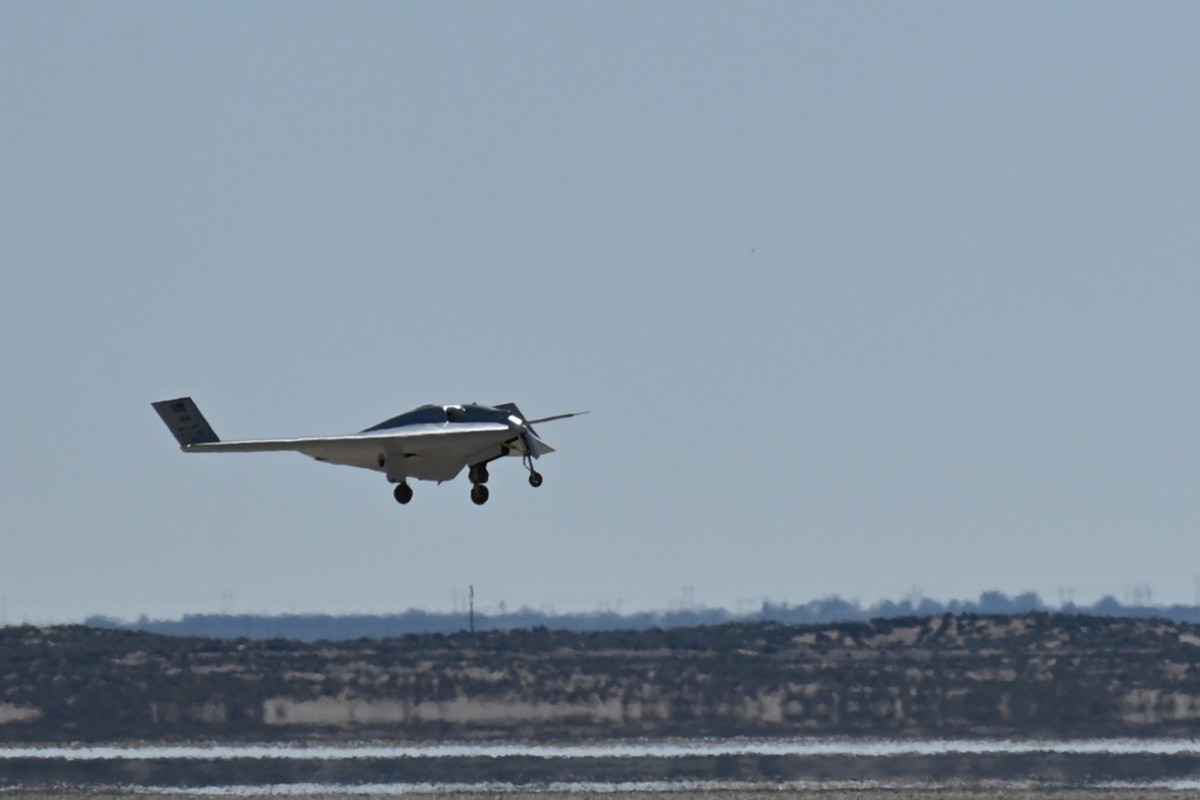
Northrop Grumman’s XRQ-73 uncrewed aircraft has begun flight testing at Edwards Air Force Base, California, under DARPA’s Series Hybrid Electric Propulsion AiRcraft Demonstration programme, known as SHEPARD, the company stated.
The XRQ-73 uses a hybrid-electric propulsion system that combines a conventional fuel source with electric power. According to Northrop Grumman, the configuration offers improved fuel efficiency, reduced emissions, and greater operational flexibility compared to conventionally powered aircraft of similar size. The programme is focused on advancing propulsion technologies for lightweight autonomous aircraft, with DARPA using the demonstration to explore next-generation options for that class of platform.
DARPA has long invested in propulsion research as a means of expanding the operational envelope of uncrewed systems, particularly in the lightweight category where endurance, efficiency, and noise signature can be critical factors. Hybrid-electric architectures have attracted growing interest across both military and commercial aviation in recent years, with proponents arguing they can offer the range benefits of fuel-based systems alongside the mechanical simplicity and lower thermal signature of electric propulsion.
Northrop Grumman states it has accumulated more than 500,000 autonomous flight test hours across seven decades of work in autonomy, a lineage that spans platforms from early reconnaissance drones through to the B-21 Raider’s supporting autonomous systems work. The company designed and built the XRQ-73 for the SHEPARD programme.
Edwards Air Force Base, located in the Mojave Desert, is the U.S. military’s primary flight test centre and has been the site of some of the most significant aircraft development programmes in aviation history. Its restricted airspace and extensive test infrastructure make it the standard choice for early-stage flight demonstrations of experimental platforms.




On the subject of drones, is there a case for the UK to consider a home-built crewless MBT? The vehicle could be armed with the same gun as CH3 but would operate either in tandem or independently of CH3s. Obviously, access for maintenance and manned override would be required. The vehicle could be considerably smaller without the need to accommodate a crew, with some possible weight savings too! By adopting a drone MBT, the CH3 regiments could be augmented, thus achieving a larger heavy-armoured component for the British fleet. Export sales could also justify the reinstatement of a UK heavy-armour industry, which is greatly missed.
I can see the appeal but is this the best use of drone technology, isn’t its greatest asset that it takes away the need for large, complex, expensive vulnerable assets like say a CH3. Having just watched the South Koreans remotely working their massive port cranes and the Swedes remotely controlling their iron ore mine equipment like computer games I’m sure it’s feasible mind (though interference is always a problem), but I note that the Ukrainians are having great success with very small tracked drones which in many environments will be a better and cheaper solution. That said I do think the move to remotely operating some large platforms is happening, we see it with missile and mobile artillery but so far it’s mainly to keep crew safe and away from potential retaliatory strikes, running ‘loyal wing tanks’ sounds like an incredibly complex task especially in environments away from vulnerable places like open ground where once they were king but they are now so easily attacked. But smaller simpler platforms with missiles or smaller guns that could operate with them and perhaps ultimately replace them even, will become common I’m sure.
Ukraine has demonstrated how a modern battlefield can quickly reverse 100 years to trench warfare and the dawn of remote weapon systems magnified in incalculable numbers. However, the lack of air support was largely responsible for the stalemate. If the UK is drawn into a broad frontal attack supported by comprehensive air cover, the conventions, such as MBTs, will still have relevance if equipped with the latest electronic countermeasures. The current UK fleet of MBTs is small even by British standards, and this is where my suggestion of a remote heavy tank comes into focus. A fleet of 70-100 remote MBTs would not only increase availability but also address manning levels and lengthy crew training. Obviously, a purchase of 50 Leopard A8s would be one method of increasing our strength, but building an autonomous tank in the UK would result in greater self-reliance and export opportunities.
How can you get air superiority when there are simple and plentiful man pads just waiting for an aviation asset to show itself? I think that thinking is what sunk the ruskies!
can see this working with having battery boost say for take off and landing and ability for powering whatever kit during flight and recharge battery.
I’ve gained $17,240 only within four weeks by comfortably working part-time from home. Immediately when I had lost my last business, I was very troubled and thankfully I’ve located this project now in this way I’m in a position to receive thousand USD directly from home. Each individual certainly can do this easy work & make more greenbacks online by visiting
following website—.,.,.,.,.—>>> JobatHome1.Com