

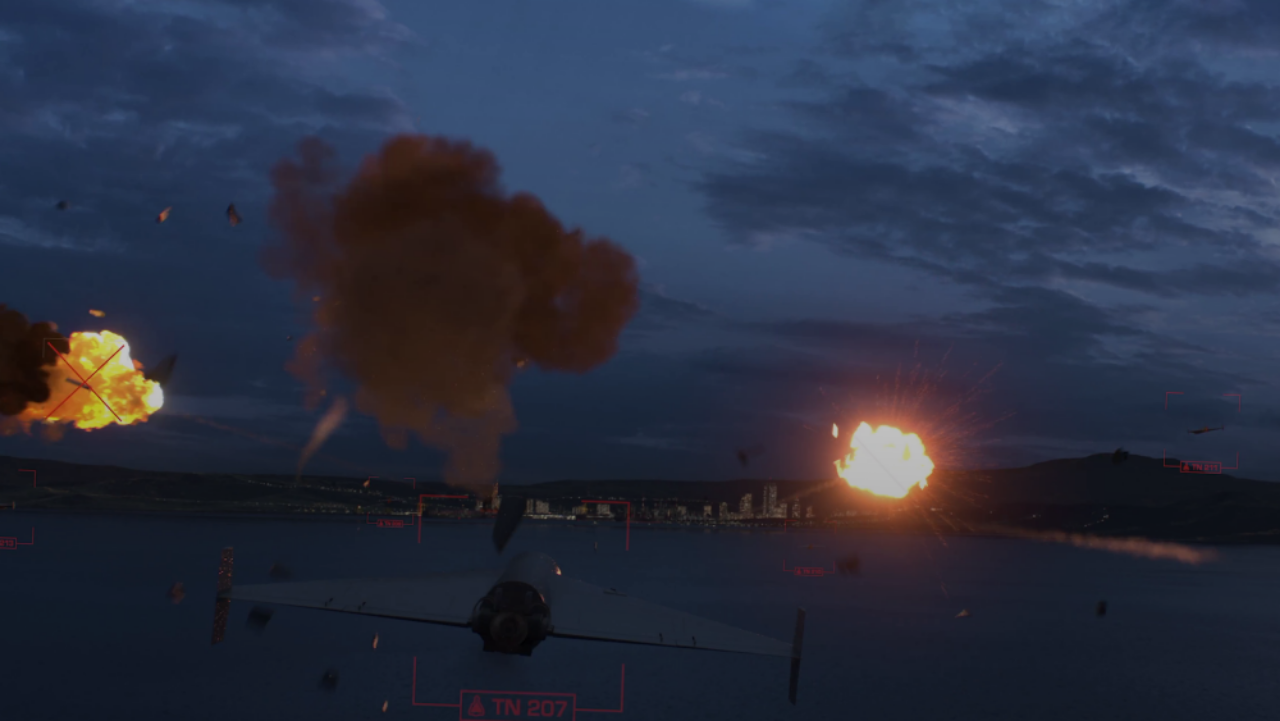
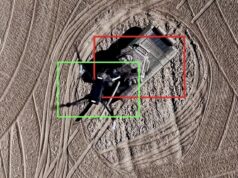
Northrop Grumman has given a name to the 50mm gun-based air defence system it has been developing to shoot down cruise missiles and drone swarms, calling it Raid Hunter, and says testing through the rest of this year will support accelerated fielding.
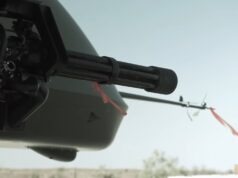
The system pairs the company’s Chain Gun with precision-guided 50mm ammunition and a networked system controller. Its purpose is to handle raids large enough to saturate conventional defences, which is a problem missiles alone cannot solve because a magazine of interceptors runs out faster than an attacker runs out of drones.
That economic point is the one the company keeps returning to. A high rate of fire, deep magazines and fast reloads are what it offers against massed threats, in place of expending an interceptor worth several hundred thousand pounds on a target worth a few thousand.
Kenn Todorov, vice president and general manager for command and control and weapons integration, said: “Raid Hunter addresses a critical short-range defense gap by delivering rapid, high-capacity protection against complex, mass aerial threats like cruise missiles and drone swarms. It provides warfighters with a cost-effective, flexible tool to decisively defeat evolving threats now and in the future, strengthening the security of vital bases and infrastructure.”
He said: “War has evolved. Air Defenders need the ability to defend against large, complex raids designed to overwhelm traditional defense solutions. Raid Hunter addresses this critical need by delivering a cost effective and deep magazine solution which can be rapidly delivered to the warfighter at scale.”
The system is built on a modular palletised form factor sized for transport aboard a C-130, with vehicle-mounted and container-based variants planned. Northrop Grumman has not said when those variants will appear, nor which customers it is working with beyond a reference to government and allied partners.
Guns had largely been written off for air defence by the 1990s, displaced by missiles that were more accurate at greater range. What has brought them back is the arithmetic of the drone war. Russian and Ukrainian forces launch small uncrewed aircraft in numbers that make missile defence unaffordable, and the same problem has appeared in the Red Sea, where Western warships have fired multi-million pound rounds at Houthi drones costing a fraction of that.
Guided ammunition is what makes the return viable as unguided cannon fire against a small manoeuvring target requires a large volume of rounds and a very good fire control solution, whereas a course-correcting projectile allows hits at longer range with fewer shots, while keeping the cost per engagement far below that of a missile.
Raid Hunter sits within what the company calls Raid Defense Solutions, its portfolio of layered kinetic counter-drone and air defence products, which combines fielded programmes with command and control software and sensor fusion.
Similar thinking is visible across the industry and among European governments. Rheinmetall has continued to develop its Skyranger turret in 30mm and 35mm forms, several armies have brought older self-propelled anti-aircraft guns back into service, and Britain has pursued the problem through directed energy work on DragonFire alongside a series of counter-drone trials.
The 50mm chain gun itself is not a new weapon. Northrop Grumman developed the XM913 in that calibre for the US Army’s optionally manned fighting vehicle programme, work that produced a gun capable of firing airburst and guided rounds from a mechanically driven, externally powered action of the kind the company has built since the Bushmaster series entered service in the 1970s.





I expect we will see Wes Streeting requisitioning the Chieftain Marksman from Bovington.
What’s the issue with using legacy CIWS like Phalanx?
No proximity ammunition natures, runs out of bullets in seconds.
40mm TRIDON is the sweet spot
It has no proximity rounds, a low ammunition count and due to the small calibre a low range.
Range and magazine depth, it burns through its ammunition very quickly and needs a direct hit to get a kill.
Thanks all.
How many will we look at, talk about, have a focus group on, invite industry to show then never buy any ? like most gun air defence we will do nothing when its clear a gun is needed due cost, number of rounds held etc May be not this one but its very clear missiles alone can not do the job as they are too few, too expensive per round.
Rapid Sentry idea but from an American company? Interesting…
Wonder if it’s a reaction to the success of the RAF Rapid Sentry and they’re realising SHORAD on a platform is better than nothing.
Think they realise their Middle East defences were totally inadequate, in short supply and over expensive for the job even against ‘defeated’ Iran. Finally getting through that gold plated expensive complex drone defence isn’t the (only) answer. I think that this is probably quite difficult to psychologically accept for a Country that has long laughed at and discarded the dangers of for example locals driving around in pickup trucks with a gun attached.
Just to add while Britain tries to take a (poor man’s) view in similar vein in peacetime when thrust into conflict we aren’t too proud to knock together all manner of cheap(ish), simple but surprisingly effective solutions come together very quickly. A quality that flourished in WW2 and thankfully persists today. Brings back memories as a kid of the ‘boffin’ saving the day with little more than sticky back plastic in comics and films. Our University system, independent individualist thinking and small business network certainly help in this response.
I believe this is the uprated Bushmaster gun they are also fitting to the Bradley replacement. The cartridge is significantly smaller than the one used by the Bofors 57mm, 50x228mm vs 57x438mm. From what I understand they “necked out” the 35mm cartridge to fit the larger round. Meaning the gun has significantly less muzzle velocity than the Bofors. But also means it can be made much lighter, as the recoil forces are a lot smaller. However, it should be carrying a much larger explosive content, and therefore have a greater kill radius than the standard 35mm gun. Which should be ideal for ant-drone work. Though the effective range will be a lot less than the Bofors. It should also be less than the 35mm round, as its heavier and less aerodynamic, but using the same mass of propellent to drive it.
Has expected missing from the text reference to the use of Italian 76mm gun with guided rounds against Houthis drones.
What? UK is more obsessed with appearance of modernity than the Americans.
It was RN that had the brilliant idea of a frigate with no guns at all.