

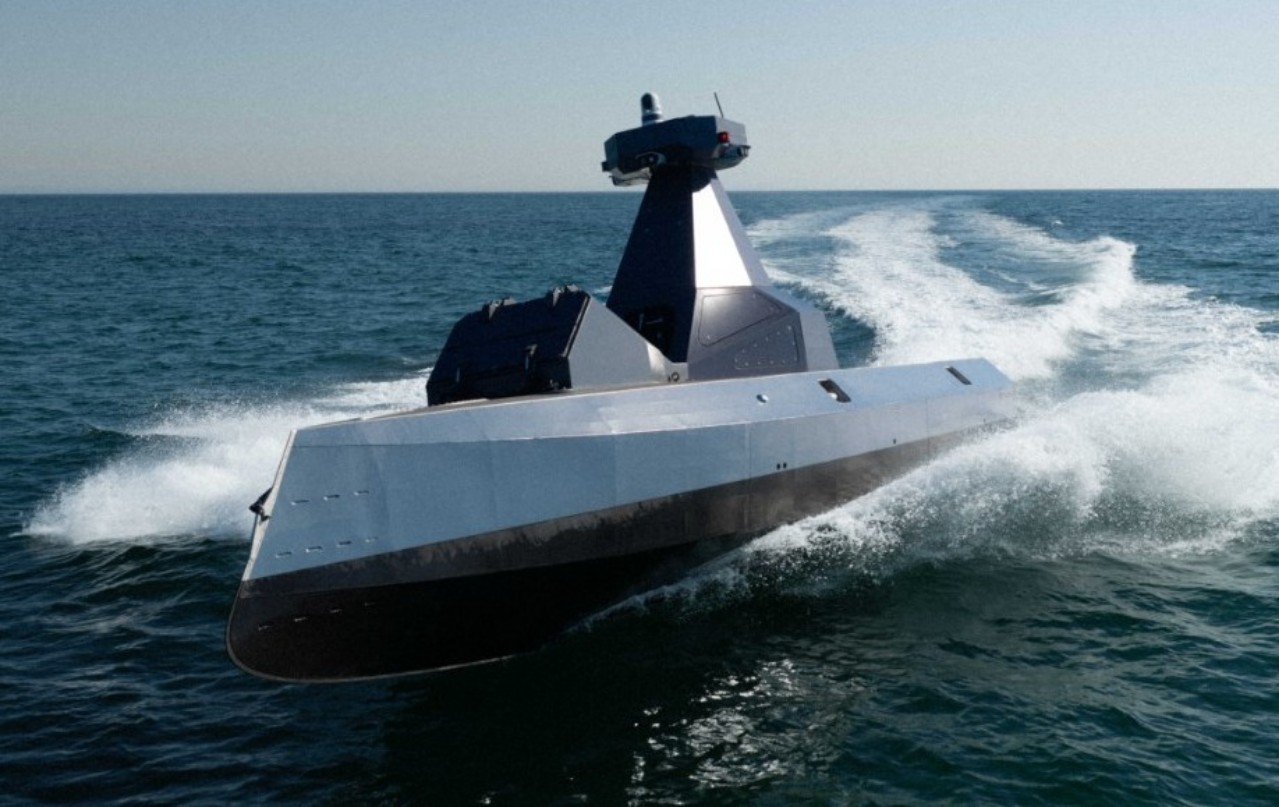
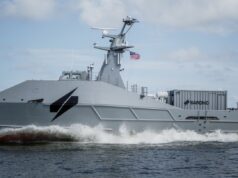
A twelve-metre armed uncrewed surface vessel built near Plymouth has been launched carrying MBDA’s Sea Venom anti-ship missile alongside loitering munitions, jammers and surveillance equipment, according to STARK, the defence technology company behind it.
Vanta 12 is described by the company as an AI-enabled modular platform able to integrate missiles, loitering munitions, anti-submarine effectors and electronic warfare systems alongside intelligence, surveillance and reconnaissance equipment, and it has been designed from the outset for mass production rather than small batch build. The boat can undertake patrols of 1,200 miles, sprint at more than 40 knots and remain continuously at sea for weeks, which STARK says brings the Greenland-Iceland-UK gap, the Baltic and European territorial waters within reach of a single vessel while reducing the number of personnel exposed to danger.
Sea Venom is already in Royal Navy service aboard the Wildcat helicopter, where it is used against fast attack craft and larger surface targets, and MBDA is now working on a version fired from the surface. Andrew Blackburn of MBDA said: “MBDA is developing a surface-launched variant of Sea Venom to meet the growing demand for precision maritime strike in complex littoral environments, to both deter and defeat a wide range of threats. This collaboration with Stark has showcased a potent new capability that is made possible through the integration of a precision weapon system such as Sea Venom onto autonomous maritime platforms such as Vanta 12. Participation in REPMUS 26 is giving both MBDA and Stark a wealth of learning that we can feed forward into the battle-winning capabilities that are needed for future Hybrid Navies.”
The missile is designed to engage targets up to the size of larger warships as well as coastal and land-based targets, including in congested waters where precision matters. Putting it on a boat of this size gives a vessel with no crew aboard the sort of strike capability that until now has come from a helicopter or a frigate.
Vanta 12 spent this week at REPMUS, the NATO exercise in Portugal that serves as the alliance’s largest event for robotics and uncrewed maritime systems, taking part in simulated combat missions and working alongside conventional vessels and other uncrewed boats.
Mike Armstrong, managing director of STARK UK, said: “Vanta 12 is the first unmanned vessel to bring together missiles, loitering munitions and surveillance to help NATO countries face down the threat.
“Vanta is an export success story for British defence, giving our NATO allies capability that can be produced at scale, deployed rapidly and adapted quickly.
“Industrial deterrence is what modern warfare increasingly demands, and what Vanta 12 has been designed to deliver.”
Fred Thomas, the MP for Plymouth Moor View, welcomed the launch in his constituency city. “It is exciting for European security, and also locally for Plymouth as a city, to see STARK launch this uncrewed boat today,” he said, adding: “Built right here in Plymouth, it will be a highly capable addition to Europe’s maritime capabilities. I am particularly excited to see anti-ship missiles, usually fired from helicopters, launch from the boat.”
The company sets the vessel against the pattern of activity now familiar in the North Atlantic and the approaches to European waters, where shadow fleet ships mask their ownership to move sanctioned cargo, transponders are switched off, undersea cables and pipelines are interfered with, and civilian-flagged vessels loiter near critical infrastructure. Around 300 shadow fleet vessels transited British waters in the first quarter of this year, and the Royal Navy interdicted the sanctioned tanker Smyrtos in the Channel in June. Vessels capable of deploying deep-sea submersibles have been sighted repeatedly near the cables carrying Britain’s data and energy.
STARK argues that answering this at scale requires lower cost uncrewed systems rather than warships, an approach it calls the Hybrid Navy and which it says is being taken up by the British, Norwegian and German armed forces. Readers will know the Royal Navy has been moving in that direction for some time, with uncrewed systems trialled for mine countermeasures and seabed monitoring and a hybrid fleet concept running through recent planning.
The company was founded in 2024 in response to operational demands from Ukraine and is headquartered in Berlin, with a presence in Germany, Ukraine, Britain, Sweden and Greece. Its first British manufacturing facility opened at Swindon in November 2025 and employs more than 100 people, and Vanta vessels have already been exported from the United Kingdom to other NATO allies. The maritime division that built and tested Vanta 12 is based in the south west of England.



Now, this really does make sense. Fast and evasive with a real punch. I can imagine swarms of these causing mayhem wherever they are.
Yayyyyy, SL Sea Venom!
These would be really useful in the Gulf, especially if we can diversify the launch platforms further to things like Protector and the Kraken boats.
I agree, best solution is probably a series of drones with smaller sensor drones possibly gun armed being paired with larger missile armed drones operating just over the horizon. Sea venom is the perfect weapon for such employment as it’s more likely to mission kill a platform than sink a ship which is what you want on an autonomous platform. That being said I doubt any Russian warship would survive contact with a firework given how bad their fire safety procedures appear to be.
Yup this concept really gels with what drone vessels can truly offer I think. The stats sound very impressive indeed, speed, endurance, flexibility and a real punch. Sounds very much like a modern revival of the original torpedo boat philosophy that so dominated coastal waters for decades. But this has a lot more potential too especially in open sea just as long as they are reliable in blue sea service and communications and/or autonomous capabilities remain effective and resistant to interference.
This company has really excelled since it was launched, in a cross border context too. Shows what can be achieved quickly if minds are put to it.
Was it designed in Plymouth? its it subject to ITAR or export approval?
Sea Venom is Anglo-French. In France it’s the Anti-Navire Leger (ANL) or lightweight anti-ship, but MN have chosen not to operate it. No ITAR.
The platform itself is fundamentally designed in the uk because the German parent has set up its marine subsidiary here, obviously some subsystems will no doubt overlap with their other business. The company was up and based in Berlin.
It’s not clear on the website, but all the blurb emphasises European defence and expertise gained from direct involvement in Ukraine- so I’m assuming that they’re gearing for ITAR-free. It’s become almost a requirement for any European defence firm now- and no bad thing.
These seem perfect for both the Falkland’s and trailing Russian ships around the UK coast especially if paired with something small like kraken.
Website says it can operate in Sea State 4 and survive State 6- so can operate up to 2.5 m swell and survive 6 m swell. Fine for the North Sea and Baltic, but North and South Atlantic would kill it.
I like the idea, but we’d need a bigger version for patrolling the Falklands and GIUK gap.
A meaningful enhancement to the B2 Rivers?
To attack what? If Rivers remain in a constabulary role, Sea Venom is overkill on the surface, but useless in the air. I think CAMM in a box might be better.
Good question. Agree enhancement of air defence is a priority. Probably the reason many suggest a gun upgrade to 40mm or even 57mm, which also gives you better surface. I think CAMM would be expensive. Doesn’t it need a director radar? Martlet would improve air defence against drones and helos. A combo of Martlet and Sea Venom ( with rotary drone surveillance) would enable you to retain a constabulary / diplomatic ( 30mm) image profile while usefully enhancing offence and self defence.
Dragon fire?
Needs destroyer levels of power, I think.
I would think the systems being developed for vehicle deployment might be more suitable. But effectiveness has to be brought into the equation and how keeping an accurate lock would be undermined on such a small moving platform. Unlike a vehicle it can’t just stop and maintain a stable base. Microwave weapons could be interesting in the future.
You cannot perform the constabulary role at sea using a drone alone. By its very nature, a constabulary operation requires a human presence. You need people who can stop and intercept a vessel, board it, establish control, identify and question those on board, inspect documentation, conduct a physical search, preserve evidence, and, where legal authority exists, detain people, seize prohibited goods, or take control of the vessel.
When I led Royal Marines on such operations, I followed a boarding doctrine. It requires training to cover the full process, from planning and preparation through to boarding, search, use of force, evidence handling, examination of ship documentation and arrest or detention. In operational deployments, we (Royal Marines) were required to secure a suspect vessel while trained Royal Navy boarding personnel conducted the detailed search, paperwork checks and questioning of the crew. This is not simply a matter of getting a camera onto a boat. It is a specialist maritime law-enforcement capability.
I can tell you from experience that getting onto a RHIB, motoring out to another vessel, coming alongside, boarding it, searching it and checking its documentation, while knowing that the people on board could present a lethal threat, is a specialist job. It requires training, judgement, physical capability, teamwork and the ability to make decisions under considerable pressure.
The reality is very different from the sanitised picture sometimes presented by people discussing autonomous maritime systems. Boarding another vessel is not a laboratory exercise. The sea is moving, the target vessel is moving, weather and visibility can deteriorate rapidly, surfaces are wet and unstable, access can be difficult, and the people you are boarding may be uncooperative, frightened, armed or deliberately trying to conceal something.
Nor does every boarding take place on a flat, calm sea on a sunny afternoon, with your mothership sitting 400 metres away and its weapons trained on the vessel you have stopped. In the real world, the boarding party becomes physically committed to the other vessel. Once you step across that gap, you introduce humans into an unpredictable environment where technology alone cannot replace judgement, authority, and physical intervention.
Drones are extremely valuable. They can provide surveillance, identification, tracking, communications support and persistent observation at a fraction of the cost of putting a manned platform into every situation. They can also reduce the risk to personnel by allowing much of the initial assessment to take place remotely.
But surveillance is not the same as enforcement. Until we have a robotic system capable of physically boarding another vessel, establishing control, dealing with unpredictable human behaviour, examining documents, conducting a lawful search, recognising concealed evidence, preserving that evidence, detaining suspects and taking whatever lawful enforcement action is required, there remains a fundamental requirement for trained personnel. Just as we are used as point defence against a hostile boarding and to take control of a Royal Navy ship. Who is there on a drone?
The technology will continue to develop, and autonomous systems will take over an increasing proportion of surveillance and reconnaissance tasks. But when the mission changes from watching a vessel to physically intervening in what is happening on that vessel, the human being remains the critical component.
That is the distinction people need to understand when they argue that drones can simply replace maritime constabulary personnel.
Constructive and informative post. No issues from me given my limited experience on rhibs and sailing dinghies. 😂
Peregrine surveillance would be good though.
We were talking about possible upgunning of B2 Rivers with missiles; still crewed all the way. I think the 12m boat with Sea Venom is looking distinctly one-way and definitely not constabulary.
And……….HMG intends to withdraw Wildcat as well as part of their latest cuts and replace with “a Drone.”
Splendid. 👏 👏 👏 👏 👏
Hi Daniele, given their role in the Army, I could understand/justify their retirement in place of drones there- because they’re recce.
But I don’t understand how they figure it makes sense for the RN, as none of these drones have the offensive capabilities that the RN rely on for their Wildcat fleet.
Hi Joe.
To be fair, the RN retirement isn’t happening for some time until a suitable replacement is found. Even so, Ex RM has explained the issues here before on relying on a Drone rather than a crewed helicopter.
Hi Daniele, fair point- I don’t even think they’ve set a provisional date? If they don’t transfer the AAC airframes over to the RN I’ll be really peeved…
I read his post on boarding actions and the importance of manned platforms, and I don’t disagree- I think there’ll always be a place for them (at least for the next 50-100 years!).
But, for me the AAC Wildcat seem to just be ISTAR; they don’t have the capacity for moving men around (we don’t do air assault these days anyway- not like the Americans), and they don’t arm them with more than a GPMG in the door as far as I’m aware. That use for a manned rotorcraft platform is incredibly hazardous on the modern battlefield, and could be done with a mix of modern rotor and fixed-wing drones, augmented by satellite.
RN is a different ballgame, in that they provide sniper overwatch to boarding parties, and have a strike and ASW capability- which will take some time for drones to fully replace.
Hi Joe.
Yes, in it’s recc role Widcat can be replaced.
But it could be used elsewhere. UAV Drone hunter further back, battlefield liaison/light transport in more benign areas.
Take GOC 3 Division and his Brigade Commanders, how do they get about, no users or handy taxies waiting and jumping in a passing MAN truck isn’t ideal. Commanders should have access to a helicopter.
This is purely another Labour Defence cut dressed up as an improvement.
Streeting was grabdstanding about Labour’s record compared to the previous Tories the other day, I suggest he’s being rather economical with the truth if you look at what this government have ordered balanced with what they’ve cut, delayed, deferred, all packaged as an improvement.
They’re all spin for me, sorry, and Wildcat is the latest victim.
But only after several iterations of trials and informed decisions.
Interestingly just watched the Australian Border Force carrying out such activities and gave a good insight into even sub military operations and the processes involved. Vessels of this nature can certainly operate in a look out role certainly but yes so much more to consider that it can’t do.
Was thinking CAMM could use EO/IR as the 30mm does. But the further out you aim the worse wet/cloudy affects you. @Mark: no power for Dragonfire. The 2D radar is currently used for volume searching, but I suppose it could be used for surface targeting, with EO/IR for point defence. Maybe neither and a bigger gun is the right answer after all.
The current Terma Scanter radar fitted to the B2 Rivers, is not good enough for either CAMM or 40mm/57mm, as its only a 2D radar, i.e. can only provide bearing and range. It can’t provide height information! If there was an option to improve the ship’s air defences it would need a much better radar, e.g. Saab 1X. The 1X can provide both threat detection and tracking capabilities, and used for gun laying.
Even though CAMM is radar agnostic. It has to have all the target details to enable to be fired in the right location to make the interception, which includes the target’s height. Otherwise when it turns its radar on, the target may be above or below it, which will waste energy trying to correct for the height error.
Clear as always. Thx
Paul.P. I agree that CAMM is two expensive and not suitable for the B2 OPV. I do think a gun upgrade to the 40mm is a good idea. As for air defence at a longer range why not the Minstral SIMBAD RC. Yes it is a point defence system but small light and effective. If we did want to improve the radar suite on the B2s then why not use the Artisan systems that are being removed from the T23s. They are surplus to requirement as the T26s are getting a different model. I think the current system is the Artisan 200 with a range of135km whilst the T26 will get the 300 with a 200km range. Combined with a containerised RUAV and possibly 4 SL Sea Venoms you get a OPV with the radar ability of a T23 and the weapons fit of a light corvette.
How does the T31 NS110 compare to the Artisan 300? And the newer Artisan NG in the works, any idea on when that’ll be available?
The NS110 has a calibrated range of 280 km for aircraft and 80km range surface. Artisan 300 has a 200 km instrumented range against aircraft and a 55km range against missiles.
I am not sure if BAE will develop a Artisan NG as they seem to be looking at the Next Generation Radar with either fixed panel or a rotating array. The single rotating seems to be designed so it can replace Artisan on the T26 with no alteration to the mast. BAE is investing into the next generation transmit receive module at the moment which is based on a clean sheet GaN module, 50-75 of these modules make up an array. It is possible that these arrays will replace Sampson on the T45s in the same back to back rotating array. However, the issue is what happens now. This new technology was planned for the future T83, with that being scrapped in favour of the CCV does BAE need to change tack on radar development?
Lots to unpack there Ron. I doubt there is the money or the desire to do an upgrade to the Rivers which significantly changes their combat status as presence and constabulary vessels. But some cheaper, modest upgrades would make them better and safer.
Having a bit of Ashm on the B2 Rivers capability won’t hurt as well SAM, like a naval Rapid Sentry. The Thai Kurabi’s have 76mm , 2x30mm and Harpoon. Yes the B2s are constabulary types but that’s not going to stop who you might come up against and having a bit of extra punch. The Isle of Man ICE naval design group have a very useful River type “Thames” class 85m opv with a 40mm, NSM and hangar for Wildcat/UAVs which might be useful B1 replacements.
Hi Quentin, per my reply to Ron I think the spending priorities are the new frigates and drones. Money is clearly very tight.
You’ll want a radar for CAMM.
Buy a few dozen and encourage the company to design and build plenty of variants.
See if we can’t put this concept together as part of a drone battle group with varying sizes and different armaments. See what works.
A decent number of these moving rapidly in your direction is going to cause concern whoever you are.
Good to see but they remain highly vulnerable without clear RoE.Is a deliberate ramming a cause to open fire? How about being captured by a foreign vessel? Would the other side always have to open fire first (if so it’s toast)..
Yeah, lots of holes to be poked by an enemy…
It seems like a useful capability, but I don’t see why we would be buying these from Stark, a German firm, when we could just buy K-3 SCOUTs from a British firm instead. They’re essentially the same product, just make a mission module with sea venom and off you go…
Their marine division was set up and based in Britain with design capabilities, so that’s a pretty big commitment to this Country.
Happy to defer to experts but my understanding is that after launch Camm receives course direction from a ship based radar director until it is near enough for its own active seeker to take over. It doesn’t do EO/IR detection. As you say, the Bofors guns do, but have shorter range than Camm.
No radar director for CAMM, it is the ship search radar that send tracking info to the CAMM coms antenna in the ship.
If that’s true, I don’t think it’s worth adding yet another radar, like Giraffe.
Sorry, that was meant to answer Paul. I think my targeting radar is only 2D.
Thx
Seeing that Sea Venom does not exists in a form capable of surface launch, this is hokum. Last thing announced at the end of last year was that MBDA was conducting engineering studies into the concept. I’ve not seen any announcement of testing or production or anything really.
The initial Sea Venom trials were all conducted from surface launched via cannisters. Taking the steps to make this a more formal process would not have been a major exercise.
I didn’t know MBDA had to run everything past you.
Perhaps you’re copy is in the post Grinch.
Have you considered that this IS the announcement?
Always in sunny , flat sea and without basic details like range for speed…
B2 OPV to light corvette?
Already been looked at.
40mm main gun – (The gun bay can take a 57 or 76)
Boxed lightweight AShMs.
CAAM in a container.
Scanter 4600 3D radar.
I’d love to know where the myth of containerised CAMM came from. The most compact way you can in theory equip a vessel with CAMM is by using the 3 cell standalone EXLS module which requires deck penetration – you will also need a radar capable of airsearch, the node that transmits the information to the missiles and a combat management system to marry everything together. All of this gets you 12 shots, on a River class this would mean kicking out the main gun posititon upfront and whatever rooms are on the deck underneath the forecastle, as well as having to change out the main mast to something that can accommodate a lot minimum a 1X Giraffe – all very expensive for 6 engagements worth of missiles and no gun.
The only other way you could do it would be to put an iLauncher on the after deck but then you still have the issue of radar and CMS with the added bonus of then having to deal with salt corrosion on the hydrolics of the launcher and water proofing the thing when its mounted in an area with quite a low fretboard. Also you only get 8 shots this way.
Just a wack something like an LML launcher with some LMM missiles behind the bridge wings on each side so it can have something to properly engage UAV’s with and call it a day. It can still operate as a very efficient OPV then whilst having a dedicated anti-drone weapon/anti-surface weapon with little to no addition cost, refit or crew.
Apologies for type errors my thumbs are big and my phone screen tiny – Maguire out.
MBDA showed a model of a containerised CAMM at a DSEI show around 5-6 years ago. The idea was to drop off by truck or helicopter a container that carried CAMM launchers, a power supply, comms link and controller all self contained. That could then be networked via a central point of control. From my understanding, it was connected via a type of MESH network.
The model at the time only showed the base version of CAMM, with the missile coming out of the top of the container, so not a standard ISO I believe, unless there was a mechanism to rotate the launcher from horizontal to vertical. We never got to see inside the container. From memory the container carried 12 CAMM.
It wouldn’t take a lot to marinise a land based container.
It really isn’t very hard. The elevating launcher of Land Ceptor put in a 20ft container – 8 rounds is a good enough air defence for a corvette – no need to remove the gun.
And give over with googles obsession with Giraffe – Scanter 4600 gives a modern 3D radar with all the air defence capability needed for missiles and the gun.
MBDA currently has 146 engineering jobs up for grabs. Someone who can create something so complex and claim it’s not that hard would be a great asset for them to have.
You mean like we can design and build truck mounted SAM systems in a matter of weeks and send them to Ukraine?
There’s a big difference between putting an IR guided missile on some launch rails taken from decommissioned jets and pointing it in the rough direction of an already known threat in an Eastern European field and waiting for what is essentially a giant MANPADS seeker to do the work vs integrating a land based missile launcher (it will go rusty in about 72 hours and be stuck in one position, there is a very good reason we have dedicated naval systems) with a shipping container that can be plug and play somehow, linking radars it hasn’t been paired with before and then joining it all up in a way that is efficient enough to detect, carry out IFF and then be able to fire in a timely manner so that it’s actually able to shoot something down moving faster than a Cessna at 9ft above sea level and you can only see it in the final 11km leaving you under a minute to do all of that.
Or you know, just don’t overcomplicate OPV’s that have never once been in a situation where they have required missile defense and end up turning them into a 21st century T-21 that is useless for combat even against a second rate foe and too maintenance heavy to be an efficient long range patrol ship.
You really do overthink everything – it’s nothing like as hard pairing NATO systems as you seem to think. And corrosion? If only the Army had considered corrosion eh?
I just know a bit about how these things work, unfortunately even with NATO standardisationwe cant just plug and play how you imagine. Salt corrosion is completely different and destroys everything, if its not desgined to resist it, it will very quickly break – hence why we have different launchers for naval systems.
Armed with Stanley knives to cut rubber boats would be useful for the channel!
Slight problem with the knives idea is that we don’t go around sinking civilan ships and watching the occupants drown. It would be an egregious breach of international and UNCLOS law and would rightly lead to the perpetrators facing war crimes charges in the Hague. Quite apart from the fact that it is completely alien to UK law and British values.
I doubt you would find any serving military personnel willing to press the knives-out button. It is basically the kind of daft populist meme that would be seized on by some with the IQ of a cornflake.
I see that Reform are running internet ads saying Stop the small boats… using the Royal Navy. The RN has repeatedly declined to take on the role, no doubt because of the risks to civilian lives if we start messing about with rubber dinghies on the high seas.
Something like this would be ideal for Taiwan I am thinking.
This Vanta 12 certainly looks pretty capable, just unsure how it fits in the RN’s hybrid CONOPS.
It is not a missile barge, so not the T91. It would need some Sea Ceptors and a good radar for that role but looks far too small to handle that fitout. Having ASW effectors doesn’t make it an ASW sloop, not without a TAS and some kinetic means of tackling enemy subs, so it doesn’t really fit the T92 role. And it doesn’t have a big capable radar, which wouldn’t anyway be feasible on a little 12m sloop, so is not the USV to fill the T94 radar picket role.
It seems designed to fill a fifth, hitherto-unspecified role, namely shadowing Russian shadow fleet tankers and cable-cutters in our coastal waters. Sounds great, except that… what does it do if the tanker or cable-cutter simply ignores it, which it should sensibly do in peacetime? If we mean to board the tanker, using Royal Marines coming in by rhib or helicopter desante, the Vanta sloop could maybe be useful riding shotgun. (As long as there isn’t a Russian frigate nearby, in which case the Vanta might get itself fried).
The four T9X vessels planned all look to have specific roles, providing the manned surface ships with greater depth, firepower and ISR. That will likely need two dozen T9X sloops/UUVs. Which will inevitably consume.the limited budget earmarked for hybrid.
The idea of a shoal of Vanta jack-of-all-trades sloops doing kinetic stuff in the North Sea or Gulf looks a bit fanciful, not that essential against the current list of priorities and no way affordable on the current budget.