

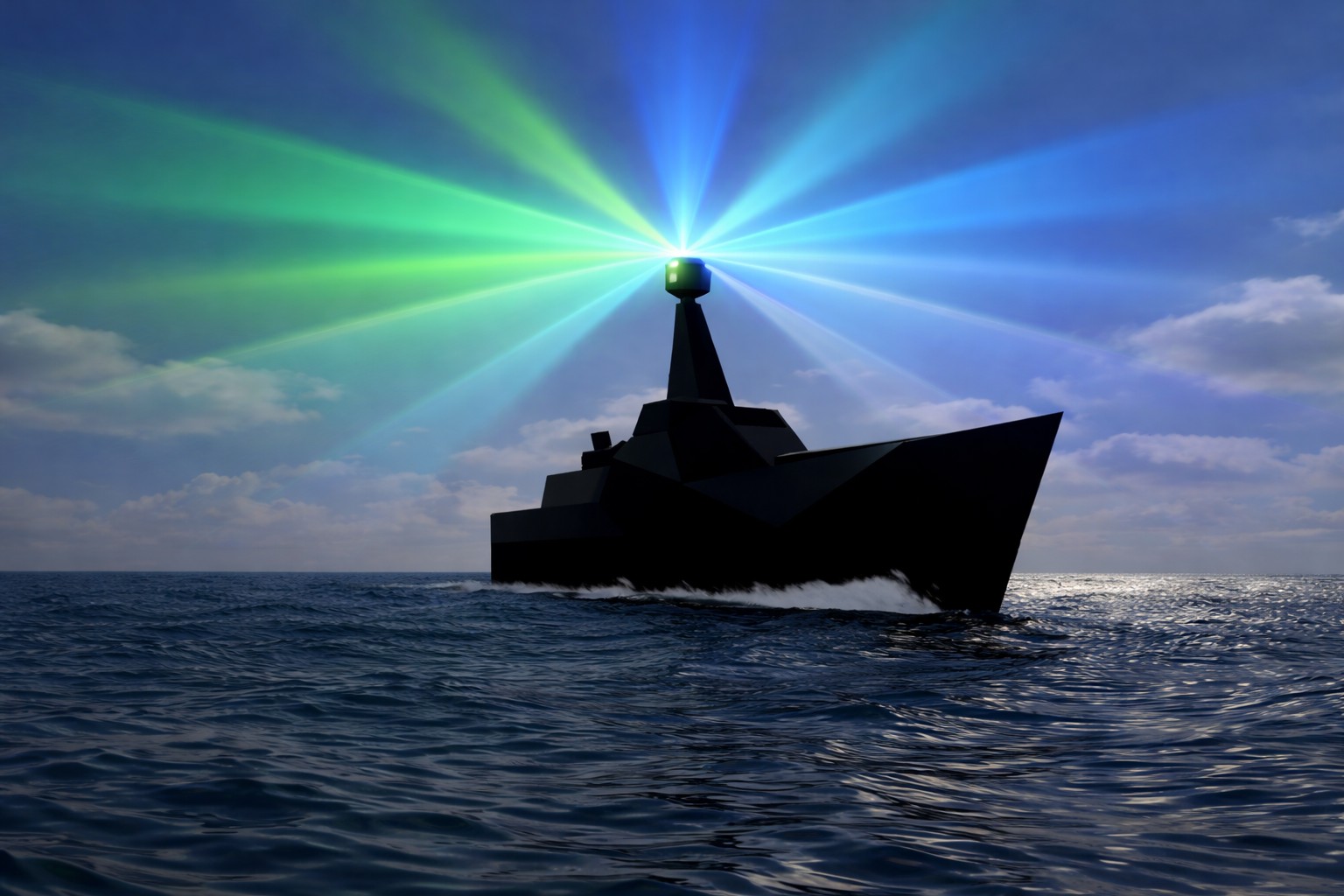
The Royal Navy is exploring the use of uncrewed picket platforms equipped with sensors to detect and track airborne threats, as part of a rapid procurement effort under Project HORUS.
A market engagement notice states that “the Royal Navy requires a rapidly procured and persistent air search capability, suitable for maritime platforms to host on board to detect, track, identify, and report airborne threats,” including drones, fast jets and cruise missiles.
The requirement places a strong emphasis on speed and maturity, with the Ministry of Defence seeking solutions that can be delivered within months. “The intention is to conduct a rapid market survey… selecting credible solutions; contracting and delivering the initial capability within four to six months,” the notice states, adding that the project is focused on “mature products with providers that are able to work at pace.”
At the core of the concept is a shift toward distributed sensing. The programme aims to “adopt a System of System Approach; introduce mass via numerous lower-cost sensors on uncrewed assets able to persist in high threat situations,” allowing the Royal Navy to extend surveillance coverage and cue higher-end weapon systems.
These systems would be expected to operate with a high degree of autonomy and persistence. The requirement specifies that platforms should be capable of remaining on station for “30 days (Threshold) or up to 90 days (Objective) without human in-person intervention or maintenance,” reflecting a move toward long-endurance, low-maintenance deployments.
The capability is also intended to reduce reliance on crewed platforms. The Ministry of Defence notes that the system must “reduce the crewed burden, reduce risk to life, [and] report air threats,” while being able to evolve over time as threats develop.
In terms of performance, the requirement sets out detection thresholds including “NATO Class 2 uncrewed air systems… anti-ship and land attack cruise missiles; [and] Gen 3 to 4 fighter-bombers at not less than 15 nautical miles,” with future expansion to include surface threats such as fast attack craft and uncrewed vessels.
Coverage requirements are also significant, with the notice stating that “a 2500km2 region must be persistently covered and reported on,” implying the need for multiple platforms operating in concert across a contested maritime environment.
Flexibility in delivery is also being considered. Project HORUS “is not limited to equipment procurement and is interested to receive proposals that exploit alternative commercial models, such as, SENSE as a service,” indicating openness to service-based or contractor-operated solutions.
The request for information is intended to shape the eventual procurement strategy, with the Ministry of Defence seeking to “develop further… understanding of the different technologies and capabilities available,” align requirements with industry, and identify options that offer value for money.



Hard to see what they are looking for here. The detection range against fighters is not great for modern radar, especially as it is talking about 3rd Gen. Also no requirement to operate alongside warships. Reading between the lines I think this is the MoD going ‘how do we get a radar picket in the Strait of Hormuz’ given the short response time, emphasis on low-tech opponents like FIAC and drones, and ‘complex littoral environment with contested geography’.
Can modern prototyping, 3D printing and the like allow us to develop new capabilities as the strategic picture changes? Additive manufacturing was going to build new drones for each mission a few years ago, perhaps some bright spark in the MoD thinks it can be done.
It’s an RFI. They are looking for information. It’s just a check on the state of the art in the hope that someone has a close solution, or even an alternative approach. I don’t think this is Gulf related, at least not for this war. I think it’s part of the Digital Targeting Web.
Possible but I wouldn’t ignore that this might very well be wanted for the Straight. We have no idea as to when warships might risk operating there let alone tankers, certainly not any time soon I suspect. It’s no doubt hoped by the Europeans/Japan at least this conflict can be toned down, some compromise found and ships start flowing again, but let’s be honest if this goes on for another 2 to 3 months then firstly by then things will really be getting so desperate in terms of oil supply and effects on economies that trying to force a passage might by then deemed the best bad option and to be honest that might be the earliest we could consider taking on the risk in the hope Iran has been degraded enough to risk it. What a damn mess either way. If it were not a very urgent request this sort of platform would surely by considered over a longer period and indeed should already have been considered the way anti ship missiles are developing, the fact it’s targeting lower end threats initially at least tends to suggest concerns about threats in the Middle East and Littoral less than Peer environments than any expected threat from say Russia.
As a surveillance systen coverng the North Sea, Baltic and North Atlantc unmanned system have an obvious use. Hwever, it needs to be carefully thought out and backed up by appropriate manned control systems and manned weapons systems – in other words, a properly funded and equipped integrated defence system. These vessels must never be considered to be complete in their own right or used as an excuse to cut costs elsewhere.
Sounds brilliant and continues the long British tradition for innovation, battle tanks and aircraft carriers, to name a few. The sooner we can develop autonomous surface and underwater naval craft, the sooner our fleet can increase to realistic numbers.
I won’t hold my breath Maurice…
Haha,very funny.
So 3-6 months to get the first one and to be deployed from a host.. so a small floaty boat maybe 10-15 meters.. stick a pair in a mission bay and you have a down threat axis picket.. very good.. but this does not replace the crewed ship.. that’s really important it makes it better but you cannot use these to reduce your number of escorts in the same way as a small ship flight does not reduce the number of ASW frigates you need.
The mission bays in T26 and T31 will be deploying systems not even dreamed of yet in their 30 year operational careers.
Thank god we didn’t go for the tiny BAE Systems Leander 2 design, the T31 has the size and volume for all sorts of bolt on goodies and deployable systems.
We just need to order more of both classes to build mass and deploy a whole fleet of unmanned systems to stitch it all together.
I think if a T-32 or new batch T-31 indeed does materialise it might be worth considering extending their mission bay capacity even more as it’s looking increasingly certain drones of various capabilities are going to be vitally important and that some ships incorporating them perhaps emphasise that capability leaving others of that class or other classes, to their general purpose or other specialities priorities. But that means increasing numbers.
Yep it seems the RN made a very good long term call insisting all their frigates have big mission bays.. I believe you could stick up to 4 12-15 meter ( well not quite 15 meters) drones in a mission bay of a type 26.. not so sure how the T31 mission bay will work ?
They certainly did, they will be absolutely invaluable in the future.
The T31 ‘mission space’ as far as anyone can tell has no access to the water, it’s just a pit under the flight deck for containers.
It will be handy for the medical or office-based PODS but not much else.
Yes it will be interesting to see how it works with drones.. they did specifically say it would support drone warfare.. but that may just be to drop in the control centre and the drones are either boat bay or fligh deck launched.
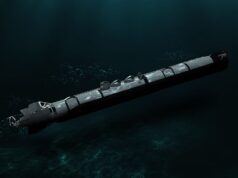
This doesn’t really look like a mission bay type USV, though it may still be small as the sensor range doesn’t justify a large hull.
“An individual combined sense and host solution must be able to remain on station for 30 days (Threshold) or up to 90 days (Objective) without human in-person intervention or maintenance. The system must be available to resume duties within 10 days (Threshold) or 5 days (Objective) following a maximum duration mission.”
The objective is about as long as the mothership’s time on station would be, so keeping with the SoH analogy they would potter out from Bahrain to form a picket line along the Iranian side, hopefully escape notice for the whole of the mission and then rotate round with maximum time on station. Something like USV Pioneer with good payload and endurance but not that much speed. Could also do drone defence of naval bases etc.
It essentially specifically says it.. “suitable for maritime platforms to host on board to detect, track, identify, and report airborne threats” they want it to be carted around by ships..
Yes, but as above the endurance requirement is given for the ‘combined sense and host solution’. They want the unmanned ‘platform’ to be modular and host the sensor payload, is how I read it.
“The Minimum Viable Product for assessment will be able to demonstrate detect and reporting against air threats from an uncrewed maritime platform underway at sea.”
… they want it to be carted around by ships.
Not a particularly odd thing for the Royal Navy to specify. It doesn’t mean it can’t be used in other ways. This RFI is for the sensor/processor: to detect, track, identify and report. How it all fits in a system of systems is still up for grabs. All it says is that it must be easy to integrate with the host and that it will be tested as an MVP from an uncrewed martitime platform.
I think the radar horizon and the stated range/height (15 nmi at 6m height) might make an aerial component necessary. I reckon a Ku or X-Band radar at 30m or higher would do the trick, and that would be a big old mast for the sort of SWATH designs we hear are being tested. Perhaps the aerial component could be tethered and power fed up the tether. TCOM’s Falcon Tethered UAS has done >30 days, but the weight of the radar would be on the margin of what a Falcon Heavy could loft (30lb). The 10nmi drone sensing range requirement would need the larger aperture, because of the low RCS.
I just asked Claude and it suggested a Ku band radar might be better, although it’s a bit swings and roundabouts. basically, because of rain attenuation, Ku would be better for the Gulf, and X-Band for North Sea/Atlantic. The Ku radar it suggested was Echodyne EchoShield.
It went on to tell me that a high mast solution on MROS was more likely. A little delving came up with a lot of flaws in the maths and underlying assumptions. MROS was never a goer for so many reasons. This kind of problem is currently at the limits of AI, and to get coherent reasoning and good maths, I ratcheted up the LMM to Opus 4.6 extended. Probably the best out there at the moment. I asked about non-US solutions and to compared tethered solutions with telecopic masts on SWATH.
Claude suggested both, but not how I imagined It suggested Kelvin Hughes on a Clark Masts 35m telescopic mast, and an Evolve Dynamics Mantis 2 short tethered with an EO/IR secondary sensor. It went with Pioneer 14 over the larger ACUA Ocean 24m because of maturity.
You still need a human to get out good solutions, but I can see AI being the first stop to create an RFI in the future (if they aren’t already doing it that way).
Something like Ocean Pioneer. Several could be deployed from a Bay in a single run. Lyme Bay?
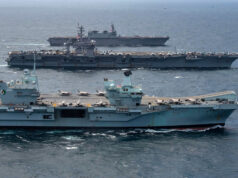
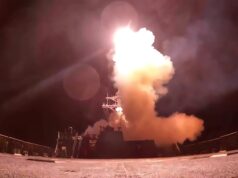
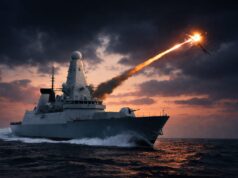
That top image reminds me of that science fiction movie The Philadelphia Experiment.
In other BREAKING NEWS it is being reported that the Iranians have hit an F-35 which managed to land safely however. Heard this earlier but wanted further collaboration. It was seemingly hit by an infrared missile. If true and it will be interesting to get the full story if so, it firstly suggests its stealth coating isn’t as invisible as hoped against IRST missiles and worse still the F-35s infrared finger print will have been recorded and no doubt will be passed on to its ‘allies’ or alternatively were the Iranians supplied with information gathered by the Russians/Chinese to target it? Either way this could have serious implications for an aircraft for which its stealth is its co-prime asset.
I suspect much data has been gleamed for Russia and China re the F35s thermal and radar signature over Iran in last few weeks.
As we all know, they fly with radar reflectors in peace time.
I don’t really believe the video that has been put out. It doesn’t look right at all.
It could have been a lucky manually aimed shot.
At some point US force got too cocky over their air dominance and forgot the loons with AA guns can get lucky and we’re flying too low – that is my read.
No matter how good the coating, there is no hiding the bloody hot jet engine exhaust. If an IR system got a view of the F35s arse there’s little that can be done about that.
Did you say ships? The royal navy doesn’t possess plural working deployable ships, usually it doesn’t even have one that is fully functional
🤡
So a remote boat with something like the Sea Giraffe 1x compact radar , satellite uplink to the frigate, and in higher threat areas maybe a remote weapons station with a GPMG?
There could be a small crewed refuelling boat that scoots about topping up the fuel tanks
Always knew those Trinity House Lighthouse vessels would come in useful.
In other news ( as reported in the Times) the MOD is considering balancing the defence budget by delaying the T83 program to the tune of £10 billion.
If those ships ever see the light of daybefore 2050 it will be an achievement. That said at the rate they’re going the Type 45s will be retiring having hardly ever been out of port.
They should get on the blower to the Ukrainians. New CDS needs to be shown the door and some serious culling of salaries in the MoD.
Desperately need some fighting spirit at senior levels with the cash to get a move on. It’s getting pretty close to the end in terms of our credibility as a country. Not quite last chance saloon but a few doors down.
It can be ship deployed without being warship deployed. Sure there are commercial vessels that could carry and launch larger drones
Am I assuming this is for the Type 90 sloop?
During WWII, one of the classes of US vessels to suffer the most attrition was the DERs, Destroyer Escort radar pickets. Being forward of the fleet and advertising your position makes for a tempting target. Whether crewed or not, I hope these new picket ships have some self defence otherwise they won’t last long.
So they are specifying drone ships, instead of air dropped bouys?
Problem is it doesn’t say what it’s actually doing. 30 days bobbing around in the channel is one thing. 30 days providing a screen for a carrier group networked in with the T45s whilst they steam around an ocean is an entirely different matter. Infact 30 days isn’t really that much in that context. How long to get to the south Atlantic, operate for a reasonable time and get back. If this drone is to have anything like a useful capability from a fleet point of view it’s going to end up being the size of a small ship anyway just to carry the fuel it needs. Then you have a small ship with no crew or defensive weapons that can’t tolerate any damage or anything breaking because there’s nobody on board to fix it. This whole business seems pretty poorly convieved to me. It’s like someone somewhere has said we should have our radars on drones and nobody has actually thought it through.