

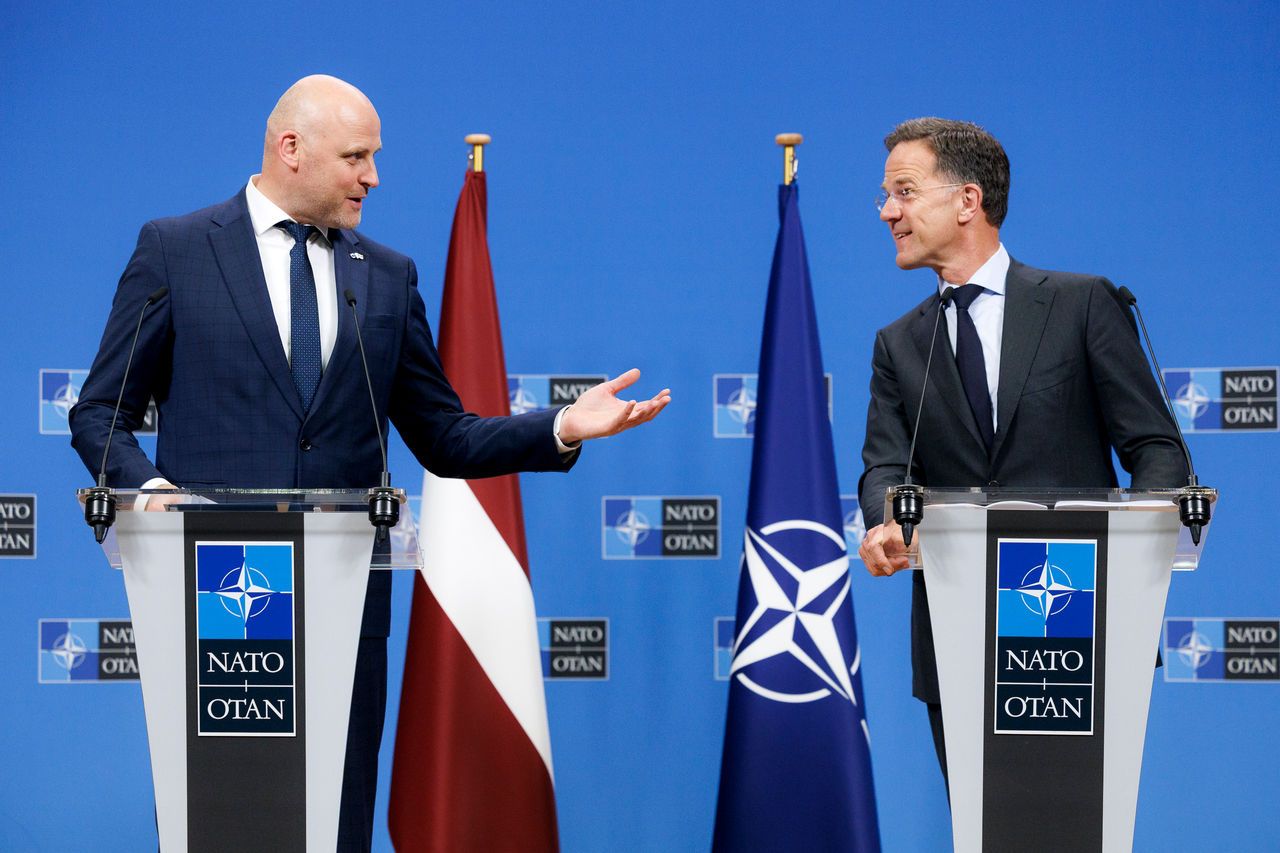
NATO Secretary General Mark Rutte has welcomed Latvian Prime Minister Andris Kulbergs to alliance headquarters in Brussels for talks on the upcoming NATO summit in Ankara and the alliance’s deterrence and defence posture.
The meeting on 17 June 2026 came in the wake of an incident earlier in the month in which French jets deployed on NATO Baltic Air Policing duties intercepted and destroyed a drone that had entered Latvian airspace. “Such drone incidents on NATO’s eastern flank show Russia’s dangerous and reckless actions,” Rutte said, as quoted by the alliance. “But it also shows once again NATO’s determination and ability to deter and defend. No Ally stands alone in NATO.”
Baltic Air Policing has been one of NATO’s longest-running collective defence missions, operating continuously since 2004 when the three Baltic states joined the alliance without possessing their own fighter capabilities. Allied air forces rotate through bases in Estonia, Latvia and Lithuania on roughly four-month detachments, providing quick reaction alert coverage along a stretch of the alliance’s eastern flank that borders both Russia and Belarus. The mission has expanded in scope and tempo since 2022, with incursions, near-misses and unidentified airborne objects becoming a more frequent feature of the operating picture.
Drone incidents in particular have grown more prominent over the past year as Russian forces use uncrewed systems at scale in Ukraine and as debris, errant systems and reconnaissance platforms have repeatedly drifted across borders into NATO territory. Latvia, Romania, Poland and other states neighbouring the conflict zone have all reported incursions, prompting alliance members to invest in counter-drone systems and to review rules of engagement for shooting down small uncrewed platforms in peacetime airspace.
Rutte singled out Latvia’s broader defence contribution, with core defence spending due to reach almost 5 per cent of GDP this year. “Delivering increased defence investment, more defence production, and of course, our strong support for Ukraine. Latvia is already showing how it’s done,” he said, according to NATO. The Secretary General linked those themes directly to the agenda for the Ankara summit next month, indicating that defence investment, production capacity and continued support for Kyiv would be central items on the table when allied leaders convene.
The Ankara summit will be the first held in Turkey and the first hosted by a member state along NATO’s southern flank in several years. Defence production, eastern flank deterrence and the Ukraine support architecture are expected to dominate the agenda alongside the alliance’s ongoing internal debate over burden-sharing.









Yet another NATO ally demonstrates that spending 5% of GDP on defence is perfectly do-able.
In Latvia’s case it is not doable at all unless you take into account that it used to cost €40 for a doctor’s appointment as wellvas for the subsequent appt.s and medicines were paid on purchase and you couldn’t get medicine unless you had the monthly note.
Unemployment benefit was dismal and other benefits non-existent.
However, Latvian society loojs after it’s own added to which officials were not adverse to making a € or 10 when it comes to Eurofunds. Notice that for high speed rail European States take a 25 – 30m trace. Latvia took and received funding for a 50m trace and that trace was to build a conventional speed line which decelerate when it hits Poland because their Railbaltica will be even slower and built by the Chinese…
And China in Latvia is big on property and influence…
Yes, let’s laud Latvia.
Talking of Drones, was just reading Deborah Haynes from Sky News, reporting about BATUS being used for large scale Drone exercises alongside the Canadians, after its drawdown from all arms battlegroup training.
Seems like a good idea? I was talking about Drone exercise issues in the UK recently.
Its the perfect place for it. As always great cooperation between the two countries.
Spam, spam spam spam spam eggs and Spam.
Green eggs?
’82 KZ750 restoration is moving ahead nicely, TVR is very close to done.
Is your KZ the road bike or the custom one ? I recall the L version but can’t picture the road version other than the Z 750 range.
TVR will be amazing, enjoy.
It’s the KZ750E model, a standard road bike.
Wish I could send you a pic of the TVR, Aston Martin California Sage Green, black interior with grey trim.
Good for Latvia. I read recently that the head of the Latavia Naval Forces (or maybe Estonia) recently visited HMNB Devonport and found it utterly depressing. It was like the last day of an “everything must go” closing down sale. Even the “paintings on the wall” were being sold. There seems a real possibility that Devonport will cease to be naval base as the last T23’s leave service, and it becomes just a dockyard. The T26’s and a few other surface ships could all be easily accommodated and home based at Portsmouth, which generally has more modern facilities.
Meanwhile we are about to have Starmer trying to pass off another round of brutal defence cuts as good news. My latest tea leaves forecast is that the “good news” for the RN will include:
* Formal cancellation of Type 32 frigate project
* Reducing RN T26 buy from 8 to 6 frigates
* Procurement decision on FADS/T83 destroyer deferred to SDR2030 and its updated PID
* LSS delayed, Bay class to be life extended instead
* No replacement for Argus
* No replacement for River Batch 1 OPV’s
* The third FSS is surplus requirements and will be offered for sale on completion