

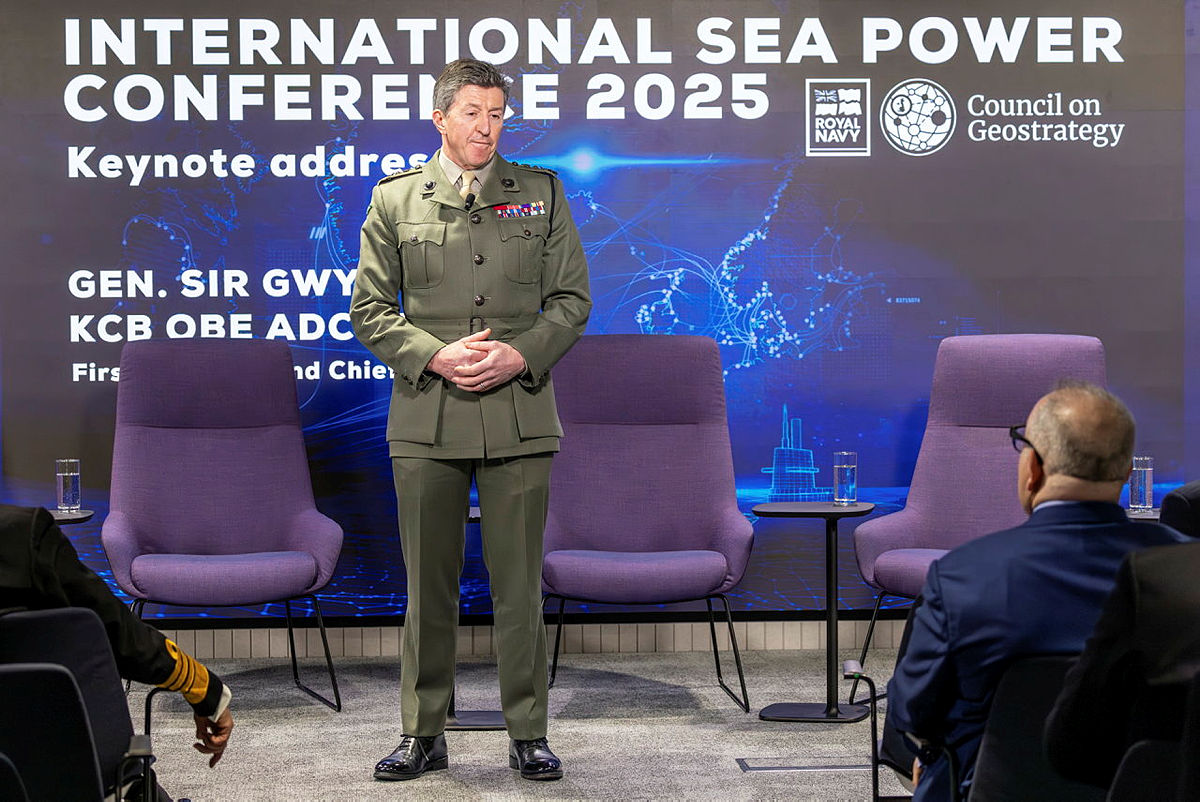
The First Sea Lord did not offer a speech so much as a demand. Speaking in London, General Sir Gwyn Jenkins sketched a world sliding toward harder edges and made plain that the Royal Navy must change faster than the threats gathering around it.
The language was clear, almost stark. The constants of the maritime world endure, he said, but the margin of advantage does not.
He began with the basics because the basics matter, Britain’s survival still rests on open sea lanes, and he reminded the room that “virtually all our trade, virtually all our data and virtually all our energy flows either above, on, or under the sea.” The Atlantic remains the nation’s shield, and geography still fixes the burden on the Royal Navy. The Norwegian coast is a hinge of NATO’s defence. The UK sits at “the cornerstone of access to the Atlantic.”
Where the tone shifted was on threat, Russia’s maritime activity has surged and not only on the surface. Jenkins warned that “the advantage that we have enjoyed in the Atlantic since the end of the Second World War is at risk” and that “what’s going on under the waves” is the real concern. The picture he painted is of a Navy still holding the line, but only just. “There is no room for complacency.” Britain’s adversaries are investing heavily and “we have to step up or we will lose that advantage.”
In the middle of this rising uncertainty, the conference itself felt unusually purposeful. Officers, officials and industry leaders spoke with a shared acknowledgement of threat and a shared urgency about what must come next. The conversations had a stripped back quality that matched the First Sea Lord’s tone. Participants were seeking each other’s views openly and without theatre, recognising that the window for incrementalism has passed. The mood was not pessimistic.
But, back to the speech, the other accelerant mentioned is technology. He described it as running faster than any planner can predict, with advances in artificial intelligence outpacing expectations. His conclusion was direct. “The pace of technological change will never, ever be as slow again as it is today.” The Navy must therefore design itself for speed, adaptiveness, and relevance.
From this came his central pitch, the warfighting hybrid navy. Three linked concepts form its core. Atlantic Bastion, a web of autonomous sensors acting as persistent eyes and ears. Atlantic Shield, a reworking of northern air defence. Atlantic Strike, a sharpened ability to hit back with force.
He pushed the urgency. Early autonomous escorts will go into the water within two years. A fast jet drone demonstrator will fly from a carrier next year. Norway has already committed to plugging its new Type 26 frigates into Bastion. And he insisted that this is not abstract. “If this all sounds like science fiction, it is not. It is science fact.”
Next year, the Royal Navy expects sensors in the Atlantic and the issuing of Bastion contracts as a service. The commando force will complete its shift to dispersed, technology-enabled teams built for the High North. And several transformations already underway will accelerate under the Warfighting Ready Plan 2029, which he launched on stage. The plan, he said, is built on extensive wargaming to understand where the Navy is strong and where allies must fill the gaps. It demands discarding legacy structures and embracing new approaches.
Leadership and culture were central. He argued that warfighting is “a discipline for action” and that the Navy must unshackle itself from processes slowing it down. He pointed to 200,000 saved person-hours by stripping back bureaucracy in the past 100 days. That time, he said, must now be reinvested in readiness.
But the message threaded through the entire speech was dependence on partners. Industry is already co-investing at a striking scale, with Jenkins noting that “for every pound we have invested, industry has invested four.” Allies are vital. “We need other allies,” he said. Only together can the UK protect undersea cables, energy routes and supply lines.
His closing was both warning and rallying cry. “We are moving out because we have no choice. The alternative is not worth thinking about.” Ready or not, the Navy is being pushed into a period defined by speed, mass, autonomy and risk.
And the First Sea Lord wants nothing less.











A very busy George this week, it would seem.
Shuttling back and forth from London to Rosyth must be quite tiring!
General Sir Gwyn Jenkins is shaping up to be the best 1SL for decades. He is trying to do important stuff genuinely quickly using as seed corn the tiny budgets (£10 million?) that he can personally sign-off on, rather than just following glacial MOD and Treasury budgetary processes where he will have long retired before any approval is likely. Hopefully Healey is backing him hard, or the blob will still win.
If the reports of the meetings between Healey and our military chiefs are true, then no, General Jenkins is not being backed. They do not have the money to deliver on the SDSR and there is a lack of any firm commitment on future Budgets. How can they possibly design a force structure and deliver a meaningful equipment plan without clear and committed timescales for the Budget. They can’t and that’s the big problem.
My guess is that, following the SDR, the ‘military chiefs’ have designed much of the force structure and made an equipment plan. Curve balls like Argus and Ajax will have screwed up this plan. I don’t know how govt works but it looks like the holdup is down to the Treasury not releasing funding budgetted for in the spending settlement. I suspect that what is happening is that the Treasury wants to see an equipment plan Mk2 showing how much more money is needed to fix the issues with Argus and Ajax. Pollard said there will be a decision one way of another on Ajax within 2 weeks. The NMH announcement is supposed to be ‘imminent’; details are leaking out from Norway.
I hope you are right Paul. A hold up based on a few areas is a completely different scenario and one that can be overcome. Lets see what happens when the equipment plan is released, hopefully by the end of the year.
Nothing ever changes. The militaries greatest enemy.
I have to agree with you, I also think he is winning that eternal battle that plagues Uk defence planning..the interservice rivalry battle.. having a marine as first sealord is a real winner for the RN..after all who can double a Marine.. they are fighters first.. the Generals always overplay the army and want boots on the ground, the admirals always want more ships and the marshals always want more fighter jets… but a marine..he just wants to win the fight.
He’ll resign soon
robi, you post a short comment which needs expanding. The General or Healey likely to resign….and why?
Morning Graham, I took that as a sort of sarcastic resignation based on past attempts to make important changes whilst “Impacting ones Cranium against a brick wall”.
Might be wrong thgough 🤔😁
Good to see a FSL actually wanting change NOW and stating it in public. Well done Sir Gwyn.
Speed, mass, risk.. all essential for fighting a war… autonomous is just a tool to achieve this without political and national buy in to doing it the proper more costly way.
Good man, talks sense, he will get no where as those that run the place are just nodding along while doing nothing. There is no money and no will to find any for defence its all window dressing sadly. He will be quietly told to pipe down and tow the line which feel he will not do. Nothing ordered in 18 months just endles whaffle.
Delay after delay about what we need or might get, never a good sign. When kit is ordered it will not be much no big spend just a bit here with the odd head line buy thats it. He right to say focus on NATO and the North Altantic, not China as the US wants us to while basicly telling us all in Europe to go to hell.
> There is no money
There’s plenty. We just spend 150billion of it on pensioner UBI. Means test it and there’ll be multitudes available for defence projects.
And back in the real world?
150 billion is the real world. I knew that you wouldn’t be able to cope with the truth.
You would not know reality if it turned up at your door, yours is just deluded rank with no substance, So what is your factual point? Rob the old to pay for defence? Means test the old so we can have few more ships? btw the worlds not flat either. Next time get your nurse to type for you .
Ah, I understand. Robbing the young is ethically sound to you, but “robbing” the old isn’t?
Answer me three questions:
How long have you been claiming the pensioner UBI?
How much did you buy your house for and what’s it worth now?
How much money do you get from your other pensions?
Reveal your greed to me, then I’ll truly understand where your allegiances lie (PS: I know it’s not with anyone but the pensioner class 😉)
They’ll do anything but build more new ships and recruit more sailors! Chatbots to fight Russia!
We are not (really) spending more on defence. Germany is not spending more on defence. Poland is pretty much surrounded by pro Russian or shortly to be pro Russian states. The eu is riddled with Sino/Russian placemen. Britain’s political classes have recently had their own scandals regarding Sino/Russian bribery. The new Chinese embassy will simply exacerbate the problem.
And the problem is that, as a consequence of our weakness, our foreign and domestic policy, already partially taken out of our hands by our dependence on France for stand by nuclear energy, international markets (dominated by producers who are not necessarily our friends) for gas, will shortly have to follow diktats from Beijing and Moscow, relayed through that delightful (not) new embassy shortly to be constructed on Tower Hill
A reforming government, systemic reform is required….but who to trust amongst Britain’s political parties?
Britain is in a perilous state.
The simple basic issue is that we are all just “Sheeple” who do as we are told and worship at the alter of the Rich and Famous.
Well that’s my take on things having watched “I’m a Celeb” once.
To be clear, I walked in whilst the wife was watching it and made the mistake of asking “What you watching ?” She gave a rather long explanation by which point I realised we were all Fucked !
There are many free thinking people who avoid such political/fame/hero/elitist worship and refrain from seeking labels or ticking boxes that only add to the basic problem. ☺️🐏🐏🐏🐏🐏🐏🐏🐏🐏🐏🐏🐏🐏
As the First Sea Lord said:
‘Leadership and culture are central’
Baaaa.
Yes sir yes sir three bags full
Interesting contrast in response to the problem between the US and the UK. The UK is investing in ‘windmills’ . The US looks like its about to invade Venezuela; the country with the world’s largest oil reserves.
The U.S. is applying exactly the kind of political pressure on Venezuela that China/Russia will apply on Europe in general, should Russia prevail in Ukraine.
In both cases, the assertion of political dominance may.not require physical invasion.
That is, of course, precisely why we must restore our conventional land deterrent in Europe; the avoidance of the subjugation of our national will in both foreign and domestic policy.
There is, presently, no sign that this country has the political will, any longer, to resist such a subjugation.
I think the risk is understood. That’s why the UK is getting back into the ballistic missile game, is getting closer to Europe, is developing a new nuclear warhead and 2000km range cruise missiles etc. It’s all very late. If Ukraine cedes the Donbas in its entirety to Russia it will be very vulnerable to further Russian advances. We need to accept that Putin will not stop until Kyiv is back under the control of Moscow. He wants to turn the clock back to 1686, when Constantinople transferred the independent Kyiv patriarch to the control of Moscow. Putin justifies this war to the Russian people as a religious war. Since Ukraine will not be a NATO member, the UK, France and Germany and the so-called coalition of the willing will have to decide whether to sign a defence pact with Ukraine. An action replay of the 1939 Anglo-Polish alliance but for Poland read Ukraine? I’m not confident we are willing or prepared to do that.
Give or take our contribution of couple of UK SSNs will be occupied with the US for a while. We need to focus on their inveigling themselves into our education establishment.
Monro, the political pressure that is being applied on Venezuela is backed by the deployment of US military forces that they can’t hope to counter, including a carrier group. It’s old style Gunship Diplomacy. By that observation, to counter a similar threat from China/Russia then Europe needs to restore its deterrent on land sea and air. The UK can and should play its part in that but, given limited budgets, it makes more sense to focus in certain areas so that we’ve at least got some cogent, sovereign capabilities that have bearing on our own, personal defence.
Continental Europe has hundreds of thousands of soldiers, the potential for millions. Some European NATO countries are landlocked and can do nothing but focus on land deterrence. As such, it is clear that, with the limited budget, Britain’s primary focus should not be on land but along the lines outlined by the 1SL in this article. That is not to say that other domains should be excluded entirely but we need a coherent plan that revolves around spending only the money that we actually have.
I know that you’re favourite mantra is to say, “that’s why we need a reforming government,” but even if that’s true, the strategy involves waiting for the next election in four years time and hoping that the people you consider to be ‘reforming’ are actually elected.
“your”
I’m hoping that all parties go into the next election on a reforming ticket, particularlyon dropping the silliness of net zero. It will then be a question of which party to trust.
We are committed, in writing, to providing a Corps HQ and two divisions to NATO. We cannot presently fulfil that commitment. That means that there is no credible land conventional deterrent on Continental Europe to deter Russia, a land power.
It is no coincidence that the 2014 annexation of Crimea took place shortly after Britain had removed its land forces from the continent. Putin was clear that Britain could not live up to the security assurances given to Ukraine and the U.S. would not move without Britain. A European commitment to Ukraine’s security was wholly absent. That rather undermines the idea of relying on our European allies. That is why we must give them a lead.
Until we restore a credible conventional land deterrent, Putin will keep going. Air power, sea power simply does not work as a conventional deterrent.
We have committed to participating in a conventional land deterrent on the continent and we must live up to our word.
That’s kind of nonsense, isn’t it? It is absolutely a coincidence that 2014 annexation occurred after Britain removed land forces from Germany. The so called Euromaidan incident that kicked off this whole affair happened in 2014 and that’s why the Russians invaded, in 2014! In addition, the US forces stationed in Europe, considerably larger than what Britain had did not deter Putin even though the US is also co signatory of the Budapest Memorandum. Sorry, the things you say just don’t add up.
The reason that Russia annexed Crimea in 2014 was because they knew they could. They were not deterred from so doing. What did NATO think might deter them thereafter?
Let us look at what happened before the 2014 annexation of Crimea.
‘As a percentage of GDP, defence spending by European allies fell from an average of 2 percent in 1995–1999 to 1.5 percent in 2014’
What happened immediately after the 2014 annexation of Crimea?
NATO’s members agreed in 2014 that they would each be spending at least 2% of their gross domestic product on defence by 2024.
What really happened?
France’s active armed forces shrank to 203,850. The British army was reduced to 73,000 and Germany could possibly deploy one brigade — numbering a few thousand soldiers — to the Baltics.
What happened after the 2022 Russian invasion of Ukraine?
European NATO countries now aspired to 5% of GDP to defence. Finland and Sweden joined NATO. Poland bought 1100 tanks.
The only true victory is deterrence. Due to Europe’s unilateral disarmament, Russia knew it could reassert its regional dominance with impunity.
Had it realised that, by 2022, Ukraine had the means to defend itself, it would not have attacked; it would have been deterred; a grotesque miscalculation.
Plenty of national leaders are complete morons. We can see that clearly. The only way to prevent a moron from making a massive military blunder is to deter him: Falklands 1982 sparked by the decision to withdraw HMS Endurance. On the other hand the 1961 Iraq invasion of Kuwait was deterred by deployment of a British armoured brigade from Bahrain. The examples are legion.
Yes, the Euromaidan incident was some kind of casus belli but NATO weakness gave the Russians the green light, and again in 2022 with the chaotic shambles of a withdrawal from Afghanistan.
We must deter Russia from moving on from Ukraine to Moldova and the Baltic States. Article 5 will not save the Baltic States if it is clear to Russia that NATO does not possess either the will or the land forces in area to eject them, should they invade; neither will the Royal Navy or the Royal Air Force….
And, of course, U.S. forces in Europe did not deter Putin in 2014 because President Obama had, in 2013, failed to act on his ‘red line’ regarding Syria. Britain had also failed to respond to that ‘red line’ in a shameful vote in parliament 29 August 2013. Indeed, that parliamentary vote, clearly indicating weakness in Britain, may very well have also contributed to the U.S. failure to act on its own regarding Syrian usage of chemical weapons.
A bigger green light to Putin regarding Crimea would be hard to imagine.
The need to deter is paramount. The threat to us is on the march in Eastern Europe. That is where our conventional deterrent must be, on land and we are committed to that.
All we lack, once more, is resolute action and that is extremely dangerous for us all.
I’ve not read a transcript of his speech.
I assume two things, there were no government ministers in the room, so he might as well have been talking to a UKDJ conference for all the power that’s there to make any difference whatsoever.
And two, while putting the spotlight on toy boats and planes that can do part of the job cheaply that real warfighting assets can do in the GIUK, and cannot deploy elsewhere on task, whil totally ignoring the elephant in the room that we have 13 escorts remaining after 30 years of cuts.
And STILL HMG come out with the waffle in response.
I like the sound of a UKDJ conference, though given George and the team’s base we might not be able to make it!
The speech is well worth reading and it’s easily available, there’s a lot in there that I don’t remember anyone from ‘inside’ acknowledging before. Pollard at least was there, but not Healey.
A lot of the speech wasn’t about the actual tech he wants to buy, but about how the Navy is getting the companies to invest their own money to match the government’s, rather than extended development contracts (less MIC, yay!), and how they are imposing fewer requirements on the contractors (shorter lag times, yay!).
Hi mate.
I’ll try and get round to it. I’m afraid I have a deeply rooted cynicism in anything a politician or a CDS, 1SL, CAS, CGS say I’m afraid.
Only matches by my scepticism of the motives of the MIC.
We’ve had these uplifting pep talks before mate, many times. Nothing changes.
I could pick you up on my Busa if you want, no traffic issues and it won’t take long to get there.
Biggest problem I can see is the Head Office (Shed) might not big big enough for all the regulars and i don’t want to trip over Danieles beard either.
I have too many years of my life left for motorcycling, I think.
Yes, George might have to rent out the BAE hall to fit everyone!
A life lived without Motorcycles, is a life lived without fun.
“One life, live it”
But have you ever flown an aeroplane? Very fun, and a heck of a lot safer.
No, I did save to do my PPL in America when I was young but Life events took over and I settled on Bikes and Fast cars instead. 46 years and 46 Bikes later, It’s still a fantastic thing to crack that throttle !
What Plane do you own ? 🤔☺️😁
I fly for free, don’t have to pay a penny for Cadets!
You could probably buy a plane with the money you spent on 46 bikes, not a small one either.
Boats all the way..
Can’t swim and they sink.
That’s what life jackets are for.. it’s usually to far to swim anyway so just call your self Bob Hope..because that is what you do if your boat sinks…
😆
I have doubts about the RN’s direction here. We have seen Ukraine rout Russia’s Black Sea fleet with autonomous vessels. But that was an inshore operation in a small area against surface ships. That is chalk and cheese next to operating small unmanned vessels across thousands of square miles in high sea states trying to identify enemy submarines.
It is basically a (theoretically) low-cost substitute because we have nothing like the number of hunter-killer submarines and ASW frigates to scratch the surface of the task. If the RN puts its money into the unmanned vessels envisaged, it will have precious little to spare for the manned escorts and submarines that will be essential to act on the acoustic and other data provided by seabed and unmanned sensors.
Whether the T92 ASW sloop will be any use at fighting the submarine war is debatable, it could quite easily turn into a floating target for enemy subs. And the T93 UUV travelling at 4 or 5 knots is not going to be tracking anything, so it looks like being just an expensive sensor.
The danger of the new 1SL’s need for speed of construction/action this day approach is that this whole Atlantic Bastion project could very easily turn into another expensive rabbit hole for the RN.
It’s last such eureka moment resulted in the carriers, which they had long agitated and campaigned for. That was £7bn down the hole, for what many.now view as a limited, somewhat peripheral and rather vulnerable capability. The downside was that, as the cash.had gone on the prestige carriers, the cupboard was bare for escorts.
Instead of a regular drumbeat of a DD or FF every year-18 months, not a single one was built in the ten Tory years after the last T45 was commissioned. It will be a 15-year gap by the time the first T26 or T31 is operational – hence the sorry state of the T23s and the enforce gapping of six escorts.
Please let us not do a repeat with a rush to a ‘world-beating’ Atlantic Bastion, which will inevitably turn into an expensive outing and quite possibly to limited military value. The RN can’t keep grabbing the other services’ budgets to pay for its procurement adventures and then squealing via the Lords that it is a great national threat that it doesn’t have enough escorts (or submarines).
Service rivalry and lobbying!.
When does that change. At least the RN Carriers actually work, and cost just a tad more than the 5 billion spent on Ajax and the nearer 12 billion the Army has pissed away on what exactly?
Meanwhile, you have the dark muttering in the press, and here, that it’s all the RAFs fault because they have no Strike Aircraft left and want some.
And who can blame them? I don’t.
The whole farcisl scenario reminds me of Adolf Hitler, ( played by HMG ) who happily divided power between his minions and watched them intrigue against each other while he kept ultimate control. That being, HMG starving the military of money so badly that they fight amongst themselves for the scraps.
Note I said military, not “Defence” a term HMG also hide behind with these mythological increases in budget that get diverted every which way but the military it seems.
CV-01 VS F111 again
Yes it sounds a reasonable plan but like everything needs funding! We will obviously concentrating our main effort in the high North and Atlantic for the next decade by the looks in terms of naval forces and RMs.
The MRSS will be interesting now will we get 3 large LPD style ship or 3-4 smaller hybrid frigate amphibious raiding vessels now like arrow head 140 or strike frigate idea?