

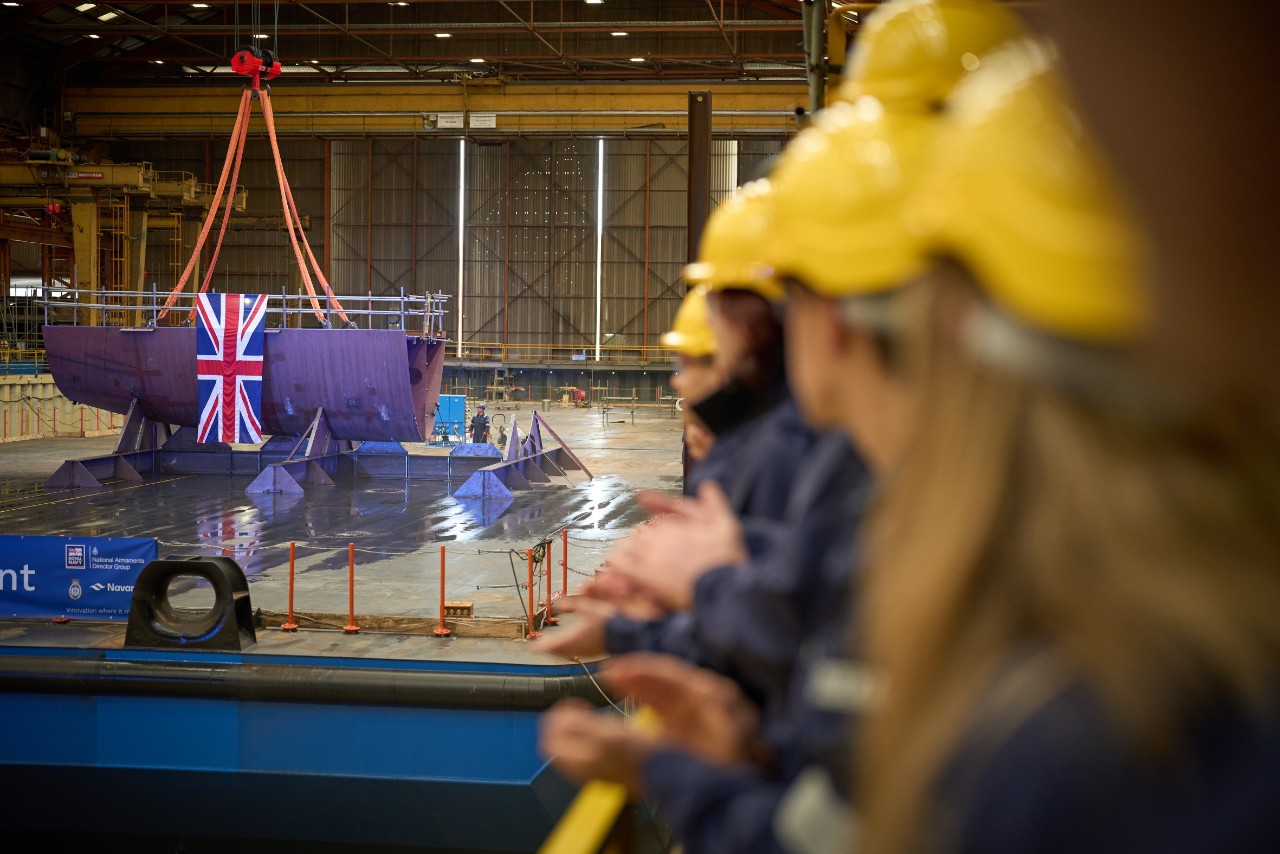
The second and third ships in the Royal Fleet Auxiliary’s new Fleet Solid Support programme will be named RFA Reliant and RFA Resourceful, with the names revealed as the keel was laid for first-of-class RFA Resurgent at Appledore in North Devon, the Royal Navy has said.
The three ships are being built to provide ammunition, stores and other supplies to Royal Navy vessels at sea, including the UK’s aircraft carriers. Sections of the vessels are being constructed at Navantia facilities in Appledore and Cadiz, as well as in Belfast, before being transported to Harland & Wolff’s Belfast facility for final integration.
Commodore Sam Shattock, head of the Royal Fleet Auxiliary, announced the names of the remaining two ships during the keel-laying ceremony for RFA Resurgent, which took place on Merchant Navy Day.
He said: “Today represents the moment when vision becomes reality, when plans and drawings come to life, effectively becoming the ship’s birthday.”
On the name of the first vessel, he added: “RFA Resurgent’s name speaks of renewal, resilience and the ability recover stronger from challenge.”
“Those qualities are reflected not only in the ship itself, but also in the people who will design, build, support and ultimately sail her.”
As part of the keel-laying ceremony, a coin was welded to the keel of RFA Resurgent by a Navantia UK apprentice, continuing a shipbuilding tradition marking the formal start of construction.
Each Fleet Solid Support ship will have a core RFA crew of 101, with accommodation for a further 80 personnel when required. Those additional personnel could include teams operating helicopters and boats or carrying out other specialist roles.
The vessels are intended to replenish Royal Navy ships with munitions, supplies and provisions while at sea. The Royal Navy says they will also be able to support wider operational activity, including counter-piracy and counter-terrorism missions and operations alongside allied forces.
The design also includes energy-efficient technologies intended to reduce power consumption. The ships are being built with the ability to use low-carbon, non-fossil fuels and future sustainable energy sources, with the Royal Navy saying the design is intended to allow the vessels to achieve Carbon Zero status by the end of their planned 30-year operational lives.
RFA Resurgent revives a name previously carried by a merchant vessel converted into a fleet replenishment ship in 1957. That ship remained in service until 1979 and supported a Joint Services scientific expedition to the Indian Ocean in 1975.
The name RFA Reliant has previously been used by three vessels, including stores and air stores support ships and a helicopter support ship. The most recent Reliant was a merchant vessel taken into naval service in 1983 and used during the multinational deployment to Lebanon in 1984, including during evacuation operations. She was sold in 1986 after being replaced in the helicopter support role by RFA Argus.
RFA Resourceful is a new name for the RFA, selected to follow the adjective-based naming convention of the class. The Royal Fleet Auxiliary previously operated an armament stores ship named RFA Resource, which served between 1966 and 1997 and received battle honours for the Falklands and Kuwait.
The Fleet Solid Support programme is also intended to support investment in UK shipyards, apprenticeships, skilled employment and domestic supply chains, while combining work in Britain with construction and expertise from Navantia’s Spanish facilities.





Good news for a change.
even better news when they come into service. I cant wait.
Interesting to read reports that the MOD has asked Navantia to accelerate delivery of these ships.
Paul.P,
Interesting, even MoD may judge that it would be extremely beneficial for CSGs, if commissioning of at least first-of-class is expedited. Contractors generally respond positively to proffered incentives. Not certain Ft. Victoria could be mission capable, even in the extremis of general, unrestricted warfare. 🤔
With all these large RFA ships being built to support carrier and fleet ops is anyone still questioning if the 8 T26 and 5 T31s along with the 6 T45/CCVs are actually enough escorts? Is it still to lean? There’s lots of push for LUSV type drones but wouldn’t a few extra quid spent on an extra T26 and T31s be more useful in getting concentrated ASW/ASuW and building up patrol presence and port to port relationships globally in the near term and commit to replace the B1 Rivers? A handful more crewed ships could give an even stronger ability to project a more “human” face to face/port to port/nation to nation influence and force, help build on mutually beneficial international trade relations, law and respect as well as the usual deterrence to counter missiles and drones.
Speculation which is above my pay grade or experience Quentin. Best guess is the B1 Rivers will be replaced by Norwegian built sub-surface drone motherships in UK EEZ waters. I wouldn’t bet on any more than 19 escorts. Allied escorts for a CSG will be the norm now; France, Netherlands, US, AUS, NZ. Also quite likely RN T31s will get deployed to replace Tamar and Spey in the ‘Indo- Pacific’.
I think the idea is to maintain Ft Vic to a level such that she can used as a training platform for the FSS crews. I interpret this news to mean that notwithstanding all the talk about unmanned ships and the N. Atlantic the UK remains committed to a CSF capability.
HMS Reliant, are they going to paint it yellow an use it for independent trading?