

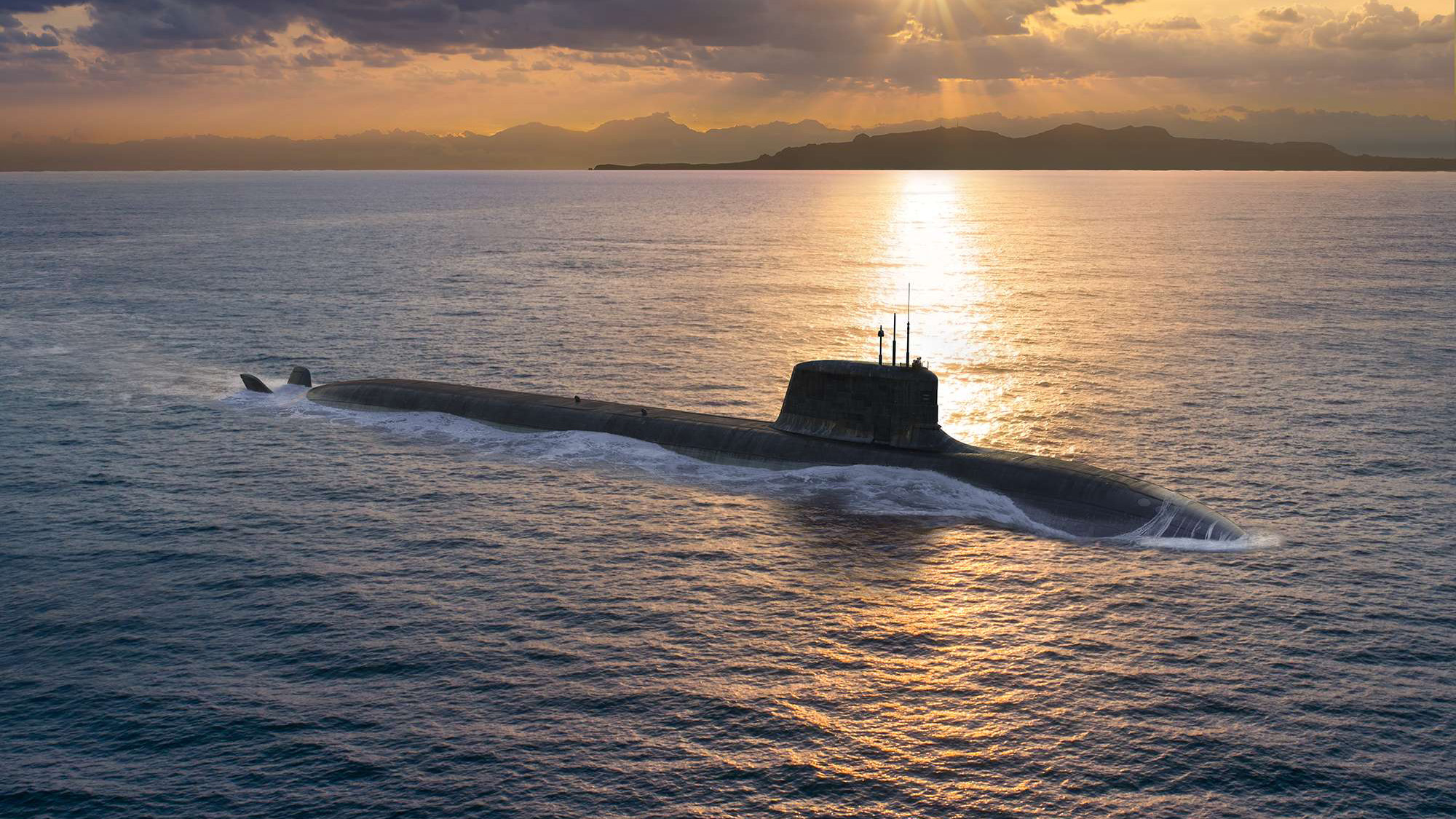
The bulk of the UK’s attack submarine fleet will continue to be focused on the Atlantic and Mediterranean despite the Indo-Pacific dimension of AUKUS, according to Sir Stephen Lovegrove.
Speaking at the Undersea Defence Technology conference in London, Lovegrove said the partnership would increase the number and capability of submarines available to the UK and its allies, while reinforcing core operating areas closer to home.
“Let there be no mistake… where the bulk of the UK’s boats will be deployed… [is] our primary theatres, the Atlantic and the Mediterranean.”
He said AUKUS would enable a larger, more capable and more integrated allied submarine presence across multiple regions. “[It] will mean that AUKUS partners are collectively able to field a higher number of more capable attack submarines… as part of a more flexible network across the globe.”
While the expansion of the UK’s submarine fleet has already been set out by government, Lovegrove framed it in terms of operational impact rather than headline numbers, pointing to increased availability and reach. “Having more SSNs, swift and undetectable in the water, is an unequivocal good for our society, our security and those of our allies.”
He also highlighted the global nature of the partnership, describing it as capable of operating seamlessly across theatres. “AUKUS is a truly theatre-agnostic partnership with an unrivalled strategic reach and ability for power projection.”
Recent activity, including HMS Anson’s deployment to Australia for a maintenance period, was cited as evidence of growing integration between UK, US and Australian forces. “It was an important milestone… before Anson silently submerged again to pursue other missions in other oceans.”
Lovegrove added that the challenge now is maintaining pace as competitors continue to invest.




It’s going to be very interesting to see how many AUKUS boats eventually get ordered. All of the talk about joint development potentially allowing a greater number of boats is all well and good, but until actual numbers start getting discussed, it’s about as believable as a chocolate teapot surviving a CASD deployment.
It would be lovely if we ended up with a dreadnought-style “we want eight and we won’t wait” for 12 boats, but realistically the best we can probably hope for is 8 or 9.
If you assume that protecting CASD going in and out of Faslane is top priority then it’s pretty much inevitable that the boats would be deployed proprtionately more often in The North Atlantic than anywhere else.
Why would you assume that is the no1 priority when we have only 1 operational SSN and it’s on the other side of the planet ? 🤷🏻
Ian,
Deep32 has stated on several occasions that the SSBNs are reasonably capable of self-protection, given latest mod Spearfish complement and deployment of advanced sonar arrays. In addition both P-8As, and T-23/T-26 should be available for sanitizing route, and eventually the assistance appropriate USV/UUVs.
The SSN(A) will undoubtedly become apex predators in the EA; the timeframe to exceed the number of Astute class may be indefinite and in danger of moving to the right.
What is it with these politicians who are desperate to sign defence pacts and agreements knowing full well they are committing this country to what cannot be delivered.
No, to what they choose not to deliver.
Beware of making assumptions. From what i can find online he’s not a Politician but a Civil Servant and ex National Security Advisor. Not sure in what capacity he is making these comments as the article doesn’t say??
Ultimately its polititions that deliver policy.
Should this kind of knowledge even be shared… Call me Naïve, but I presumed we would operate anywhere in the world.
This isn’t providing any new information, rather restating that the deployment of RN submarines to Australia is very much an occasional nicety.
Our SSNs have a couple of public standing commitments, namely protection of the deterrent and providing Tomahawk capability in the Middle East – AKA “focused on the Atlantic and Mediterranean”, as the article puts it. Theoretically there should also be one assigned to the carrier group, but the current fleet of 6 isn’t enough to routinely do that.
None of that means they won’t redeploy boats as and when needed, but the reality of only sustaining 1-2 active submarines means the secrecy involved in their exact locations is doing a lot of heavy lifting.
A fantasy world based on delusion. Closer to home Lord Robertson and Sir Richard Barrons, two of the three co authors of the governments SDR have attscked current underfunding. Lord Robertson is reported as saying there is a “corrosive complacency today in Britains’s political leadership”. He carreid.on…”we are underprepared, we are underinsured, we are under attack” Sir Richard agreed. Politicians are paying “lip service is paid to the risks” The comments have been supported by two former Labour defence secretaries.
Quite widely reported, but not on this site for some reason. It generally seems to be steering clear of reporting anything relating to this government’s handling of defence or the funding thereof.
There are usually lots of comments but very few get into the nitty griity of politics, party political or otherwise.
Good our one working sub will be busy,
It will be based in Gibraltar so it can alternate quickly between the two so the Treasury will be pleased.
it being the only working one, sad state of affairs but very much how things are. A class of attack sub still being built that we can only get one of 6 to work.
Any idea why 5 out of the 6 attack subs are out of action. Surely you can make one good one from the 5?
No idea, newly ish built and not working. Ummm sounds like the Type 45 all over again. I think there is a lack of dry docks etc
Those were the good old days of the Armilla patrol. Those were times when the country had armed forces; I don’t know what to call them now. 35 years of very drastic cuts.
Alternate title. UK submarine to focus….
The use of the word “bulk” is very amusing.
What attack fleet??????
Makes you wonder where they will send the one operational Astute. But I guess that is the point, you do not know where it is, Australia, Gulf of Oman, North Atlantic, Med….
Busily making its way back to the UK, we don’t want to appear anywhere near the war incase we’re accused of taking part..
A tenner says Dragon will be back within a month too.
It’s actually waiting to re enter port in Australia !
Sounds like commencement of the now traditional dance to massage expectations downwards.
Like T45:
12
Up to 12
8
Up to 8
6
And
1 out If we’re lucky !
Given that the Astute design started as Trafalgar B2, one would have hoped that operational availability issues would have been sorted, but apparently not. Let us hope those issues are given due emphasis in developing AUKUS.
MOD arithmetic at its finest 😁
Instead of 12 AUKUS why not go for 9 and also some AIP subs. For 3 Astutes you can buy 7.5 Dosan Ahn Chango, let’s say 6 if British made and designed as we haven’t done for a while and will have some different parts. That would give 15 subs instead of 12 so 5 in the water instead of 4. If the 2 AIP subs in the water focus on North Sea/ GIUK that lets a simultaneous 1 AUKUS to be with a carrier, 1 in the Pacific and 1 Atlantic/Med, quite a respectable global spread whilst still having emphasis at home.
An AIP like the Chango is also still pretty effective in open ocean if required with a long range and VLS. SK pops one out every 18 months (2 docks, 3 year build time) so if managed well we could do every 2 years allowing always on sub construction and a cheaper design if we need some more boats quickly.
AUKUS will be able to focus on big missions and be gold plated whilst reduced numbers down to 9 won’t be an issue as the holes will be covered anyway by the AIP.
For blue water navies the USA and the UK SSK’s have been largely useless for years which is why we got rid of them. With low earth orbit radar satellite constellations now a reality as well as laser system that can see anything under water from space SSK’s are very limited in their undetectable applications which is why Australia decided to switch to SSN A. Most of the niche roles SSK’s are still good at are rapidly being taken over by UUV’s and drones.
No nuclear sub equipped navy that discarded conventional subs has gone back to conventional. Yes AIP are superior to conventional snorting boats but they don’t match up to SSN’s and reducing the numbers just increases unit costs.
AUKUS/ DNE and GCAP will put even greater pressure on the defence budget. Realistically, if we want greater numbers, we have to choose less complex, less expensive designs. If we only opt for high end platforms, we will struggle to maintain existing numbers.
I agee with you except for SSN’s and fighter jets. All evidence suggest that such platforms operating a the very highest end of capability can generate kill ratios many times there number.
F35 has a kill ratio of 15.1 over fourth generation aircraft and it’s cheaper.
A SeaWolf would likely have a very similar kill ratio against a simpler older design.
Seawolf ? Jim compared to the latest BIV/V Virginias it’s rather “so last century”. If the USN had stuck with it, built in bulk and continuously improved them they would still be world class. Whats more not creating a build gap would probably have avoided the downturns in production / maintenance capacity so have been cheaper in the long run.
The only caveat I make in that statement is USS Jimmy Carter which is very much an unknown quantity as she is very much a “Spook” boat.
Hi ABC, perhaps a bad analogy on my part but I meant to show a comparison between a system built to the edge of capability at the time as opposed to the Virginia that was built to a more affordable budget.
I’m all for more mass however with some items cutting cost to add that mass is a bad saving. Having two badly performing cheaper nuclear submarines is not a saving. One better performing more expensive submarine is likely to be able to take out many multiple of the cheaper units.
The F35 has never “killed” another manned aircraft, of any “generation”.
There was an Yak 130 killed over Teheran maybe by an F35
Agree, I’d like to see a better balance between quality and quantity, in all save a few niche areas. Two of which Jim has already mentioned.
The bulk of….🤣🤣🤣
What 1 or 2 at maximum..
More gaslighting for labour voting simpletons to clap over.