

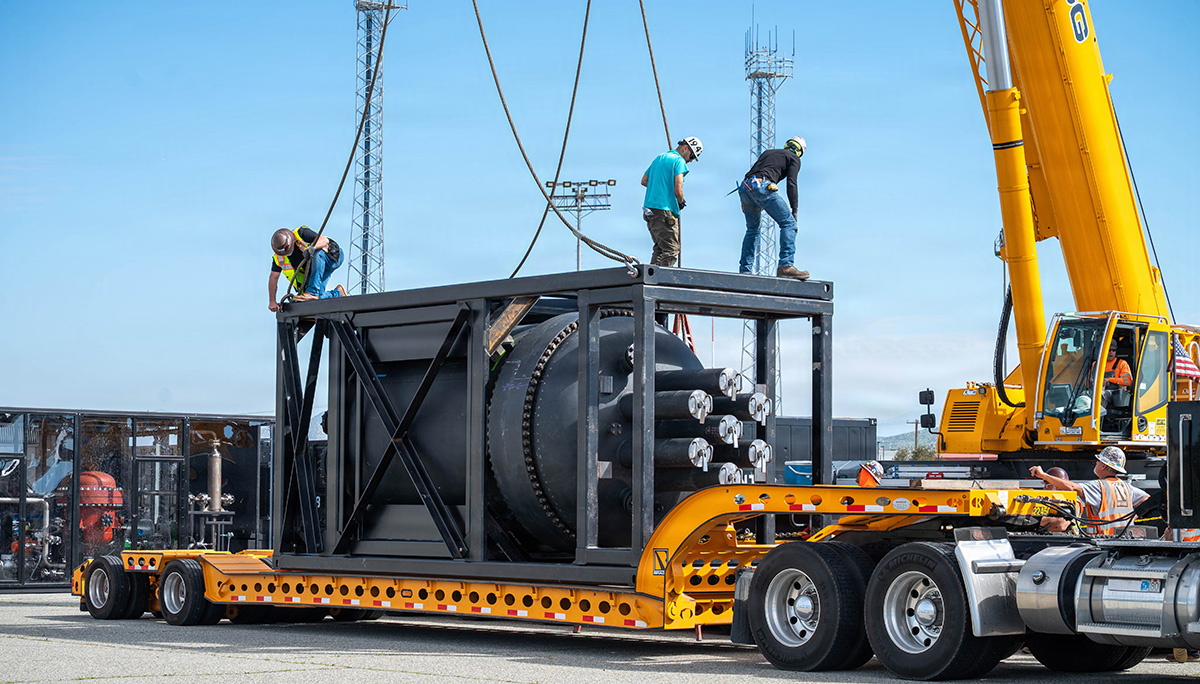
U.S. Air Force personnel, including reservists from the 419th Fighter Wing, have supported the first military airlift of a transportable micro-nuclear reactor.
The operation, known as Operation Windlord, saw a C-17 Globemaster III deliver the containerised reactor to Hill Air Force Base in Utah on 15 February. The system forms part of Project Pele, a U.S. Department of Defense initiative to develop small, transportable nuclear reactors designed to provide power to remote or austere military locations.
Following the aircraft’s arrival, logistics teams including the 67th Aerial Port Squadron, 151st Air Transportation Flight and 75th Logistics Readiness Squadron were responsible for unloading and transferring the reactor. The effort demonstrated the handling of highly specialised cargo and the integration of reserve and active units in strategic airlift operations, according to the U.S. Air Force.
Tech. Sgt. William McCalmant, cargo processing supervisor with the 67th APS, said: “This operation is a prime example of how the Reserve is a day-to-day operational force. We’re not just training for a future conflict. We are delivering readiness and enabling the military’s lethality now, ensuring groundbreaking technology like this can be fielded safely and effectively.”
The microreactor, roughly the size of a standard shipping container, is designed with modular components and safety systems that allow transport by air, land or sea and assembly at forward locations. It is intended to reduce reliance on conventional fuel supply chains, which can be vulnerable and logistically demanding.










Now they just need to make it power the plane
What could possibly go wrong?
The US and UK tried that in the 1950’s. The Convair NB-36H was one such aircraft but projects ultimately failed due to massive radiation shielding weight, reactor safety concerns, and the advent of ICBMs
The last time the US tried that trick, it was cancelled by JFK to pay for the Apollo programme.
What do you do with the micro reactor when you pull out of the base in a hurry?
I could well understand the idea of using them on established bases as a power supply that was not grid connected.
I can also see why these might be a good idea to recharge vehicles in the field and with the battery physics round the corner these might well be needed sooner that you might think.
Certain elements can be injected into the system which poison the reactor, making the contents useless for anything other than making a dirty bomb. Anyone trying to make a bomb from it would probably die in the process anyway.
Absolutely true that the chain reaction can be poisoned.
As you say the issue is that it is still a mass or radioactive gumpf and that breaks the nuclear non proliferation treaties.
If I remember correctly the soviet union used to have a bunch of “nuclear batteries” to power lighthouses along there northern and western coasts. When the union collapsed they were just abandoned, luckily most are in the middle of nowhere.
They also have left a load of RORSAT reactor cores floating around in orbit that will come crashing back to earth in about 300 years.. right bunch of polluting shite heads the Soviets.
I remember watching a program on those things, all over the place in Russia powering out of the way stations and like you said lighthouses etc, all rotting away and just left! Russian infrastructure is and has been since the 90s is fucked.
Rolls Royce’s website has an interesting Advanced Modular Reactor a step down from the SMR at 25MWe. Could be handy for powercut-proofing bases, but a lot less mobile than this type.
Also, perhaps, surface ships?
25MW is an awful lot. OK 50% loss to turn into electricity.
Green fuel synthesis needs a *lot* of constant power at a level that solar and batteries can’t really supply.
It’s 25MW electricity, 75MW thermal which isn’t great efficiency. It’s hard to tell from the CGI but it looks about the size of a big house.
Reactors in that power range are competing with MT30 and the like.
Well if the output is 25MW electrical that really is a lot and is small town capacity levels but not peak levels. Would cover off ~7,500 homes. Augmented with a few containers of batteries it would cover off ~15,000 homes for the evening peak. This is always the issue with sizing power plant – the peak usage rather than average.
Although the waste heat can easily power a district heating system on a base so there will be substantial other benefits as well. No need to mess around with heat pumps etc.
The website’s here if you want to have a look for yourself:
rolls-roycecom/innovation/advanced-nuclear-technologies/advanced-modular-reactors.aspx
The industries listed as applications are quite telling: “Data centres”, “Defence”, “Industrial heat”, “Maritime and logistics”, “Mining” and “Remote Communities”. Anything that needs lots of cheap power that isn’t dependent on outside energy supply.
It becomes a lot more cost effective if there is a local use for the waste heat…….
That said are these things real or are they power point presentations?
The maritime thing is interesting as they could be pitching it as an MT30 adjunct…ie one MT30 and one of these for baseload.
Hah.. i was going to say, they just need to remember to take it with them when they leave