

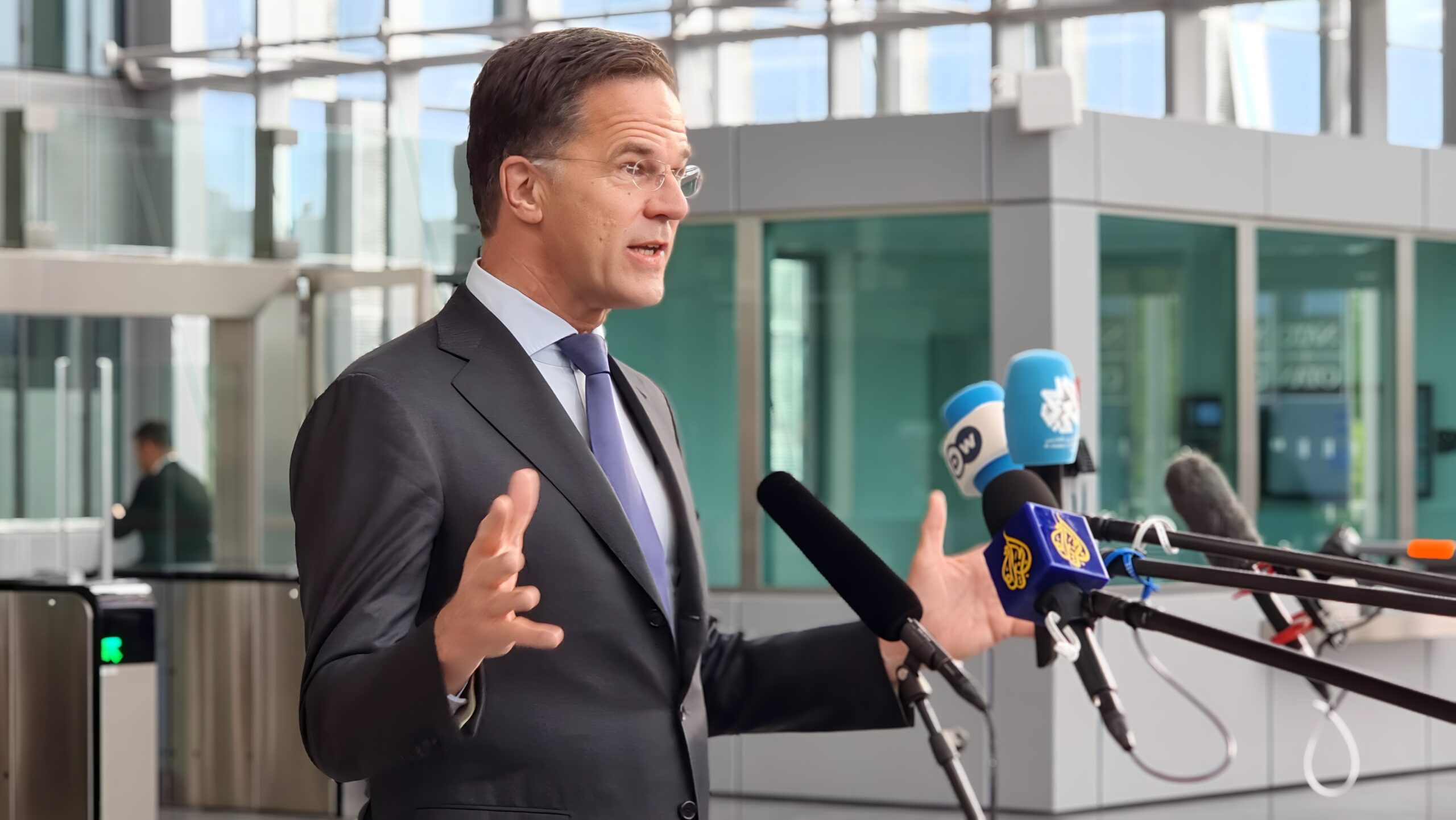
NATO Secretary General Mark Rutte has warned that European allies must urgently expand defence industrial production, arguing that while the Alliance can defend itself today, long-term deterrence will fail without significantly higher output across NATO states.
Speaking at the World Economic Forum in Davos, Rutte said the challenge facing the Alliance was no longer limited to spending targets alone, but increasingly centred on whether Western industry can generate equipment at the pace required to deter or sustain conflict.
Addressing questions over whether Europe could defend itself without the United States, Rutte rejected the premise, stressing that NATO remains a fully integrated transatlantic alliance. He said the United States and Canada are not simply security guarantors for Europe, but are themselves dependent on stability across the Atlantic, Arctic and European regions. “For the United States to stay safe, you need a safe Arctic, a safe Atlantic, and a safe Europe,” he said, adding that Europe’s security rests both on its own growing contributions and on the enduring transatlantic relationship.
Rutte declined to comment publicly on tensions surrounding Greenland, where recent political remarks have raised concerns among allies, arguing that public intervention would undermine diplomatic efforts. However, he acknowledged that the Arctic has become a central strategic issue for NATO, with increased activity by both Russia and China. He noted that seven of the eight Arctic states are now NATO members and confirmed that Alliance ambassadors agreed last year to strengthen collective defence in the High North, describing Arctic security as increasingly inseparable from Euro-Atlantic stability.
Turning to defence spending, Rutte argued that political pressure from Washington had forced long-delayed European decisions. He said it was unrealistic to believe that many European economies would have reached the 2% GDP benchmark without sustained US pressure, and suggested the same applied to current plans to raise defence spending significantly higher. While acknowledging that these comments may be unpopular, he said the effect had been to force Europe to confront the reality that it must assume greater responsibility for its own defence, even as the United States maintains substantial forces on the continent.
Despite this, Rutte stressed that money alone would not solve NATO’s readiness challenge. He warned that defence industrial capacity across the Alliance remains inadequate, pointing to examples of allies being forced to procure equipment outside Europe and North America due to production constraints. “We are not producing nearly enough,” he said, arguing that both military and civilian industries must be prepared for rapid expansion in a crisis. He contrasted NATO’s position with Russia’s war economy, noting that Moscow is devoting around 40% of its state budget to defence and sustaining losses that would previously have been considered politically impossible.
Rutte said NATO is capable of defending itself today, but cautioned that readiness in the coming years cannot be assumed. “Yes, we are ready today,” he said, “but we have to be ready in ’27, ’29 and ’31.” He argued that the decisions taken at last year’s NATO summit, including commitments to higher spending and industrial expansion, were essential not because of political pressure from any one ally, but because adversaries are already planning against future NATO weakness rather than current strength.
Throughout the discussion, Rutte repeatedly returned to Ukraine as the central security issue facing the Alliance. He warned that political attention risked drifting toward secondary disputes while Russian missile and drone attacks continue against Ukrainian energy infrastructure during extreme winter conditions. “The main issue is not Greenland now,” he said. “The main issue is Ukraine.” He urged allies to maintain urgent military support, particularly air defence and interceptors, warning that delays in deliveries could have immediate battlefield consequences even as diplomatic efforts continue.
Closing his remarks, Rutte defended increased defence spending and military preparation as a necessary means of preventing war rather than provoking it. “If you want to prevent war, prepare for war,” he said, arguing that deterrence depends on convincing adversaries that aggression would trigger an overwhelming response. Without sustained industrial mobilisation, he warned, NATO risks appearing strong today but vulnerable tomorrow.






Rutte, his predecessor and the americans have been saying this for years. It’s pretty pitiful that it still needs to be said in 2026
Give’s Trump all the ammo he needs and finds him correct when he calls Europe weak or layabouts when it comes to putting all the burden on a handful of nations in the alliance e.g. USA, UK and France
The likes of Canada, Spain and Italy really need a foot up their arse in this regard
I think Canada has already had a pretty big foot up its arse in the last year or so, don’t you?
Well the thing is with Italy whos building the most major surface combatant’s in Europe ? Italy will have 21 destroyers and frigates in the early 30s.. even the U.S. will only have 90
Well considering NATO’s biggest threat is Russia and their Black Sea Fleet got humiliated by Ukraine who has zero major surface units, I think Italy investing in so many surface ships is a massive waste of money. The NATO naval presence currently in the Med is more than enough to counter whatever pitiful naval force the Russians could throw at them.
Wel Italy sort of understand that sea power is fundamentally important to survival..
I wish we did…..
Yes it would be nice.. I live in hope.
We’re not really pulling our weight in proportionate terms compared to e.g. Poland.
Wait for a huge missile attack then maybe something will happen.
It’s not often I agree with Trump – my personal opinion of him is about as low as you can ge. However, on defence he is right about one thing. We need to spend more. We also need to become more self reliant. Sadly, America is now part of the problem. Europe including the EU and UK needs to get it’s act together and fill in the gaps – quickly. There are many items of equipment we still depend on America for – need to develop our own sources. Not in 10 years, now.
Good luck getting Starmer to Boost defence the man’s simply not interested in defence .He often says the words more money in Defence since the end of the cold war but in reality he’s cutting ship, Aircraft ,AFVs etc .NATO Secretary shouldn’t bother wasting is time with Starmer and is government.
I hope Starmer’s paying attention 🤔
Does he ever speak Starmer I wonder? In a collection of laggards we are rapidly becoming the worst offenders.