

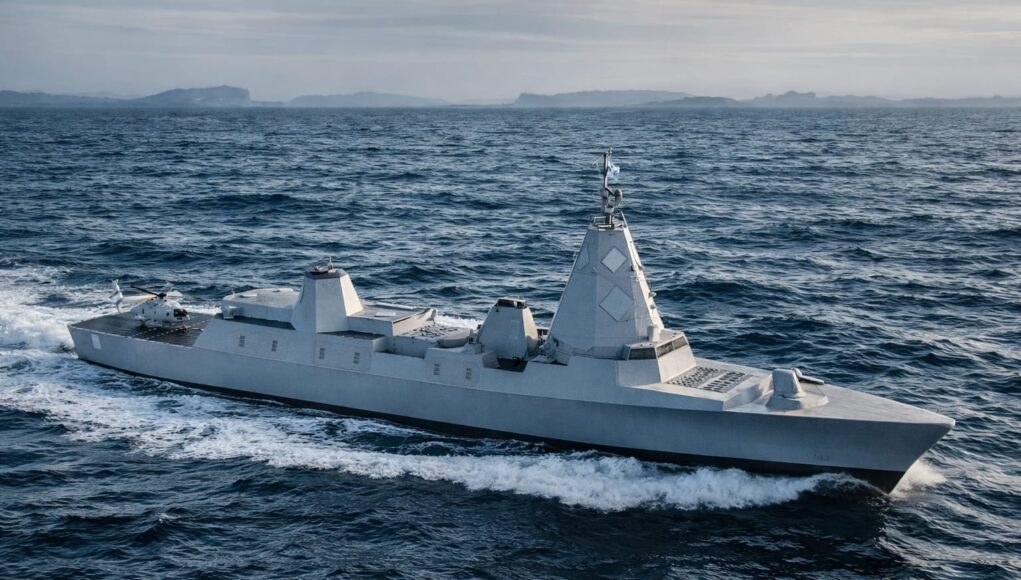
The Prime Minister has said he is insisting there be no delays to the future Type 83 destroyer programme, amid concerns that budget pressures could disrupt momentum in the UK’s shipbuilding sector.
Responding to questions from Labour MP Patricia Ferguson, Keir Starmer said “I do not want delays, and that is why I am insisting that there should not be any delays in the order.” He added that “it is really important that those orders continue in the way that is expected,” signalling an intention to maintain continuity in naval procurement.
He linked the issue directly to the industrial base, stating “shipbuilding is obviously hugely important in Scotland,” and highlighting the recently secured Norwegian frigate deal, which he said would provide “at least a decade’s worth of work in Scotland.” He added that he had visited the Clyde to engage with the workforce and demonstrate that “there is more work in the shipyards for them and for the next generation.”
Starmer also framed shipbuilding within a broader strategic context, noting that the Norway agreement “ensures that there is interoperability between our frigates and Norway’s frigates,” which he described as “an increasingly important part of the strategic work that we are doing.”
On export opportunities, including a potential Danish order for Type 31 frigates to be built at Rosyth, the Prime Minister confirmed the UK was “working very hard on it, including at leader level,” adding “I very much hope we can make progress.” He pointed to existing agreements with Indonesia and Norway, as well as defence cooperation with Turkey, as examples of a wider approach that combines industrial output with closer military integration.
He said such deals are “not just the orders but how we integrate and work strategically with our NATO partners,” underlining a shift toward deeper interoperability and coordination across allied fleets.
Pressed on how to balance exports with domestic fleet requirements at a time when the Royal Navy is under strain, Starmer said “we need both, and we need to get that right,” again emphasising interoperability. “The fact that we and Norway will have the same capability… is a really big step forward,” he said, arguing that standardisation across allies improves operational effectiveness.
He added that lessons from Ukraine had exposed the limitations of fragmented capabilities, stating that “by having different capabilities over the years… it has been more difficult than it otherwise… should have been,” and that he was seeking to improve “co-operation and co-ordination” across European partners.
On wider defence infrastructure, including Faslane and Lossiemouth, Starmer said investment was “kept under constant review” and described maintaining the UK’s nuclear deterrent as “the first priority.” He reflected on a recent visit to Faslane, describing it as “a very humbling experience,” noting the demands placed on submarine crews and their families.











The RN have set out a Hybrid Navy strategy.
None of the vessels set out in that vision are T26, T31, or T83. Why does the MOD insist on just buying newer versions of the same type of equipment despite the environment changing. If you want medium and large uncrewed vessels, build those. Build for tomorrow, or even today’s conflicts, not yesterday’s.
Wdym? Type 83 is at the centre of the hybrid navy concept. Manned ships are still needed to coordinate unmanned ships.
Hybrid navy? Ridiculous yuppir speak. The navy is an organisation that exists to fight and not jolly around to put fires out in every shithole on the planet. The expeditionary mindset should be abandoned and a return to the ability to wage war with the numbers and quality it needs drones and unmanned this and multirole that? Can we defend the nation? We cannot until the gaps are filled
Good.
Now show us the money. T83 cannot be frittered away by making FADS all about the fads.
T83? I’m not convinced that I a new design from scratch is the best way to go. Id like either a batch 2 type 45 or the T26 in a destroyer configuration. The production line drumbeat is already in place after aircraft carriers destroyers are probably the next most expensive item in a fleet inventory. The navy must have a decent order size. Life extension for the type 45 should be in place already. They are not old ships.
The T45 still have loads of life left in them. It’s better to push the T83 program and get a couple more T26 built instead. The can still do spiral development on the radar starting with the type 91 sloop and develop a land based equivalent to SAMP/T.
Don’t you need to keep the design skills alive otherwise it dies. Same with advanced radar. Unless the Country is happy to buy a foreign system. The knock on from gapping it would be huge and risks a T23 situation as T45 age and fall apart and no replacement in place. The T45 are likely to be very busy it the world’s situation stays tense.
Top tier land and based GBAB is going to need something more advanced that Aster NT ( 1500km range BMs) if weapons aimed from the mid east are to be countered.
I honestly don’t much about a ships life expectancy other than what I read on sites like this and NL, but surely the type 45 should have plenty of life left in them considering how long they’ve spent sitting in port. Isn’t HMS Daring close to 9 years? So I’d quite happily take a couple more type 31’s with there smaller crew size that wouldn’t cost the world their budget, And make sure with the extra time they design the type 83 to be not just one of the best AAW ships but an all round capable warship ASW and land attack. And if at all possible more than 6.. as proven of late that is simply not enough.
Ships still age, Daring has sat there, rumours of parts being stripped. Hull plates degrade in water. What was the original build quality? Are Bae likely to say yes to a life extension then ramp up the costs? They have form for ripping off the taxpayer.
The question still remains what do you do with the architects, and radar specialists?
Samson will need to be kept current, that’s more money when flat arrays in a bigger mast appear the better option and one every ally is going for. Hypersonic mean constant look radars not a spin every second , else why are future plans of all other navies for fixed panels?
Keeping T45 in service is a gamble and I would bet it costs more in the long run than building newer , more modern warships
Type 31 is a ship for lower tiered combat. It’s lack of sonar or a dipping helo means it also would need money spent on it . Yes we should build more for some missions, and a more capable batch 2 makes sense but 6 AAW destroyers isn’t enough
They should build T83 with some overlap for the remaining T45.
They need to decide what the replacement for Aster will be ( or larger bodied development) and what the UK BM defence looks like and plan a ship big enough to take it.
If costs need to be contained , then work with the Italians?
Type 45s for the next 3 to 4 years will take on the bulk of the escort duties and will be harder worked as there is so few of them. The treasury haven’t cottoned on the buy less then the faster they wear out, typhoons will be the same issue, there are very few doing a lot of flying.
Aster 30NT block II can deal with anything fired from the Middle East (MRBM)
All the T26, T31 and T83 need to get et all their mk41s, missiles and radars allocated before any T91s. Instead of T91s why not go with more T31s or some AH120s?
We need type 91 due to a lack of man power. We can also make type 91 more cheaply. Due to being unmanned it can be made to civilian standards making it considerably cheaper.
Can it now?
So it doesn’t matter if T91 is a one hit wonder that goes to the bottom with £100m of missiles on a £200m barge?
There is attritable and there is attritable and there is stupid…..so building to a purely civil spec with no redundancy is stupid….but the further you go to MILSPEC the more expensive they will be….you will respond ‘defensive weaponry’ which is fine but that needs to be part of a survival fabric which includes BDR.
The type 45 should be able to go for extra years, but even if Type 83 isn’t moved to the right it still will deliver later than planned, it’ll take longer than expected to design and build, due to its likely cost, construction will be spread over as many years as possible like with T26 to reduce in year costs of the program, so allowing it to slip at all now will just increase the risk of gapping or need expensive refits for the T45s. Look how much was spent on lifex for the T23s since 2014, that would have been 3/4 extra type 31 if replacements had have been done in a timely manner.
Make a destroyer variant of type 26. By the time the current planned ships are built this will be the on time and on budget solution.
As I understand it, that’s what Canada is doing.
I am talking about the concept where they made a 96 mk 41 cell vls variant.
Ah, the Canadian ship has a 24 MK41 cell vls
Well, we will hold you to your word Sir Kier. The problem is that there is no money, even less with the increase in the price of oil and gas. There are reports that Heidi Alexander is hoping to save £billions by lowering the target speed requirement for HS2. Hope she succeeds. I’ve also heard that Reeves agrees privately with pragmatic people in the conservative party that the Office of Budget responsibility borrowing rules are unnecessarily restrictive. If she (and Milliband ) could stomach a portion of humble pie, borrow and drill a bit more and given a bit of luck with export orders we might navigate our way to a DIP that’s affordable and acceptable 🤞
The problem is more borrowing is totally non-feasible. Global bond markets absolutely hate gilts owing to years of fiscal and monetary incompetence and every time more spending/borrowing is announced, there is a measurable uptick in yields. Now knocking around 5% gross redemption yield on the 10 year, way beyond any of our peer economies and totally unaffordable at scale. As restrictive as the OBR may or may not be, they are not the important factor here. Forget borrowing
Its a question of spending priorities, the defence uplift is there, its contained within the ‘vast’ welfare budget.
Labour simply won’t go near that, so we are facing a continued decline in our Armed forces.
Most would agree with you Levi. It’s all above my pay grade so I have to trust our elected representatives. I suspect that the reason the UK pays more to borrow is simply that we cannot feed ourselves and are completely dependent on selling some manufacture or service ( even our universities), simply to eat and keep warm. Social unrest is always just a whisper away. Orwell’s 1984 started when you had to key in your reg number to park – arriving after having driven over roads that are disintegrating. Pat Macfadden outlined a strategy for addressing the core problem – a decade long trend of increasing %age of able people not in work. Good luck reversing that. As my grandmother said, you can take a horse to water but you can’t make it drink. Faith in the UK, is conspicuous by its absence, in more ways than one.
Why then is the Bank of England engaging in quantitative tightening again this year? The markets don’t want it, the Chancellor doesn’t want it. According to Andrew Bailey the BoE are doing it to create headroom for more QE later. How about not doing that and spending money on Defence instead?
Debt interest alone is 120bn per annim. Debt is what got us into this mess in the first place. The entire Western system is one giant debt fuelled bubble, particularly the US. Growth in the money supply will eventually lead to the greatest crash ever, its on the way regardless of if they can kick the can down the road further.
We don’t need debt, we desperately need economic growth.
Fiat money was a great idea, people tell me. Donald Trump portrait commemorative gold nickels and dimes could be a good investment.
This idea of drilling a bit more would be nothing but a pr (mythical one at that) job. There would be no actual benefit in any short term way if at all. We need gas if anything and the North Sea has never been a great gas store, it’s running out we haven’t been self sufficient since the turn of the Century. As for oil forgetting its technical make up, the companies would need to get a very beneficial tax agreement to open new wells, which as tax is our only actual benefit from a commodity sold on the World market could limit further our benefits. North Sea oil is such a tiny percentage of the total it won’t bring down World prices. People talk about Norway upping its output and exploration but firstly it uses very little itself, for example it’s totally committed to electric vehicles and secondly from what I’m reading most of the new output and exploration is now in the Arctic high north, not available to us in our sector. I have never been against more output from the North Sea but in my view only if it directly benefits us as it did Norway with its Sovereign Wealth Fund or feeding directly into Britain and used for out benefit but that simply isn’t going to happen or can’t happen now. So the idea of drill, drill, drill is for the most part a con that will not be of any sovereign benefit even if politically as policy cutting off the option of new licences wasn’t in my view sensible in itself. The biggest concern would be if new policy now would con the public for popularity purposes while delaying the move to shedding ourselves of reliance on fossil fuels. The main reason for the cost of our energy was a mad rush for gas powered power stations so we could dump coal and nuclear. The latter was a big error and will take years to now partly reverse, and costly. Again ludicrously and by historical design, electricity is priced on gas because fossil fuels were predominantly once used to generate it and gas was plentiful and cheap. That has to change for a start, Spain doesn’t do it that way. Sadly however decisions made 3 decades ago have trapped us now, especially as along he way no Govt read the runes and changed things just doubled down of erroneous thinking.
So what you are saying is that Millband is right snd the only useful thing we could do is break the link between electrycity pricing and gas prices? I think that’ liberal party policy.
The link between solar/wind generation and gas pricing is for the birds. Pure regulatory capture.
I fully agree with getting rid of that linkage and instead contracting at some sensible rates.
I what’s going on is that Reeves prefers to keep things the way they are and collect the tax from the excess profits of the energy companies. I suspect that breaking the link would disproportionately benefit above average income households who have been able to afford insulation, PV panels and heat pumps.
Huh. Isn’t that the other way around? Breaking the link would reduce electricity prices, benefitting the people who use the most electricity.
Drilling for more oil won’t help us NOW, it’s true. But that is the excuse they used in the USA who are now a net exporter of Gas and oil because (with a few Presidential deviations) looked at the long term and went ahead anyway. Same with rare metals. Mining won’t help NOW but if you press on and plan ahead it will in the future. Apart from anything else, what has the Govt got to lose? They get a bit of cash and the Oil companies carry the bulk if not all of the cost of exploration. If they strike gold, good for them and us.
Same principle with the T83. We all know how long it takes to select a new ship let alone build one. We need to start the process now to have any chance of having them available when we need them in 15-20 years time.
To be honest there are some easy no pain wins really..if anyone was willing to tell people this is what is needed.
1) as you say drill more oil and gas to sell
2) decoupling the wholesale price of electricity from gas ( as it’s only about a quarter of generating capacity but LPG dictates the price)
3) scale back HS2 and focus on its ability to increase rail capacity not speed.. nobody gives a shit if they arrive in Birmingham 30 mins quicker.. in the 21c we have zoom meetings.
4) make the pension means tested.. not brutally but in the same way they did child benefit.. if your a higher rate taxpayer that year, you don’t get a state pension payment that.. over 1 million people get a state pension paying higher rate tax..also graduate up to the higher rate.. thats more than 10 billion a year now.. more in the future.. don’t keep upping the retirement age.. we are living longer but we are not any healthier after 65 and don’t keep the pension restricted..
5) different fiscal rules for capital investments.. investment in infrastructure and wealth creation must happen you cut that you cut the future.. a big part of the issues we have with our state now relates to the impact of 16 years of austerity on capital investment.
6) some things cannot be private.. if it’s a natural monopoly and fundamental to the state it must be owned by the state..the private sector only works if there is choice and a market to sustain choice and competition.
Just FYI HS2 is about capacity as much as it’s about speed. It was designed explicitly to reduce congestion on the ECML, especially around the choke points North of Birmingham and leading into Manchester. As for scaling back, there’s virtually nothing left to scale back, all that remains thanks to the conservatives, is the leg from Birmingham to “near London.” At least it’s looking like Labour is scaling it back up and expanding Euston to take HS2 trains now.
While speed isn’t the be all end all, it still is important if you are a) going to be competative with driving, b) when you look at the actual plans for HS2 beyond Birmingham where it not only would have been competative with cars but would have started to be competative with short haul air travel within the UK. Even if you are a science denier and don’t give a rats ass about climate change, there’s a ridiculous number of flights from London to places like Newcastle and Edinburgh which *should* be going over to international flights.
It’s more about the 80/20 rule with speed, the present speed requirement is well in the 20 bit.. if they scale it down to the 80 it will be better.. to me it’s better to go 80% on speed and actually link all the northern cities.
That’s not what’s happening though. The speed requirement (I’d very much argue is not in the 20 bit, it’s needed to make the system competative, but that’s moot as you see below) is baked in now. HS2 Phase 1 is the only bit that is being built, the “Norther Cities” bit (Phase 2A, 2B West and 2B East) have all been cancelled and are simply not happening, even with a reduction in speed. Phase 1, from Old Oak to Birmingham and (fingers crossed) Euston, is under construction. A meaningful reduction in design speed would mean halting construction to go into another round of planning, and then restarting construction to a new plan, and if you think that will save money. Ha!
Instead we are now going to invest a shit tonne of money into a route that can support true highspeed rail and are saving pennies (nowhere near enough to fund any of the Phase 2 bits even if the government had the slightest intention of revisiting them) by operating trains at 125mph. This is ridiculous.
If I might dive in here…..
*If* HS2 speed had been lower from the start say 189mph would have been fine it would have been much cheaper than the 250mph chosen.
Why? Because the very high speed limited the minimum radii as well as increasing the size of tunnels to deal with the pressure differential. But also because of the required straightness of the track and very high imposed ground loading the route was totally constrained and so became enormously expensive to weave done the possible route avoiding the best represented NIMBYs which lead in turn to some enormously expensive engineering.
Yes, it would have been much better to stuck with HS1 speeds and the HS1 design and execution teams rather than start to design high speed rail like we’d never done it before.
The next issue was the build started before the scheme was fully bottomed out…
So I fully agree there are no worthwhile savings now as the costs are baked in.
By that logic, shouldn’t we have just created more slow line capacity and have taken all slow freight trains off the WCML? It would allow a significant increase in train density if all trains were capable of the same speed, in much the same way the London Underground works. If Dern is right about the choke points being North of Birmingham, couldn’t that still be done from Birmingham to Manchester at a much lower cost?
It is to do with a few other things too.
Firstly the maximum speed of WCML is 125mph (tilting) and 110mph non tilting.
The next issue are stations – as WCML is existing there would be a huge bun fight to reduce the stopping frequencies of the trains to make the running speeds higher.
Then there is the issue of the interlinking of the network as everything in the area connects to WCML.
So it was easier to make a new ‘super fast’ passenger service to remove the express trains to clear train paths on WCML. Now this clears more paths than you might think as the signalling is, I think, set out for 110mph running, from BR days, so 125mph running requires double blocking on the twin track bottleneck stretches. The intention of the originally proposed 140mph running was to change the signal blocking to 70mph spacings so that the line naturally ran at either 70 or 140mph – that of course never happened due to the demise of RailTrack.
Finally the alignments on WCML are from an historical patchwork quilt of line building so getting better running speeds on that is very very hard and doing anything about the bottlenecks is also really challenging – mind you if you did throw fractions of HS2 money in that direction it might be sortable with underpassing tunnels…..
Who knew you were a train spotter supportive..
Not really – I just sat in a few briefings before HS2 kicked off.
[un]fortunately I don’t forget much…..
The mess we see today was born out of really good intentions….
We could have a discussion about ‘moving block signalling’ but I’ve got a nice glass of red to drink….
Yes, and the same could’ve been said about loading gauge. HS2 could’ve been built cheaper to UK loading gauge and slower standards (not that anyone is suggesting that for anywhere north of B’ham of coures >_>) but it would be a shame.
I think the issue is running at really high speed makes sense if you are planning on running HS2 services to Manchester and then on the WCML to Scotland, which of course was the original plan. The returns only become diminishing when you salami slice the program down, and then, well you’re back to what we were saying, the costs are already baked in.
I’ve paid NI all my life and PAYE…That included my pension contribution..You can absolutely forget making it a means tested benefit ..More socialsist bollocks to pay for those that haven’t paid.
You paid for your parents and grand parents to have state pension not you.. the state pension is a benefit you can play it however you want.. it’s a benefit that’s paid paid to an ever growing population for an ever longer time.. as set up it was designed to pay about 15% of the population a pension until their median death at 72.. not almost 25% of the population till 82.. you cannot call making the state pension means tested socialist bollocks because the socialist bollox is universality in benefits..
Not a single penny of your (or mine) NI or tax contributions go towards your state pension. The state pension is paid by the current tax payer. It has always been like this, NI is simply another tax.
An income of £63500 means that you already pay tax equivalent to the full State Pension. Approximately 1.75 times median income
Yep and anyone who is clever makes sure a good portion of there retirement revenue is tax free..
But the reality is we simply cannot keep paying state pension to everyone it’s a zero sum game.. life expectancy increases and reduced birth rates has created a prefect storm.
The main reason for this is because we have increased life span, but not increased health life years.. this means essentially everyone is getting an extra decade.. but to give that decade we have to pay a fortune in healthcare costs as well as the state pension and care costs.. I did a little exercise and toted up the shares of NHS, social care and state pension as a percentage of GDP is about 11% of GDP.. that means 25% of all government spending is on the over 65s
The cost of the state pension in 1980 was 2% and the NHS 5%.. that’s when median expected life was 72.. now median expected life is 82 and we spend 5.1% of our GDP on the state pension and 11% of GPP on health care ( over 40% of that is on the over 65s… someone in their 80s costs the same as 7 working aged people healthcare wise).. by the 2070 the state pension will cost over 8% of GP even when they have shifted the retirement age to 71… that is both wrong and unsustainable.. and god knows how much the NHS will cost when the over 65 population is 27-28% of the population and average life expectancy will be 87…by 2070 it’s likely close to half of all government spending will be be on the health social care and pensions of the over 71s ( poor bastards will not even be classed as old until they are 71)… and at present we are not making any headway on healthy life years.. so everyone will be on benefits before they retire..
Unless we can have a rational conversation that goes away from the the “it’s my right, I’m owed it” we are as a nation screwed.. it’s not our rights we payed national insurance so our parents could have a pension.. our children will pay far more for our pensions and our healthcare..
Ah yes the west is billions in debt and spending billions on repayments. Dont think borrowing more is a good idea
Cutting speed requirements for HS2 is the height of stupidity. First of all, the line is in construction. If they think they’ll save any money by stopping and going back to a design and consultation phase, and then restart building to a lower spec they’re out of their minds.
Also hamstringing the project into oblivion.
As I understood the article the cost reduction argument was subtle. It wasn’t to be achieved by changing the ‘spec’ of the track, but rather found by eliminating the cost and delay of a test track that would be need to be built or hired to test the trains at the target HS2 speeds. These it seems, are higher than the continental ‘norm’. The proposal, suggested by Mark Wild, head of HS2 would reduce the top speed from 360kph to 300kph, HS1 speed. Earlier implementation is part of the cost reduction calculation.
That’s even stupider. Like this is momunmentally stupid.
We are paying for a geniuine high speed line, and high speed trains anyway, and we are now pinching pennies on a test track to further hamstring what’s left of this project.
Well, the detail calculation of the savings is known only to Wild and Alexander. I can see both arguments but politics and other commitments play. If its case of 186mph not 225mph and completion 5 years earlier versus 5 more T31s I think I would go with the frigates. If the track build is future proof and its only the testing phase of the project then you could in theory come back and upgrade later. ( Uncle…I know they won’t :-)). Back of a fag packet the higher speed saves about 6 minutes Euston to New Street.
You said yourself you know they won’t.
This is unbearably stupid.
It has already been ‘descoped’ from 250 -> 225mph.
The question is can they start running the trains at 189mph which can be tested on HS1 and then move testing to HS2 track which means the first year or so of running on HS2 is 189mph and then it moves to 225mph once the testing is completed.
If it fails, that might be too late to do anything. But I’d be okay with that.
189mph running would be no disaster and would make no perceptible difference to journey times over 100 miles. Even at that speed 40mins non stopping is quite realistic allowing for a comfortable acceleration and deceleration.
The bigger problem is that, as ever in the UK, we are adding stops to a super express service – honestly we cannot help ourselves. Which of itself deryors the point of super high running speeds.
Euston -> Old Oak -> Birmingham Interchange -> Curzon Street which is just loopy as the train will only get up to any kind of speed between Old Oak & Birmingham Interchange which is all of 90 miles.
👍🏻
We also all know how it will really turn out, they’ll reduce the speed to save money but the project will still cost the same or more than before when it had a higher speed target.
So many construction projects get delayed due to cost, they rarely actually go down by the time it is delivered and end up costing the same or more even after value engineering but you end up with a lesser result. HS2s main issue is the sheer time it’s taking to deliver with inflation increasing the cost year on year.
The real main issue with HS2 is that both parties have knee capped it to the point where we are paying “revolutionaise rail transit in the UK” prices for a stump that will provide no benefit.
Both parties? Labour haven’t had anything much to do with it, how could they at this point?
Labour haven’t had as bad an impact on HS2 as the conservatives, but they’ve absolutely done their fair share of kneecapping, such as letting the powers for aquiring land north of Birmingham lapse, which means that future HS2 light plans such as what Andy Burnham is suggesting, have become much more difficult to execute.
👍🏻
It’s penny pinching, to save costs on testing the trains. The line has been built to run the trains at the specified speed and frequency – the highest in Europe. By running the trains more slowly, you then need to buy more trains in order to deliver the capacity required. HS2 was built because of capacity bottlenecks on the WCML.
Surely, the capacity issue is substantially addressed by building the additional HS2 route ?As to the capacity of the HS2 route itself, I’m no expert in queing theory but I would guess a difference of 5 or 6 minutes at most in the Euston – Birmingham journey time won’t make a lot of difference.
Only partially. Capacity is dependent upon time taken on the journey. If you slow the trains, you need more trains to transport the same number of people.
Yes, you’re guessing.
Or fuller trains.
I think passengers would complain at seats being removed to squeeze more in on a standing-only service…
Well, as I understood the article the proposal would mean HS2 London to Brum would get finished years earlier by removing a substantial task from the gannt chart with a marginal knock on impact ( negligable?). Neither of us knows what the savings would be or how the politics get spun. We just have to assume that Wild does and offloads the decision to the minister and the cabinet. Impressive to see lots of expert posts though.
Well there’s your problem, not having any knowledge about this other than the above article. 🤷🏻♂️
All it removes is the testing of the new trains at the speed HS2 is built for.
That’s all.
Yes, but the effect of doing that must be economically and politically material. Otherwise the Minister for Transport wouldn’t arrange to let the idea be known?
Politically it makes sense to float any ideas of doing anything to reduce the cost of HS2.
Economically it’s bonkers.
Alas economics and politics don’t always align. For example, a major reason for the massive cost of HS2 is simply to placate NIMBYs, by putting it through tunnels and cuttings more than is necessary.
The class 895’s that will run on HS2 already have higher capcity than a lot of trains on the British mainlines, eg the class 810’s that EMR recently bougth are 120m long and have a capcity of around 300, while the 895’s are 200m long with a capcity of 500, and are designed to be used operationally with two sets coupled together for a 400m long 1000 seat train.
The capacity issue isn’t so much about seats though as about trains (although yes there is a lot of pressure in terms of seats too on the WCML). It might sound counter intuitive, but think about how you can’t run a express train for people who want to get from Brum to London at the same time as a halting service, which might seem abstract but if you live in Rugby or Milton Kenyes is not so abstract. And that’s before you remember that the UK operates a mixed network where freight also has to be fit around services.
The sad fact is that the main benefits of HS2 where around alleviating bottlenecks around Crewe and Manchester, as well as tying in with NPR to provide the North with some actually decent rail connectivity, and all that’s been cut away and Labour have no intention of restoring any form of it.
Morning, interesting info on train units. Thx. When I wrote the first post it wasn’t my intention to kick off a detailed discussion on the UK network; routes, bottlenecks, technology: but it’s been an education. I was simply pointing out the efforts the govt were making to find money – hopefully for defence. As regards labour’s policies for rail I would have thought that idealogically they are in favour of a good national rail network service; public transport in general in fact. But who knows, times change.
Which it does nothing to address as HS2 stops before the bottleneck…..
Wrong. There are three bottlenecks:
• Rugby to Nuneaton
• Shugborough Tunnel/Colwich Junction
• Winsford – Weaver Junction
HS2 will address the first, but since it’s cutting not the latter ones.
Showing how stupid a decision it was to scrap the Birmingham to Manchester section.
Addressing one of three bottlenecks doesn’t achieve any significant net improvement as the other two bottleneck still control the absolutes traffic volumes.
Except you’re assuming HS2 is the only remedy to the bottlenecks, whereas it’s possible to address some of them by improvements: eg £85 million was spent in 2024 on improving Colwich Junction to reduce the bottleneck.
And while the bottlenecks north of Brum aren’t addressed by HS2, it is the Euston to Birmingham part of the WCML that is the busiest part of the route.
Andy Burnham and co where fighting for a plan to basically do HS2 2a and bw light.
It would have been sad, because it would have had UK instead of European Loading Gauge, which would destroy any future proofing, and be built to 125mph standards, and we’d then be stuck with both, but hey, at least it would have helped the bottlenecks.
It would’ve been a good Plan B compromise.
Personally I think they should have reformed planning permission for infrastructure of a strategic/ national importance, to slash the number applications, both outside and inside of the HS2 Act (known as Schedule 17 submissions).
After doing that, I would have pressed on with HS2, as designed, at full-speed, to Manchester.
100% agreed on full speed to manchester. Going with UK loading gauge or lowered speed to manchester would just bite us in the arse in the future.
Also Gareth Dennis ripped into this
https space ://www.youtube. space com/watch?v=ZyhatpeBsA8
PM insisting no delays to Defence Investment Plan, oh, wait, Type-83 Destroyer now.
Starmer insisting there won’t be delays. There isn’t even a finalized design, yet so talk of delays is meaningless. If BAE is to build them, T26 orders mean construction work can’t start until after 2035 at the earliest. If T83 can built at the same pace as later T26 models, the earliest in service date would be 2040.
Every new piece of equipment is more complex and expensive than its predecessor. Unless we break that pattern, even a modestly increased budget will only deliver smaller numbers.
Our leaders, political and military, seem incapable of recognizing that and keep repeating the mistakes of the past_
Aircraft carriers too big and expensive for the aircraft numbers we need or can afford
Submarines bigger and more complex than needed with AUKUS looking likely to be even worse
Unproven power system on destroyers that have kept them out of service for years
10 ton tracked reconnaissance vehicle replaced by a 40 ton platform that doesn’t work properly..
These failures are not due to lack of funding but poor initial decisions.
I wonder if the start point of speculation of delays to T83 is more about T45. The latest out off service dates I’ve seen for T45 are 2035-2038. Given that they won’t all have finished PIP and the weapons upgrades until around 2030 and, as you say, the BAE yards will be producing T26 through to almost 2040, that doesn’t seem sensible. Maybe somebody mentions moving the T45 out of service to the right and it gets interpreted as cost-saving delays to the replacement?
It always annoys me when it’s sad that QE and POW are expected to be in service for 50 ytears,yet,designed to have a fast production rate is vital can’t design other ships that are able to last as long.. why not? How much consideration is put into the project development? Remember starmers TWELVE Submarines pledge? That was pure bullshit and everyone knows it. He and the CIRCUS OF A GOVERNMENT IS NOT GOOD NEWS. For the navy no matter how you dress it. The MOD is unfit for purpose and should be replaced by a new organisation. Until there is clarity and commonsense l, and no dusty, crusty admirals air marshals and generals cluttering the organisation.the ingenuity,and the ability to innovate and put into practice new ideas and things which has been lacking for too long.
Or 12 now then.
.
.
I call BS
Or 12 now then.
I call BS
Show me the money…..
Well we can all trust his word there will never be a U turn so thats is that issue firmly sorted until at least next week.
“Ensures that there is interoperability between our frigates and Norway’s frigates”, which he described as “an increasingly important part of the strategic work that we are doing.” As I understand it, one of the projected 8 Type 26’s has been / will be passed over to Norway leaving only 7 for the RN. One wonders whether “interoperability” will be used as an excuse not to order a replacement for the RN. There were going to be 12 Type 45’s, then it was 8 and finally six.
8 for the RN has been repeatedly confirmed.
Their ships will effectively become our ‘expanded navy’ in reality. You can see the cogs ticking over and the pr machine working out the message.
Stop spreading disinformation.
The RN have ordered 8, and are getting 8.
The Norwegian T26s are in addition to the above.
Sounds positive, but there’s always a but and a doubt, isn’t there.
Does that mean tens of billions lost from other programmes HMG refuse to fund?
It’s got to the stage so many simply don’t believe a word these people say any more…including me.
I’ll wait for the DIP and all the positives in it, Mr Starmer, excluding all the re announcements, spin, and programmes kicked so far down the road the next government pays for them, leaving you to sternly criticise any cuts from the opposition benches.
An old trick.
Yes?
Hi M8, If you have the patience and can resist the temptation to throw a brick at your TV, I highly recommend watching the session Starmer had with the Commons Liaison Committee yesterday (it’s on You Tube). It was pretty brutal at times and shows just what an Odious Little Snake he is, the 2.7% of GDP by end of this Parliament was mentioned as was 3%by end of next one.
So not good news, but they did actually get some info out of him, the DIP is finished and it’s sat on his desk and it’s going to be his decision as to how it goes.
I now have a lot of respect for Tan Dhesi Singh who is the Chair of the Commons select committee for Defence, he just kept on digging till he got some sort of answers. Odd thing was he was one half of a “Good Cop, Bad Cop” double act with Sir Geoffrey Clifton-Brown (chair of the Public Accounts Committee) it’s quite entertaining watching Starmer squirm.
Hi mate.
No, I’d get too upset.
Starmer nauseates me, he has no interest in defence, only his and Labour’s agenda.
I’m surprised he knows what T83 is.
I think he’s slightly more clued in than people give him credit for. If you were battling over the DIP for this long, I think you’d also get quite familiar with its contents 🙂
Any good lawyer is up to his neck in rewrites of the small print. Or in this case the big print no doubt. 🤓
As Sir Humphrey always put it ‘get rid of the difficult bit in the title; it does less harm there than on the statute book.’
That is why it is called Defence Investment Plan – that is the closest you will come to an uplift in investment!
If you look on SPF I linked the actual questions and answers when Starmer was in front of the committee. He sounds a lot more knowledgeable and direct than most people give him credit for, the level of obfuscation is better than I expected.
Have you actually watched it? It’s on You Tube.
No, I don’t have the time.
Lots more umming and ahhing?
More nothing words from our Dear Leader.
To my mind, “The fact that we and Norway will have the same capability… is a really big step forward,” means he (or more likely the Treasury) thinks their three T26 plus 5 for us will be enough.
At that Liaison Committee meeting, Starmer also said that the DIP was on his desk awaiting his decision as to whether to side with the MOD or the Treasury. I can’t see any such decision happening before the May elections, and if they go badly for Starmer, which is likely, he could be even more beholden to the left or fighting for his career. Either way, that’s bad news for the DIP being published. I’m now thinking autumn at the earliest. I’ll be delighted if I’m wrong.
There was that purdah mentioned, which suggests if it’s not very soon, it will have to be after the elections. What seemed to be holding things up was a way to pay for it using current rules, so he could tell parliament it’s fully costed. They all seem obssessed by that these days, although it’s killing the economy. So he’s dependent on the Treasury to come up with something to help Defence out. I have to agree with you, that sounds like later rather than sooner to me too.
Last year Gordon Brown (Mr. Prudence himself) said that the rise in Defence spending should be treated as exceptional, as it has been in Germany, and that it shouldn’t be subject to Rachael Reeve’s fiscal rules. This doesn’t seem to have gone down well with the current government, or they’d have already issued special defence bonds.
He’s a lawyer and a politician with a track record of deception and U turns. His word is valueless.
That’s the only thing you can count on. Make a lawyerly statement people take as a promise, then 180 it, and give people a new BS Story. UK now in the worst place possible until tomorrow when its even worse.
So we have no plans to delay, but still have delays to the plans. No DIP and Type 83 not yet out of Concept. Of course there will be delays, and we’ll get statements about how the first ship was never supposed to become operational when the first T45s went out of service. We have to ask are they planning on Lifexing the T45 or gapping again.
Pick a nice, safe project a looooong way out to demonstrate your commitment to the Royal Navy, knowing there is absolutely no chance of this coming back to bit you on the arse.
LOL.
Not to be overly pessimistic, but it seems Starmer said he doesn’t want any delays to the order, not the actual delivery of the destroyers. We know how much the MoD love to drag programs out to spread the cost.
Recent events have show that the claimed readiness levels for RN warships were no-nonsense – the 50% at “high readiness” (i.e., operationally available in 10 days or less) proving to include warships that were in or needed a maintenance period.
Nevertheless, with PIP finally winding down and the frigate force barely able to cover the TAPS/FRE roles until the early 2030’s – the T45’s are set to become hard worked. Hopefully we will see the traditional model of two fully operational T45’s (CSG or otherwise deployed), two on trials/training/workup/assisted maintenance and just two in refit/capability upgrade. The upgraded T45’s are very capable units but the RN (and even the PM?!) now knows all too well the dangers of trying to push a hull beyond its design life, even if it has spent years just berthed alongside in Portsmouth.
Sounds right. Both could be true though. I listened to her today replying to a question on the subject. I understood from her answer that she thought she wanted to target relief with the tax she collected rather than let all ( mostly high income?) customers benefit from cheaper prices.
Well this thread was completely detailed by HS2 🤣😂. Who would have thought there was such passion about trains in the UKDJ community.. maybe a HS2 update article is needed.
Are you kidding? We spend all day arguing about what kind of propulsion plant or weapons delivery platform a ship will have, and you thought there wouldn’t be an interest in trains???
Trains, ships, tanks, planes, it’s all exciting stuff.
The Neurodiverse, Train, and Military Enthusiast ven diagram is just a circle.
You could even say “derailed” or “sent off track” both in a good way. Enjoyed reading everyone’s post. No such HS trains yet here in Aus yet but they’re talking about Newcastle to Sydney to Canberra then with extensions north to Brisbane and south to Melbourne.