

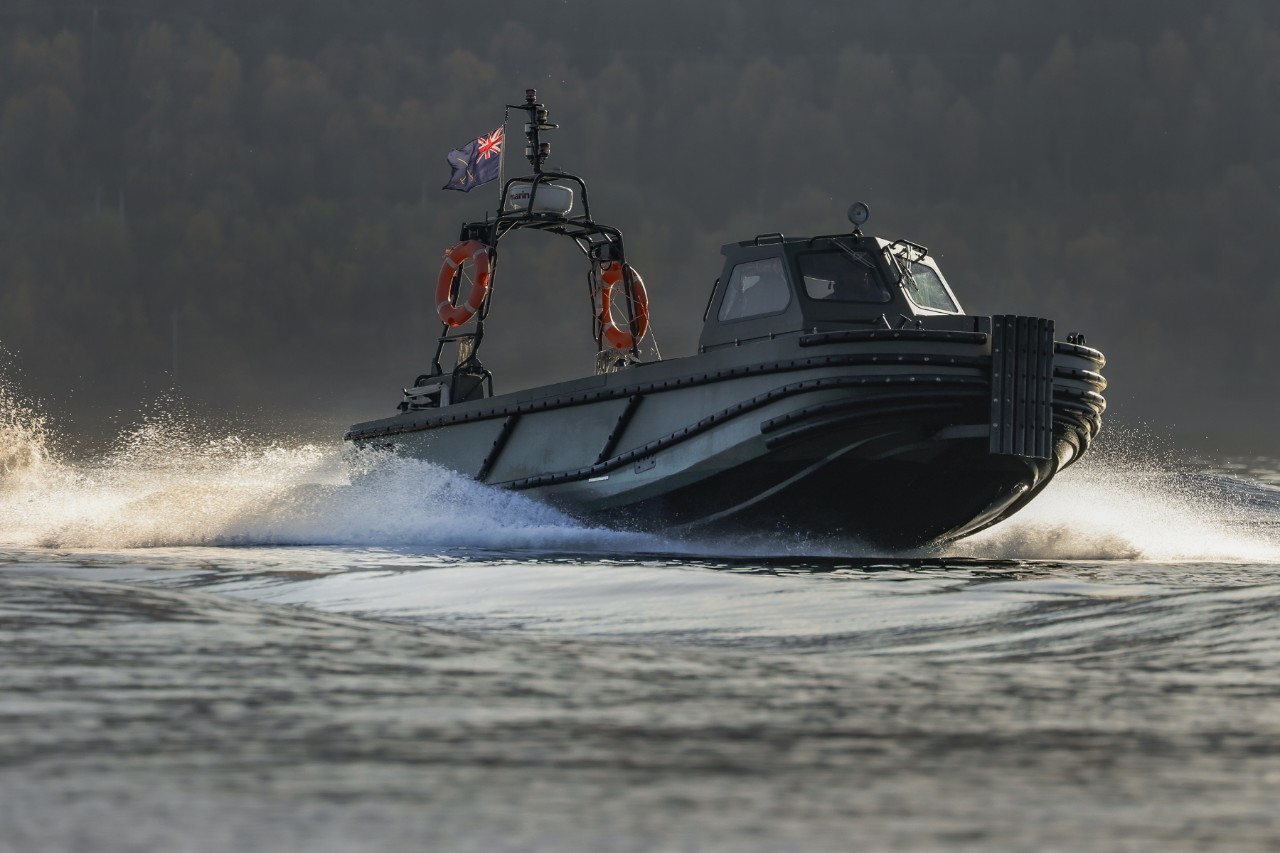
Serco has been awarded a seven-year contract to provide in-service support for the British Army’s fleet of 512 marine vessels, according to the company.
The agreement will see Serco support the Ministry of Defence’s Boats Team across a range of activities including maintenance, repair, spares, trials and associated technical services. The contract is due to begin in April 2026, with work carried out at sites in the south of England.
The Army’s marine fleet is used to move troops, vehicles and supplies during ship-to-shore operations in a range of environments, forming a key component of the Army’s amphibious and logistical capability.
More than 140 Mexeflotes will be supported under the contract. These modular platforms can operate as powered rafts, pontoons or causeways, and are widely used to transfer vehicles and equipment from ship to shore where port infrastructure is unavailable.
Also included are 18 Combat Support Boats, which play a central role in bridging, amphibious manoeuvre and diving operations, alongside Army Work Boats that enable fuel delivery to deployed forces using dracones.
A wider range of smaller and specialist craft will also be maintained, including Gemini 650 rigid inflatable boats, hard hull riverine craft designed for shallow water operations, lightweight assault boats and Avon Redcrests.
Serco said the contract reflects its experience in defence engineering and asset management, particularly within the maritime domain.
Anthony Kirby, Serco Group Chief Executive Officer, said: “We are proud to be supporting this specialised fleet of marine assets, which are vital for operational and strategic effectiveness and personnel deployments on coastal or near-shore environments on behalf of the British Army and the Ministry of Defence’s Boats Team.”
He added: “Military preparedness is a key priority and our success in securing this contract reflects the strength of our expertise and capabilities in defence engineering and asset management and builds on our recent strong momentum in the defence maritime sector.”


512 seems a high number, as does 140 plus Mexefloat, considering that the Bays only carry 4, I think?
Even adding those with 17 and 165, a decent number for a change?
I thought there’d be more than 18 CSBs.
Propaganda mate, believe nowt.
Maybe mate….maybe…I’d guess the vast majority are Avon Redcrests, which I thought would be a type of bird with a name like that!
So, a dinghy.
I’d like to see a full breakdown by type.
Reminds me of a time I saw online, easily over a decade ago, one DE&S document that listed the varied types of boats and riverine craft existing across all three services, it was an eye opener, more than I thought. It listed the DE&S IPTs supporting them, and the list even included various ID acronyms of the elements within UKSF who use them.
Which I then went and worked out most, it wasn’t hard.
Not a list that was probably meant for public consumption, but it was interesting how many types and numbers there actually were.
I’ve still got the list.
Oh there were loads of different kinds l am sure. Like 82 when every armoury was raided for MGs to go south. Some of the contents were just ancient and amazing.
Seen some of those stories of what was in the old Depots on here.
Lots cleared out post Cold War, if we believe all the official accounts.
Some areas, i’m not so sure, but I’m a nosy so and so who looks into stuff and heard some interesting things.
But yes, overall, from the old MAFF Depots to the GGs to the RSGs, all gone.