

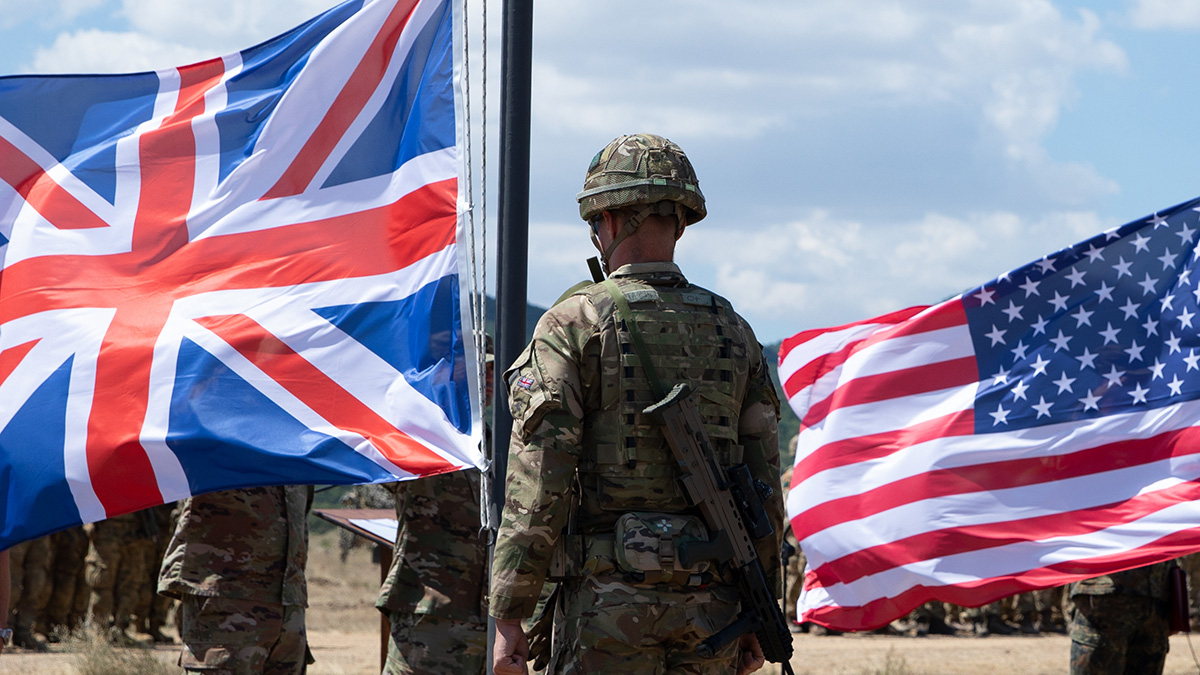
In a 13 March op-ed for UK Defence Journal, I asked: ‘What next for the UK–US special relationship?’ Given recent events, the more pressing question now is whether it is time to rethink it.
Since then, President Trump’s open and repeated criticism of the UK has continued. He has moved from saying he does not need the Royal Navy, or other allied ships, to help open the Strait of Hormuz, to requesting support, before subsequently dismissing British aircraft carriers as ‘toys’.
The President has also threatened to walk away, saying what happens in the Gulf doesn’t affect the US and others can sort out his mess. He continues to denigrate the sacrifices of the UK and allies in Afghanistan and Iraq.
But it is not only him. His closest advisers, including the Vice President, Secretary of Defence/War and Secretary of State, do the same. All also continue to perpetuate lies about NATO and how allies have never come to the support of the US.
Anyone who knows their history knows that is patently untrue. The only time NATO’s Article 5 has ever been invoked has been by the United States after 9/11. The US didn’t come to the UK’s (and Israel’s, incidentally) support in Suez (leaving aside the legitimacy of that conflict as well). There are valid questions about US support for the UK during the Falklands War (certainly the US Ambassador to the UN, Jeane Kirkpatrick, did everything she could to support Argentina).
At the same time, the President has lifted oil embargoes on Russia and Iran (the country they are at war with!!!). Logic, reason, good sense, and support for allies do not seem to be characteristics of this administration. And it is going to take a long time for the US to win back what it has lost in a heartbeat.
And it is notable that those in UK politics and on social media who were screaming the loudest, demanding that the UK support the US in a conflict we were not consulted about and do not agree on the legality of, have now gone somewhat quiet. That is unsurprising, as the economic impacts of the conflict are really beginning to hurt the UK. Oil, petrol, gas and electricity prices are on an upward spiral. But things have the potential to get much worse.
If this conflict continues, food prices are also on an upward curve. Farmers I know in the UK are already making clear that this will be a result not only of the increase in fuel and energy, but also of the increase in fertiliser prices. Things have the potential to get much, much worse. All as a result of the decisions of the US and Israel, apparently without any real plan or thought of the longer term.
But what of the Special Relationship?
As I said in my previous piece: ‘In reality, there have been questions around the nature and strength of the “Special Relationship” for many years, from many US administrations. Some of those are good questions focused on the UK’s unwillingness to spend on defence or step up on the right occasions. So, let’s not believe these questions are new ones.’
When I was working on Iraq, there were occasions when folks in the State Department and Department of Defense questioned the UK’s ability or commitment to that conflict. They would often talk about what we did (or didn’t, in their view, do in Basra). That led to some fairly heated discussions (which I was part of) about the UK ‘cutting and running’. So let’s not get too starry-eyed about this relationship.
Maybe all we are seeing now is a more brutal and open explanation of what many in the US think, and have thought for some time: that the Special Relationship is only special to the US if we do what they want, and that UK concerns play very much second fiddle.
Maybe President Trump and those around him have done us a favour by making so clear the disdain in the US system for the UK.
Disdain which is not wholly unfair.
The UK slashed defence spending at the end of the Cold War to ensure there was a ‘peace dividend’. Despite claims from governments ever since, our combat ability on land, sea and in the air is significantly less than it was even 10 years ago.
We do not spend enough on defence because, in many ways, it is unpopular with an electorate that wants to see better social services and a better NHS, for example. And successive UK governments have prioritised such spending over defence spending, comfortable in the fact that the US would always pick up the slack.
That cosy little belief has been blown out of the water by the Trump administration.
But, as I say, maybe they have done us a favour. Maybe it is time for us to get the message that if we want to be taken seriously, we need to act seriously and spend to develop some real capabilities. To maybe realise that our future lies with Europe on defence, not an unreliable and untrustworthy US.
Brexit has also weakened us financially, economically and politically. One of the key aspects of the Special Relationship was the fact that both the US and mainland Europe saw us as a bridge and conduit to the other. We voluntarily removed that and therefore reduced our value, especially to the US.
Time for us to therefore accept that our relationship with the US is no different to that of any country, figure out what we are going to do with our European neighbours, who are closer to us now in terms of values, and up our defence spending. The Special Relationship is little more than words under this administration. Let’s accept that and figure out what we do next.
This article is the opinion of the author and not necessarily that of the UK Defence Journal. If you would like to submit your own article on this topic or any other, please see our submission guidelines










The special relationship has been a one way street for quite a long time. It existed under Thatcher and Regan. But since then it’s really not been special. The UK no longer has the economic clout to produce a military force sufficient for overseas adventure. Defence review after defence review always focused on the appearance of power projection without the actual ability to deliver. The MOD wastes money on r&d for projects we can never afford to continue the false impression that we are a tier one military. That stupidity seems to be ever growing. It’s time to get back to basics. Stop the dreaming, determine exactly what we need our armed forces to do and make sure it can do that. We have relied too much on trading space for time. Our adversary needs to cross Europe etc. The primary focus should be on the defence of this island first. If France invaded tomorrow how long would we last ? A few days ? Build fortress UK first. Real air defence capable of extending engagements lasting months. Real artillery numbers real infantry numbers. It’s nice to have an aircraft carrier and as we do have overseas territory we do need one. Do we need 2? Probably not. Once the UK is secured then and only then should we be considering power projection. It’s time to admit we are no longer a great power and focus on realistic and achievable objectives.
We certainly do have the financial clout to spend 3.5% on defence in a sustained manner. Our governments have simply chosen not to do so, while they spend ‘vast’ sums of money on welfare, litteraly paying hundreds of thousands of super morbidly obese people to get bigger … And give them mobility cars, to get about in!!!
We have millions of people utterly dependent on State handouts that quite simply can’t be arsed to work….
We need to take billions from that broken and bloated mess of a system and divert investment back into defence.
As we push into defence growth and reinvestment, we need to be razer focused on providing the right equipment to the armed forces , in a timely manner.
If the government insists on feeding the money into the UK MIC at any cost, then the extra financing required, ( compared to a viable and affordable COTS solution) should come from the DTI budget, not the defence budget.
If they carry on insisting on propping up the likes of Italian helicopter companies, then let another department pay the tab for political decisions.
Spending more is useless if the money is wasted. The UK does not have a spending issue, it has an efficiency issue. Which is why France achieves more with less budget.
If the UK had the french efficiency with the same budget as today, the Royal Navy would definitely be fixed, all 6 T45s would be operational, T26 would be in service already and HR and maintenance issues would be a thing of the past.
And then the surplus budget vs the french would be used to acquire more stuff rather than endlessly plug the multiple drain holes with expensive tape.
I agree with much of what you say Fereh, the money is spent poorly.
Much of the UK’s military procurement is politically mandated, over the actual Military preferences and as a result, costs a great deal more.
All is not great in France however, the French government have effectively collapsed the Franco German fighter project, due to French insistence on having the lions share of the project.
Dassault has cut off its nose to spite it’s face and might well have seriously damaged it’s future prospects as the rest of the world pushes forward into Gen 6. The reality is, with only French money to finance a fighter project, it will likely be far less ambitious, as the required funds simply arn’t there.
Even if France can generate partners for the project elsewhere, they are now falling behind, as GCAP and F47, plus the numerous Chinese projects rapidly gather pace.
Likewise, the French Navy accept a lower spec from it’s warships and submarines, smaller displacement and generally less capable, but with a primerally Mediterranean focus, thats perhaps not a particular issue.
The French military lack any heavy lift helicopters and the Tiger is questionable to say the least.
There is no special relationship.
Tell the Americans to do one and build indigenous capability AKA, ”Hi NHS, we need the money for something more important.”
Couple that to a message to the British public that they have to start manning up and losing some fat – note to self – do more exercise.
Paul Kennedy wrote in his 1986(?) book, the Rise and Fall of the Great Powers how the military industrial complex so bankrupts the Country that the Country falls apart from within, the US is on that death spiral, and China may not be that far behind, pootin is holding on but ultimately, Russia faces the same fate and India might wish to cash in but, demographics are working against it.
England should strive for a 360 defence capability that can influence national interests: PARA Bde with Royal and frigates but we need to stop the bollards on special relationships, especially America – we have always been a something to be put down by America and ridden over rough shod, let’s realise that and adapt to the new reality.
Unfortunately, to stip US equipment for UK and other partners collaborative efforts would take a defence budget of 6+% for decades.
Its all doable, but the cost will be absolutely astronomical.
Replace Trident D5 with a Franco British SLBM, one that will work in the Dreadnought common launch silo, is that even possible???
That alone would be many billions to develop.
C17, Chinook, Posiden, E7 all these have to go with viable replacment…
Then there’s US military satellite and intelligence sharing, etc, etc, etc….
Its a vast, expensive and daunting undertaking.
As a former avid reader of Tom Clancy, I’ve always liked your name 😉
The US star is waning and will either slowly atrophy or on current form, implode given the current; ahem’ leadership. That should be a warning to us about two issues:
1. A NATO ally was denied resources and intelligence at a critical juncture in a war with an openly belligerent, anti-NATO power – Russia; it rather raises the prospect of should one get on the wrong side of the US Administration, one could suffer the same fate.
2. Those resources will simply become unaffordable for the US to produce as their economy goes into a nose-dive, thus denuding us of those resources.
We really need to come up with a credible Plan B that does not out-source our defence to an unreliable ally.
I don’t disagree with you mate, im just pointing out the ‘vast’ cost and daunting nature of decoupling ourselves from the US military umbilical cord.
I do think the US has proven itself to be an increasingly erratic partner, you can say, ‘well it’s only Trump’, alas mini me Vance seems equally erratic and would pick up that baton and do God knows with it!
The days of true statesman like Reagan and Bush Senior are sadly gone, they have been replaced with reality TV stars, Trump rattles on for the cameras, just making shit up as he goes, before saying precisely the opposite, occasionally in the next sentence.
I often wonder what Bush senior would make of it, he would probably say in that great Texan accent of his, ” you elected this idiot” !!!
There are no breaks on him and it would appear, nobody in his administration able to get him to take a pause and think.
He’s surrounded himself with yes men and many are starting to wonder about his sanity.
There is no special relationship because the UK does not want to hold up its end of the bargain it’s time for the US to take its missiles back. there never was any special relationship. The US just tried to prop the UK up after the disaster of world war II. And the failure of the empire. Trident needs to stay back in the US where it was developed And the UK never actually had a true independent nuclear program. And don’t tell anyone about that. The Goofy UK nuclear program pre-World 2 . That’s the biggest fantasy thing that’s ever been propped up
So you’re Russian then Rayski?
Slightly overplayed your hand there Comrade, I hope they don’t cut your vodka allowance.
I’m not sure, that you are not wrong 😉
Take care!