

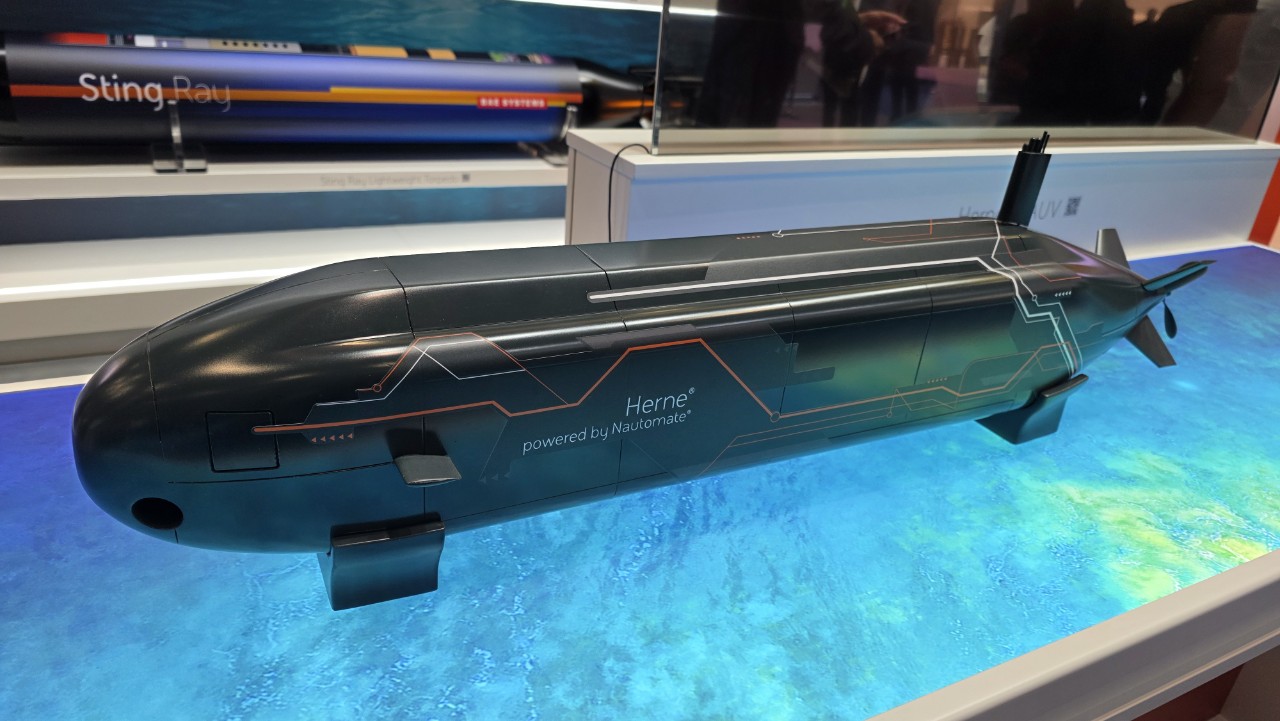
BAE Systems’ Herne extra-large autonomous underwater vehicle is being positioned to become the first platform of its kind certified under Lloyd’s Register frameworks.
Developed as an extra-large autonomous underwater vehicle, Herne is designed for extended operations with a modular architecture that allows payloads and mission systems to be adapted as requirements evolve, with BAE Systems’ Nautomate autonomous control system underpinning its operation.
Lloyd’s Register is leading Herne through certification against its Unmanned Marine Systems (UMS) Code, alongside classification under its Submersibles and Diving Systems rules, in what is described as a first-of-kind process intended to establish a recognised assurance pathway for large uncrewed submersibles.
The approach is designed to move autonomous underwater systems beyond experimental use by providing a structured and independently verified route to safety and reliability, with Lloyd’s Register stating that the framework delivers “a robust and structured pathway to ensure the safety and reliability of large uncrewed submersibles”.
If successful, Herne is expected to become the first XLAUV certified under the UMS Code and the first uncrewed submersible classed under the SDS rules, setting a precedent for how future platforms are assessed and approved.
The focus on certification reflects the unique challenges of operating underwater, where platforms cannot rely on conventional sensing such as radar or optical systems and instead depend on sonar, inertial navigation and advanced algorithms to interpret their surroundings and avoid hazards.
This places a greater focus on software assurance, with autonomous decision-making required to function reliably in conditions of limited sensing and high uncertainty, and with Nautomate progressing through Lloyd’s Register’s software conformity assessment as part of the wider certification effort.
Nick Martin of BAE Systems, commenting on the programme, said assurance is being embedded from the outset rather than treated as an add-on..
“Assurance must be designed in, not added on,” he said.
He added that independent assurance frameworks are essential to scaling autonomous systems beyond bespoke deployments, noting that clear and repeatable standards will be required if such capabilities are to be adopted more widely by navies.
Interest in these kind of systems is, clearly, growing, with industry and operators seeking to extend reach, persistence and flexibility in increasingly contested maritime environments, and with certification increasingly seen as a prerequisite for operational use rather than a later-stage consideration, this is a good step forward.


A fleet of these plus a few SSK would make a good basis for protecting our undersea infrastructure
Herne the hunter?
I suppose the key question will be can it deliver an effector. It’s all very well have the most wonderful sensor web in existence.. but when the button is pressed for war can it fire an effector.
Exactly. Unmanned subs are (clearly) the future of ASW in my opinion, but it is only really useful if it carries the threat of even a single lightweight torpedo.
“Exactly. Unmanned subs are (clearly) the future of ASW in my opinion, but it is only really useful if it carries the threat of even a single lightweight torpedo.”
If the problem of communication under water isn’t fixed i don’t think they will be.