

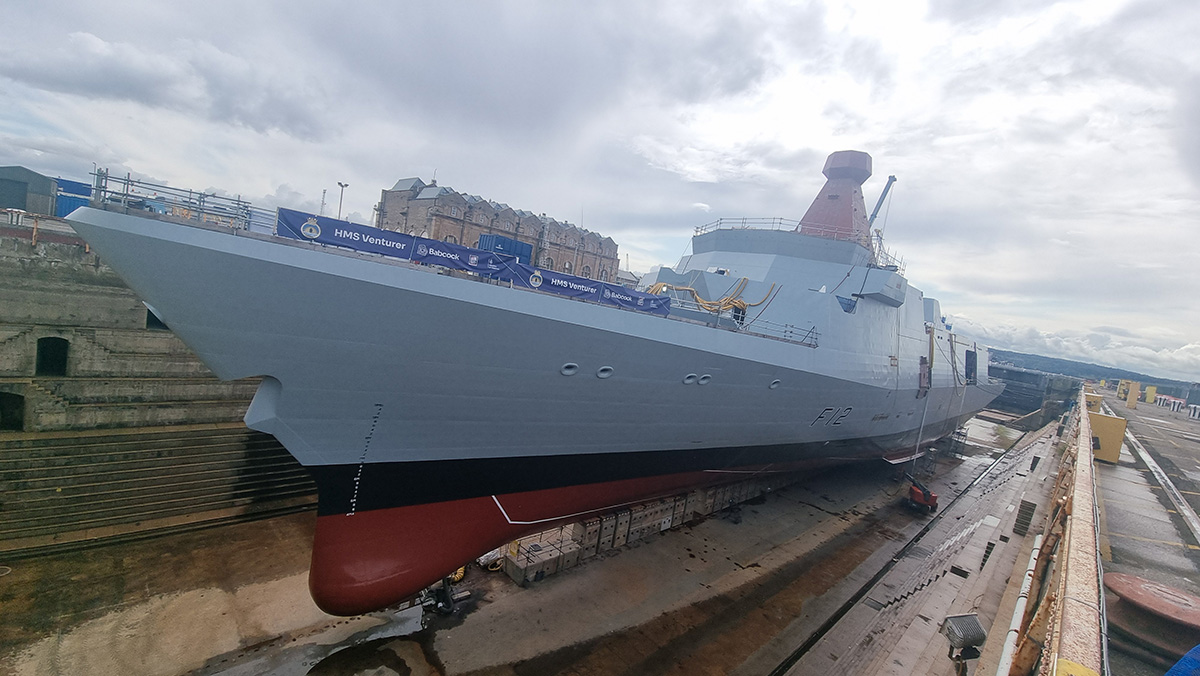
Babcock has reported a GBP 140 million charge on the Type 31 frigate contract after higher than expected rework levels during the outfitting and commissioning phase of the five-ship programme.
Babcock International has posted a £140 million charge against its Type 31 general purpose frigate contract, attributing the cost overrun to design changes and the consequences of out-of-sequence build activity earlier in the programme.
The company floated the first two ships during the financial year ending 31 March 2026, laid the keel of ship three, and formally commenced construction of ship four. However, as structural completion of the lead ship progresses, rework requirements during outfitting have proven more complex and more costly than anticipated, with knock-on effects to ship two also identified.
Babcock said the number of rework events was not entirely unexpected, but that their occurrence in the later stages of completion increased both complexity and cost. The company has completed an engineering maturity review and updated its estimates to complete the programme, incorporating higher production costs and an increased risk contingency. Around £100 million of the charge will be recognised as a revenue reversal in FY26, with the remainder added to the contract loss provision. Cash costs will be spread across the remainder of the programme.
Ships three and four remain in early construction, and Babcock said the extent of impact on those and subsequent vessels was comparatively reduced.
Here’s the full statement:
“During the year we floated off the first and second ships in the five-ship programme, laid the keel of ship three and formally commenced the build of ship four at its steel cutting ceremony.
As we finish structural completion of ship one, the bulk of the remaining work now relates to outfitting and commissioning. During the outfitting stage we have experienced higher than expected levels of rework as a result of changes to the design and the long-term impacts of out-of-sequence build activity earlier in the programme. Whilst the number of such rework events is not entirely unexpected, the work is being performed in the later stages of completion and therefore is more complex and more costly. The ability to enable the work to be performed to support increasing levels of programme productivity has also been impacted. As the build of ship two is close behind ship one, there is also some cross over in the design-related rework necessary to this ship. With ships three and four still in the early construction stages, the extent of impact on these and future vessels is comparatively reduced.
As a consequence, we have performed an engineering maturity review, and we have updated our financial estimates to complete the programme, given the elevated levels of work due to engineering change and productivity. These re-estimates not only cover the production costs of material and personnel, but also an increased programme risk contingency.
This is reflected in an expected charge on the contract (subject to audit) of £140 million for the revised costs to complete delivery of the Type 31 design and build contract, which is fully recognised in FY26, but the cash costs of which will be incurred over the remainder of the programme. We estimate c.£100 million of this £140 million will be recognised as a revenue reversal in FY26 with the balance increasing the contract loss provision.”
Despite the Type 31 charge, the broader financial results for FY26 point to a business in strong underlying health. Excluding the charge, Babcock reported underlying operating profit of £433 million and an operating margin of 8.2 per cent, ahead of its 8.0 per cent full-year target. Revenue reached £5,273 million, representing organic growth of 10 per cent at constant exchange rates, driven primarily by Nuclear and Aviation.
Nuclear was the standout performer, with revenue growing 14 per cent to £2,070 million and underlying operating profit rising 23 per cent to £197 million. The division’s margin reached 9.5 per cent, meeting the Group’s medium-term target. Aviation also delivered strong results, with revenue up 34 per cent to £431 million, driven by the ramp-up of the Mentor 2 programme in France and a helicopter emergency services contract in British Columbia.
Beyond the financial results, Babcock secured a series of notable programme milestones during the year. The company signed a Letter of Intent for two further Arrowhead 140 frigate licences for Indonesia under the £4 billion Maritime Partnerships Programme, and expanded its partnership with HII to manufacture complex submarine assemblies at Rosyth for the US Virginia Class Block VI programme. In civil nuclear, a joint venture between Cavendish Nuclear and Amentum was selected as Owner’s Engineer for Great British Energy’s first small modular reactor project at Wylfa, a contract worth up to £300 million over 14 years.
Underlying free cash flow increased significantly to £262 million, and net debt fell to £329 million, giving a gearing ratio of 0.2x. The Group completed a £200 million share buyback in April 2026 and has announced a further £200 million programme to commence alongside publication of its full year results.
Babcock said FY27 expectations remain unchanged, with around 70 per cent of forecast revenue already under contract. The company reiterated its medium-term guidance of mid-single digit revenue growth, an underlying operating margin of at least 9 per cent, and operating cash conversion of at least 80 per cent.
Full year audited results, delayed by the Type 31 restatement, are now expected in late June. Harry Holt, who succeeded David Lockwood as Group Chief Executive on 1 April 2026, will join the Board in June.




If only we had more companies like Babcock.
I’ve gained $17,240 only within four weeks by comfortably working part-time from home. Immediately when I had lost my last business, I was very troubled and thankfully I’ve located this project now in this way I’m in a position to receive thousand USD directly from home. Each individual certainly can do this easy work & make more greenbacks online by visiting
following website—.,.,.,.,.—>>> JobatHome1.Com
I am a bit confused about this.
Are Babcock “writing down” a loss of £140M against the company’s books, or are they expecting MOD to pay for this extra work because of “design changes”
I believe it was a ‘fixed price’ deal for the first 5 as far as the MoD are concerned. The capability insertions are a separate contract. So, Babcock are absorbing a financial loss into their accounts (thus reducing their profit and liability to Corporation Tax 😉).
Cheers Rob, that makes sense.
My interpretation of the corporate speak is they are booking the loss in the current year but expect to recover it from the MOD but it’s not guaranteed.
Yes, Babcock’s is taking the 140 million as a loss. Some will go against the company and some will go against the Type 31 program but that’s just internal detail. No expectation of being refunded by MoD or anyone else.
Some of that cost if not all is put down to assembly in the wrong order. The details of this and the blame are not disclosed. That sounds like a mistake that all involved are too embarressed to disclose. The mind boggles.
So rework during fitout isn’t actually unusual then on first and second ships of class? Just like the type 45s, oh and little dual fuel prototype ferries!
Which is why building small classes of ship is stupidly expensive.
#1-3 is a learning curve and #4 onwards are steady state.
So ordering 3 more *identical* T31 makes a lot of sense. OK you fit the Mk41 from the off but leave the rest alone.
Absolutely, if they concentrated on adaptable hulls that would help. The only problem with big ships is that it takes a much longer to build them. Lots of cheaper smaller ones spread around all the yards would provide some depth and less of a problem if one of the major ships is lost or out of service.
Utter rubbish. It’s been decades since the cost of a ship was considered proportional to its size.
What has proportionality got to do with it? Don’t reply in the absolute. Certainly one big ship will be cheaper than lots of others but that is putting all resources into one platform. Lots of smaller ships equals more resilience.
Is this about cost or effectiveness and survivability? In any event I wasn’t arguing about the cost at all.
You’re the one saying cheaper smaller ships are better. I’m just saying they’re demonstrably not.
No I didn’t say they were better. The problem with social media reactions is that people tend to go off half-cocked without actually thinking. In any event where on earth do you get your ‘demonstrably’ from? This argument is all about effectiveness, and a few high quality platforms are more vulnerable to loss than lots of large smaller ones. You only need to look at what is happening in the Straits of Hormuz! It may be that Iran’s larger capital ships have been sunk, but what about the huge numbers of smaller ones still reaping havoc? What I am arguing about is that lots of smaller patrol or corvette class ships are universally more useful and even expendable. Not to replace things like air defence destroyers or GP frigates but to complement and even protect those resources which were themselves intended to protect even larger ships. Swarming tactics can overwhelm large highly capable ships. We might have a few large and capable warships but they cannot be everywhere. If you wish to ‘demonstrate’ why your statement is ‘demonstrably’ true please do so.
Small ships aren’t better though. Tiny range, low power meaning poor radar. Bad reserve buoyancy and compartmentalisation making for poor DC.
Small ships are fine for an OPV, but when making escorts having 2 escorts that can’t actually sail where you want them to go, carry half the amount of weapons each and can only scan a quarter the area of sky isn’t helpful despite sending 2 compared to 1 that can actually reach the destination.
As for those swarming tactics, look at the ranges of those crappy drones. That alone makes them pointless from a RN perspective
Horses for courses.
For blue water expeditionary activities, yes larger is better. For aircraft carrier protection also.
But for ‘policing’ style activities, harassment operations small is much better.
Also one small ship can carry one missile. Lots of ships have lots of missiles. Lots of missiles in one ship risks losing the lot in one go!
Horses for courses.
The issue is the reason their cost is so low is they are taking most of their kit from the outgoing frigates. As there won’t be enough to cover another order, they would have to be added at full price for any subsequent batch. Hopefully still viable.
There were 13 frigates until recently…5 T31…. of the radars, CMS, guns are from the frigates….
Aren’t they also going to the t26?
ARTISAN is going to T26 but it may be that the enhanced ARTISAN is actually used on T26 there is no clarity on that.
The sonars were supposed to be transplanted from T23 -> T26.
4.5″ certainly isn’t being up cycled.
30mm may be being up cycled.
EO sensors maybe?
Navigation radar was I thought new issue.
So I am not sure what else there is to strip and reuse as GFE and TBH GFE almost always costs more than new.
What kit???? All the Type 31 major systems are different to the Type 23’s.
Don’t think the details have ever been confirmed, the order just states cost plus mod supplied kit.
To be fair the silo fit out of the t31 still hasn’t been confirmed. We know what the hull can take but not how many will be fitted.
The Different Kit from Type 23 has been known from day 1,there is no ambiguity.
To my knowledge there has been no official confirmation from the MOD or Babcock of what kit or at what base cost. So anything known is purely speculation / educated guesses.
Keep digging, I’m sure Australia is in sight by now.
I think an important reason the cost of T31 is relatively low is that the MOD adopted ‘ build to budget ‘ procurement rather than ‘budget to requirements’. So the ship is fitted with lots of COTS items: the guns, the radar, the diesels ( no gas turbines), the CMS, no sonar. This gave rise to lots of criticism of capability of course. Also, its likely that in morphing the Iver Huitfeld into the Arrowhead T31, designers took the opportunity to simplify the internals to reduce construction and maintrnance costs.
I don’t think the ‘internals’ were ‘simplified’. NL did an informative piece on this explaining how the design had to be brought up to UK MoD/RN survivability standards. This included increased compartmentalisation plus more DC & FF equipment.
Fair point. Optimising or customising might have been better choice.
Not sure if this will help Babcock get the NZ order but even getting a further one or two for 5+3+1+1 = 10. Offer to sell NZ number 5 and 10?
Which is a marvellous reason to get on with building another 5- economies of scale can be a wonderul thing. Pleases order a pair for the New Zealand navy as well.
Hope Babcock can keep its momentum going and land some new orders from Denmark, Sweden, NZ and maybe some additional for the RN. Good luck!
Hopefully it doesn’t involve us giving away more build slots like with the Norway deal.
At this point, it basically can’t – or there will be no navy to replace.
You think that will worry the government?
Where is this Government thou speaketh of, I ask?
Ah yes, silly me…🙃
I think the UK needs the economic benefit more urgently than the actual ships. So, I would expect the government would let others queue jump if they will get export orders. The cost of living is destroying the nation, the lack of frigates is not.
The cost of living “destroying the nation” is perhaps a bit on the strong side.
A navy that cannot deter a war with Russia however; now that has the capacity to destroy the nation in a much more meaningful and literal sense.
Perhaps, but the population are suffering en mass now. There is no kinetic attack now or ever from Russia. So, the economic problem outweighs the military kit problem easily.
It’s an easy rhetoric to spread, that war is the major threat. Poverty and the economy is the silent killer however, claiming and destroying lives on the daily… The job of the responsible is to balance priorities, which is reflected in the budget. The peace dividend saw the military threat degraded, which subsequently saw the defence budget decreased. Recent years the military threat has increased, and so the defence budget has grown.
Besides the threat of war is not so high even still, Russia knows it cannot beat NATO and will avoid that fight despite all its bluster. In the unlikely event of war following failings of their state, an entire allied continent separates the British Isles from the Russian Army and Air Force, and NATO and our navies can stay them easily from the North Atlantic. Britain also benefits greatly from its locale; the bulk of the Russian strike threat will have to clear NATO airspace and dozens of European nations to even have a chance at striking British soil.
Besides Russia has not even the ability to best Ukraine in a short war, in a prolonged war too they’ve not the economy to best even a single major European state let alone NATO combined. Russia is only a fraction of what the Soviet Union once was, and it spends on defence only a fraction of what the Soviet Union spent in the past. There simply is no credible threat there that can destroy or cripple the nation, to warrant such high defence expenditures as we have seen in the turbulent past. The current plans for the defence budget is more than adequate enough to ensure the safety of the British Isles… It is enough as well to muster an expeditionary capability too.
Good post Zue though I think most of us here woukd like a genuine uptake in UK defence capabilities.
I think you are naively wrong in your assumptions. Granted I also don’t believe Russia would initiate a full on invasion into NATO. But instead do lots of small incursions that have lots of deniability. Up to and including the scale of the “Green Men” invasion of Crimea. Where under the pretence of “Russian” speaking citizens being threatened or mistreated by Ukrainians. It used troops without any insignia to help support the local police in suppressing unrest. Bearing in mind there was no local unrest and the police were not under attack from mobs. But they quietly took over Crimea, then enacted an election for separation from Ukraine and “re-joining” Russia. Which with hindsight was a stepping stone needed for the invasion of Ukraine itself.
Russia uses a term called “Maskirovka”, which means misdirection, masking or disguise. They have used this officially in both politics and military matters since WW2. It is part of their doctrine. It was seen prior to the February 2022 invasion of Ukraine. Where they held joint exercises with Belarus and invited NATO observers to watch them. Whilst denying any threat to Ukraine.
The threat to the UK may seem far away, but with today’s technology it is now right at our door. The most obvious threat is from Cyber attacks. Where Russia along with other Nations, conducts attacks on the UK daily. You can also see this politically, where it is obvious that they have successfully campaigned to drive a wedge between the US and the rest of NATO. To such an extent that Trump feels that the US should no longer be a part of NATO, but perhaps more importantly may not support any Article 5 invocation.
Military wise, Russia does not need to have bombers in the sky, flying around Norway to attack us from the Atlantic. Nor does it need to use submarine launch cruise missiles at us. Instead it could easily hit us with the Oreshnik medium ranged ballistic missile. This has a “published” range of 3100 miles (5000km). Which means they can launch the missile from Kaliningrad, Belarus or western Russia and be capable of hitting any part of the UK.
The distance between Kaliningrad and London is only 880 miles (1417km). Which also means they could easily launch a swarm of Shahed 136 drones at us. These have a range over 1200 miles (1930km). Not to mention the ground launch version of the Kh-101 cruise missile has a similar range. So again they could be launched from Belarus and over the Baltic states.
This is not scaremongering, but a heathy recognition of Russia’s capabilities. We should not base our defensive capabilities or posture, on the premise that any attack must first go through our NATO neighbours. We our decision is based upon: “As the threat goes through their airspace, they will defend us!” Politics will not stop an attack, but try to sort out the mess following one. The invocation of Article 5, must first be put to a vote by each NATO partner. It does mean some members have the option of abstaining. But it does mean the voted response won’t stop an immediate attack, only what must be done following the attack.
To see how Russia could do a limited attack on the UK that tries to bypass NATO. Where their aim to substantially reduce out military capabilities as a form of punishment in supporting Ukraine. It would be good to watch/listen to the Wargame: A Sky News and Tortoise Media podcast series that simulates a Russian attack on the UK. The attack is legitimised due to a False Flag event. In essence there are four sides that take part, the UK, Russia, NATO and the US. The UK runs a COBRA emergency meeting following accusations made by Russia, where the PM is played by Ben Wallace, plus they have a number of ex-cabinet members from when Boris was PM, as well as an ex CDS and Foreign Office people. Whilst Russia uses the Maskirovka playbook against NATO and conducts a surprise cruise missile attack on the UK. What follows is very eye opening, especially how limited our response would be, but also how easy it would be to significantly reduce are military to almost ineffectiveness. The response is made worse by the internal politics within NATO and the US in coming to our aid.
Yes what is mentioned above is just a wargame, but there was a high degree of believability due to the actors who took part. But based on our then 2025 military strengths, readiness and capabilities, it highlights how precarious and threadbare our defences are, especially to a coordinated surprise attack.
interesting post Davey – nicely written.
Those medium ranged ballistic missiles would need to fly over NATO airspace to reach the United Kingdom, somehow evading the alliances various radars and interceptors and not provoking NATO wholesale… Same goes for their Shaheds and cruise missiles. The space between Russia and the United Kingdom is full of our allies, who would not take kindly to Russian transgressions unto their territory. A Russian ballistic missile overhead Germany targeting the United Kingdom, is still a Russian ballistic missile overhead Germany. The space surrounding the United Kingdom is full of our allies. The space surrounding us is surveyed by our and our allies radars and interceptors… That space is king.
Now yes, hypothetical Russian missile strikes on the United Kingdom in enough mass to overwhelm current defences and structures, could be damaging… But frankly, the chance of that happening over the course of the next decade is nigh zero in grand strategy, and would also only cause limited, temporary damage. Besides in the event of war with NATO or otherwise with an alliance of European nations, Britain would be the least of Russia’s problems… It would also be concerned with Poland, Germany, France, Denmark, Norway, and Italy – and all the other states that they’ve antagonized… That is before the missiles ever fly over us. Perhaps Article 5 is successfully invoked, perhaps not… The United Kingdom would still otherwise benefit from its alliances otherwise, it would not fight a war alone. It would also benefit from its integration into the NATO command structure and its operations as it does on the daily.
Grey Zone Warfare too does not require massive budgets to counter or conduct, and will have already been accounted for in the current budget. It’s not a new threat, it’s the principal way Russia has been conducting itself in the past few decades to harm us. So too has been observed by our allies, Russia’s conduct in foreign nations affairs. Those allies have since come to understand more than us, the threat of Russian interference. They’re the ones bordering Russia, and they’re the ones most affected by those actions.
Russia is not an existential threat to Britain. Likewise, Britain is not an existential threat to Russia. Britain is not the main concern of Russia, a conglomeration of antagonized European states is. The threat that Russia does pose to Britain has already been measured, weighed, and countered with the current updated budget and other priorities… We don’t need to be spending a fortune on a dozen aircraft carriers and hundreds of destroyers, like some nutcases think we should be. Other matters take priority.
The key to that is to spread the work across other yards. The imperative for export income is quite high!
If the UK ordered 3-5 more maybe it would be doable to sell hull 5 & 8 or 10. If the AH140/T31 is a bargain NZ may order 2-3 if they need to replace either of their OPVs but they’re bound to weigh things up with Mogami benefits of interoperability with Aus and Japan. Just looking at the T31 layout it looks more modular and upgradable than the Mogami but I’m very biased. We had a Mogami visit Sydney recently and it sure looked very sleek and shiny.
I would have thought that the best argument for NZ to order T31 rather than Mogami depends on whether both AUS and NZ see more value in having 3 ‘patrol’ frigates to complement the RAS fleet versus 2 additional ‘full fat’ Mogami frigates.
The JMSDF have already committed to 12 ‘Upgraded’ Mogami Class Frigates, plus with the Australian Order they are well ahead of the game.
Denmark is the best bet. Swedes will go with the French or Spanish and Kiwi’s will buy Mogami like the Aussies.
Spain has no chance to win the Swedish tender. Their design only exists on paper while Sweden wants the fastest delivery possible which is why they prefer the french frigate but they won’t sign anything until they can get Saab as much work as possible.
The Frogs gave Saab some reciprocal work by purchasing GlobalEye! I agree, they look favourite for the Swedes. But, I thought that Navantia had a ‘production line’ of frigates and their design was ‘oven ready’ so, they were ‘guaranteeing’ delivery?
Yes but Saab’s aviation division is about to be busy as multiply countries and NATO are getting interested in the Global eye while, beyond 5 submarines on order, Saab Kockums doesn’t have much to do.
A new frigate order from the swedish government is critical to keep that skill in Sweden. That makes things more complicated though I’m sure they can work out a deal with the French to split the production between France and Sweden.
What if…
Babcock sub-contracted out both Danish and Swedish T31 build to SAAB?
That could be a game changer.
Why not? Poland and Indonesia are building Arrowhead 140 variants.
SAAB does not have any shipyard capability to build frigates.
Navantia have started F110 Construction for the Spanish Navy, plus some other Orders from Saudi Arabia I believe.
Can’t imagine a NZ buy not in alignment with Aus.
Q. Has Dumpf failed to notice the state of the NZ military?
Their prescence near a resource rich environment can’t have escaped his all seeing, hod like eye, can it?
There was a paywalled article yesterday saying the Swedish Navy is leaning towards the FDI, in part as France is offering to transfer a hull straight to let them start using the Frigate. But the Swedish government hasn’t signed off on it.
I’m not sure it’s so clear cut. The head of SE Navy is pushing for FDI but it’s interesting to note that he studied twice at french military universities, and therefore probably has personal connections within the french naval establishment. But he’s also complaining that SE government are prioritizing domestic industrial interests (i.e. Saab). If SE government were not leaning (at least somewhat) toward the A120 bid, I’m not sure why else he would be complaining.
They shouldering the cost, not the MOD, or so I beleave
So what are the changes? £140M doesn’t sound like rerouting some pipework.
Ship #1 was put together with a very low level of block outfitting.
As I and a large number of other people pointed out, this is a dreadful way of block building. I’d have expected to see each block fully plumbed etc before assembly. The give away was the lack of pipe ends and duct ends.
Physically inserting lengths of duct or pipe gets harder as they have to be brought aboard in shorter sections. This means more cartage labour and more labour joining the sections together as well as more connections to QA. So it is very Labour and cost negative.
As I under it the hull was closed up before all the machinery was installed.
Does that increase the risk of defects?
Like every other comment you have made here, this is not correct. Not even close.
Would you care to share your superior knowledge with us so that we may all learn from it.
The photos of #1 blocks were conspicuous in their absence of pipe and duct ends. Many of us, with experience, commented on this. I’m puzzled how it is otherwise: do tell?
The lack of certain main machinery before closing up was announced by Babcock due to COVID – hence the holes that had to be cut in the sides. Maybe Babcock got it wrong: do tell?
I believe it was a ‘fixed price’ deal for the first 5 as far as the MoD are concerned. The capability insertions are a separate contract. So, Babcock are absorbing a financial loss into their accounts (thus reducing their profit and liability to Corporation Tax 😉).
As predicted at the very start.
Maybe ordering the full 13 T26’s was a better bet all along given the costings ?
The cost of all 5 type 31s is 1.25 billion. The cost of one type 26 is just under 1 billion. Babcock’s had this on their side of the risk register and there’s no increase in cost to the MoD
The £1.25 Billion for 5 Ships never progressed,it was raised to £2 billion to get the Programme started,and since then there has been Two Price Revisions from memory.
Incorrect. The contract with Babcock’s remained constant at 1.25 billion. The cost of GFE was increased to cover CAMM.
More recently, Babcock’s was awarded a small increase (based on terms in the contract) to cover increases due to events not under their control i.e COVID.
The overall MoD budget for the program was 2 billion and that was increased for the CAMM & COVID. The current number has not been shared with us.
They’re closer to £400 million each by most appraisals, not the original £250 million goal.
No as explained above.
5 x 400 million = 2 billion.
hang on, I’ll do it again….
Nope still the same !
It’s OK Leh, Grinch can’t count 🤣🤣🤣🤣🤣🤣🤣🤣🤣🤣🤣🤣🤣🤣🤣🤣🤣
You are (deliberately ) conflating the cost of the ships with the cost of the program to acquire the ships, test them and get them into service.
Cost of each ship = cost to build plus cost of GFE plus cost of fitting GFE. Probably around 300 million.
Cost of program = cost of 5 ships plus all the other shit to get them into service: infrastructure, ammunition, missiles, training, trials etc etc.
You’re like the guy when asked how much his car cost, added in the cost of the garage, driveway, fuel, driving lessons, insurance, road tax etc. Nah, he doesn’t exist, no one will be so stupid would they Mr Halfwitted?
The last exact figure I saw for just the cost of the ship was £317m. With some reasoned working outs you can estimate a “fully equipped” Type 31 with a hull sonar and 32 mk.41 will be around £360m to purchase
Sounds about right.
To get a deployable T31 costs £400M.
A T31 with no radar, guns, CMS, decoys, anti-torpedo sonar or E/O sensors costs a little bit more than £250M.
There is no chance at all that T26 costs less than 1,5B per ship. With the low productivity of the shipyard it is inevitable.
Someone is paying that.
The T25BII are contracted at £850m.
Productivity is an issue, a big issue for BAES not for the taxpayer to fix.
Except the biggest part of that poor productivity is that the ships are being built at an uneconomically slow rate due to the drip feed of money from the Treasury.
But I think you missed my point.
The T26’s If ordered and built In greater numbers would have reduced their successive costs ever lower, whereas the 5 different T31’s costs have risen and risen ever closer to those of the T26’s. Now given the up specced T31’s increased costs, the two Frigates are “Bang for bang” actually not too far off being equal In “Buck for Buck”.
Why not build 5 T26’s as the General Purpose Version that T31 Is ?
Not by 50%.
Take the sonars and Mk41 off a T26 build cost and it would be interesting to see how close they get to each other. The massive benefit with a T26 GPF order would have been common type, continous prodution and continous improvements with one spares and maintenence supply chain and easier crewing.
3 Large ships all of differing designs and propulsion in handfuls of numbers doesnt make much sense. Apart from the later T26’s they’ll all be first of type with all the potential issue that brings as we’ve seen with the T45’s.
RN will have the first two T26’s, most likely, and the other 6 will be BII’s.
It will be the same price if you take off anything that costs money
A rather dumb and inaccurate point as Ron states.
Lol, I damaged your fragile ego again ! 😁
It’s OK, Ron hasn’t a clue what I meant either.
Luckily, others do.
(Makes note,)
No Humour,
Can’t add up simple numbers,
Has no clue how to understand anyone else’s viewpoint,
posts nothing but Snarky remarks,
wants to appear knowledgeable but has nothing to back It up,
same old same old 🤦♀️
It’s Babcock eating the cost out of their profits so not a big issue for the taxpayers and it looks like it was mainly increased cost due to first in class learning as well a Babcocks inexperience.
Baby steps always lead to face planting and crying.
This inefficiency has a cost for other taxpayers, Babcock pays less tax per unit of time.
Yes but that’s not so much.. a lot of the tax back into the system comes from employment tax’s and wider supply chain..
The corporation tax on that 120million as profit would have been 25% but if your paying extra labour it’s head to the 40% mark as tax
So from a getting money back in tax base then spending more on workforce and supplier costs is better than profit..
I’d stick my head above the parapet and say that if we don’t order more frigates from Babcock soon, we should seriously consider paying them more for the first 5 instead. £250m was always a really small value and even for a second tier frigate with hand-me-downs, £350m-£400m would have been a more expected starting point. Babcock did this country a huge favour taking on the contract, and we should keep that in mind. Asking for another £30m per unit would not be outrageous. Nor would paying it.
Fixed price isnt firm price. Inflation and depending on the contract, increases in the contractors costs will be added. The devil is always in the details when it comes to contracts, its scope and risk that actually matter.
We’re in a really stupid position of a navy consisting of T45, T26 and T31. All tiny hull numbers, each with their own maintenance requirements and supply chains and a very real possibility of the T26 and T31 experiencing first of type problems baked into them due to the rush to get them out.
T31 could easily end up having more and more bolted on and ending up costing as much as T26 per unit with years in refits.
If we’re going to be a small navy having a common hull and propulsion across the fleet would save so much down the line in maintenance, crewing and our production lines would have mature designs, continuous improvement and crews could switch ships easily.
The biggest risk the RN faces is actually beyond the T23 issues, its if the first of type T26 and T31 emerge with design or manufacturing issues making their availability problematic.
In other words, the sky is falling.
🤦♂️🤣
Rush to get them out? T26 has taken forever and we aren’t there yet!
Exactly. The USN has made disastrous procurement decisions- Zumwalt, LCS, Constellation- but keeps building ABs without major problems.
T83 needs to be an adapted T26 not a whole new design. And if MRSS is ever ordered, a variant of T31 would make sense. Anything larger and more complex will be unaffordable.
I fear you don’t understand the underlying causes of the Zumwalt, LCS & Constallation problems. Let alone the fact that the Type 26 design was heavily optimized for ASW with minimal AA capability.
Arguably, the reason that Zumwalt, LCS, Constellation have been such big failures is, at least in part, *because* they keep pumping out ABs without maintaining institutional shipdesigning skill.
By sticking to a single hull or do-it-all ship, we would get medium-term gains (lots of cheaper ships that we can just pump out), but potentially longer term losses (if we *need* a new hull, we may really struggle to design one a la the Americans)
In adition to what Pencilfish said, the AB’s are also getting to the limits of what can phyisically be done with the design, and when the USN needs a new hull to replace the AB’s what then?
Type 26 really isn’t suited to air defence though. At most could maybe fit 64 VLS whilst we should be looking at 96-128. It doesn’t have an amazing power generation so can’t carry a top quality radar. Wasn’t made to carry heavy radar, just look at the issues Australia is having with mounting their radar. It’s also relatively slow compared to a proper air defence ship, and speed is helpful in air defences.
By the time you’ve fixed all of those issues you’ll have spent more than simply making a new ship
Your points are valid – but all Warships are ‘relatively’ slow,, especially where Air Attack is concerned, the RN ballpark of 30 knots is there or thereabouts with all Escorts.
Inevitable, there is also that pesky issue, what’s it called, ahh . . “inflation”.
It would be nice to see another batch of 5 ordered for delivery 2030-35. Focused as a North Atlantic combatant..
24-36 CAMM
Gun armament as per batch 1
NSM x8
Thin line towed array
ASW autonomous vehicles
No complications just keep it simple.
Oh yeah and as you say NSM x 8. Would also like to see navalised Rapid Sentry port and starboard amidships to back up the guns in taking down drones . Far cheaper than having to do it by expending limited on number and much more expensive CAAM. Would fit them to QEC and OPV too. Made in Belfast also a plus 🇬🇧👍
The Bofors 57mm and 40mm Guns should make short work of Drones 😊.
Focused on North Atlantic yet possesses no ship mounted ASW weaponry going for the Type 26 mistake of somehow believing 1 helicopter can provide 24/7 coverage
You can now stick a light weight torpedo on many delivery systems.. airborne or surface autonomous systems..
ASW work is not a solo affair anyway and an organic lightweight torpedo is not really doing much in the Atlantic.. it’s for snap engagements in confined waters.. an SSN in the ocean is never getting close enough to fire an organic lightweight torpedo weight torpedo at it.. if you don’t have the ability to deliver an effector at long range your screwed because the heavyweight torpedo will kill you well before your in light weight torpedo range.. and if your dashing to get within range the SSN will hear you coming..
T26 will have organic ASW weapons as they have said they are going to purchase a rocket assisted torpedo delivery system for the Mk41 launchers…
But the reality is it’s always going to be sending an air asset to finalise the kill chain and drop a torpedo on it.. you’re not sending your frigate in for a knife fight.
Agreed in full – I’m sure we would all like a follow on Batch 2 class of five but to be realistic three more of an.identical design but with 32 MK41 fitted from the off is more realistic IMHO and makes perfect sense to me . Fastest and cheapest way to grow the surface fleet and would leave us with 6 x T45 8 x T26 and 8 x T31 a pretty balanced fleet.
6 + 8 + 8 = ?
Grinch, any Idea ?
🤣🤣🤣🤣
Oh I keep forgetting, you don’t answer me anymore do you lol.
Seriously though, that Fleet would be more realistic but It’s now having the crew numbers That’s the biggest issue. So many ships have been culled yet there seems to be a huge shortage of Seamen.
Once we have ships actually doing things again that aren’t falling apart retainment will increase.
Recruitment is up afterall.