

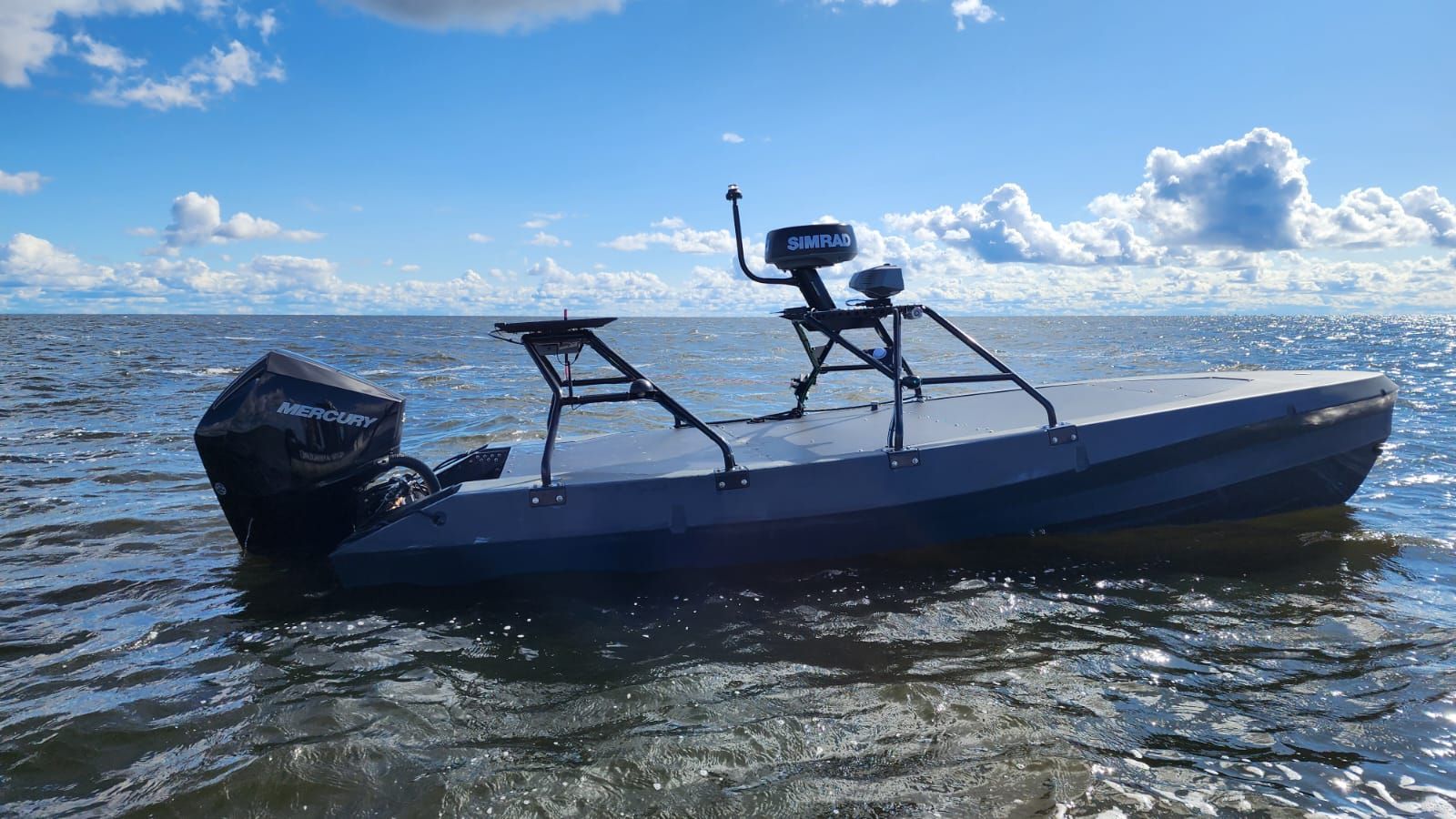
Sam Vye has built SYOS in five years into one of the world’s bigger manufacturers of uncrewed surface vessels, and standing next to an SM300 Bravo at the Combined Naval Event in Farnborough, the company’s CEO makes a reasonable case for why the timing matters.
“The SM300 is a six metre USV specifically designed to be low cost and with high production capacity. It’s designed for manufacturing, to do 30 units per month out of a single facility, and it’s designed to be effective in contested environments, whether that’s in Ukraine or other conflicted environments globally.”
Around 140 are in operational use in Ukraine, which gives the company a credibility that many of its competitors in the uncrewed space cannot yet claim. SYOS is a joint UK-New Zealand SME with its maritime headquarters in Fareham, and has grown to 170 people entirely on contract revenue, without venture capital or institutional investment behind it. The company’s pitch is straightforward: its products are field-deployed operational systems, not demonstrators, and that distinction matters in a market where plenty of competitors are still at the trial stage.
The SM300 hull is roto-moulded, making it fast to produce and reportedly difficult to destroy, capable of 49 knots with a range of nearly 700 nautical miles and a modular payload bay that can be configured for strike, ISR, electronic warfare or maritime air defence missions. “These vessels are low cost but high capability and they’re multi-role. They can ultimately do anything with whatever payload it might be, whether it’s strike capability, whether it’s ISR, whether it’s electronic warfare, and we’re working on iterative spiral development to act as maritime air defence capability,” Vye says.
The common thread across everything SYOS makes is AAIMS, a single software backbone that links the company’s surface vessels, air vehicles and now its subsurface vehicles into what it describes as a system of systems running from the air to the seabed. “What AAIMS does is power all of the vehicles and allows multi-domain, multi-vehicle command and control,” Vye says, and it is this software layer, more than any individual platform, that the company is really selling.
Above the water, SYOS produces the SA200, a 200-kilogram payload uncrewed helicopter with two hours of endurance, and the company is working with the Royal Navy on autonomous deck landing operations from Royal Navy vessels. On the surface, alongside the SM300, it has developed the SM400, known in Royal Navy service as the Rattler, built directly to Royal Navy specification with dual satellite communications, an onboard generator and HVAC systems.
The SM1000, a twelve-metre vessel designed for large-scale maritime domain awareness and security patrols, takes the autonomy and sensor integration work done on the SM300 and applies it to a larger hull with modular payload capabilities. “It’s taken all of the learnings, high TRL autonomy system sensor integration learnings around how to get systems through contested environments, and we’re applying that to ultimately a larger hull,” Vye says.
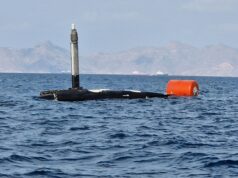
The SU10 uncrewed underwater vehicle, announced at CNE, extends that portfolio below the waterline. Designed for mine countermeasures, subsea infrastructure protection and persistent surveillance, it integrates with the SM300 and can be launched, operated and recovered remotely, with its first operational mission, mapping sea ice in the Antarctic, planned within months.
The New Zealand Defence Force contract, covering SM300 USVs, aerial systems and autonomous ground vehicles, adds weight to the Indo-Pacific side of the business, and Vye was quick to align himself with the First Sea Lord’s morning address on the need for faster, cheaper development.
“It was encouraging to hear the First Sea Lord emphasise the need to reduce the cost of production and accelerate the pace of development, which aligns directly with the SYOS philosophy. Multi-year acquisition models must give way to iterative spiral development, it is about delivering the most competitive cost to capability as rapidly as possible.”
With the SU10 now in the portfolio, the system of systems argument SYOS has been making starts to have more substance behind it, covering USVs, UAVs, UGVs and now UUVs, all connected through a single autonomy stack and all, the company insists, proven in the field rather than on a test range.


I’ve gained $17,240 only within four weeks by comfortably working part-time from home. Immediately when I had lost my last business, I was very troubled and thankfully I’ve located this project now in this way I’m in a position to receive thousand USD directly from home. Each individual certainly can do this easy work & make more greenbacks online by visiting
following website—.,.,.,.,.—>>> JobatHome1.Com