

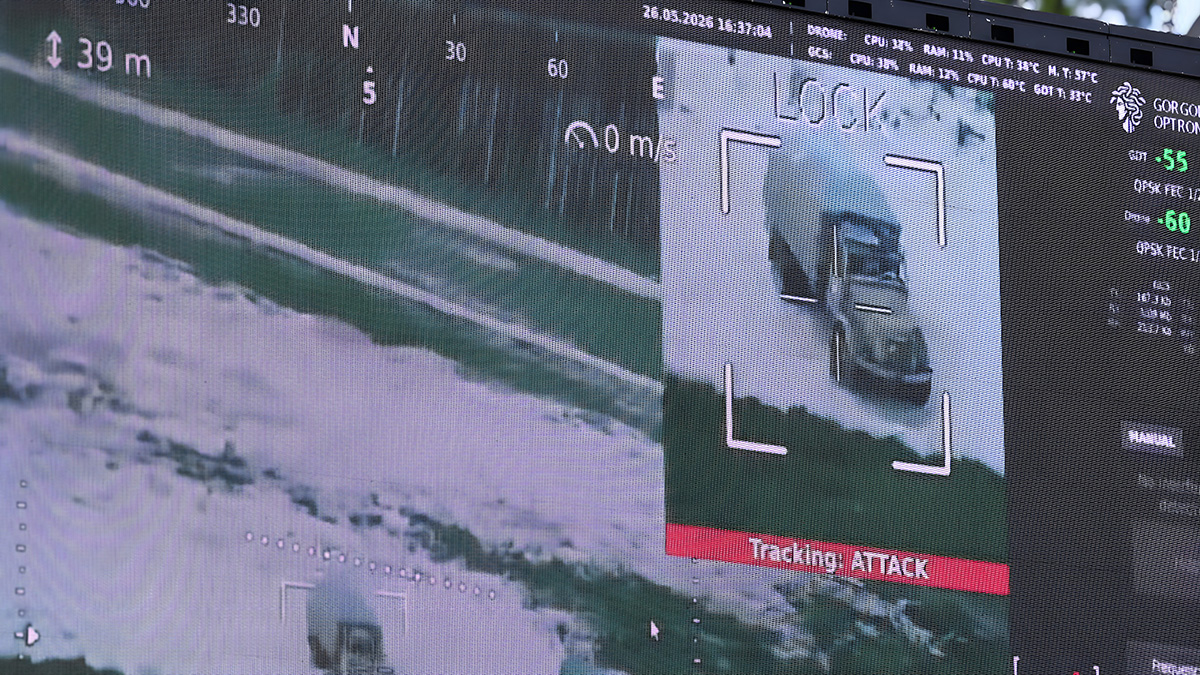
In a forest in southern Latvia, around 100 kilometres southeast of Riga and less than 150 kilometres from the Russian border, a drone rises into the grey Baltic sky before, seconds later, something shoots it down.
NATO, an alliance that has spent decades moving at the pace of committee meetings and lengthy procurement cycles, is trying to learn to move at the speed of war, and it’s working.
The lesson driving that effort has been brutal and unavoidable, because since Russia’s full-scale invasion of Ukraine in 2022, drone warfare has transformed the battlefield faster than any bureaucracy was designed to keep up with, producing a situation in which systems that are cutting-edge in January can be obsolete by March, and where NATO’s traditional approach of buying things across a decade-long cycle is being tested against a threat that Ukraine burns through in weeks. The alliance knows it has a problem, and what it is now trying to do, in this forest in Latvia and in meeting rooms across the continent, is build a credible answer to it.
The plan
Last year, at the NATO summit in The Hague, member nations approved the Rapid Adoption Action Plan, known as RAAP, a deliberately blunt piece of policy whose goal is to get new military technology into the hands of NATO nations within 24 months, representing a dramatic compression of a procurement process that has traditionally taken closer to a decade to complete.
Back in February, sitting in a press briefing in NATO headquarters in Brussels, I asked whether that 24-month target was too optimistic or whether, given the pace at which drone warfare was evolving, it might already be too slow. The answer was striking: the goal was described as realistic and in some cases not even ambitious enough, with the assurance that “there are cases where 24 months can be too long… commercial off-the-shelf solutions can be acquired within six to nine months,” and that “based on empirical data… we’ve seen that 24 months is reasonable… and we’re having evidence that this works.”
Standing in Latvia four months later, that answer looks prophetic, because the machinery being built to deliver on it is now visible and operational, and a briefing in Riga ahead of Latvia’s International Drone Summit laid out what that ambition means in practice and why the old model of harmonising requirements across member nations before procuring a single agreed solution was, in the counter-drone domain, increasingly failing to keep pace with the threat.
The new model works differently, built around nine operational use cases covering everything from point defence to convoy protection to border surveillance, with companies invited to test their products against those scenarios and the ones that perform well going into a catalogue that nations can draw from when a requirement emerges, rather than beginning the slow process of requirements harmonisation from scratch. “We didn’t start with the requirements from nations. We built nine use cases and let’s try to map company products across these use cases.”
The inspiration for this approach comes partly from Ukraine itself, where Kyiv’s Brave One marketplace has demonstrated that rapid acquisition and trialling of commercial drone technology is not only possible but militarily effective, a model the US Army has since adopted with its own counter-drone marketplace, to which Poland has already committed procurement funding, and which NATO is now watching closely as it develops its own version.
The range
Policy of this kind is only as good as the testing infrastructure behind it, and that is precisely where Latvia’s Sēlija Training Area comes in, a site carved out of dense state forest between the municipalities of Aizkraukle and Jēkabpils that covers 25,000 hectares with twice that amount of designated airspace above it, and where what was forestry land three years ago is now the most active counter-drone testing environment in the NATO alliance, complete with a control tower, shooting ranges, tactical infantry areas and the kind of open sky that lets an interceptor drone actually reach the speed and altitude at which it would need to operate in combat.
The site only reached initial operational capability in early 2026 and was opened formally in February, yet is already running at a pace that more established ranges would struggle to match, with five testing campaigns planned across the year under the leadership of Major Modris Kairišs, who heads Latvia’s Autonomous Systems Competence Centre and has built a programme that drew 17 companies to the March campaign alone, four of them Ukrainian, with Japanese, Korean and Australian firms also making contact about future participation as the range’s reputation within the alliance grows.
The geography is not incidental to any of this, because Sēlija sits around 150 kilometres from the Russian border, close enough that the threat being tested against is not theoretical, and the open terrain and unrestricted airspace allow for conditions that indoor or suburban ranges simply cannot replicate, including high-speed intercept runs, electronic warfare assessment across live frequencies and kinetic engagement against real aerial targets, all in an environment designed to reflect the messy, unpredictable reality of a battlefield rather than the controlled conditions of a laboratory.
The badge
The results of testing at Sēlija and the five other NATO innovation ranges feed into what the alliance is calling the Innovation Badge, a quality assurance mark designed to tell a potential buyer that a system has been tested, assessed and sufficiently de-risked to be worth serious procurement consideration, with the first pilot badges expected to be awarded in September once the governance framework underpinning the scheme has been finalised with member nations over the summer.
But the badge raises its own distinct and pressing questions about whether any quality assurance process can genuinely keep pace with technology that evolves faster than the paperwork designed to validate it. “Drone warfare is additive by its very nature,” I asked when there, “Systems require frequent updates. Can a company make those changes without having to restart the badge process?”
It is far from an abstract concern, because on the battlefields of Ukraine, counter-drone systems are updated, patched and iterated on a timescale measured in days rather than procurement cycles, meaning a badge awarded to a system in September may, by December, belong to something meaningfully different from what is actually being fielded. The tension was acknowledged directly: the badge is tied to a specific system configuration at the time of testing, significant changes require retesting, and precisely where the line falls between a minor update and a change substantial enough to invalidate the assurance is still being negotiated with member nations. “The maintenance of the badge, and how regularly companies need to be testing in the innovation range, is part of the discussion we are having with nations at the moment,” came the response, with the model compared to common criteria frameworks used in cybersecurity rather than formal certification, with the value of the badge resting ultimately on the trust that buyers come to place in the ranges themselves.
The hard part
The technology, for all its complexity, is not where the greatest resistance lies, because companies broadly understand what NATO wants and are moving to provide it with a speed and flexibility that NATO itself described as refreshingly straightforward to work with. The harder challenge is entirely internal, rooted in the fact that NATO’s own planning processes, built around long-term capability targets and multi-year procurement cycles, sit uneasily alongside a threat domain that evolves faster than any planning cycle was designed to track, and where getting alliance institutions, member nations and military commands to genuinely change how they think about procurement, rather than simply nodding at the idea of change, remains the central obstacle to the whole enterprise. “We have a very easy life working with industry. It’s more difficult to work across NATO stakeholders and impact things that have been done like this for many, many years.”
At Sēlija, watching another drone fall out of the Baltic sky, the urgency of all of this is not difficult to grasp, and the question the alliance is now racing to answer is whether that same urgency is felt with equal clarity in the rooms where the decisions that matter most are actually made.












“We have a very easy life working with industry. It’s more difficult to work across NATO stakeholders and impact things that have been done like this for many, many years.”
Hmm…
NATO procurement has a deeper problem of longstanding:
‘The launch by Russia of a war in Ukraine four years ago significantly increased the demand for armaments among members of the North Atlantic Treaty Organization (NATO). The NSPA, the Alliance’s Support and Procurement Agency headquartered in Luxembourg, enables member states to jointly purchase weapons systems and ammunition. In 2025, it placed orders worth 10 billion euros.
This has sparked considerable interest: last October, Le Soir, La Lettre, and Follow the Money revealed that corruption investigations targeting consultants and intermediaries had been opened in Belgium, elsewhere in Europe, and in the United States.’
Defence procurement in Britain and in NATO is not fit for purpose. Systemic reform is required.
I’ve gained $17,240 only within four weeks by comfortably working part-time from home. Immediately when I had lost my last business, I was very troubled and thankfully I’ve located this project now in this way I’m in a position to receive thousand USD directly from home. Each individual certainly can do this easy work & make more greenbacks online by visiting
following website—.,.,.,.,.—>>> JobatHome1.Com