

For some of the war, the UK’s relationship with Ukraine has run one way: British equipment, British money and British training going east.
A roundtable at Portcullis House, however, has argued that this framing is now out of date, and that the harder question facing the UK is how to learn from a country that has become one of the fastest sources of military innovation in the world.
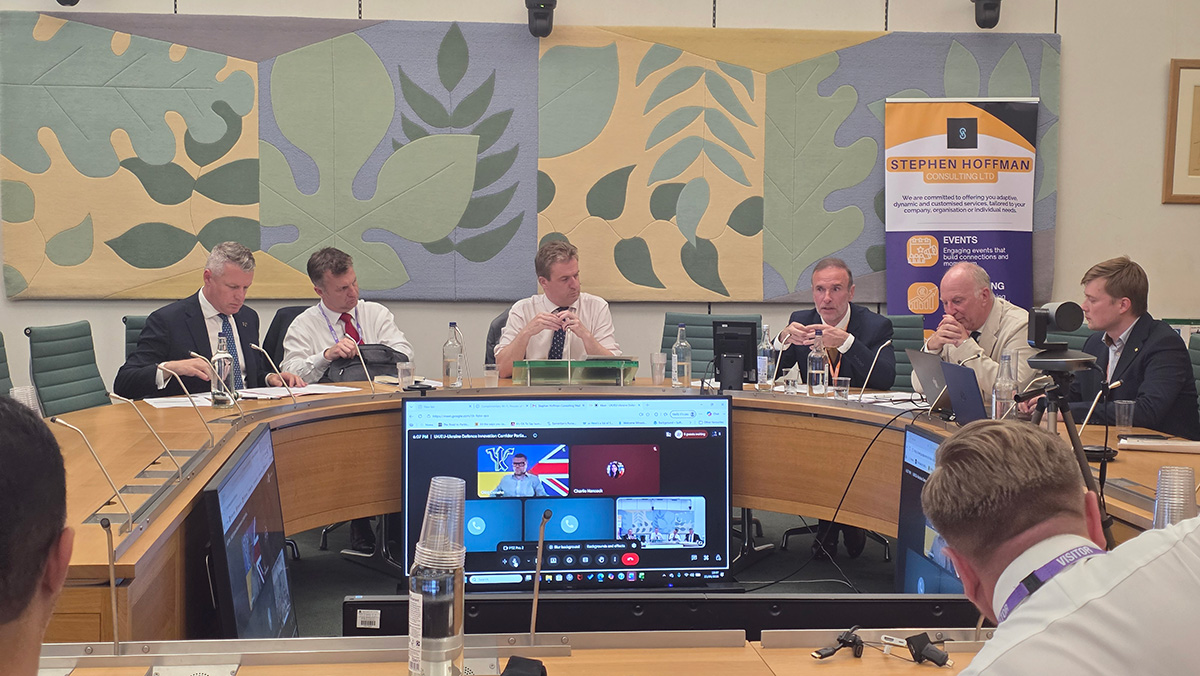
The event, hosted by Graeme Downie MP, was organised by Tech Connecta Vertex Ltd and Stephen Hoffman Consulting Ltd. It was built around a proposed UK/EU-Ukraine Defence Innovation Corridor: a framework intended to connect Ukrainian universities, manufacturers and researchers with UK and European industry, investors and government.
The pitch is that structure is the missing piece, because the collaboration is happening in pockets already and what does not yet exist is a reliable pipeline to move IP, people and production between the two countries at the speed the war demands.
Downie put the case for it in straightforward terms, telling this publication after the event that “the lessons that Ukraine has to teach us are now at least as much as the ways we can support them.” The model was whole-of-society mobilisation, the same instinct he said had kept Ukraine in the fight. “How has Ukraine managed to hold out against Russia for so long? It’s by capturing the whole of society, the universities, the whole ecosystem, and focusing on one goal,” he said. “The lessons from that for us, in defence, innovation and the economy, are absolutely massive.”
The argument running underneath the evening was about speed, and the gap between how fast weapons now change on the battlefield and how slowly Western systems are bought.
Andrew Coe of Leonardo, who previously commanded the UK’s NATO air policing detachment in Romania, put it in terms of his own career. Capability development had traditionally taken years from operational need to fielded system, he said, “but if that happened now, we would lose.” In Ukraine, he said, adaptation is measured “not in years, in months, and often in weeks,” and sometimes less than a week, leaving the UK still buying for a slower war than the one being fought.
Colonel (Ret.) Seb Pollington, who spent six years as an embedded NATO advisor in southern Europe, gave the operational version of the same point. He described a platoon commander near Kupiansk able to message a manufacturer about a fault or a needed change and get a fix back, in some cases, within days or hours. Set against that, he said, “systems that take two years to procure are often now obsolete in six months. The battlefield does not wait for committees.” His conclusion was that advantage will come less from holding small numbers of exquisite systems and more from organisations “that can learn, produce, modify and scale faster than any opponent,” so that the winner “may not be the side with the best weapon, but the side that learns fastest.”
That reframing, Ukraine as teacher rather than client, was the thread the organisers wanted the room to leave with, and Coe made it explicit when he said that “Ukraine should not be viewed as a recipient of support. It is increasingly a source of innovation, operational understanding and hard-earned experience.” The relationship, he argued, needs to “evolve beyond donor and beneficiary and become one of genuine partnership.”
Dan Danchenko of Tech Connecta Vertex described the Corridor as “a continuous pipeline of innovation,” sitting as a practical layer beneath the agreements the two governments have already signed. The point, he argued, is to reach the parts those agreements miss, because government-to-government schemes do not cover business-to-business or academic links, and it is there, in the universities and the SMEs, that he says much of Ukraine’s invention is happening. He framed the effort as a race against time, warning that Ukrainian companies are already being courted by other countries and that British hesitation has a cost.
The initiative is not starting from nothing, and according to material circulated at the event it already claims a network of seven Ukrainian universities, fifteen Ukrainian defence and dual-use companies, the Association of Ukrainian Defence Manufacturers and the Sikorsky Challenge ecosystem, alongside more than seventy UK defence and dual-use firms, plus investors and regional stakeholders. Its stated technology priorities run from drones and autonomous systems to advanced manufacturing, aerospace, cybersecurity, defence medicine and AI.
What it is trying to fix became clearest from the Ukrainian side as Denys Kalachov, of the Association of Ukrainian Defence Manufacturers, traced the sector’s growth from a handful of firms when the association was founded in 2017 to more than 150 today, while warning that scale has not removed the barriers to working with foreign partners. He described invisible regulatory obstacles, particularly around intellectual property, that can expose Ukrainian firms to criminal investigation at home, deter investors, and stall partnerships before they start. For him the framework is the prize, and as he put it, “this corridor of innovations, and the framework around it, would be the innovation itself.”
The roundtable drew government as well as industry, with Luke Pollard MP, Minister for Defence Readiness and Industry, taking part, a presence the organisers and Downie treated as a signal of how seriously the initiative is being taken. Downie said the engagement on the night, from government, parliamentarians and the number of SMEs in the room, was itself evidence of demand.
He was careful about how the relationship is sold to the public, insisting that “this is not about the UK giving things to Ukraine. This is a meaningful partnership, and we are learning as much from them as they are getting from us, and that balance will continue to shift.” Asked how anyone would know the initiative had worked, he pointed away from rhetoric and towards activity, predicting “increased collaboration between Ukrainian companies and UK companies, military to military, but also business to business and government to government.”
Asked what success would look like, Downie was clear that it would be activity on the ground, predicting “increased collaboration between Ukrainian companies and UK companies, military to military, but also business to business and government to government.”
For its backers, the harder task begins now: turning a room full of goodwill, and a minister’s presence, into the procurement routes, investment mechanisms and IP protections that would let the partnership move at the speed everyone in the room agreed the war demands.








The UK’s Ukraine experience is invaluable, I’m often amazed by the muppets that shoot their mouths off about support for Ukraine, they seem completely devoid of the concepts of proxy wars. For three hundred years the UK did everything it could to not fight continental wars and instead leverage its economic and technical base to supply proxy forces in Europe to do the fighting.
For a mere £4 billion a year for four years we have completely stripped Russia of its Soviet era tank fleet, expanded NATO to the point we have a boarder just 50 miles away from Murmansk and gained invaluable insight into an entire new form of warfare for the loss of one British soldier.
That same money spent on UK armed forces directly would have achieved next to nothing.
Not to mention the crippling damage to Russians Naval ambitions and the psychological impact of such a bloody and damaging war. Russia has been fundamentally changed, weakened and humiliated on the world stage. Yes we’ve paid a lot of money but i’d rather war happen over there than over here.
Indeed for Putin it’s all about how he survives this, it’s the only reason it continues because he is almost certainly in more danger when it stops than now as it continues it’s the only unifying element even as disapproval grows. How long that is the case is the only balance to be considered by him and his acolytes, it’s a wall and a hard place and lives merely expendable pawns. They will bluster yes that will never stop, no doubt within weeks of it stopping, they will be claiming they are the most powerful fighting force in the World but in reality only total delusional madness (not totally to be rejected mind, just look at Trump’s repetitive madness and related cover ups) will get them starting a serious fighting war for a rather long time. Actions and disruption short of that will be their primary tactic for years to come.
The biggest muppet on this blog is you and the 100% complete crap you post here. “For three hundred years the UK did everything it could to not fight continental wars”. What a load of bullshit, try Wikipedia and get some history right
Jim’s reference to ‘300 years’ on the may be a bit off the mark but he’s 100% right on the rest. You’ve obviously never heard of the War of the Spanish Succession, the 7 Years War and the Napoleonic Wars. We provided troops in each of these conflicts but we were heavily reliant on allies on the Continent to provide the bulk of land forces.
Relying on its Navy and building coalitions to fight on the Continent was, at least until the 20th Century, the ‘British Way of War.’ Read Corbett who makes this really clear. It was also our plan for WW2 until the French were rapidly defeated in 1940 and we were forced to fight on our own.
So, with Ukraine, we’re just following the same plan we always have.
Wikipedia is fine as a source but it looks like that reading a history book would serve you better. Either that or just stop being such an obvious Russian stooge.
Interesting the comments in this article (coincidence or otherwise) in my mind harks back to my thoughts on the Review and following DIP and how, especially with its delays, it’s becoming increasingly out of date as events change priorities outside of it with realtime experience. Does a relatively set in stone process really best handle this. So yes it further adds to my questioning of whether this methodology is really the best way to pursue defence spending decision making and something more ongoing, progressive and flexible, even if has some defined core longer term project commitments, should be introduced with levels of project urgency and monies adjusted as time passes and priorities changed.
Perhaps instead we should plan to plug UK Armed forces into Ukraine’s war tech and cut out the GUCCI UK industry🤔🤣😒
‘How has Ukraine managed to hold out against Russia for so long?’
Deregulation.
‘The battlefield does not wait for committees…
organisations “that can learn, produce, modify and scale faster than any opponent,”…the winner “may not be the side with the best weapon, but the side that learns fastest.”
That is not the Britain, Westminster, Whitehall of today…which condemns us to be losers…
Systemic reform is required.
i can get ukraine have learn’t the hard way about modern warfare tactics, i don’t get they’re leading on the technology though ?
Interesting that this group of chaps hosted by a lowly back-bench MP, have come to the conclusion in June 2026 that we should be learning lessons from the Ukraine war.
Of course we have been learning lessons at the tactical level through our contacts with Ukrainian Forces being trained on Op Orbital from Dec 2014 and from its successor, Op Interflex from July 2022.
I would have hoped that lessons at the Operational and Strategic level and those for Politicians and Industry should have started to be picked up some time ago.