

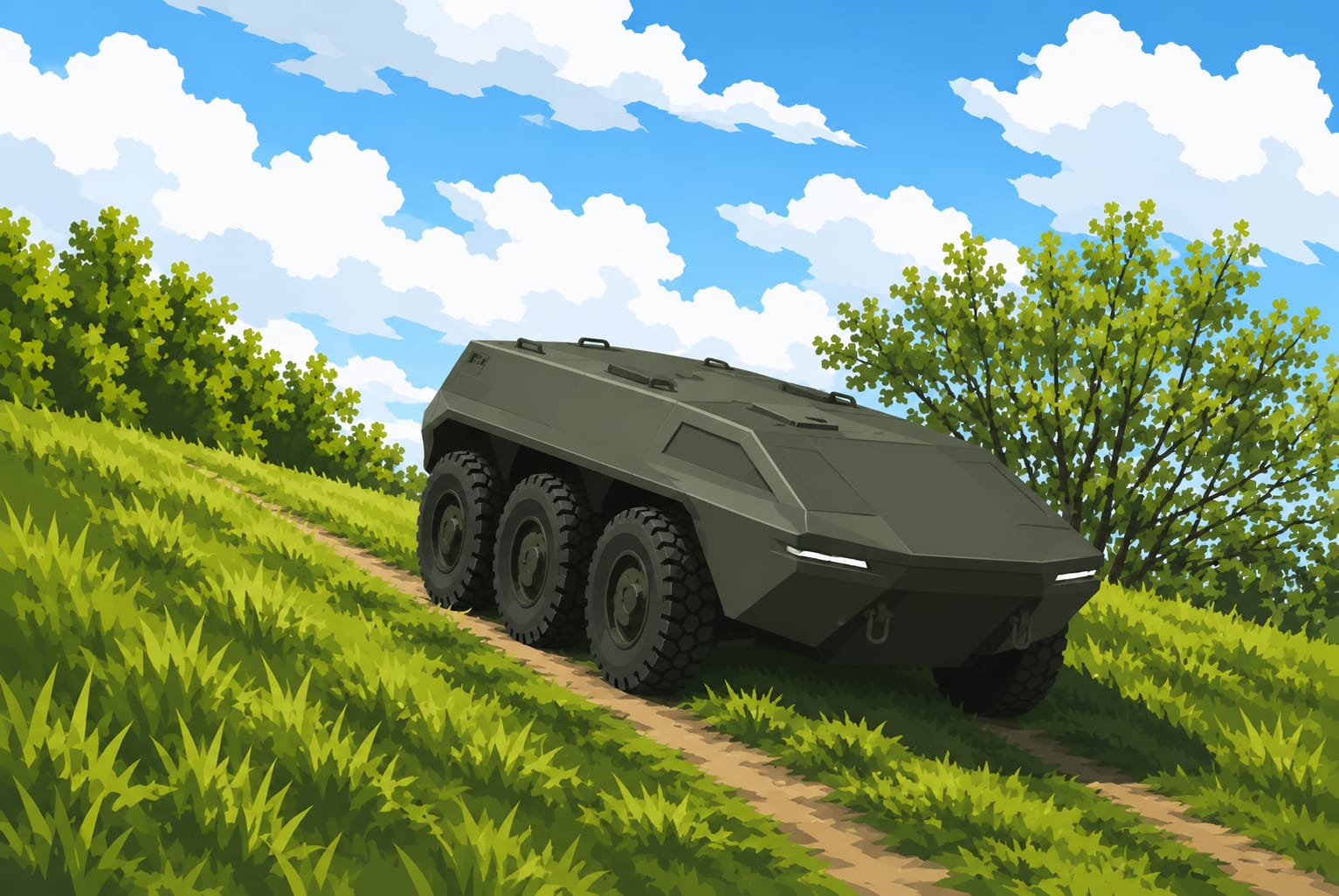
The British Army’s next generation of land forces will include investment in uncrewed ground vehicles, Defence Secretary Dan Jarvis told defence audiences at the Royal United Services Institute.
In his first major address since taking on the defence brief twelve days earlier, Jarvis told the RUSI Land Warfare Conference on 23 June that the forthcoming Defence Investment Plan would put resources behind the Army’s modernisation ambitions, including investment in robotic ground platforms. “The DIP will make real those ambitions, and that includes investing in the uncrewed ground vehicles the Army requires to build the next generation of land forces,” he said.
The commitment here is one of the clearer public signals to date that the British Army intends to field uncrewed ground systems as a recognised investment line rather than as a series of niche experiments. Trials and demonstrations involving robotic platforms have featured in recent Army activity, including work conducted under the Robotic Platoon Vehicle programme, and concept development continues across the Future Soldier framework. The remarks indicate that those efforts will move beyond experimentation and into formal programme investment.
Jarvis credited General Sir Roly Walker, the Chief of the General Staff, with driving the modernisation effort. “The land forces which prevail tomorrow will be those who combine high-end platforms with mass, agility and considerable expertise,” he said. “General Walker has achieved this. He has done more to modernise the British Army than any other Chief of the General Staff in living memory. You heard his vision earlier. The DIP will make real those ambitions.”
Walker’s modernisation agenda has placed considerable push on what the Army terms a recce-strike complex, integrating uncrewed aerial, ground and undersea systems with longer-range artillery, electronic warfare and precision fires. The recce-strike concept draws heavily on observed Ukrainian practice and on lessons emerging from broader trials work across NATO armies, and it has formed the intellectual backbone of much of the Army’s recent equipment and doctrine work.
Jarvis set the investment in uncrewed ground vehicles within a wider discussion of the lessons emerging from the war in Ukraine. “It would be reckless to ignore the lessons of Ukraine,” he said. “Artificial intelligence, autonomy and uncrewed systems are no longer capabilities of the future. They will receive investment that reflects their strategic importance.” He described the pace of innovation in defence as having accelerated in a way he had not seen during his earlier time in the military, with development cycles now measured in months rather than years.
The Defence Secretary, a former Parachute Regiment officer who served in Afghanistan, Iraq, Northern Ireland, Kosovo and Sierra Leone, was at pains to caution against an over-correction toward uncrewed platforms. “There are some who hold the view that we should trade everything in the locker for drones,” he said. “I understand the temptation, but there are important distinctions to make. For as long as we remain a member of NATO, we won’t fight alone. And for as long as we maintain our independent nuclear deterrent, we will always command our own destiny.” He added that even in Ukraine, conflict was still being fought in the trenches where ground was held street by street and where artillery and deep precision strike had proven invaluable.
The reference to uncrewed ground vehicles is one of several capability indicators Jarvis gave during the address. He listed recent and prospective tasks the armed forces had been required to handle, including protecting the seabed in the High North, securing the skies in the Middle East, preparing for the regeneration of Ukraine’s forces and readying to reopen the Strait of Hormuz, and he said Britain needed a flexible, hybrid, integrated force that could deter and fight across every domain.
The detail of the Army’s robotic ground vehicle plans, including platform selection, numbers, timelines and the units that will field them, has yet to be set out publicly and will turn on the contents of the Defence Investment Plan. Jarvis said the document remained his immediate priority and that he was working to finalise and publish it, having taken on the defence brief twelve days earlier following the departure of John Healey.








Still lacking in any kind of detail to be taken seriously at this point IMO. Right now it’s just more talk and no action.
This is getting out of hand again.
They like you…..
I don’t know who benefits from them, the links aren’t valid and they’re blatantly scams.
A form of attack perhaps, to discourage people from using the website?
ATU is testing these things, we just need to wait for the tests and trials to end and someone make a decision and buy.
We ahould have got these instead of that heap of junk Ajax. We could have bought more of them, they are more stealthy – less of a target and if the worst happens they ard unscrewed. But the army had to have a large target with NO Active Protection System. This Ajax is supposed to be on the front line with no APS, what genius came up with that one – he/she is obviously not an Ajax crewman. But please spend more of the taxpayers money on the obsolescent concept that is Ajax. We should move to flexible unmanned systems that we can deploy in numbers just like Ukraine forces are doing in a real war now not the past war the army is tooling up for!
Rob, the Army wanted Ajax in 2010… the issue is not that we need a new recce vehicle now, it’s that Ajax was also supposed to be the digital backbone of the original Strike concept that is morphing into recce strike.
Without that, you also lose a lot of the planned connectivity. The Army is not entirely to blame for failed defence procurement and certainly not for a failure to deliver by a Defence contractor.
Agreed. I don’t know just what Ajax carries digitally and ISTAR wise, but could the whole package be put on a UGV of that size?
That would depend on the power pack and the ability to problem solve.
Digital radios can take a surprisingly large amount of power, especially when its data dominant comms being sent. Plus, they do go wrong and it requires the crew to problem solve the issue and get it back online (which is often a physical connection thing rather than software).
The power output also goes up with ECM etc.
So, if it’s diesel powered it might be ok power wise. Anything battery powered will have short legs as soon as it needs to be pumping out data and ECM.
AJAX has largely been paid for. All that is required of the AJAX programme is maintenance.
Whereas this is new spending.
If they get rid of AJAX … they get rid of all that previous investment and time put into it.
Too big to fail…. reminds me of the bridge too far….
I do feel Ajax is through a decade of delays looking a bit like Britains misplaced tank thinking in the thirties with under armed cruisers at one end and slow medium infantry supporting tanks at the other, neither of which had much life in them by the time the war started. I may be sounding naive here but if Ajax is supposed to be operating in or near the front but isn’t a fighting vehicle what protects it? If it’s a mobile communications room then will it rapidly become vulnerable in its stated role? I have no answers here but I can’t get my head around how it works in the sort if warfare we see in the Ukraine. Hopefully the answers to this are valid ones as and when the theory is tested.
It’s designed to be in the contact battle, full Stanag protection and a serious boost in firepower over Warrior and CVRT.
It’s digital fit is envisaged to be concurrently communicating data around the force package.
Meh. Without self defence against drones and missiles it does not mean much.
I do feel there may be mileage in automating some of the Ajax family of vehicles as well as Warrior. I know some ideas around an anti-mine vehicle using Warrior are being considered. As I see it, the less we expose troops to direct/exposed danger, the better, and an autonomous system is one way to help achieve that.
6 Warrior are being converted as part of Project WEEVIL.
So we are investing in new air and ground based drones and half a dozen new capabilities for the army but we have a fixed head count and we won’t cut any existing capbages of capabilities 🤔
Quite right too.
There’ll be lots of people looking at screens by the sound of it. Hope energy supplies and communications are all kept secure and someone is watching are the proverbial back door with all this. Too much fixation on drones might distract from all the non-drone effectors still in play on the battlefield.
What Cap Badges, Jim?
Once I’d have supported cutting a couple of Infantry Battalions to give the headcount to extra CS CSS formations.
Now, they’ve all got their roles now 11 Bde and ASOB are here.
And they’re obviously moving posts around here and there, as out of the hat 39 Royal Artillery is/has reformed, with the same Army establishment.
Maybe due to the up and coming KGA Batteries.
From what I’ve seen, most of the Drones and UGV slot into existing formations.
The extras that are needed are more logistics, more GBAD, more medics, more artillery and OWE.
All these MoD missile and OWE programs, I think they mostly end up with Ukraine, though maybe a RA forms in future to operate the BM they talk of.
Pity your cap badge analogy doesn’t apply to the RE then they seem to be hellbent on reducing capability there!
Anyone who’s happy to throw away all conventional capabilities for Drones is an idiot, so I’m glad Jarvis and the Army are awake.
A mix is required.
I read a piece in the Guardian, calling the QEC obsolete and we should buy Drones instead.
I’d like to see a Drone fly out into the middle of the Atlantic, launch airstrikes, and launch troops towards a shore via helicopter.
I know some are gagging for it, but all Drones would turn us into a Defence force capable of little else.
They complement, not replace.
I don’t think gagging for it is the right description.
It’s an area where we are currently lacking and some countries with limited funds are investing and getting results.
We should always fully invest in any new tech, understand it and know how to counter it. Also if it is any good we should get it and in the necessary quantities. Personally I see a need for both. I picture QEC setting sail accompanied by numerous drones. .
Having too many sea based drones might hinder or clutter up fleet movements and controlling them in rough seas will be challenging Will thry be able to be refuelled for long deployments, maybe a tender vessel mothership might then bd required? Where do they all go when doing port to port visits?
Wish they’d get the main ships and carriers fully fitted out armaments and tech wise first before putting them elsewhere.
Well I myself don’t think any of that will be a problem mate, these things are all worked out.
Port visits? Would they even take part in the multitude of “other tasks” such as those?
I liked the idea of 2 or 3 large USV forming the “HMS Glasgow Group.” Name all them as well, and highlight them online like a traditional ships Internet page, gives an identity.
From a “soldiers” vernacular, the word “gagging” would be acceptable or fit the speech.
In my time if someone was “gagging for it”, it didn’t mean that they couldn’t speak, it might that they were really keen to try, do or taste something. Examples such as when thirsty….. he was gagging for a beer,
Yes, thus my use of it. Really keen, in other words.
Agreed, like the sound of these big USVs accompanying every main asset.
Agreed many politicians, treasury folk eyes sparkling at the thought of only annual spending on drones no more year long projects they drip feed and cut for short term savings and even officers wanted to make a name for themselves wanting to go all in on them but the reality is counters are coming just as fast ukraine ew stops 70% of russian drones but now gets through less that 5% of sea drone attacks now apparently across the black sea. We need to get to a minimum mass to realy take advantage of drones as extendors. Jarvis seems to get it hopefully the pressure from allies and even the unions gets too much to stop expansion as its tidied to reindustrialsation now and industry made a big play of apprenticeships and jobs etc. All wishful thinking though with reeves and miliband hanging about like a bad smell
Funny you mentioned that!👀🤔
Im going to quote what General Syrskyi, Ukraine just said !!
General Syrskyi: At present, we’re making virtually no use of armoured vehicles. Our military personnel, just like enemy, effectively advancing on foot, as in World War I.
In order to reach front line for offensive operations, infantryman sometimes has to march 10-15 km on foot.
This raises the question: how can we neutralise this advantage enjoyed by drones and give our armour a new lease of life?
The answer lies in developing active defence systems that will shoot down drones themselves and complement the existing system, where drones are used to shoot down other drones.
Then all conventional types of weaponry — tanks, infantry fighting vehicles, artillery — will be given a new lease of life and will once again be deployed extensively.
But these will no longer be tanks or infantry fighting vehicles in the conventional sense, but highly sophisticated systems capable of countering various threats posed by drones.
If there’s no image, don’t use some AI jazzed up image to report unfunded aspirations.
Having too many sea based drones might hinder or clutter up fleet movements and controlling them in rough seas will be challenging Will thry be able to be refuelled for long deployments, maybe a tender vessel mothership might then bd required? Where do they all go when doing port to port visits?
Wish they’d get the main ships and carriers fully fitted out armaments and tech wise first before putting them elsewhere.
*apologies for the double dipping.
Exactly if you have hundreds of usv and uuv you still need something to deploy,defend and maintain them plus it massively lowers the entry to conflict what if we have 2 t91 sloops shaddowing a russian corvette through the channel and they knick one or sink it out of “precaution” are we going to do eff all if we haven’t lost any people it basically defets the point of a deterrent, the talk of unproven lusv as replacements for manned ships vs magazine and sensor extendors is realy frustrating, plus once you add up the costs of development, arming them, control and maintaining you still end up with an expensive platfrom that has less flexibility over a manned ship.
You are a totalitarian dictator with a million strong army, 4,000 tanks etc.
You have a problem. Your native population, united by a single language, is declining by half a million annually. This trend is accelerating, making the country weaker by five million of working age every decade. You have a brilliant idea. Across the border are two countries with large minorities, millions of citizens who share your language and culture. If you incorporate them into your own country by force of arms, you solve your demographic crisis and make your country look strong.
You ask your Army Chief of Staff to draw up a plan for a swift coup de main operation against one of the adjacent nations to last three days only.
One of those adjacent nations has an army of two hundred thousand, a thousand tanks, five armoured divisions supported by three hundred and fifty self propelled howitzers, drones etc.
The other adjacent nation has an army of seventy thousand, one hundred and forty eight tanks, one armoured brigade supported by seventy two self propelled howitzers, drones etc.
Which of the two adjacent nations deters you from attacking, directs your planning towards a coup de main against the other?
both nations have a mutual defence treaty. an attack on one is treated as an attack on both. Now your dictator would face a war on two fronts against 270000 soldiers, 1148 tanks, 6 armoured divisions, 122 howitzers.
Too late for Ukraine this time round, but NATO is how we defend against Russia. We do need to pull our weight in there certainly and that means increased spending for sure.
The two adjacent countries have a mutual defence treaty that states ‘if such an armed attack occurs, each of them, in exercise of the right of individual or collective self-defence recognized by Article 51 of the Charter of the United Nations, will assist the Party or Parties so attacked by taking forthwith, individually and in concert with the other Parties, such action as it deems necessary…’
But the totalitarian dictator knows that the country with an army of seventy thousand previously signed a Memorandum giving security assurances to another country and then reneged on those assurances. He therefore believes that neither country will come to the other’s assistance. This opinion is supported in a detailed briefing by his intelligence chief.
His Army Chief of Staff has now come up with a plan of attack against one of the adjacent nations
Which one will be attacked; which one has successfully deterred attack?
Totalitarian came from Total…
Putin is no totalitarian, he do not forces you to be pro Putin, he forces you to not be anti Putin. He also allows private ownership economy.
He is an Authoritarian. It is important to know what words mean.
The discussion above concerns deterrence.
Quite clearly, Poland will deter any military adventurism from Russia. Norway, the Baltic States, backed by Britain, cannot.
You wish to dance on the head of a pin regarding a bunkered down brutal indicted war criminal with the blood of millions on his hands; millions of citizens displaced by his actions? Bizarre…
‘Putin’s Russia has become a “neo-totalitarian” regime. The classic Friedrich-Brzezinski model of totalitarianism, exemplified by the Stalin regime, no longer fits in the twenty-first century. Departures from the classic model include the absence of a single dominant ideology, a single party, compulsory state ownership of the media, and complete state control over the economy. Instead, the article posits six factors that are essential components of a neo-totalitarian regime: (1) near-total suppression of political opposition; (2) political power concentrated in the top executive, with executive power dominating all political parties, federal, regional, and local political institutions as well as the judiciary; (3) almost total control over the mass media and increased control over social media; (4) a civil society purged of groups that hold independent or oppositionist views; (5) a new form of societal terror; and (6) sham elections at all levels.’
and i suspect their going to need to spend even more, it’s hard to see why white males would fight for a country where their second class citizens
New capabilities don’t replace old capabilities- they just open up another front that you have to deal with. It is very seldom that a military technology renders an older technology obsolete. If you have a fleet of 1000 scifi war machines and your opponent has a fleet of 1000 scifi war machines AND a sharp stick, then your opponent has the advantage.
Glad to see some caution about drones. The real lesson from the Ukraine war is that Russian forces have been utterly incompetent, completely failing to conduct co ordinated all arms operations. The war has descended into drone warfare because that is all either side is capable of.
Western armies would first destroy air defence systems to achieve air dominance then coordinate air strikes with armoured forces.
Unmanned ground vehicles might be useful for mine clearance but would anyone entrust them to provide re supply from distance?
There’s lots of uncrewed systems in the Army, most sat in the tank park, gun park, Coy vehicle lines and MT troops! All they need is some people in uniform to use them!
Since Ajax seems completely unsuitable for people maybe just make them unmanned? Or trial the concept at least
Oh Lord, here we go AGAIN. The potential here for another major financial cock-up must be huge.