

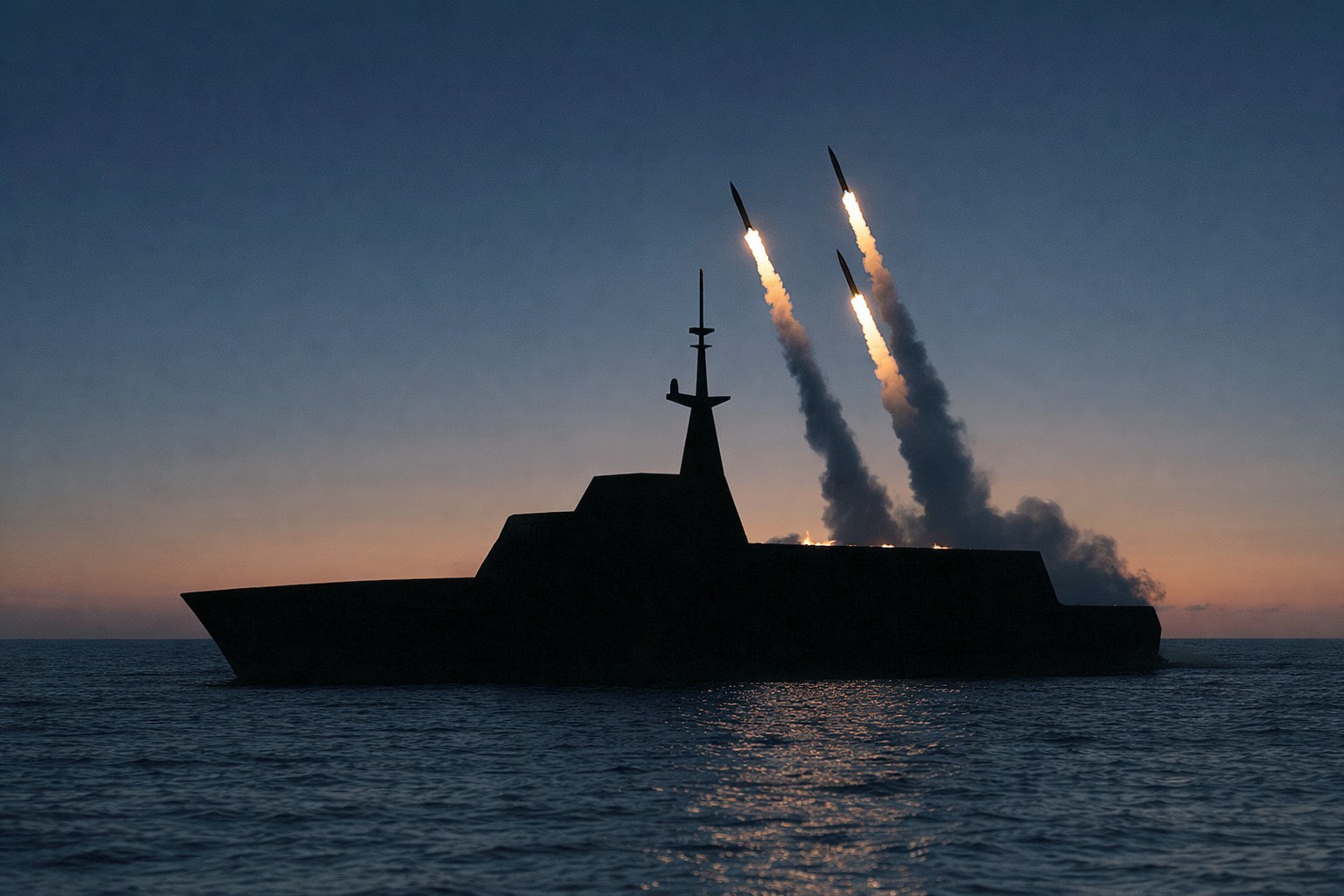
The Ministry of Defence has set out its thinking behind cancelling the Type 83 destroyer, saying the classified analysis that shaped the decision drew on lessons from ongoing conflicts and concluded that a mix of crewed and uncrewed vessels will deliver greater missile capacity and mass, where an expensive, exquisite platform would have left the Royal Navy with too few ships to cover its tasks.
The rationale came in written parliamentary answers from Minister for Defence Readiness and Industry Luke Pollard on 10 July, responding to Andrew Bowie, the Conservative MP for West Aberdeenshire and Kincardine, who asked what assessment has been made of the impact on the Royal Navy’s high-end air defence capability of cancelling a planned class of up to eight Type 83 destroyers intended to replace the Type 45 fleet, and what analysis was used for the decision to replace the programme with the hybrid navy approach.
“The decision to move to this hybrid approach was taken after detailed analysis of current and future threats, including lessons from ongoing conflicts,” Pollard said. “The specific analysis is necessarily classified, but the mix of crewed and uncrewed systems will produce a more flexible force, with greater missile capacity while also improving mass. The alternative, an expensive, exquisite platform such as the Type 83, would have resulted in too few ships to cover all the Royal Navy’s tasks, increasing risk.”
The maritime air defence role currently delivered by the Type 45s will in future fall to “a mix of crewed Common Combat Vessels and uncrewed, autonomous missile (Type 91) and sensor (Type 94) ships,” the minister said.
The up to eight ships referenced in Bowie’s question would have exceeded the six Type 45 destroyers the class was to replace, and the answer’s argument is one of affordability and numbers rather than capability, holding that the cost of a high-end crewed destroyer would have constrained the fleet below what the Royal Navy’s tasks require, where the hybrid mix of six Common Combat Vessels operating with Type 91 missile platforms and Type 94 sensor platforms offers greater missile capacity and mass for the money, and the uncrewed escorts extend beyond the air defence group, with the eight Type 26 and five Type 31 frigates each expected to operate accompanied by a number of drone escorts, making the family the underpinning of the whole surface fleet rather than of the Common Combat Vessels alone.
The department has addressed the cancellation’s other dimensions in parallel answers, telling Parliament the same day that the Type 83 was an early-stage concept on which no decisions had been made about where or how it would be built, and that detailed planning for the transition between the Type 45s and the hybrid maritime air defence capability will determine whether a life extension of the current destroyers is implemented, with a final decision not expected until 2027-28.
The answers do not say how many Type 91 and Type 94 vessels will accompany the six Common Combat Vessels in the air defence role, how the combined missile capacity of the hybrid force compares with what eight Type 83s would have carried, or what the classified analysis concluded about the survivability of uncrewed platforms against the threats the destroyers were designed to meet.


Basically, the only thing that’s changed is that they’ve realised using a cruiser as the control node was too expensive, and have swapped to a frigate.
Exactly. And the frigate won’t have a radar as good as Samson neither will the unmanned drone ships.
SAMPSON will be 40 years old by the time this happens . Any modern radar based on gallium nitride will be far superior to SAMPSON.
The sad thing is they will likely end up putting a good radar on top (or worse half way up) a much smaller mast, thus reducing the radar horizon. My understanding is that the high placing of the SAMPSON radar and hence the good horizon is what impresses the USN about the T45 compared to the AB’s which damn impressive radars of their own.
Given to wide spread use of fast sea skimming missiles and increasingly drones, radar horizon will matter and in high threat areas such as the high north 24/7 coverage will be a requirement for any on station group. As bad weather is likely to have a significant impact on the use of anything but the largest of aerial drones an escort group will be reliant on ship mounted radars for at least some of the time it is on station. Putting a drone radar picket up threat to open out the group’s radar horizon will simply put the drone at risk, especially if the drone is even smaller (say 2,000 tons) than the crewed command ship (say 4,000 tons) as any attack on the drone ship will have even less warning.
I’d be interested to see the studies’ data and assumptions list as my guess is that the assumed cost of the drones relative to the crewed command ship and the likely loss rates are such that big ships are out. It might prove correct, but my guess is that it won’t. Why? Because I would hazard a guess and that they end up putting a pretty good radar on the drone to protect the crewed assets and then decide that the radar is too expensive to be considered attritable, so they put some defences on the ship, so it gets bigger, so… You get the picture.
Cheers CR
The high placement of SAMPSON on T45 did impress the US navy back in 2010 but things have moved on. The high placement comes with severe limitations on size and number of plates.
Doesn’t seem to deter the RAN. Latest renderings of the Hunter class has 6 faces with 4 plates on each face. Absolute beast of a thing integrating 3 bands (L, S, and X) in one mast
I really do not believe that this concept will turn out to be cheaper so I really do hope that is not the basis upon which it has been selected. The capability of the various elements will dictate whether this will be mere style over substance or indeed smoke and mirrors operationally. On paper the concept makes a lot of sense but so much to validate, develop and operate I don’t see this as a remotely smooth transition and I’m sure the likes of the Daily Mail will be getting their digital pencils ready to highlight the inevitable issues. Mind you they likely would if we concentrated on golden destroyers instead.
While we will parrot about mirroring US efforts, somehow I suspect they will gloss over the likelihood that the US will retain (probably expand) great capability on their central ships and use drones to expand upon them, I fear that we will be making the drones the vital element of what will be otherwise relatively impotent control vessels that are sitting ducks in their own right. For the powers that be this looks too good an opportunity to be able to present growth and capability while in reality reducing capability and in their mind costs. What could possibly go wrong. It’s not the theory that I am so much wary of it’s those implementing it.
Emphasis on cheap has almost always cost lives ! I could understand perhaps cutting back on the number of ships or even reducing the spec slightly, but not cutting it out completely ! As the ex defence minister said we must give them the money to do the job. Cut the money were giving to Pakistan !
Don’t be so ridiculous. There are scads of radars today with gallium nitride technology that are inferior to Sampson.
Cost!, cost,! cost! Cost! ..COST..! .
Did I mention cost…?
I think you may have mentioned it once, but you many have gotten away with it 😉
Exactly, the Command ship is just a non Gucci version of the T83 but we get 6 instead of 3 and it’s probably not built by BAE.
What then will BAE be building after all the T26s are done?
Hope the CCV and its T91 and T94 “picket” companions can all get along in whatever weather conditions, and go the distance at speed and not be a hindrance. Baseline ships still should be kitted out with a decent armanent just in case.
As another poster suggested the T83 and T32 types seem to have morphed together into this. Is the RN going to look at a Tender/MROSs type vessel for assisting drones at sea?
Assuming they finish around 2040/2045, they can build new OPVs, for example, and then begin construction in 2050 on the first ASW-CCV to replace the T26.
Yes those command ships will need reasonable capability but considering how little (initial at least) regard for weaponising our major ships now what possible faith can we have that they will be.
They have said nothing because one presumes it takes away the ‘high tech’ message they are/will use to hide the above, but a type something or other to actually be capable of maintaining these drones is going to be vital, though I fear for now they see that as the command ship itself in some obscure way. The fact that all (even the basic) details and answers to some pretty pertinent questions are being kept ‘secret’ concerns me. Is it because they have yet to be truly addressed technologically and the presumption is that they will simply be solved as the concept matures?
That might be decided around 2030 when we have a little experience in hybrid. All we have now is tainted by politics and desperation. The results of the simulations will have been read through budget tinted spectacles and the cost of the new systems wildly underestimated because of unknown unknowns. The saving grace is that the decision to axe the T45s in mid-decade can be reversed.
There is supposed to be a second MROSS ship, but that won’t go to BAE. It could go to Navantia, or the Balaena group, who by then should be re-renamed Cammell Laird (throwing away a massive brand name in favour of one with zero recognition factor is a “brave” choice).
That doesn’t answer your question of what BAE will be building at Goven, but I’d guess export opportunities will be available if they can show themselves capable of speed. Eleven years for HMS Glasgow will taint their reputation despite where the blame lies. If they end up doing half the Anglo-Dutch amphibs, it will mean someone else has cocked up badly (a la Swan Hunter).
Well the Canadian version of T26 has Spy7 radar & if you combine that with the extra Mk41 VLS cells that BAE offered to Australia, you would have a well armed air defence “frigate” without spending £3 billion on R&D.
“the Command ship is just a non Gucci version of the T83”
You mean a far less capable replacement that saves money at the expense of effective defence.
How do you know it’s going to be far less capable? We don’t know what capability T83 was going to have.
The navy themselves have already acknowledged CCV will be less capable than what was planned for T83 – you don’t refer to something as expensive and exquisite if its the cheap and cheerful option. We’ve also seen enough concepts for T83 to determine that we were looking at something in the realm of an Arleigh Burke or the larger Asian derivatives.
The most damning thing? Dropping the term destroyer from the name. The T83 was meant to operate alongside and be supplemented by drones; there is a very real chance the CCV lacks the ability to operate independently at all.
It really depends on the targeting system of the replacement CCVs.
At present, a cruiser does a lot more than just controlling other autonomous ships.
I agree that swapping cruisers for frigates is the way forward but it needs to be done right as to not lose capabilities.
Indeed. And that is the factor that concerns me.
T31 is based on an AAW frigate, so it’s not like we don’t have the tech to do second tier escorts. It’s the new hybrid split we have no experience of.
The Type 31 is based on an AAW frigate that failed at AAW the first time it was used for real and was sent home.
Which was nothing to do with the frigate’s design, and instead with the CMS and the ammunition.
Type 31 is an all right ship, and there is a place for them. But they are not a good replacement for the T45s.
Will they give the Common Combat Vessels a C designation?
Thinking? This is the navy?!
There’s no thinking behind it at all. Just a look at what they’ll cost, and the rabid fixation with the drone Idea. It’s not the the strategy, it’s the wrong people in the decision process. I’m sick of all the expeditionary mindset. I want a navy that can fight and with enough to do it. And I want a sailor as first sea lord.
I e just enjoyed watching a video on YouTube about the ten best corvettes in the world and I’m convinced that the u. Knhas had the complete fleet make up the type 24 replacement could have been a corvette of a design like the Swedish Visby or the Saar 6.even the Norwegian missile boat would be a real bonus. Big, like the type 26, is one thing, but, but it’s so incredibly expensive and oversized we could have reconfigure our 8 T26 as destroyers we , now we have the big sheds to build in should be able to churn a powerful design of our own quite quickly
So the obvious answers, first don’t replace the 45s fix them and keep them in addition to the 83s and add the drone boats as well. It is a humiliation that a maritime country doesn’t have a navy that could defend it’s own harbour never mind our trade routes.
How tall is a trident missile, maybe the nuclear weapons of the UK will be in drone submarines
Won’t happen for a variety of reasons. Not without a seismic shift in the public’s perception of nuclear weapons.
Run that past me again?
So 6 x T83 is ‘not enough to cover all the tasks’.
But 6 x CCV can magically cover all these tasks?
MOD logic
There wasn’t the budget for six Type-83. They could afford maybe 3 or 4, which means there would at best be 1 available.
The statement from the MoD is total garbage. It completely ignores the issue of marginal costs and relies on magical thinking to suggest that the new “solution” will be cheaper. Given that the requirement for radars and missiles is driven by the threat and must stay the same, it will ALWAYS be cheaper to put a few extra feet into a hull for the missiles than buy another hull, propulsion system, etc. The proposed solution will cost MORE not less than the conventional solution.
That wasn’t the cost issue with Type-83. The design was going to be packed with bleeding edge technology that needed Treasury funding to develop. The radar in particular is a costly problem as in effect no serious funding into a successor to SAMPSON has been invested in. Type-83 was going to have a ruinously expensive development price tag that the Defence budget could not accommodate without cutting hull numbers. Whatever CCV ends up as will use current cutting edge off the shelf technology…especially the radar which also solves a problem in respect of a certain AUKUS agreement.
How it solves a radar problem when 10000t T83 would have much more energy power available for radars than an eventual 2000t T94?
Note that everyone is going dual and triple band for radars.
It solves a defence industrial problem in relation to AUKUS….join the dots. As for T94 and tangentially the T91…you are aware of the distraction method of throwing a dead cat on then table? Both are a distraction that will probably never seriously get any where beyond a prototype.
I’m assuming this is a veiled reference to CEAFAR. BAE are going to lose their mind, given just how much they’ve invested in sovereign UK radar production.
CEFAR exists, works, and is proven.
All BAE has is vaporware and development concepts.
See below.
Unlikely that would be the case, BAE has not made any significant moves to start developing a successor to Sampson. Sampson was costly and failed to get any exports, the money is in integration these days. BAE Systems is already partnered with CEA for integration work on the CEAFAR radar modules. One of the primary reasons that Type-83 became unaffordable is the potential cost of developing a Sampson successor. CEAFAR is a far lower risk solution and BAE Systems appears to already be working on adapting it it to UK vessels. As AUKUS is a two way street I suspect BAE Systems will seek to licence build parts of the CEAFAR panels domestically.
BAE are developing their own radar technology which aims to replace Artisan and SAMPSON with a scalable family based on the same TRM panels. This has been well documented and they stand to gain nothing from adopting CEAFAR.
BAE has several large naval radar demonstrators under construction, centred around the Next Generation Transmit/Receive Module and the Artisan NG.
There’s this line that I see repeated that the RN and MoD have not funded anything building upon Sampson. That’s technically correct, but not because the MoD isn’t funding a follow-up large radar, it’s because the base for this new radar is Artisan, not Sampson.
The NGT/R module, that is in the near-product phase, is intended to be a modular array. You want a frigate-sized array? Use fewer modules. Need something for fleet defence? Increase the number of modules and the power behind them.
The MoD has also funded the FADS TDP for a radar, which is very likely a larger variant of the ‘Artisan NG’ (the name for the demonstrator of the NGT/R module programme).
There’s Hyperion as well, though that’s very far in the future (T26 replacement).
So, yeah, there’s plenty of ‘near-product’ BAE radar systems, and, yeah, they will be pissed if the MoD decides to import CEAFAR.
As for CEAFAR itself, whilst it’s definitely a capable system, it’s also not notably more capable than the other modern modular radar families in SPY-6, SPY-7 and Sea Fire.
Have you read the dip? The CCV wont be 2000 tons, it will likely be 6 to 8000 tons so will have space for a very goid radar. The drone shios will have radars to supplement this, not replace it.
That’s certainly worth noting. Makes a big difference… potentially anyway. Depends how the space is used I guess.🧐
Read. The. Article.
At no point did the MoD ever say we were getting 6xT83
People just invent shit in their heads then make up magical cuts because their fantasy number was not achieved.
T83 was always to be a command ship for drones. It was never a like for like replacement of T45.
Re-writing history, always the fall back of a Labour party hack.
there is no logic apart from being cheap and not defending us
Yep, that’s the truth.
Or it could be the RN running a long game around the treasury.. knowing that the government of whatever colour from 2030 will be stuck with the 3.5% promised for 2035…
So let’s bless the RN with cunning….
Personally I actually think this is the RN playing the treasury.. we always assume these changes are the service being a victim.. but in this case I think it’s the service seeing a few barriers and playing a pass the ball to get around them to their goal..
1)The type 32 was an a major surface combatant designed to be a drone fleet mother ship.. the RN needed 5 of them and a fleet of ocean going drones.. but zero funding promised..
2) it knows very well that it’s T45s are all being updated between now and 2032 and have hulls that can last 35-40 years at normal levels of hull plate loss… so it knows after the power and systems updates taking it to 2032 it can really run the T45s into the 2045-2050 timeframe…
3) it needs another surface combatant order delivering after the T31 from 2030 as well as its drone warships.. but it does not presently have the capital to build the drones.. 5 new combatants from 2030-2035 and design a whole new AAW destroyer ( one that it will not potentially need for 20 years ).. it knows the government is desperate to re industrialise, protect the Babcock frigate factory and create a maritime drone industry….it also knows that the 2030 government will need to plan for defence expenditure to hit the 3.5/5% mark.. so its got the opportunity to have new programmes for 2035…
So how to get lots of new major surface combatants ordered for building from 2030 and the Drones…
1) develops the CCV and the drone companions that may just mean at some future time we don’t need 8 very expensive AAW Destroyers.. if we can have six of the CCVs plus drone toys we will not need 5 T32s and we will work to see how few T45s we can manage with… and the CCV can be a Babcock arrow 140 derivative as that’s the only possible option we could build…
And I would bet money that as the defence budget increases in the 2030s the RNs finds the only practical way to defend the carrier battle group from the very high ends threats is to a T45 strapped to it as a minimum.. se we need x numbers of destroyers to replace the T45s in 45-50… yes and we do deffo need the T45s running to 45-50 until they come on board.. and no we are not greedy or gold plate fanatics so could we have one of the nice AAW capable T26s some other nations have conveniently stumped up the cash to design… and as BAE will de despairing for orders without that the government will essentially give in…
The navy have played a blinder the have got one more T32.. made it a AAW capable version not a cut price Nelly.. up armed the T31s to serious ASuW strike combatants and got funding for a whole autonomous navy… simply by selling the idea they would back away from 8 ( like who ever thought they would get 8 large T83s) large AAW destroyers.. and look at maybe extending the T45s ( like that was never a thing anyway) and seeing if they can do without A core or larger AAW destroyers… the answer in the early 2030s will be no.. and BAE will be begging to give a reasonable answer in an AAW batch 2 T26 design…
By the end of the decade it’s pretty much guaranteed that both Putin and Trump will be gone and the world will get a lot less volatile. So I wouldn’t bet the farm on UK defence spending ever actually getting to 3.5% let alone 5%
The MOD and defence industry know this, it’s the reason they are all pushing hard right now to get a bigger spending uplift *before* the geopolitical winds shift. Government are playing the opposite game of kicking the can down the road.
That’s presuming those that replace Putin and Trump are mentally sound and of rationale minds! MAGA seems entrenched within the US Republican party, I don’t see them changing tack anytime soon. If Putin survives the fallout from his Ukraine War debacle, he will personally pick his replacement when the time comes. He will not pick a moderate!
I’m not suggesting an ‘end of history’ style revision as was postulated at the end of the Cold War. Post Putin/Trump both Russia and the USA will continue to be problematic, and there’s always still China to think about. But it’s now very clear that both of the mad-men’s days are numbered, and the impetus for greatly increased defense spending will likely fall with them. We will probably get to 3%, and perhaps a bit more, but short of WW3 overtly breaking out, talk of 5% or so is fantasy.
Glossing over the rest of the borderline fantasy, in what world are the Type 45s lasting until 2045-50?
The experience with the T23s should provide enough warning against such an idea. A small force of ships can either be run hard or kept in service for a long time; trying both leads to shortages, breakdowns, and gaps. Now that we’re almost out of frigates, and with years to go until Glasgow or Venturer enter service, the T45s are going to be shouldering the bulk of the escort tasks for the next few years.
Combine that with the increasing expense and difficulty of keeping 2000s-era systems compatible with an increasingly software-dependent future, and it’s entirely likely the T45s don’t see service past 2040
Well comparing a T45 to a T23 Is comparing and apple and a pear…. The life of a hull is very much related to 2 things, maintenance and hull plating… now if we assume the maintenance if the two types is similar it comes to hull plating..
Now a ship on average loses .1mm of hull plate thickness a year or about 1mm a decade.. the type 23 essentially had an average hull thickness of 8-10mm if you loss 25% of hull plate thickness your needing a hull rebuilt.. so essentially the T23 hulls were needing massive hull work at the 25 year + point.. and they are all essentially getting retired when their 5 year loyds survey of hull plate thickens comes up at about 30-35 years old.
The T45s hull thickness was generally 12- 15mm with most of the critical structural areas being 15mm that gives you the a lot more years than a T23.
But we will see and saying it will never happen is simply speculation as is my view. But what I do know is hull plate thickens matters and the T45s have about an extra 2mm+ to lose.
Yes the type 83 was looking to cost around 2 or 3 billion so we simply couldn’t afford 6 on the budget we would of got 4 at best probably 3.
Same as the Germans have just cancelled their F126 frigates due to cost estimated over 18 billion euros for 6 ship and arriving year late! Wasting 2 billion euros in design work.
Least we have stopped before we have pissed away billions in an ideal world we would get both but not happening on our budgets I’m afraid.
£2Bn+? Well yes, you take the propulsion system from a carrier, build it into a cruiser sized hull, a a proper ABM capable radar and a lot of missiles and that’s the entry price for a modern AAW DDG/CG.
Are deluding ourselves we’ve found the magic beans that buys us cheap warships.
Th money is there, HMG is just choosing not to spend it.
Yes you could be correct a lot of unknowns and risks.who knows another 3 or 4 years down the road they may of changed their minds again and type 83 may be back with more funding.
At least the type 45 should be in good nick to excellent air defence shit well into the 2040s if required.
Ship🤣🤣
Works just fine in context, I assumed that was what you meant 🙂
Yes indeed.😆
That is the conclusion arising from experience. There is a step change in force projection happening as great as any in a century. By this, the present state of the R.N. is something of a bonus; fewer legacy ships to worry about. With a bit of nous the drone ships (Mk.I) might be ready before 2030, The world’s great navies have a problem we, by chance and ineptitude, can avoid. Recent developments in recruiting British based S.M.E.’s to produce concepts for cheaper long range attack drones at scale have been encouraging. Another area has been underwater drone development – perhaps the most significant. We have Ukraine to thank for this dramatic alteration to defence thinking.
Yes ukraine war has changed a lot of military thinking its just getting the right balance between the crewed and unscrewed not an easy challenge.
We shouldn’t use the Ukraine War as a yardstick to base what our forces should look like. There are definitely lessons to be learned from how a Nation on paper at least should have been overrun and occupied, but not only survived the first invasion incursion, then repelled it and then went on the offensive by using drones. As they didn’t have the men or materiel for large scale ground based offensives.
The Russian Navy as is, is a pale reflection of the what it was during the heady Soviet days. The sinking of the Moskva should have been a wake up call for the Russian Navy, but they plodded on using the same tactics regardless. The Moskva, in some respects was more window dressing over capabilities. It hadn’t been modernized in years, its combat management systems were not interlinked, but stand alone. Plus some of its close-in air defence systems weren’t working.
Strategically Russia attacked the wrong Ukrainian coastline, instead of conducting amphibious operations along the north coast of the Sea of Azov, they should have attacked the Odessa coastline, to cut off Ukraine’s primary export capability. Their amphibious capabilities in the Black Sea are now spent, they have lost too many amphibious ships and besides, Ukraine has heavily fortified the Odessa coastline.
One take we have from seeing loads of YouTube videos of attacks of Russian shipping, is how ineffective the Russian counter drone fire is. Either ships that are underway at sea or tied up in port, at the moment at least, it does seem that at least one drone gets through.
On the face of it, it looks like the RN is having to double down on “cheaper” drones, as they haven’t the funding for the T83 etc. But then the T83 was earmarked to operate with a number of drones, that would act as force multipliers or secondary missile magazines. The main difference is they have dropped the idea of the T83 and replaced it with the common combat vessel (CCV). However, for the CCV to operate in a heavily contested environment, it must be capable of operating on its own, without the “loyal wingmen”. Therefore, it must have the ability to detect, track and engage all manner of threats that can be employed to take it out. To do that successfully you can’t scrimp on the systems the ship uses.
Lots of work if we build it in the UK so better htat people work than sit ide on the dole costing us billions. We also could reduce the cost significantly pwer unit buy buying more and selling them abroad. We could buy say two dozen which would give the royal navy a little bit of weight.
The MOD has gone drone happy.
Surely a large ship such as the Type 83 would be able to carry larger more sophisticated radar and comms
as well as having better capacity for high powered DEWs in the future?
CCV should complementary not a replacement.
Absolutely. But that would mean paying for actual defence which this lot doesn’t want to do.
And I think the RN know that but also know that it’s unlikely they can wiggle out of the 3.5% commitment for 2035 and have learnt a lesson about getting your jam now…
Personally I actually think this is the RN playing the treasury.. we always assume these changes are the service being a victim.. but in this case I think it’s the service seeing a few barriers and playing a pass the ball to get around them to their goal..
1)The type 32 was an a major surface combatant designed to be a drone fleet mother ship.. the RN needed 5 of them and a fleet of ocean going drones.. but zero funding promised..
2) it knows very well that it’s T45s are all being updated between now and 2032 and have hulls that can last 35-40 years at normal levels of hull plate loss… so it knows after the power and systems updates taking it to 2032 it can really run the T45s into the 2045-2050 timeframe…
3) it needs another surface combatant order delivering after the T31 from 2030 as well as its drone warships.. but it does not presently have the capital to build the drones.. 5 new combatants from 2030-2035 and design a whole new AAW destroyer ( one that it will not potentially need for 20 years ).. it knows the government is desperate to re industrialise, protect the Babcock frigate factory and create a maritime drone industry….it also knows that the 2030 government will need to plan for defence expenditure to hit the 3.5/5% mark.. so its got the opportunity to have new programmes for 2035…
So how to get lots of new major surface combatants ordered for building from 2030 and the Drones…
1) develops the CCV and the drone companions that may just mean at some future time we don’t need 8 very expensive AAW Destroyers.. if we can have six of the CCVs plus drone toys we will not need 5 T32s and we will work to see how few T45s we can manage with… and the CCV can be a Babcock arrow 140 derivative as that’s the only possible option we could build…
And I would bet money that as the defence budget increases in the 2030s the RNs finds the only practical way to defend the carrier battle group from the very high ends threats is to a T45 strapped to it as a minimum.. se we need x numbers of destroyers to replace the T45s in 45-50… yes and we do deffo need the T45s running to 45-50 until they come on board.. and no we are not greedy or gold plate fanatics so could we have one of the nice AAW capable T26s some other nations have conveniently stumped up the cash to design… and as BAE will de despairing for orders without that the government will essentially give in…
The navy have played a blinder the have got one more T32.. made it a AAW capable version not a cut price Nelly.. up armed the T31s to serious ASuW strike combatants and got funding for a whole autonomous navy… simply by selling the idea they would back away from 8 ( like who ever thought they would get 8 large T83s) large AAW destroyers.. and look at maybe extending the T45s ( like that was never a thing anyway) and seeing if they can do without A core or larger AAW destroyers… the answer in the early 2030s will be no.. and BAE will be begging to give a reasonable answer in an AAW batch 2 T26 design…
Yep they have learnt no lessons. Its not any longer about the minimum we can get away with, it’s now what we NEED. No other country is dumping high end equipment for drones they are increasing spending. How many ballistic missiles can drones shoot down.?T45 etc could. Type 45 starts to go out of service 2035 it means the carriers go with them, no FAD.. How many MIGs can drones shoot down, but they are getting rid of meteor and any successor. This undermines GCAP because in the air to air role I doubt without such missile it can compete with adversaries. But look on the bright side Mohammed can put his feet up as we give him 60 k a year to look after his 4 wife’s and 11 kids !
A drone equipped with the same weapons systems as a T45 could perform the same air defence function, so long as it is able to obtain the required targeting information.
Meteor is not being canned.
The carriers are fine.
“so long as it is able to obtain the required targeting information.”
But it doesnt únless:
A- magically a 2000t Type 94 can match the energy power for its dual or triple band radars that a 10000t cruiser would have.
B- RN decided to not have medium to high end ABM interceptors.
The B implies they dont have clue that the rocket industry is going a giant expansion due to space race ,the war success of long range missile attacks, besides the significant improvements of the opposite interceptors,
Except you are completely forgetting the CCV, which will be at least 6009 tons probably more, and will have a high end radar. The drone ships simply add to the overall radar picture.
A 6000t warship don’t cut it for an ABM radar plus self defense even assuming the ABM interceptors are in a drone ship nearby.
Honestly I think they know that and I think the RN are playing a clever game of jam now…
Personally I actually think this is the RN playing the treasury.. we always assume these changes are the service being a victim.. but in this case I think it’s the service seeing a few barriers and playing a pass the ball to get around them to their goal..
1)The type 32 was an a major surface combatant designed to be a drone fleet mother ship.. the RN needed 5 of them and a fleet of ocean going drones.. but zero funding promised..
2) it knows very well that it’s T45s are all being updated between now and 2032 and have hulls that can last 35-40 years at normal levels of hull plate loss… so it knows after the power and systems updates taking it to 2032 it can really run the T45s into the 2045-2050 timeframe…
3) it needs another surface combatant order delivering after the T31 from 2030 as well as its drone warships.. but it does not presently have the capital to build the drones.. 5 new combatants from 2030-2035 and design a whole new AAW destroyer ( one that it will not potentially need for 20 years ).. it knows the government is desperate to re industrialise, protect the Babcock frigate factory and create a maritime drone industry….it also knows that the 2030 government will need to plan for defence expenditure to hit the 3.5/5% mark.. so its got the opportunity to have new programmes for 2035…
So how to get lots of new major surface combatants ordered for building from 2030 and the Drones…
1) develops the CCV and the drone companions that may just mean at some future time we don’t need 8 very expensive AAW Destroyers.. if we can have six of the CCVs plus drone toys we will not need 5 T32s and we will work to see how few T45s we can manage with… and the CCV can be a Babcock arrow 140 derivative as that’s the only possible option we could build…
And I would bet money that as the defence budget increases in the 2030s the RNs finds the only practical way to defend the carrier battle group from the very high ends threats is to a T45 strapped to it as a minimum.. se we need x numbers of destroyers to replace the T45s in 45-50… yes and we do deffo need the T45s running to 45-50 until they come on board.. and no we are not greedy or gold plate fanatics so could we have one of the nice AAW capable T26s some other nations have conveniently stumped up the cash to design… and as BAE will de despairing for orders without that the government will essentially give in…
The navy have played a blinder the have got one more T32.. made it a AAW capable version not a cut price Nelly.. up armed the T31s to serious ASuW strike combatants and got funding for a whole autonomous navy… simply by selling the idea they would back away from 8 ( like who ever thought they would get 8 large T83s) large AAW destroyers.. and look at maybe extending the T45s ( like that was never a thing anyway) and seeing if they can do without A core or larger AAW destroyers… the answer in the early 2030s will be no.. and BAE will be begging to give a reasonable answer in an AAW batch 2 T26 design…
Two wars have been fought with drones and missiles. Yet you don’t think that’s the way for the RN. How affective have those large Russian warships been in the Black Sea? The ones that aren’t sunk that is.
You’re right – the technology game has changed and the RN has to be at the forefront of that change. It’s the fastest way to build mass and lethality – alongside crewed vessels
Really? Moskva was a 80’s tech, we are talking little more than Type 42. Even more dubious its state.
Yes Ukraine has won the sea war outright with not one manned warship.
What maritime role do think the Russian navy was performing that would be applicable to the RN in the North Atlantic?
The biggest problems I foresee in the hybrid fleet is the environment (sea keeping, sensor performance etc) and sustainability (maintenance, repairs, damage control etc)
I think we need to be careful about what works in the confined space of the Black Sea, may not work in the open ocean. The Atlantic, Pacific, Indian oceans are pretty big, with large waves & fierce storms.
If there’s savings on the T83 and amongst all these drone numbers are 8 T26s enough? Would an extra 1 or 2 add a sharper uplift to ASW and maybe making less drones necessary and having the extra utility and of helo abilities? Even a extra T31 for an uptake in ASuW? Will a drone ever be as capable as a fitted out ship? Maybe later on but what about now?
What maritime role do think the Russian navy was performing that would be applicable to the RN in the North Atlantic?
The biggest problems I foresee in the hybrid fleet is the environment (sea keeping, sensor performance etc) and sustainability (maintenance, repairs, damage control etc).
The thinking…. Oh it’s cheap and we can justify buying foreign instead of developing our own. Ok, so it’s not effective but when did that matter
Well the new Spanish F110 Frigate will have Spy7 radar & MK41 VLS & costs around $1 billion each. Spain owns shipyards in the UK so…………..
If they are built here using British workers and British raw materials then I dont care. We need LOTS of ships and yes probaby lots of drones AS WELL
I just can not see how it work successfully. Definitely worth progessing but too early to start cancelling frigates we do not have enough of. Its gonna be a bit like going cycling , having to stop everytime one person in group gets a puncture . Humans repair frigates boats on the move . The slightest engineering issue on these unmanned frigates is going to require human inyervention to repair .
Madness utter madness
Edit: Hey UKDJ when I go to share an article on X it no longer works in the X app it wants me to log into X through a browser – is this intentional?
Cheers
As the T83 was never designed or costed I am at a loss to understand how the MOD has worked out that 2/3/4/5/ hulls are going to be cheaper and more capable, particularly as the MOD is renowned for it’s cost saving and efficeincy !!🫣
The MOD/HMT have convinced themselves that this is the most cost effective direction to take…!
If it fails they’ll simply blame each other..
A very novice spectator should be able to see there are great unknowns on this path and hurdles all over the place… And that costs could spiral very quickly but the short term political (MOD) and financial (HMT) needs out weigh the longer term Military Capabilitie risks …
Sorry, but it makes perfect sense, more mass is the key. More hulls = more sensors & more missiles in a larger area, same on land & in the air, it’s called domination of an enemy without a serious unsustainable casualty rate
More hulls yes, but given half of those hills don’t have sensors, it’s not the same as more frigates. The plan requires all of the Type 90 combo to be with the CCV to work, so we’ll still only end up with 6 sets.
More missiles? The Type 83 was looking at 96-128 VLS, I have severe doubts a small unmanned ship will carry that many.
Also, inverse square law, to double the range of a radar you need 4 times the power, and it gives 4 times the area. Using 2 half sized and half prices radars add up to the same price but only covers half the area
Once upon a time we had 12 AAW Destroyers in the shape of the Type 42. Then some idiot decided 8 x Type 45 would suffice, and another senior idiot decided to sacrifice hulls 7 & 8 to bring forward Type 26 and this is where we are now. We need 12 x Type 83 to do the job and that would be great. But HMT will not fund defence full stop, and the DIP with its obsession for cheap umanned vessels fully reliant on a mothership with a powerful radar which could have been fitted to a Type 83 is laughable.
Exactly
££££££££££
👍👍👍
Just me, the Type 31 frigates were meant to be the best exemplar of the cheap surface warship at £250m a copy. They will of course be more than that now due to the passage of years and military inflation.
They were never genuinely £250m. The RN didn’t include things like radar and combat suite in that price so they could fit the treasuries £250m requirement, then stuck them on in upgrades.
They currently cost about £317m each, still have no proper VLS defence, and no sonar means they’ll have to be escorted anywhere and enemy sub might be.
That said, giving it a basic hull sonar and 32 mk.41 will bring the price up to around £360, which is still very cheap for a ship of its would be capabilities by that point.
Just me, the Type 31 frigates were meant to be the best exemplar of the cheap surface warship at £250m a copy. They will of course be more than that now due to the passage of years and military inflation.
I guess.
You could get a mediocre destroyer for the price of a brand-new T31 with all the bells and whistles probably.
Also in x years time destroyers are likely to be very cheap indeed. At this rate, they will be marginally above the cost of their scrap value and companies and countries will be flooding to sell their destroyers to the RN. (It’s already happening to some extent). Only some ships will remain worthy. The RN has a niche carved out and can still make use of them, and there will be lots of companies and countries trying to offload their ships at a fraction of the price. Same goes for the T23 era models of ship.
Really though they do different jobs, the T45s and T31s, which is why it was a bit ridiculous announcing the destroyers will be replaced with a CCV that will be supposedly be based on the T31. That doesn’t really make a lot of sense; which is why there is likely to be (and already is) some backtracking TBD
And only 5. A few more of these and more real presence will be available.
The nao report on t45 is damnitng from the start.
But there is no thinking behind their decisions and never was.
It’s just money and politics.
They want more junk f35s so the blue navy auffers
It”s a bit like the early days of naval aviation, the battle winner in WW2. I don’t think the Royal Navy has any choice but to get stuck into USVs as quickly as possible, engage in lessons learned, fast development cycles on the job:
‘USVs fit a new fast-paced era of warfare. Due to their small size, cheap production cost, and remote nature, USVs can be tested in the field without significant loss if things go wrong. This allows a quick cycle of trial-by-fire innovation, which has proven incredibly effective in producing successful prototypes for Ukraine: different Ukrainian USV types have struck Russian targets on land, sea, and air, while Russia always seemed one step behind. Thus, smaller navies can out-innovate larger ones with such a quick innovation cycle, challenging the status quo of naval power.
For bigger navies, USVs represent a threat to their already established naval power and ships…Larger navies are still likely to focus on bigger platforms that field a variety of capabilities and can operate globally. This focus on larger platforms will inherently limit a larger navy’s understanding of new USV technology and heighten the chance they are caught by surprise like the Black Sea Fleet.
Big navies must also become comfortable with a faster development cycle for weapons. Ukraine has shown how quickly combat situations can change, developing its first combat USVs in three months and chasing off the Black Sea Fleet in under three years.’
Lessons from Ukraine’s Naval Drones, Ryan Podnar Feb 2026
2000-3000t drone, proper minimum hull size for ocean work, is not small nor will be cheap
The R&D required is massive and then real world operational experience kicks in with further modifications to CONOPS and design. There is such a long development path ahead. The RN has to be in it to win it.
If you go subsurface, for example, hull sizes can be smaller. Mass is good in so many ways, most importantly for deterrence, so the idea of USVs is obviously an attractive one.
C2 in a contested environment is alwsys fraught but AI adds another element, makes the whole concept more credible.. That seems to me to be the area where this innovation either stands or falls.
Actually lack of official references to AI have surprised me
I wonder what their definition of increased mass is?
And in the mean time the USN get Trump Battleships . Love to know what the America Admirals think of our plans ?
The ISN is trying to figure out how to fight as the smaller navy… they are flailing around a bit.. they are heading for their surface fleet to be massively outnumbered.. 80-90 Burkes vs 20 14,000 ton destroyers, 80+ 7-8000 ton destroyers, 80+ 5-6000 frigates and 60-80 corvettes
Fund it properly and build the T83.
And in addition improve the AAW abilities of the T26s and T31s, to network with each other with T45s. Add drones when needed.
And in addition improve the AAW abilities of the T26s and T31s, to network with T45s. Add drones when needed.
* sorry for doubling
Read somewhere recently that Stratos is delayed to early 2030s so will this mean an uptake in NSM and Tomahawk for the RN?
What it comes down to is cutting detection capabilities to increase mass and missiles. Personally I would have built brand new modernised T45’s.
Interesting in that is about the first official admittance that the RN would be too small for its commitments, even with 8 T83’s. 8 T83 + 8 T26 + 5 T31 = 21 “escorts”, of which perhaps 14 would usually be operational (i.e. R0-R5). By comparison we currently have 6 T45 and 6 (soon 5) T23 = 12 “escorts”, of which perhaps 5 or 6 are operational. So currently the RN has about a third of the operational escorts it needs to fulfil directed tasks and key commitments. That sounds about right, e.g. the embarrassment of the UK having to beg Germany to provide a destroyer (FGS Sachsen) to be the flagship of Commodore Maryla Ingham for SNMG1 duties because HMS Dragon was re-assigned at the last minute and the RN had no other vessel available will take a long time to live down in NATO circles. No wonder the USN has decided to take over command of the NATO Allied Maritime Command (MARCOM) from the RN, even though the Headquarters is at Northwood. Shades of the Yanks arriving at Lord Haig’s HQ in the 1969 film Oh What a Lovely War.
This will all end in tears with billions wasted and T83 late and in too few numbers.
It’s all looking like a repeat of UK aviation in the 1960’s.
The future was VTOL – VTOL fighters, attack aircraft, bombers, transports, airliners, £Billions spent developing VTOL everything – and at the end of it?
The only outcome was a Hawker VTOL demonstrator rushed into production as a shockingly bad ground attack aircraft.
And the UK aviation industry lost a generation of its development cycle and fell off its global perch.
It feels more like if the RN had taken HMS Furious’ attack on the Zeppelin sheds at Tondern and decided to abandon capital ship production entirely in the early 1920s in favour of aircraft carriers. Might pay off in the long run but inferior in the development period.
There are definite theoretical advantages to VTOL too, just look at Barnes Wallis’ Swallow series.
Wonder how difficult it will be to up grade these Drones over their operation life…?
Just how long a life will they have…? 18 yrs ?
Relying as they will on massive computer power and AI driven systems – a full tech refresh every 18 months.
These drones may be ‘cheap’ to buy, but they will have short operational lives between expensive and constant tech upgrades
I wonder how easy it will be to board them and take them home???
It might pay off, but it’s one hell of a risk to bet the loss of entire development skillset in the hope it will be alright on the night developing unmanned systems using undeveloped or proven technology.
Look at carriers – we didn’t design a new carrier after 1944 until the mid 60’s, the ill stared CVA-01, a rather terrible design full of gee wizz ideas that fortunately never saw the light of day, and then we have CVF. It looks like a carrier, but it’s not, too many compromises and at heart, it’s just an LPH.
Ditto attack submarines – the T Boats were carry through from previous classes and built well, built fast, great boats – then we took time off. A Boats? Had to call in Electric Boat to dig us out of a we’ve forgotten how to do this hole.
Merchant shipping companies have been looking at unmanned ships for decades, but decided a very lean manned ship is as far as they want to go, either technically, or financially.
30 days operating in a benign environment on fixed routes? Doable. But add 24/7/365 all weather operations and an enemy who made be urinating in your wheaties? Nah.
“It looks like a carrier, but it’s not, too many compromises and at heart, it’s just an LPH”
Utter, utter rubbish.
Yes, as a ‘carrier’ it’s pretty rubbish.
Hopefully they keep the CCV development simple ish and bang out a AAW version of arrowhead140.. get them building from 2030 and get them all out for 2040.. keep the T45s running.. then all of a sudden the RN escort fleet is the size it needs to be.. then from 2038-39 realise they also want a AAW destroyer and start building that as well.. because from that 2039 point the RN will not be building any new major surface combatants unless it’s a AAW destroyer… it will have 19 Frigates and CCVs all less than 12 years old.. so if it wants to keep complex warships being built it’s going to need to build a set of AAW destroyers.. and little else to spend its extra capitalisation money apart from SSNs..
keeping the T45s running well into the 4040s and build a new class of warships in 2039 is the way the RN can have 25+ major combatant…. If it does not it will kill the industry in 2040 and if the world is still a bomb waiting to explode it will not do that
Good summary. What’s BAE going to be doing after the T26s if it all goes to Babcock and whoever else?
By 2039, BAE will not have designed a Destroyer in 40 years.
T45 is fundamentally the Anglo-French-Italian Horizon design from the late 90’s.
You cannot take a 40 year design holiday – even as it was T83 was a major design hurdle for BAE – the biggest UK surface combatant designed since the 1940’s
Then you buy essentially what is available and don’t build a whole new AAW destroyer.. BAE will have a very good AAW version of the T26 thanks to Australia… maybe we just end up with a version of that.
10000 tons good radar good effectors…
Hunter NFW! CEFAR pushed the weight right up hard against the design limits – there is no tonnage left for growth. It’s eaten up all the design limits – and the contingency.
The Canuck one is the way – stayed well inside the design tonnage, SPY-7 is very capable and drop a mission bay and theres your extra VLS silo for depth of fire.
Just thinking out loud….
Don’t you want, multiple potentially smaller picket radars around a main ship for dealing with high speed sea skimming missiles, as that sounds like a job drone ships, giving the main targets a longer, reaction time?
If being attacked by, surface drones, again don’t you want multiple smaller picket radars around the main targets?
Then look at ballistic missiles, yes you want something upward looking, but having three or four angles looking up, over say qa 1 mile circle, would give you a much more accurate picture, through triangulation of where the missile actually is?
Both the T 31 and T 26 have considered more more processing power and space, to allow specialist teams like an air defence team to be added to them, this may be particularly true for the T 31?
On a separate point, although the T 31 is an off-the-shelf radar that we do not a lot of experience of, if you read the specs of it, it is seems a match for the artisan on the T26 and maybe even better for instance, it’s a 4D versus a 3D radar? Someone with much more expertise than me on here I’m sure could confirm this or correct it?
The Type 31 is a bargain basement radar. Acquired for its low price.
It is not though if you look it up!!
Both radars are 3D/4D. 4D is just Thales marketing blurb, basically 4D is range, bearing elevation and velocity.
Multiple smaller radars = smaller detection range, but networked together gives you a greater situational awareness picture. You can’t network together radars to give you greater detection range, as you can’t “mesh” the radar transmissions together to give you mutual interference. As the radars are too far apart. A network of picket radars will expand you radar horizon, thereby allowing the mothership a greater view around it. As well as more time to react to a sea skimming missile or two.
So the analysis showed the intended Type 83 class was to few in number, so the logic follows to not increase the class numbers and add area AAW to the too few in number T26/T31 which are ill- equiped for the mission. Now that is a great example of idiot logic.
.
.
There is operational lessons from the ongoing Ukraine War against the russians or the dump wars [yes he’s made peace dozens of times 🙃] in the Middle East, or Taiwans situation against the chinese [lowercase lack of respect intentional] which point to the block obsolencence of high-end manned AAW, ASW or MCM warships – It is a shame the UK public is so ignorantly sea-blind and not holding their representatives accountable.
.
.
As I have mentioned in other similar threads of this stupidity of the highest order, this is not to say minimally manned* arsenal ships have a role in the future augmenting, not replacing manned platforms, whether they be land, air or maritime.
.
.
Within this hare-brained idea, I also note the T26 and T31 frigates, maybe 13 if you are lucky when they finish entering service in the next 20 years [!] are ill-equiped for the AAW mission set, while too few in number themselves. This star-node arrangement in command and control is flawed for anyone who knows or can [not everyone can!] comprehend what happens when that ASW of GP frigate bites a torpedo or missile, what impact that will have on the layered defence of the a carrier battlegroup it is tasked with protecting [noting the UK carriers are woefully under-armed with he onboard system [singular note] 3 phalanx’s and the RAF owned F-35s too few in number and also lacking standoff weapon systems] – FIGHT, MOVE, FLOAT may just get tipped upside down.
.
.
There is no escaping the UK government and its populace have wasted away its principle defence force, the RN so it is ill equipped presently and into the future, just when it will need it moving forward in these uncertain times.
.
.
*Having worked in Weapons Engineering I know from experience you cannot have a warship with munitions without its crew of various specialities, weapons need maintaining, it is a simple fact of life. A computer and some geek behind a screen cannot replace that. Fact.
.
.
…Imagine also, the scenario when [and I add, not if] someone nefarious just takes said unmanned asset[s]?
Rhetorically of course.
The crew.
Where is the edit button gone Ed?
Should read: There is no operational lessons…
It’s more PR than anything meaningful..
Just how long do we really think we could last in a Conflict situation with what there proposing….!
Sounds like were preparing for a Ukraine type holding operation at best…!
There ya go – weapons. Weapons go wrong, weapons misfire, weapons run out of bullets
Let’s look at the 40mm Bofors that’s the de facto baseline weapon on all these drone ships.
Non hull penetrating mount? 100 rounds in the onboard carousel – then click……
Want more rounds? You need a bloke below decks pushing rounds into the loader chute.
So, it’s a system that has 100 stored rounds.
And then of course, the mount has a door in the back of the gunhouse – why?
So a sturdy WE can nip in and grab the case extractor if a round decides not to feed or eject – which Bofors rounds are want to do from time to time…. BANG! BANG! BANG! Click…. bugger!
I completely agree, if your building a 2000 ton combatant, which is really the minimum size for blue water.. you are going to want a command and minimal maintenance crew…
By all means let the autonomous systems run everything.. but have and officer of the watch and a commanding officer to make a decision on the ground if it gets complicated.. and have some guys to fix stuff if it goes wrong.. say a crew of 10… the ship essentially runs itself.. the officer in command makes it legally a commissioned warship with all the powers that entails.. there is human decision making for the Gray and the maritime world is often grey as it’s a lower stakes playground of great powers… and If a gun needs fixing it gets fixed…
You could even change the culture and make it very short duration.. changing out the crew every couple of weeks via helicopter with CCV and other major warships hosting the semi autonomous vessel crews…a CCV could host say 5 crews with 5 crews on 5 semi autonomous vessels all rotating around…. That way you keep the accommodation very austere.. making the autonomous guys a specific arm of the RN .. like the submarine service or FAA.
At present they are being very black and white in their thinking… major combatants that have a drone swarm.. they are not thinking Gray…
By thinking grey with vessels that have autonomous systems but human oversight they can create lots of commissioned warships… not just a few surface combatants with a load of limited use slave semi autonomous vessels ( and they will always be semi autonomous because nobody will let a fully autonomous system free on the oceans to go and hunt and kill as it so wishes).
Ship designers already allow for minimum and maximum crew numbers, with service users deciding on the composition of those crew members.
.
.
I am not aware of any major warship design which operates at the minimum crew number that was specified in the initial marketing brochure. I know, for example, the new Italian and Japanese frigates are boosting crew numbers above those specified in said promotional brochures.
.
.
My point is, the crews of current warships do not include ‘hotel guests’, all are required to serve some function(s) vital to the platforms operation.
.
.
In fact all the talk of these unarmed vessels augmenting the capabilities of a maned vessel will, if they ever come to pass, lead to an increase in manning levels in the manned nodes of this system of systems, as the manned, or more manned node takes on a mother ship role for these augmented ship nodes.
.
.
It should also be noted, some of the muted concepts for these unnamed boats are such that, in the event of a fault, the size of the ‘robot’ will negate tying up alongside in anything other than a very low sea state – which may not be ideal when faults occur (more so!) in roughers and what happens then when your AAW robot has a. faulty microswitch, sensor or developed a flood; your manned node, most likely your primary ASW manned frigate would have to leave its optimal position to go off and service the robot, when it calms down, while assuming no enemy takes advantage of this situation, especially any aerial threats, given the AAW robot is out of service!
– This is just one operation scenario which I am sure some ignorant analyst[s]/bean counter[s] has attributed a number too and after a workshop, either reduced it or added a lifetime multiplier to it to diminish its impact to any risk discussions.
So let me get this straight.
For years, the Type 32 was promoted as the Royal Navy’s future: a platform for autonomous systems, modular payloads, uncrewed vehicles and distributed operations. It was repeatedly presented as a key part of the Navy’s evolution.
Now we’re told that because the Navy is embracing autonomous systems, modular payloads, uncrewed vehicles and distributed operations… the Type 32 is no longer needed. That ain’t a strategic explanation
The same argument is now creeping into the discussion around Type 83. Apparently “hybrid” warships will somehow compensate for having fewer dedicated air-defence destroyers. But drones don’t replace large radar arrays, ballistic missile defence, command-and-control facilities or deep missile magazines. They enhance those capabilities, they don’t eliminate the need for them.
This feels like Whitehall’s favourite trick: cancel a programme, then rewrite its original purpose so the cancellation sounds like innovation instead of compromise.
If the strategic requirement has genuinely changed, publish the evidence. Show the threat assessment. Explain why the Royal Navy now needs fewer high-end escorts than it did a few years ago.
If you can’t do that, don’t expect people to accept that cancelling a future class of warship was somehow always the plan.
Many of us remember exactly how the Type 32 was sold. Pretending otherwise doesn’t inspire confidence, but raises questions about whether the narrative is being rewritten to fit budget decisions rather than operational reality.
The Royal Navy deserves honest explanations, not clever rebranding. Sailors can’t fight wars with PowerPoint presentations and buzzwords.circ
Personally I actually think this is the RN playing the treasury.. we always assume these changes are the service being a victim.. but in this case I think it’s the service seeing a few barriers and playing a pass the ball to get around them to their goal..
1)The type 32 was an a major surface combatant designed to be a drone fleet mother ship.. the RN needed 5 of them and a fleet of ocean going drones.. but zero funding promised..
2) it knows very well that it’s T45s are all being updated between now and 2032 and have hulls that can last 35-40 years at normal levels of hull plate loss… so it knows after the power and systems updates taking it to 2032 it can really run the T45s into the 2045-2050 timeframe…
3) it needs another surface combatant order delivering after the T31 from 2030 as well as its drone warships.. but it does not presently have the capital to build the drones.. 5 new combatants from 2030-2035 and design a whole new AAW destroyer ( one that it will not potentially need for 20 years ).. it knows the government is desperate to re industrialise, protect the Babcock frigate factory and create a maritime drone industry….it also knows that the 2030 government will need to plan for defence expenditure to hit the 3.5/5% mark.. so its got the opportunity to have new programmes for 2035…
So how to get lots of new major surface combatants ordered for building from 2030 and the Drones…
1) develops the CCV and the drone companions that may just mean at some future time we don’t need 8 very expensive AAW Destroyers.. if we can have six of the CCVs plus drone toys we will not need 5 T32s and we will work to see how few T45s we can manage with… and the CCV can be a Babcock arrow 140 derivative as that’s the only possible option we could build…
And I would bet money that as the defence budget increases in the 2030s the RNs finds the only practical way to defend the carrier battle group from the very high ends threats is to a T45 strapped to it as a minimum.. se we need x numbers of destroyers to replace the T45s in 45-50… yes and we do deffo need the T45s running to 45-50 until they come on board.. and no we are not greedy or gold plate fanatics so could we have one of the nice AAW capable T26s some other nations have conveniently stumped up the cash to design… and as BAE will de despairing for orders without that the government will essentially give in…
The navy have played a blinder the have got one more T32.. made it a AAW capable version not a cut price Nelly.. up armed the T31s to serious ASuW strike combatants and got funding for a whole autonomous navy… simply by selling the idea they would back away from 8 ( like who ever thought they would get 8 large T83s) large AAW destroyers.. and look at maybe extending the T45s ( like that was never a thing anyway) and seeing if they can do without A core or larger AAW destroyers… the answer in the early 2030s will be no.. and BAE will be begging to give a reasonable answer in an AAW batch 2 T26 design…
Yes. And just changing the subject. Frigate slots for type 26. Do we need to revisit the Scotstoun development around 2014-15. Not constructing the building dock, just the highly developed steel working and lay down facilities, to feed that build hall across the river. International shipbuilding orders should not be seen as a negative, surely?
The lack of clarity and cohesion can be seen in the naming. CCAs are the uncrewed part of Hybrid Air, whereas CCVs are the crewed part of Hybrid Navy. That suggests to me that our Integrated Force is far from integrated.
So I was thinking over the last two days and I am concerned about the CCV. A question that I haven’t heard asked or answered yet is ‘Are the CCVs in sole control of the drone flotilla assigned to it. With just 6 CCVs there will almost certainly never be more than 3 at sea at any one time. One will be delegated to provide defence for the carrier strike group, one fleet ready escort(Because we don’t have enough type-26s to spare one) and one attached to a NATO formation.
If they have sole control of the drones there is something to keep firmly in mind. They will be targeted first in any engagement. Take out the CCV, take out the entire flotilla of drones. Take out the flotilla and leave the CSG virtually defenceless. So do we build the equivalent of the USS Mount Witney (AKA Floating Target Practice) or do we ensure that the new single point of failure in the entire solution can look after itself? Thoughts please.
There’s been little joint up capabilities in the British military for quite some time … Costs and money have taken over politically for what capabilities we have left and our services have tried to muddle on as best they can… ! Conventional forces are in general in a poor state the Navy our prime concern on this site is truly Dreadful…!
Barely get a boat or vessel to sea…!
And here we are pushing down a road at top speed with totally unknown obstacles, with no apparent back up plan…!@
I’ve lost count of the number of sailings that were cancelled or delayed due to mechanical failure. If this new concept is reliant on a warship being accompanied by self-propelled drones then the chances of such failures are multiplied accordingly. Of course, if they stopped paying so much money to those who choose to do nothing then there’d be plenty of money for enough ‘proper’ warships.
Not sure I understand the negativity about cancelling the T83. People are projecting their idea of what it could be and getting angry about it being cancelled. The truth is that it was only ever at a early concept stage and nothing had been decided about capability or numbers.
The RN could have dealt with it differently to avoid negative headlines about cancelling a class of ship that didn’t exist. They could have simply said that T83 design is ongoing and that they envisage a smaller platform that controls drone ships to give mass.
The problem was everyone expected the next Destroyer to be a Type 46, but the first Sea Lord announced the Type 83 harking back to the Type 82 that was Air defence and Anti submarine with Sea Dart and Ikara the 83 would be a system of system. It all smoke and mirrors by the MOD to hide their intransigence.
I wonder how long these studies have been going on. I suspect a quick we’ve got no money (which they obviously have foreign aid etc) “decision” has been written on tbe back of a fag packet.
Good luck trying to do a boarding party with a crew less ship. The human element completely removed is insane. Decisions can be based on what’s in front of your eyes.
No doubt they’ll be late being built over budget and no good.
Insane.
The crewed asset accompanies.
The T91, T92, and T94 work in tandem with the T26, T31, T45 and CCV when they replace T45.
But yes, for many tasks, from boarding to RAS to repairs surely a skeleton crew is needed or needs to board, oh and Wildcat is going as well so few helis about.
In recent news, it transpires the NHS spent £10B on PPE it didn’t need or use. You could buy 12 Type 45 destroyers for that. And they say the MoD wastes money!