

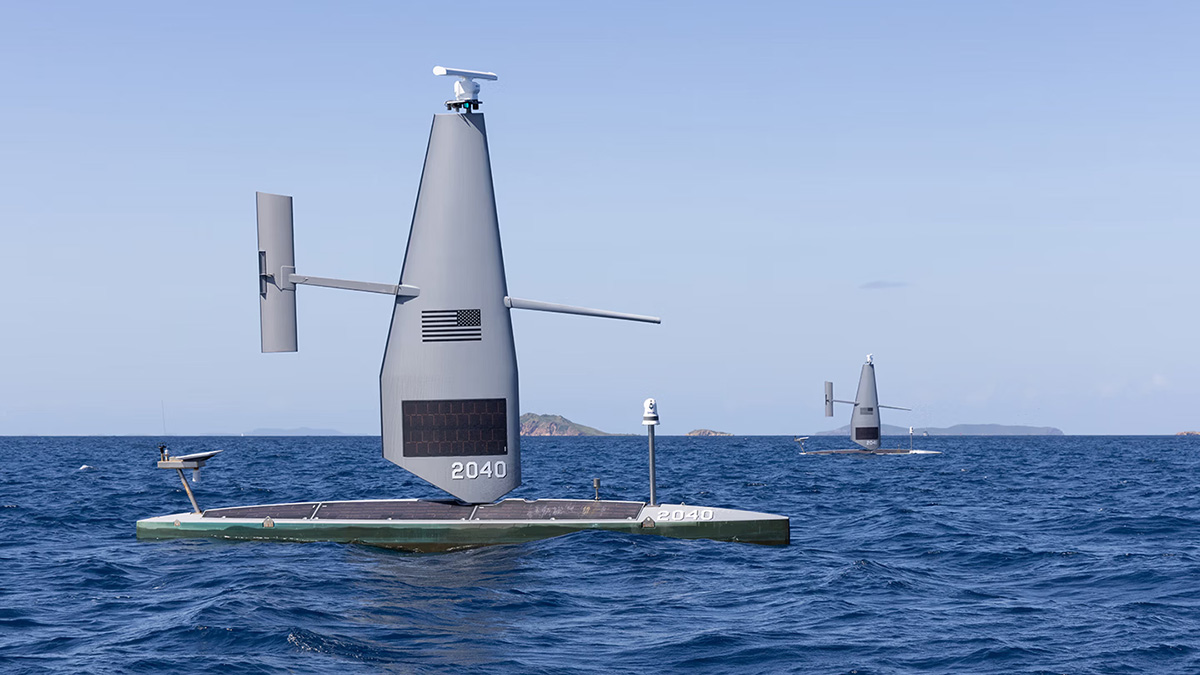
Lockheed Martin and Saildrone have fired two rounds from an uncrewed Surveyor vessel during RIMPAC 2026, using US Navy targeting data and a remotely operated combat system to engage a surrogate high-speed surface threat.
Lockheed Martin and Saildrone have completed a live-fire demonstration from an uncrewed surface vessel during RIMPAC 2026, launching two rounds from a Surveyor-class platform fitted with a Joint Air-to-Ground Missile dual launcher, according to the company.
The demonstration near Hawaii paired the Saildrone Surveyor with Lockheed Martin’s JAGM Dual Launcher and the US Navy’s Adjunct Remote Engagement System, or ARES, for fire control and command and control. Working in coordination with the USS Theodore Roosevelt carrier strike group, the uncrewed vessel acted on targeting information relating to a surrogate high-speed surface craft.
Lockheed Martin said the system progressed from concept to live demonstration in six months, with the work sponsored by the US Navy Fleet Experimentation Program during Exercise Rim of the Pacific. The announcement does not state the precise configuration of the rounds fired, beyond identifying the platform as integrated with the JAGM launcher, nor does it describe the engagement result in detail.
The companies also used the Surveyor to demonstrate a passive electronic warfare capability during the exercise. Operating alongside an MH-60S helicopter, the uncrewed vessel detected, classified and identified a surrogate threat radar system, according to Lockheed Martin. The activity therefore combined remote weapons employment with a separate sensing role rather than focusing solely on the launcher.
Paul Lemmo, vice president and general manager of Sensors, Effectors and Mission Systems at Lockheed Martin, said, as quoted in a news update: “Lockheed Martin and Saildrone are leading the way to leverage the strength of industry to deliver autonomous platforms with containerized capabilities for our national defense. We will continue to invest in new capabilities ahead of need to accelerate and de-risk deployment of urgently needed defense technologies.”
Saildrone founder and chief executive Richard Jenkins said, as quoted in the same news update: “This successful live fire demonstration was the result of pairing one of the most tried and trusted munitions with the most operationally deployed class of USV on the planet.”
He added: “Not only does this deliver mission-ready, kinetic USV capability today, but it also de-risks and accelerates our journey of fitting more sophisticated kinetic capabilities, like the Mk70 launcher, to our larger platform, the Saildrone Spectre.”
The Surveyor test is intended to form the first of several trials involving Saildrone vessels integrated with US Navy combat systems. Lockheed Martin and Saildrone are also looking towards the larger Spectre-class USV, which the companies say is being designed to accommodate heavier containerised payloads. Planned examples include the Lockheed Martin Mk 70 launcher and the Surveillance Towed Array Sensor System, or SURTASS.
The Mk 70 is a containerised derivative of the US Navy’s Mk 41 vertical launch architecture and would represent a substantial increase in weapon capacity and missile size compared with the JAGM installation demonstrated aboard Surveyor. The companies have not announced a completed Mk 70 live-fire integration on Spectre, and the August trial should not be read as demonstrating that future configuration.
JAGM itself uses a dual-mode seeker combining semi-active laser and millimetre-wave radar guidance. Lockheed Martin is promoting the weapon for a wider range of missions, including counter-UAS applications, as it examines ways of adapting existing missiles and launchers to uncrewed maritime platforms.
Further testing is planned to expand the types of payload carried by Saildrone vessels and examine how larger uncrewed platforms can be incorporated into Navy combat systems. The Surveyor firing establishes that a commercially derived USV can receive targeting information through the ARES architecture and conduct a remotely controlled live-fire engagement at sea, while the more heavily armed Spectre configuration remains a subsequent development objective.






I did not have sail powered eco-friendly attack drones on my bingo card today but, this has to be one of the cooler concepts developed recently.
Bring back the age of sail!
Hated sewing the sails awful for the nails
Righto, Victory’s under DAMP as we speak 🙃🕳️🇬🇧👍.