

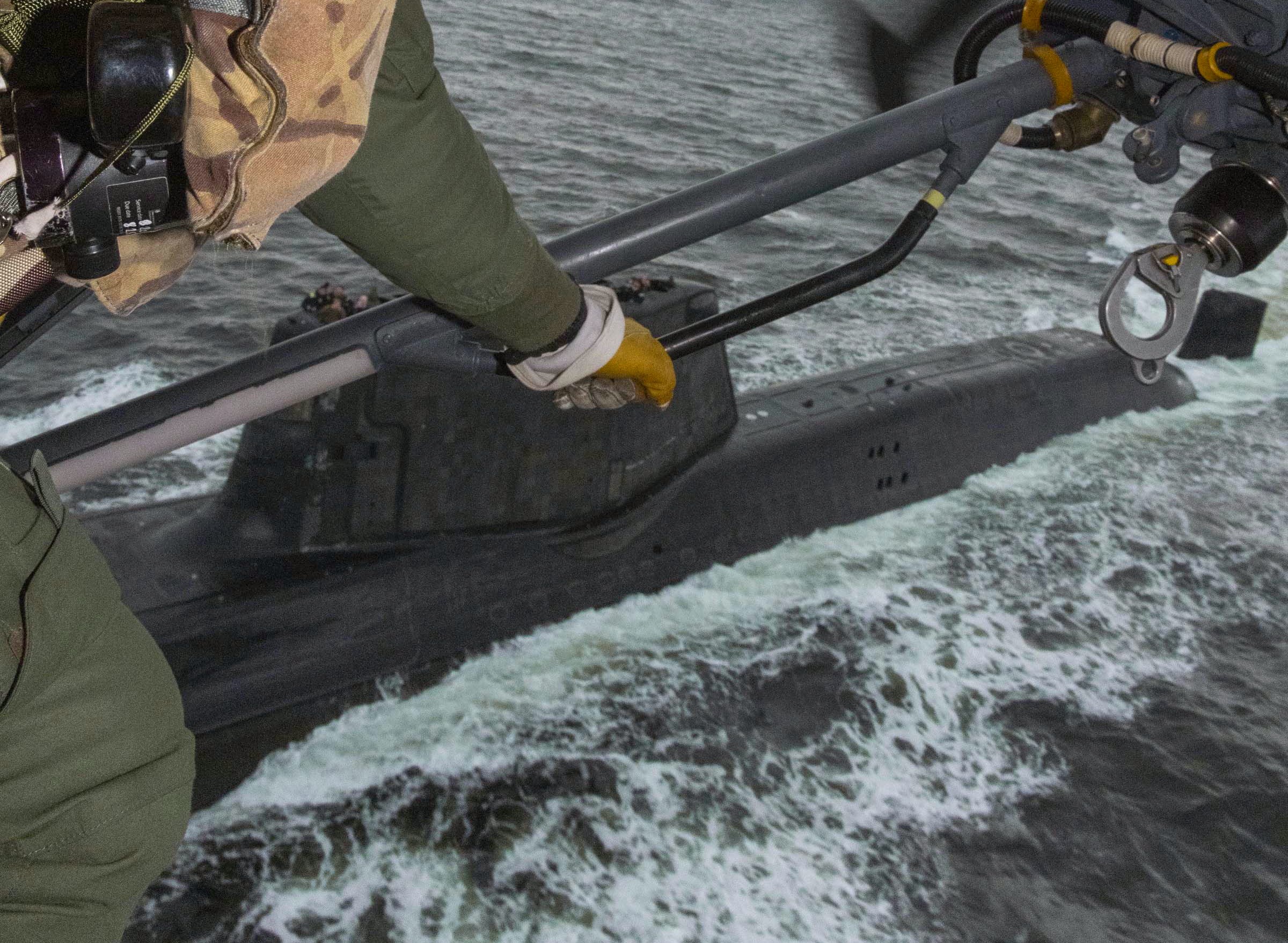
Britain and its allies are struggling to contain Russian submarines, the First Sea Lord has said, in an unusually direct assessment given in an interview for the Council on Geostrategy’s Defence Talks podcast.
General Sir Gwyn Jenkins, the first Royal Marine to lead the Royal Navy, was asked what threats concern him most in his own environment. He pointed to a real growth in Russian undersea capability, and then went further than the service normally does in public.
He said: “We are, if we’re really honest, as allies, we are struggling to contain very capable submarines, a very advanced so-called research programme, which is directly aimed at our critical underwater infrastructure.”
He was equally blunt about the organisation running that programme, which Moscow presents as a deep sea research directorate. He said: “Let’s not kid ourselves. It’s not a research agency. It is an independently funded arm of the Russian state, whose sole purpose is to pursue the destruction of critical underwater infrastructure, in particular in the event of a transition towards war, or just as an economic leverage for the Russian state.”
The context he set out is Britain’s dependence on the sea. The country relies on it for its data, virtually all of its trade and virtually all of its energy, with cables, pipelines and interconnectors running out from the coast in every direction and no practical means of guarding all of them at once.
The Main Directorate of Deep Sea Research, known by its Russian initials GUGI, operates a small fleet of specialist vessels and deep diving submarines, including the mother ship Belgorod and the Yantar, the survey vessel British ministers have previously described as designed to threaten underwater infrastructure and which the Ministry of Defence confirmed it was tracking in November 2025. The directorate reports separately from the Russian Navy proper, which is the arrangement the First Sea Lord’s reference to an independently funded arm of the state describes.
The answer he is pursuing is Atlantic Bastion, the layered effort to monitor the approaches and protect both undersea infrastructure and the patrol areas used by British nuclear submarines. Its surveillance element, Atlantic Net, is a network of autonomous sensors connected by data links, and the First Sea Lord said the Navy has down-selected to a preferred consortium, expects to be on contract later this year and should have the first sensors in the water by the end of it.
Britain’s own anti-submarine force rests on the Astute-class boats, the Type 23 frigates now being replaced by the Type 26, and the P-8A Poseidon fleet at RAF Lossiemouth, all of which are committed to protecting the deterrent and the carrier strike group alongside the wider North Atlantic task.
Listen to the full interview
The conversation runs a good deal wider than the extracts covered here. Over the course of the episode the First Sea Lord also discusses reforming officer selection and training, how the Navy intends to unleash innovation at the front line, the three strands of the Atlantic programme in Bastion, Strike and Shield, the relationship with industry that the hybrid fleet depends on, and his own reading of how the strategic picture has changed since he joined the military at the end of the Cold War. Interviews with a serving First Sea Lord at this length are rare, and anyone with an interest in where the Royal Navy is heading over the next decade will get considerably more from listening to it in full than from any write-up.
General Sir Gwyn Jenkins was interviewed by Viktorija Starych-Samueliene and Paul Mason. The episode is available on YouTube, Spotify and Apple Podcasts.
Defence Talks is produced by the Council on Geostrategy, a London-based think tank founded in 2021 which focuses on British foreign, defence and trade policy, the Indo-Pacific and the geopolitics of technology, and which publishes the journal Britain’s World alongside its research output. The series is delivered in partnership with ADS Group, the trade association representing the British aerospace, defence, security and space industries, and is sponsored by BAE Systems.



Just as well the type 31 possesses no sonar and barely any ASW capabilities. Have we not learned the lessons from the Falklands where shortcuts cost lives
Polish A140/T31 are getting Captas 2 towed array. The RAF has publicly stated it needs a minimum of 12 P-8. Now they have gone up to $328 m each, I sadly doubt HM Treasury will stump up for the extra 3.
Correct me if I am wrong but currently still none of the Astutes are in service and only a few ageing type 23’s. No wonder we are struggling to monitor the Russians.
So it is allies that are struggling because RN have no ASW ships and submarines do no get out of port…
I wouldn’t be surprised if by now most of our undersea assets have charges laid next to them to cut us off in minutes.
Our governments have done an appalling job on defence and relaxed far too much post cold war, and with piss-poor planning to boot.
Not to Woory HEALEY to the Rescue…
Sadly a man that seems to have gone AWOL ..
Dare I say Taken us all for fools ..!
‘…data shows that global concern specifically regarding inter-state military conflict has risen significantly. For instance, nearby European neighbours like Poland saw concern over military conflict jump to 40%.’
But not in Britain, Germany or France: ‘Climate change 1st Place (or tied for 1st) in the UK, Canada, and Germany. Outpaced individual mentions of hostile state actors when framed as a “macro threat to global stability”.
Until that changes, and it won’t until it is too late, Britain’s armed forces will continue to ‘suck on the hind tit’
Without firm political leadership on defence of the realm (not happening before the next election, probably not even after that), we are fecked, well on the way to being comprehensively fecked…
Well they best get a move on and order more Type 26’s so make up for the ones allocated to Norway.
Having all our Astutes alongside really isn’t helping, plus the shortage of P8s and Type 23s. Has the sonar fitted to the Type 45s been re-activated? Plus of course the Tupe 31s have no anti-sub capability…..it seems our governments continue to forget we’re an Island. . surrounded by water…