

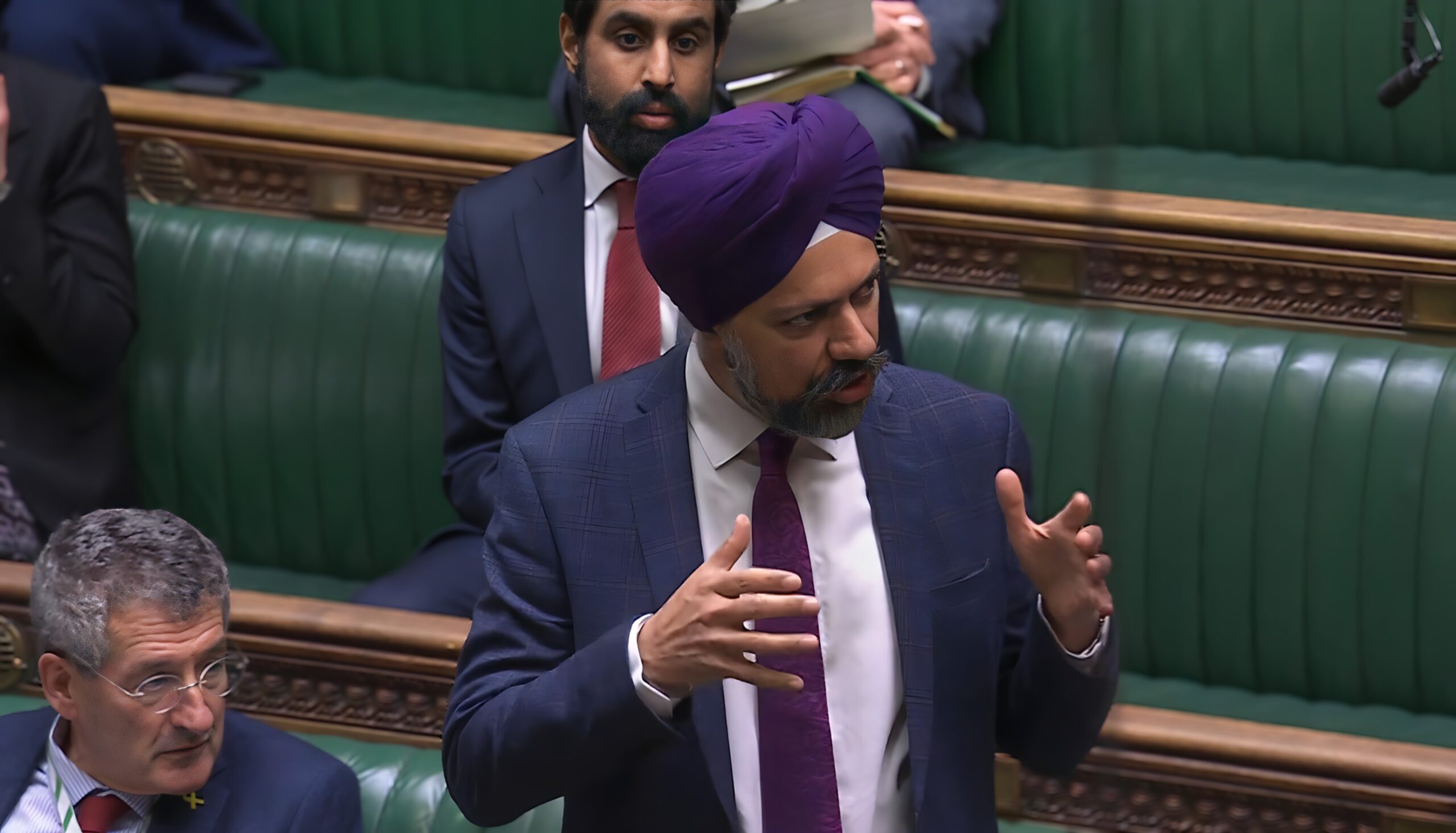
The Prime Minister has told the Commons that he has already committed to a pathway to spending three per cent of gross domestic product on defence, in response to a question pressing him to do so urgently rather than waiting for a future fiscal event.
Tanmanjeet Singh Dhesi, the Labour MP for Slough and chair of the Defence Committee, put the question at Prime Minister’s Questions on Wednesday.
He said: “The British people should be under no illusion that the nation faces a significantly increased threat level, especially from Russia, but also that we have a US leadership for whom European security is no longer a focus or a priority. That is why it is imperative that we invest in our armed forces in the here and now, rather than being sorry later. Indeed, defence is definitely one area where vibes alone just will not be enough.
“Rather than kicking the can down the road, waiting for a fiscal event in a future year, will the Prime Minister urgently commit to charting a pathway to reaching 3% of GDP being spent on defence by 2030? As his Chancellor rightly noted, that is critical to keeping our country safe.”
Andy Burnham replied: “I have made that commitment, I have made it very clearly, and I have done so for a considerable time. I was in Ukraine last week for a very specific reason: to repeat it on the world stage. My hon. Friend can be absolutely sure of that.”
He went on: “Alongside our commitment to defence, we also have to build the resilience of Britain. We need to ensure that the maximum amount of the funding committed to the defence investment plan goes back into the reindustrialisation of our communities. We should do more to maintain sovereign manufacturing and production capability here, and that will be a theme of my Government. We will make sure that British taxpayers’ money goes to supporting industry in our own country, to make us more resilient going into the future.”
The exchange turns on a distinction between committing to a figure and setting out how it will be reached. Dhesi’s question asked for a pathway, and specifically for one that does not wait on a future fiscal event, which is the point on which the government has previously declined to be drawn.
Wes Streeting, the Defence Secretary, has argued that announcing a spending figure without setting out how it will be funded invites a loss of market confidence and rising borrowing costs. He has said he has every confidence the Defence Investment Plan will be fully funded, and has not ruled out tax rises as part of the answer.
The Office for Budget Responsibility has previously put the cost of reaching three per cent at an additional £17.3 billion in 2029-30. Behind the domestic argument sits NATO’s push towards 3.5 per cent of GDP on core defence by 2035, agreed at the alliance summit in The Hague.
The second half of Burnham’s answer picks up a theme the government, current and former, has been developing through the Defence Industrial Strategy and the Defence Investment Plan, which commits £298 billion to defence over four years.
The department has pointed to figures published last month showing that spending with industry supported 274,000 jobs across the United Kingdom in 2024/25, with £31.9 billion spent, including 12,200 direct jobs in Scotland where shipbuilding and submarines account for 7,900 of them. Jobs supported by spending on weapons and ammunition manufacturing rose 51 per cent across the country over the same period, an increase the department attributes to the drive to rebuild what it calls an always on pipeline of munitions supply.











Committed to producing a pathway to something not even in this Parliament. That’s an awfully long way from actually reaching 3%. First the commitment, then the pathway, which will be produced nearly three years into the five-year Parliament. Three years to get there of which two years will be in this Parliament. And that’s the easy part as there are still things that can/will be fiddled by bringing current spending under the defence umbrella, rather than actually increasing spending.
I’m minded of an old proverb about charity: what you give now is gold, what you promise to give in your lifetime is silver, what you give after your death is mere brass.
🥱
I do not see 3% by 2030 being remotely feasible. Finding the extra £17bn per year would require taking a scythe to not just welfare spending but right across public services. No government is going to do that, because the public would rebel against further cuts to key services that have already been cut to the bone during the many years of austerity.
Fellow NATO members are in the same boat, except that EU members can draw funds for equipment and infrastructure from the EU’s SAFE scheme. (Long-term, low interest loans guaranteed by an EU fund). The Treasury is apparently against this approach, because it means more borrowing and interest. But in Germany and elsewhere, the SAFE money is being excluded from.the national debt, because it is, in City terms, a long-term, repayable investment, not borrowing to pay for day-to-day running costs. Unless we have that kind of option.open to us, getting to 3% in under 4 years is a forlorn hope.
As it stands, HMG has to first find the missing £5bn from the DIP equation. Healey needs to do that in next month’s budget or cut some of the planned defence capabilities. The signs are that he will find the money.
At next year’s spending review, HMG will lay out the plan for how we get from 2.5% to 3.5% by 2035. It will most likely be a linear increase of 0.15% or so every year from 2028/29 to 2035/36. That would get us to something like 2.8% by 2030/31. It is probably the best we can hope for. On the positive side, defence spend will be up 20% on what Labour inherited in 2024. So pint half full.
Healey’s big challenge is to break Treasury orthodoxy regarding avenues to top-up defence budget, such as the SAFE-style fund proposed by Canada and Carney, or defence ‘war bonds’, or a sovereign defence investment fund involving the City, or some such plan. Failing that, HMG is going to have to bite the bullet and put a penny or two on the tax of middle and high earners, which will get a squeal of protest from predictable political quarters.
For Kemi to be banging on about 3% by 2030 is a bit rich, given the hammering defence spending took in the previous 14 years of Conservative management.