

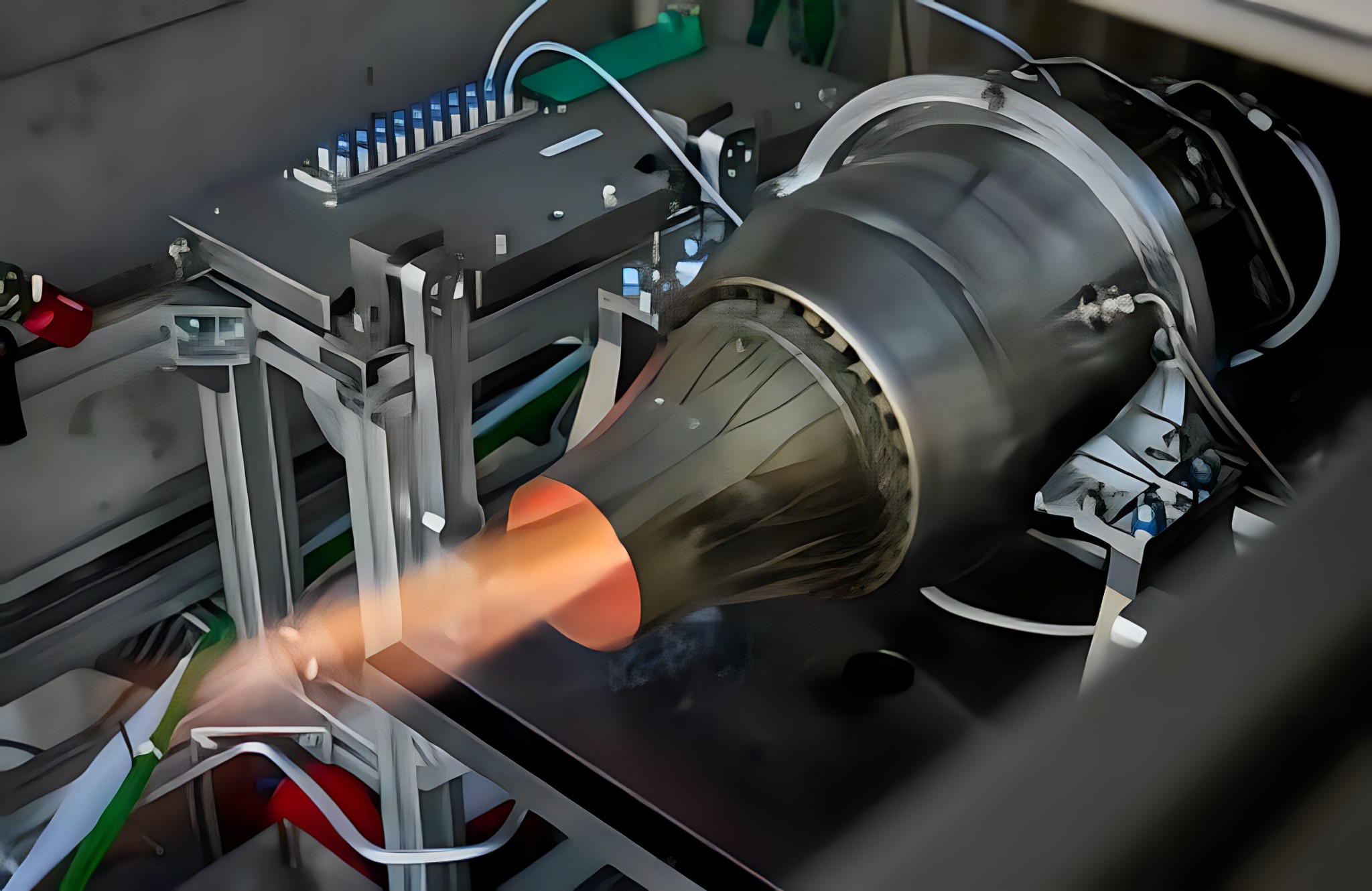
Britain has developed a new family of domestically produced turbojet engines, with one design taken from the drawing board to the air in less than seven months and a smaller engine already entering serial production, the Government has announced.
The programme is being run by the Ministry of Defence’s Strategic Capabilities Office with UK start-up Alloyed, combining government investment with matched funding from the company to establish a sovereign British propulsion capability for future weapons and aircraft.
The family spans engines producing between 30N and 2,000N of thrust, covering potential applications ranging from relatively small uncrewed aircraft to larger systems.
Two engines have already moved beyond the initial development stage. A 300N-class engine has completed flight testing and is now in serial production in the UK, while a larger 1,100N-class design progressed from its initial concept to flight-ready status in less than seven months.
The Government said the work had established the ability to design, manufacture, test and support this class of engine domestically, reducing reliance on overseas propulsion supply chains.
Defence Readiness and Industry Minister Luke Pollard said: “Taking a jet engine from concept to flight-ready in just a matter of months shows how defence and industry can work together to deliver capabilities at the speed required by today’s world.”
He added: “The threats we face demand the ability to produce cutting-edge technology on demand and at scale – this programme delivers that, combining sovereign manufacturing, digital engineering and industrial innovation to ensure our Armed Forces retain an operational advantage, while delivering good jobs for working people here in the UK.”
Digital design and production
The engines have been developed using a digitally led engineering and manufacturing process intended to reduce the time between design, testing and production.
Alongside the engines themselves, the programme has established a UK-based digital design and modelling capability which the Government says can be used to develop new propulsion systems and variants in months rather than years.
The approach combines digital engineering with modular design, allowing elements of an engine to be changed or improved without requiring a complete redesign of the propulsion system.
Alloyed chief executive Michael Holmes said: “Working alongside the Ministry of Defence has enabled Alloyed to bring to bear its world-leading metals technologies to mature and demonstrate advanced propulsion systems at remarkable pace while building a lasting capability in the UK.”
He added: “This programme shows the power of combining defence expertise, digital engineering and industrial innovation.”
The 30N to 2,000N thrust range would allow the underlying technology to be applied across systems of markedly different sizes, while the modular architecture is intended to make later adaptations easier as operational requirements change.
Production expanding in Britain
More than 60 engineering and advanced manufacturing jobs have already been created through the programme, according to the Government, with a further 45 positions expected during the next 12 months as production increases.
The work also involves more than 40 suppliers across the UK, most of them small and medium-sized businesses.
The co-development model differs from a conventional procurement in which Defence specifies a finished system and then purchases it from industry. Instead, the Strategic Capabilities Office and Alloyed have jointly funded and developed the technology, with the aim of shortening development cycles and retaining the resulting industrial capability in Britain.
The Government said the programme supports commitments in the Strategic Defence Review to strengthen the domestic defence industrial base and increase the speed at which new technology can be developed and fielded.
There is also an export ambition, as Ministers said the propulsion technology could eventually be offered to allies seeking domestically supportable or resilient engine solutions, although no export customers or specific overseas programmes have yet been announced.
For now, the most concrete result is the move into production of the 300N-class engine and the rapid development of the larger 1,100N design, giving Britain a new domestically based turbojet development and manufacturing capability spanning a much wider family of future systems.












Two 2kN class engines is what is supposed to power MGI’s Vortex ultra cheap ACP, so being able to produce a lot of them is a good thing. Also the 1.1kN designs power MGI Tigershark, for Project Brakestop.
For old fashioned people like me, who are used to thrust being quoted in pounds, a newton equals 0.224808943 pounds of thrust.
Cor! I bet Rolls Royce, BAEs and the Usual Defence Contractor Suspects are spitting nails at this hyperspeed development by small and emerging companies!
Great news! Industry can move quickly but is usually hamstrung by HMG indecision and prevarication – Then foreign predators come and buy up our best ideas. We end up losing the tech edge, exports, jobs. Hopefully this will not happen on this occasion.
Alloyed were founded in 2017 and are an Oxford University spin off using digital design and 3D printing. This has the advantage that their end product is ITAR and export restriction free. I believe they intend to franchise local manufacture to friendly allies and pass digital manufacturing files.
Will give PBS Aerspace and others a run for their money
O/T but drone related. The DT is reporting that Burnham is considering helping Saudi Arabia defend its east-west pipeline pumping stations from Iranian drone attacks.