

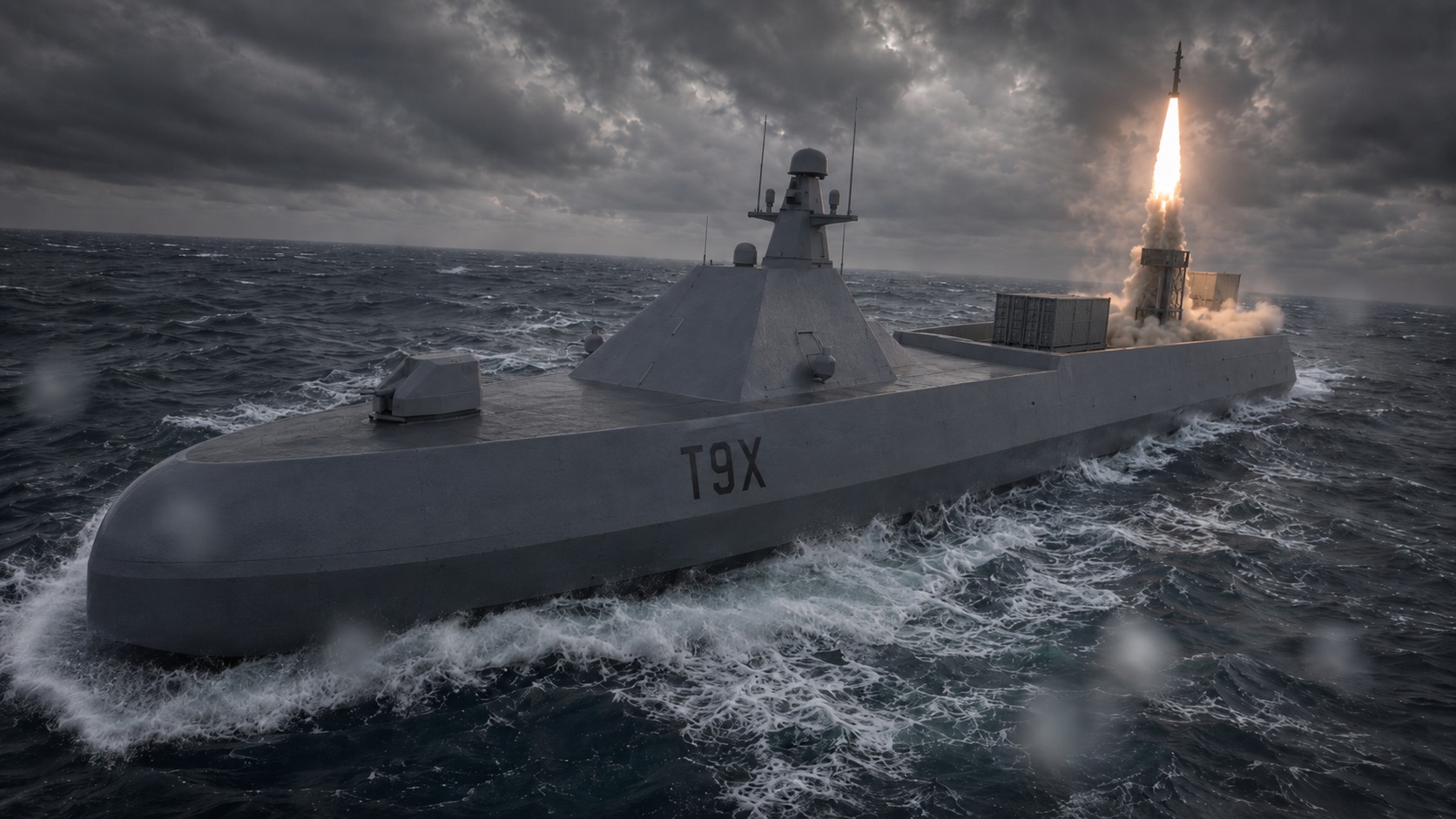
General Sir Gwyn Jenkins, the First Sea Lord, has rejected criticism that the hybrid navy is too ambitious, saying Britain will lose if it faces an opponent that has adopted new technology and it has not, according to remarks made at the International Sea Power Conference.
Speaking on board HMS Prince of Wales in Oslo, Jenkins said: “And what is often leveled at me: you’re going too fast. The hybrid navy is ambitious. The technology is not ready. You need to slow down. I reject all of that. I reject it all because it is not a choice. The only risk, the only risk that I’m interested in, is that if we have to go to war, we are not ready. We can’t afford to be in that position. We have to embrace what is available to us now, because if we find ourselves against an opponent who has done so and we have not, we will lose.” He added: “Our job is to win.”
Jenkins told delegates that his job was to be ready, whether or not a wider war comes, and to work out how to harness the best available technology. He said: “But to do that, we’re going to have to take some chances. We’re going to have to take some risk.” He described the conference as a place for action, adding: “This is not another talking shop.”
Jenkins made a similar argument in August, telling the Council on Geostrategy’s Defence Talks podcast that the Navy would “probably lose” against an opponent that had shifted to autonomous warfare while Britain had not, while war games showed conventional warships were still needed.
The Royal Navy commissioned its first autonomous squadron in Portsmouth last week, and Luke Pollard, Minister for Defence Readiness and Industry, announced at the same conference a framework with Ocean Infinity Solutions for Atlantic Net, the first of the Navy’s Atlantic Bastion capabilities.




We need the Navy to be modernised and for its lethality to be increased very quickly. What we do not need to do is to draw down the manned ships too quickly, and preferably not at all! Apparently only three out of our seven frigates are available for sea duties.
The thing is, it’s not about moving to fast… you cannot really be “to fast” to adopt something as generally early adopters do get the advantage.
But the question is “ are you making it all about autonomous systems over crewed ships when we do still require ( and probably always will) crewed ships.
It should not be a zero sum game between autonomous and crewed, autonomous should enhance the power of crewed ships.
This may mean you change what a crewed ship looks like and the capabilities it has, as each crewed ship becomes a spider in a web.. I can see a time when essentially every crewed surface combatant essentially becomes what the carrier now is to the carrier battle group.. the crewed ship will need a large flight deck, boat deck, command and control and crews to manage and maintain a drone fleet, with good self defence… but its main sword and shield becomes the autonomous systems it deploys and controls ( just as the sword of the carrier is its air wing and its shield is its escorts).
A T31 with an autonomous C&C in its mission bay and a pair of each of the T9x vessels under its control is no longer a patrol frigate it’s a sea control fleet… you may say yes but the T31 is the weakness kill that you kill the drone fleets cohesion and local C&C yes but if you kill the carrier you have essentially killed the carrier battle group.. it’s now just a Surface action group.
In the end they should crack on with this as fast as possible, but they should also crack on with building surface vessels as fast as possible as well.. so get the T31s build ASAP move straight into the CCV build as soon as space is free and as soon as the T26 line has a space start building the next iteration on that line..
It will be interesting to see what the final iteration of a crewed vessel at that heart of a drone fleet looks like once blue water drones have fully matured, but it’s probably not going to be anything like a modern destroyer or frigate.. it’s probably going to be very big, have its own organic air wing, have a big well deck to carry repair tenders for the larger autonomous vessels and even some of its own medium/small sized autonomous vessels, have good self defence and may have its own very good sensors or it may not..have significant command and control as well as comms.. I suspect it will be as quite as possible to hid in its web… I can imagine a late 21c autonomous fleet command and control ship looking a lot like an Italian aircraft carrier or a US amphibious flat top… but with the amphibious side of these vessels essentially converted to sea control and autonomous fleet management.
Agreed. I hold great hope for the T91 92 93 94s.
I’ll be happier once they’re ordered in proper quantities and the procedures for docking, resupply, repairs and all the rest explained, let alone interference in international waters.
The mothers are like a big RFA, a factory ship for the smaller ones to berth with. Negate the mother, then what?
Yep, you negate the mother and you negate a lot of the capabilities of the drone battle group.. but essentially that’s the same weakness as any surface group, kill the carrier kill the carrier battle group, kill the amphibious vessel kill the amphibious group..
The technology allowing the provision of the Command Ship, remote unmanned Sensor platform and remote unmanned launch platforms is nowhere near ready. If an Area Defence capability is to be maintained into the early 2040s T45 and Sea Viper are the only available solutions. Type 83 having gone. I am no longer sure what FADS is supposed to comprise.
I see the size of the vessels commissioned last week and feel that they’re a long way from a full-size blue-water asset.
Until they retire, we’ll never hear from the RN engineers who hit a glass ceiling at Rear Admiral. Today, what do they really think is achievable in the next 3 to 5 years? Whilst a relatively small vessel might be able to drag a towed array through the water to work with a Type 26, can the same be said of a fairly massive radar array such as SPY 6 or SPY 7 or CEAFAR bobbing about on a ‘sloop’ whilst trying to provide data on small, very fast moving ballistic and hypersonic threats? The Chinese, US and Italians don’t appear to think so.
Finally, these are supposed to be relatively cheap and attritable platforms. Are they really? If so, they should be speaking in terms of ordering dozens of them but, they won’t because, they aren’t. Most of the spectacular images we see from Ukraine and Iran are suicide/kamikaze weapons. Low budget and for use just once only. These sloops are not attritable so, they will morph; they’ll need self defence such as 40 mm gun systems. There will be system failures and so, a small engineering detachment will be on board for quick repair cycles. They’ll require food and sleeping quarters. The vessels will get bigger and bigger as the months and years of development pass. Finally, it’ll look and smell like a frigate!
The technology and new techniques is not ready yet.
IMHO the main risks of uncrewed fleet are:
Signals/Communication links between CCV and drones – data reliability and possible Latency bottlenecks under combat conditions
Communication links signal attenuation (especially on high seas)
Seaworthiness and sailing as a large flotilla
Maintenance, fault detection and mitigation.
Battle damage detection and control
Rearming refueling at sea
Risk of Boarding and Sabotage or electronic hijacking
Ideally, this tech should be developed in parallel with the T-83 , not instead of it