

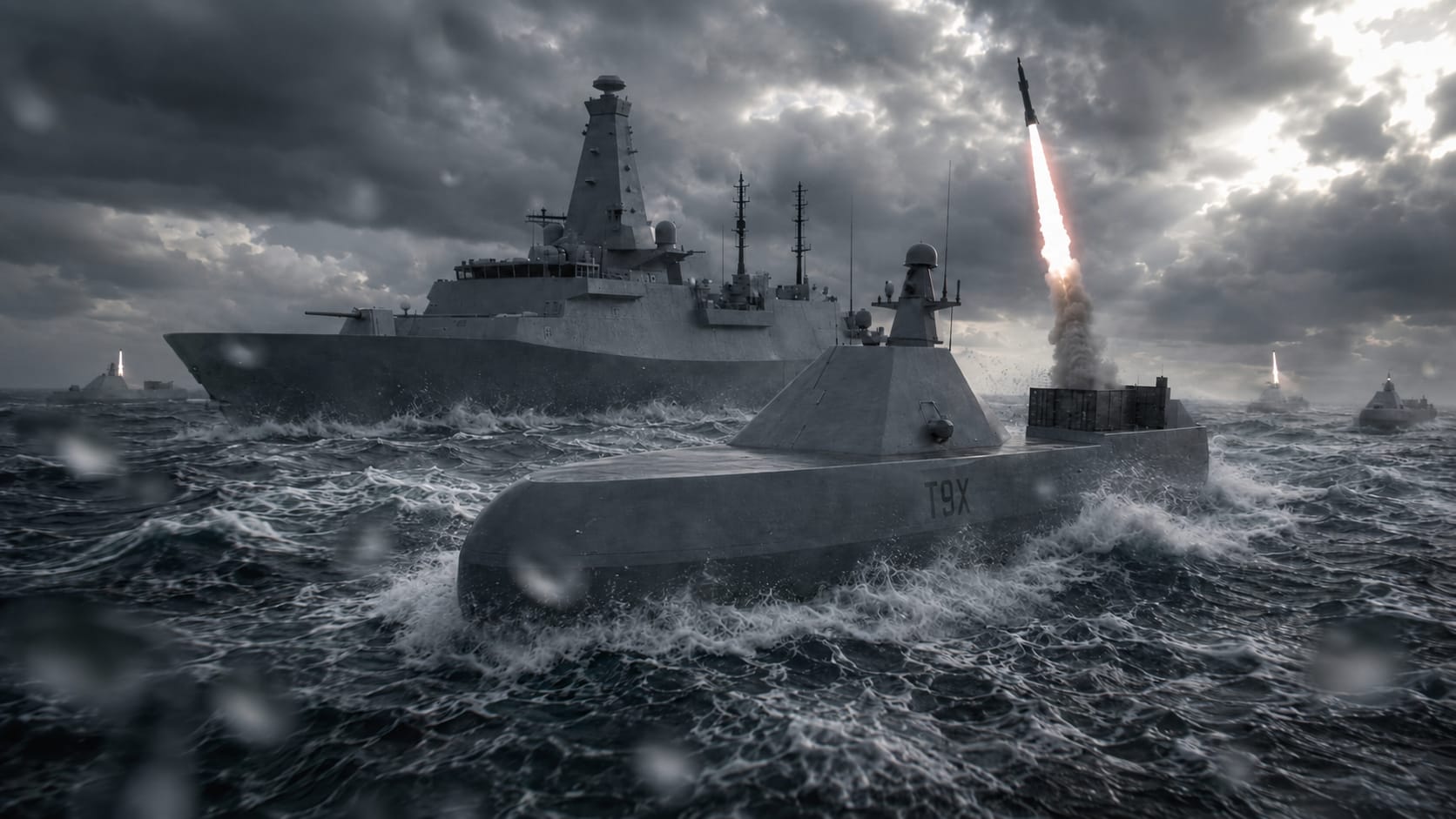
The Royal Navy would probably lose a war against an opponent that had made the transition to autonomous warfare while Britain had not, the First Sea Lord has said, in an interview for the Council on Geostrategy’s Defence Talks podcast.
General Sir Gwyn Jenkins, the first Royal Marine to lead the service, told Viktorija Starych-Samueliene and Paul Mason: “If we were to find ourselves fighting an opponent who had transitioned to autonomous warfare, and we had not, we will probably lose. And my job is not to lose. My job is to win.”
He said that made the shift a necessity rather than a gamble. “I don’t see it as a risk in embracing this transition. I see it as an absolute necessity. You must do, and we have to do it.”
The lesson he draws is explicitly from recent fighting. “I think the lesson to draw from the Black Sea and now the Straits of Hormuz is if we were to find ourselves fighting an opponent who had transitioned to autonomous warfare, and we had not, we will probably lose.”
He described the change facing navies as fundamental rather than incremental. “I kind of describe this as, it’s an overused phrase, but this is a paradigm shift. It is a fundamental reframing of what maritime power is and how we will wield it.”
Asked directly about the purpose of a surface platform in an age when it can be found and destroyed by asymmetric means, he said the answer is not that warships become irrelevant. “I don’t think it makes the manned warships irrelevant. I think it just changes the way that you’re going to operate them, and it changes the way you achieve mass.”
On the detractors, he said: “Much like any good historian will tell you, there were plenty of detractors back at those transition times. Plenty who argued that steam would never replace sail. Plenty who argued that aircraft carriers were irrelevant. Plenty that said that submarines were ungentlemanly and shouldn’t be pursued. There are plenty now questioning this transition as well, but my perspective as running the navy is we have no choice here.”
‘Not a research agency’
The First Sea Lord was blunt about the Russian organisation conducting what Moscow describes as deep sea research, saying its purpose is destruction rather than science.
He said: “Let’s not kid ourselves. It’s not a research agency. It is an independently funded arm of the Russian state, whose sole purpose is to pursue the destruction of critical underwater infrastructure, in particular in the event of a transition towards war, or just as an economic leverage for the Russian state.”
He was equally direct about how well the alliance is coping with the wider undersea threat. “We are, if we’re really honest, as allies, we are struggling to contain very capable submarines,” he said, describing a real growth in Russian undersea capability alongside the so-called research programme aimed at British cables and pipelines.
Britain depends on the sea for its data, virtually all of its trade and virtually all of its energy, he said.
The Black Sea lesson
General Jenkins pointed to what Ukraine has achieved against a far larger opponent, describing it as a warning to every Western navy.
He said: “We only have to look at the war in Ukraine and what the Ukrainian Navy, a navy in name but not in being in the way that we would recognise it, and what it’s managed to do to the Russian fleet in the Black Sea, completely neutralise one of the most advanced fleets in the world. That is a wake-up call to all of us.”
He cautioned against applying those lessons wholesale, noting that the Atlantic is a very different proposition from the constrained waters of the Black Sea or the Strait of Hormuz, while adding that this implies no complacency.
He framed the change as comparable to the great transitions in naval history, from sail to steam, wood to iron, the arrival of the dreadnought, the aircraft carrier and the submarine, observing that each had its detractors at the time.
Crewed warships are not going away, in his account, but their role changes. He said the Navy has been running service-wide war games to test the hybrid fleet, and that “time and again, the tests come back with you still need conventional warships in this mix. They’re just further back and have a slightly different role.”
Interchangeability
On allies, General Jenkins set out an ambition beyond the familiar language of interoperability.
Interchangeability, he said, means it is agnostic which nation is in a given place conducting a task, with each navy acting for the others’ collective requirements and able to exchange capabilities.
The Norwegian Type 26 agreement is the vehicle for that. Norway will build identical ships, and he said Norwegian sailors are already working alongside British crews on HMS Glasgow in Scotland before she has been launched.
Other Joint Expeditionary Force navies have noticed. Chiefs of navy signed a statement of intent in London a couple of months ago for what he called the enhanced JEF Navy or Northern Navies concept, covering training, doctrine, capability and equipment, with formal ratification aimed for November in Norway.
He described the JEF as complementary to NATO rather than a substitute, valuable because it does not require consensus among all thirty-two allies and can therefore move earlier in a crisis. He said the NATO commanders he speaks with welcome it for exactly that reason.
Asked what concerns him most, the First Sea Lord returned to uncertainty, saying alliances feel fragile and pointing to “the rise of state on state contestation, not just competition, and a number of possible scenarios in the future that could lead to even catastrophic events with no certainty that we can avoid them.”
The interview was not, on the whole, a pessimistic one. He described the Royal Navy as still a reference navy that others wish to emulate and follow, said allied navies recognise Britain is leading the world on the hybrid concepts and want to join that journey, and pointed to Atlantic Net as a world leading proposition arriving on a timetable that has the first sensors in the water this year. The Norwegian Type 26 partnership, with identical ships and Norwegian sailors already working aboard HMS Glasgow before she has launched, he presented as the platform on which interchangeability between allied navies gets built.
Listen to the full interview
The conversation runs a good deal wider than the extracts covered here. Over the course of the episode the First Sea Lord also discusses reforming officer selection and training, how the Navy intends to unleash innovation at the front line, the three strands of the Atlantic programme in Bastion, Strike and Shield, the relationship with industry that the hybrid fleet depends on, and his own reading of how the strategic picture has changed since he joined the military at the end of the Cold War. Interviews with a serving First Sea Lord at this length are rare, and anyone with an interest in where the Royal Navy is heading over the next decade will get considerably more from listening to it in full than from any write-up.
General Sir Gwyn Jenkins was interviewed by Viktorija Starych-Samueliene and Paul Mason. The episode is available on YouTube, Spotify and Apple Podcasts.
Defence Talks is produced by the Council on Geostrategy, a London-based think tank founded in 2021 which focuses on British foreign, defence and trade policy, the Indo-Pacific and the geopolitics of technology, and which publishes the journal Britain’s World alongside its research output. The series is delivered in partnership with ADS Group, the trade association representing the British aerospace, defence, security and space industries, and is sponsored by BAE Systems.



Against who exactly? The UK could never again contribute in any real measure to anything. Falkland’s, nope, First Gulf War, nope, protect the shores of the UK, nope. UK pays out more than France on defence and gets way less. questions need asking and answers made to us taxpayers. Get the basics right and simple works best in most cases. Show you have the capability to badly hurt an opponent and your doing the job of deterrence which protects us all.
You have the answer to your question already, autonomy.
I’m not getting the impression Gus wants anything other destroyers, Frigates and carriers.
If he were in the 1930s he would be pushing the tried and tested horse.
Agree 😂
Incorrect in my opinion with almost everything. I think we could get a little more in the way of value for money however
Let’s take the Falklands as an example. Firstly we are there and holding the islands for as long as the islanders want us to. Argentina currently lack the necessary to get a foot in the door. The RN could take back the islands with just one carrier group in my humble opinion.Argentina knows both of these things. That is deterrence.
In my view we need autonomous systems in addition to what we currently have. We have a blank canvas in that area. The Ukraine conflict is showing us what works and what does not. That is by far the best comparison rather than with France who have also become just as complacent as the UK, Germany, US etc. as they have not been in a serious war for about 80 years.
” The RN could take back the islands with just one carrier group in my humble opinion.Argentina knows both of these things.”
What? how, there are no escorts, no troops transporters.
Not ideal numbers but we do have escorts. Troop transport should not be an issue.
People on here are, rightly, always pushing for more assets. I can’t recall anyone suggesting we have no assets.
You have escorts? What do you go there with? 2 T45 and how many T23 can go to South Atlantic? 1? 2? and how do you make any rotation?
Yes we have escorts. I’m not anticipating any need to actually go to the Falklands at all so having a hypothetical discussion over what we would send would depend upon the circumstances at the time (if it happens). Suffice it to say if we needed to do a job at any point in time I am confident we could do it. Let’s be blunt the UK is normally way ahead of it’s allies fighting for what is right long before anyone has noticed the difference between right and wrong.
Retaking Falklands cannot be an argument for uk naval strategy.
Deterring aggression is the object of any exercise. What we have currently works.
I agree that one carrier with 24 F35B; Astute; 2 x T45 (post Napier that won’t be an issue) and some frigates (and there is the problem) would be far more powerful than the ‘82 task force was
BUT
The ‘82 task force had depth; took hits; carried on fighting.
Correct SB – we are short on Frigates that is true but we do have some still.
Totally agree there was depth in 82 – that said the T45 is 10 times the lethality of the T42.
Don’t think Argentina would have wanted to get vaguely close with their forces in 1982 or let’s assume thirty or so F16s they have produced from somewhere as if by magic.
Much of our defensive strategy for the islands rests on the ability of the Argentinians to take the islands in the first place and not lose all their assets doing so.
Part of a deterrent strategy is to make the whole thing look impossible.
Well I suspect they are suitably deterred (and have been for 40 years). They have very little to work with. To invade the islands and take MP would be a miracle and then to hold it against the inevitable British response. Also to risk attack from one of their neighbours whilst they are distracted. Can’t see it happening however I’m sure we are being ever vigilant.
Given what we are seeing in Ukraine it’s seems mental to me anyone is even asking questions about autonomy being the future. Of course it’s the future, the only question is when is it ready and the RN is doing exactly the right thing. Setting forth a program while retaining the ability to extend its existing assets.
This is the same pragmatic approach that saw the RN spend large amounts of money upgrading Queen Elizabeth class battleships while order more aircraft carriers than modern battleships in the late 1930’s
The need for a hybrid navy is so great that we are the only country doing it, or are we just saving money?
Off all the navy’s in the world to do this you would expect the UK to be first or second. We do operate the world’s second most advanced navy and many of our capabilities are the best in the world.
The US was also rapidly moving this way until they get a president who believes in battleships and steam catapults.
You are looking at the same navy as me are you Jim? Carriers mostly in port, no available nukes, destroyers well behind scedule for upgrades, five frigates overdue for retirement, next to no amphibious capability.
You might be interested to know that our new chancellor has decided not to mentioin the promise of three per cent in his first budget. There is going to an announcemnet before the end of 2027 laying out a “pathway” of how it “might” be acheived. What a surprise. Of course he’s got the job he wanted now hasn’t he.
Got to agree with you what RN is Jim referring to?
Of course you will be aware you can have highly advanced weapons that spend the vast amount of their time in maintenance, on average more advanced capabilities spend more time in maintenance. See F35 for details but I would not like to try and fight an F35 in an F16 no matter how many ours maintenance the F35 has to do.
It’s clutching ay starws time again is it?
He is right Geoff. Its not just about simple numbers. Every navy has warships and boats and logistics vessels in refits and maintenance. And can’t do everything all of the time. Our enemies are just as constrained.
Robert, I’m sorry but if we were down to the last frigate and the last aircraft i tnink you would come up with an explanatin as to there not being a problem. You and I have watched for years the decline, the decimation of our armed forces levels, and yet there are still comments to the effect that evrything will be all right. Well, I don’t accept that and I never will, even though there is precious little I can do about it.
Of course it’s a problem, but new very capable warships are in build and we will be back to 19 Escorts. We have many layers to our defence capabilites that go beyond just Frigate numbers. And the close work with our NATO allies. We have to move away from just thinking it’s our 5 T23s against the rest of the world
Exactly. We can’t afford to risk potentially large sums of money on autonomous platforms that remain unproven beyond very limited demonstration.
Whether 19 surface escorts and 6/7 SSNs are sufficient can’t be properly assessed because we have nowhere near those numbers actually available and won’t for many more years.
Judging by what it can currently deliver, it is hard not to see the RN as a colossal waste of money- a sad indictment of years of poor decisions and leadership.
The RN can deliver a carrier strike group anywhere on the planet and has run a continuous capability to destroy any hostile nation on earth in 30 minutes. It’s provided this capability continuously and completely uninterrupted for nearly sixty years. Please list all the nations on earth that can’t do either of those things.
People get so bogged down in the minutiae of frigates that they are unable to see the woods for the trees.
The reality is frigates achieve very little, the RN had far too many frigates for too long. They were a near complete waste of time in every conflict we have fought since world war 2. If the Cold War ever turned hot our fifty frigate fleet of largely cheap as chips barely able to find submarines (T42,T12,T21’s) would have been whipped out by the Soviets 400 submarines pretty fast.
Despite its temporary set backs and availability problems the RN is far more capable that the shower of shite we sent to the Falklands in 1982. A fleet that was built to the absolute cheapest possible standards and asked to do the near impossible and it only succeeded because of the absolute professionalism of the men and the ineptitude of the enemy.
People responsible for platforms like T42 and T21 should have been tried for treason, it didn’t matter how many of them their was.
One carrier now and agin with planes lent by the RAF with no escorts. That’s the end game Jim is it. Well, God help us.
T42 was an AAW destroyer……
ASW frigates are rather important as 1SL clearly states that Russian subs are a real threat..
Good point. Lots of design and operational challenges with the Type 91 and 94. It’s valid to debate T83 or equivalent ( new Italian DDX concept). Less so with Type 92 ASW, which fortunately is the highest priority.
Having lots of ASW tugs with a towed array does make a lot of sense.
Something like hybrid drive so they can run silent on the hunt and then recharge whilst waiting for the next tasking.
Yes, but it’s all very advanced stuff which is my point, not the maintenance state 🤦
And abandoning the building up of their only dedicated drone brigade replacing it with troops with hyper hormone induced lust for war fighting apparently. Difficult to know presently as a result of the madness of the Supreme Commander what the US really wants, anyone who expresses an opinion other than Trump and Hegseth get sacked.
Still this commitment to drone ships by the UK is still somewhat risky simply because so much of the technology has yet to be proven. I think the move is a logical one but the question to be answered is how far and fast we should take it. For a start if you can’t guarantee this system cannot be hacked or interfered with you will, if you don’t have enough manned warships be in a very precarious position especially when even without a commitment to drone vessels we do t have enough conventional ships.
So in the end I think it’s a balance, indeed finding the right balance and hitting the sweet spot that even the most sophisticated pre-conflict predictions and war games find tough to do. So one has to be careful not simply to rely on something that looks great on digital paper beforehand not living up to that potential in actual conflict. After all while it’s true, as the article states, obstruction to new technology and strategy has been costly in the past, it’s also true that in some cases presumptions about new technologies and ideas and strategies in future conflicts have proved not to survive early experience in those conflicts and after often costly learning curves unceremoniously dumped, sometimes too late in the day, so it’s not a black and white or completely predictable scenario. Ukraine teaches us that lesson as much as about the effectiveness of new technologies, in particular drones. Indeed it showed that much of NATO’s well researched and tested fighting philosophy too didn’t work in Ukraine. Yes at first that was put down to Ukranian forces inability to pursue it properly, but that argument interestingly has disappeared over time as an acceptance has prevailed that much of the philosophy simply wouldn’t work as presumed there.
Can we rent the Gosport ferry and arm it?
The good news is if there is ever another Falklands conflict the navy won’t be involved. Well, maybe a couple of Hunter Killers but nothing else. If we thought for one second the Argentinians were stupid enough to try again, even with as little as 48 hrs notice we could fly down a couple of Infantry Battalions, AD and Artillery. We may not have enough stuff to take on Lichenstein but we have more than enough for the Argentinians.
I agree, no need for the navy if the Falklands ever kicked off. One M270 with PrSM could guard the entire Falklands from any warship ship or amphibious landing and only Aster of SM6 could defend against it, neither of which Argentina has. The UK already has access to multiple satellites that could provide a kill chain targeting solution.
We have 70 M270’s and PrSM will be in stock by next year.
But no doubt some paradigm of wisdom will be on here shortly to tell me we don’t have enough frigates to retake the Falklands and we not a proper navy any more because proper navy’s have loads of frigates unless it’s the US navy which has no frigates 🤦♂️
As if HMS Bullet Catcher using its hull to absorb Argentine weapons was the reason for success last time.
@Jim that is really disrespectful to those who did serve on frigates with woeful defensive weaponry.
“Much like any good historian will tell you, there were plenty of detractors back at those transition times. Plenty who argued that steam would never replace sail. Plenty who argued that aircraft carriers were irrelevant. Plenty that said that submarines were ungentlemanly and shouldn’t be pursued. There are plenty now questioning this transition as well, but my perspective as running the navy is we have no choice here.””
Wow! so all transition have been correct? could anyone remind 1SL that the Royal Navy transition from the anti aircraft gun to the anti aircraft missile was a disaster with dozens of sailors and marines dead as a result?
Yes but the question wasn’t, are missile going to replace guns as the primary anti aircraft weapon, but when will missile be ready to replace guns.
No one doubts today that anti aircraft missiles are the primary defensive weapon for the fleet despite some of the issues around first generation weapons.
It’s the same with drones today, they are already the dominant anti mine system, it’s only a question of when the will become the dominate anti submarine and anti air warfare system.
That might be ten years from now or it might be twenty but I can guarantee by the middle of the decade having 200+ bodies onboard supporting a single ship with two radars and 48 missiles in just 6 hulls will look pretty antiquated. Type 83 was basically looking to take this exact concept add 50 more missiles and cut the hulls to 3.
You put it succinctly, it’s not about the general trend it’s about the route you take and the timing. You don’t simply replace the present philosophy with a new one until it’s truly fit for purpose and the problem to solve, as the Falklands proved is to predict exactly when that is the case and realistically only actual conflict truly answers, despite all the sophisticated modelling these days. Proven technology should always be a back up till it’s proven unnecessary. Even then gun systems we thought were redundant a decade or more ago are suddenly being found to be very useful against a new technology we didn’t expect to be so lethal as it’s become, which only complicates that decision making.
But they are very different gun systems (whole systems) from then to now.
No they aren’t. 76mm old version guns hit Stix missiles in 2nd battle of Latakia and Red Sea drones 50 years later.
The 1SL is being somewhat disingenuous in stating that authomous systems are necessary over manned full capability platforms, such as frigates and destroyers.
.
.
I would go into question his credentials and perhaps it demonstrate the folly of his [1SL] rank & position.
.
.
What all these experts, decision-making and commentators, fail to comprehend is that autonomous systems, drones being common cache term, are merely a guided munition, in some form or another. The platforms proposed, replacing for example the T83 destroyer, offer much inferior capabilities and the genesis for this ‘revolution’ is purely fiscal arse clinching due to an underlying condition of sea-blindness.
.
.
Some almost make this sound like a Fisher-esque moment for the RN, like steam engines, turbines, Dreadnought, the list goes on.
.
.
This is where they are deluded and disingenuous. They, including this pretender 1SL, try to invoke historical memories of changes in naval history, in naval construction, which maintained British dominance of the seas. History considers some these, mentioned before, major step changes, defining moments in naval construction, thereby providing the tools for personnel to win in war. Another perspective, from an engineering perspective, is that these were more evolutional, utilising current advancements in technology to meet operator requirements.
– For example. The need for more concentrated weight of fire led to the all-big-gun battleship. The trend with the mixed gun ships before it had mets it zenith, leading to a closer range of larger calibres, which led to the spotting issues of fire-control [another topic entirely].
.
.
Trying to keep this post on point and not Steven King-esque, going back to the point I made earlier “…providing the tools for personnel to win in war”. Autonomous platforms have a place in modern warfare. Do they replace manned platforms, such as destroyers? Absolutely not.
And aren’t the drone sea and sub sea-scapes of quite different order to the land, air and Asov sea environments in Ukraine? Why can’t the UK afford to get out of this “19” ship box and see the sense of having a few more ship platforms which will give the RN greater capacity for projecting presence, port visits, maintaining international trade lanes, humanitarian relief, strengthening the back bone behind all the fleet of proposed drones.
“ He cautioned against applying those lessons wholesale, noting that the Atlantic is a very different proposition from the constrained waters of the Black Sea or the Strait of Hormuz, while adding that this implies no complacency.”
And that is what is important and why T45 is being g extended to keep mass.
Part of the issue is that we do t have capacity to add mass; replace mass and export as the woeful delivery times for the frigates highlight.
I really, really hope we see frigates rolling out from each line every 9-12 months now.
Mass still matters. The Royal Navy needs numbers, not just new toys.
I served in the Falklands, and we sailed with roughly fifty destroyers and frigates (with really outdated and sub-par weaponry) and could still take losses and keep going, and even with all of those, we still needed the support of STUFT. Today, I’m pretty sure the RN has eleven escorts. Six Type 45s, five Type 23s. That’s the whole surface fleet (OPVs don’t count as much as MOD will argue otherwise and I’m pretty sure realistically we only have three 23s).
Eleven hulls, however good, can’t be in the Gulf, the Atlantic and alongside the carrier group at once, and every loss becomes a strategic event rather than an operational one. Technology makes a small fleet better at its one job. It doesn’t make the fleet bigger.
Ukraine has no navy to speak of and has still gutted a third of Russia’s Black Sea Fleet using £250k drones, swarmed rather than duelled. That’s mass, delivered cheap and attritable instead of exquisite.
I think the MOD has started to get this. £5bn committed to uncrewed platforms across air, surface and subsurface as part of a “Hybrid Navy,” with trials already running. In my opinion, that’s the right instinct. None of it replaces a destroyer’s magazine or a frigate’s sonar. It doesn’t need to. It needs to do everything else, so the few exquisite ships we can still afford only have to do what only they can do.
We need both. Right now we’ve got nowhere near enough of either.