

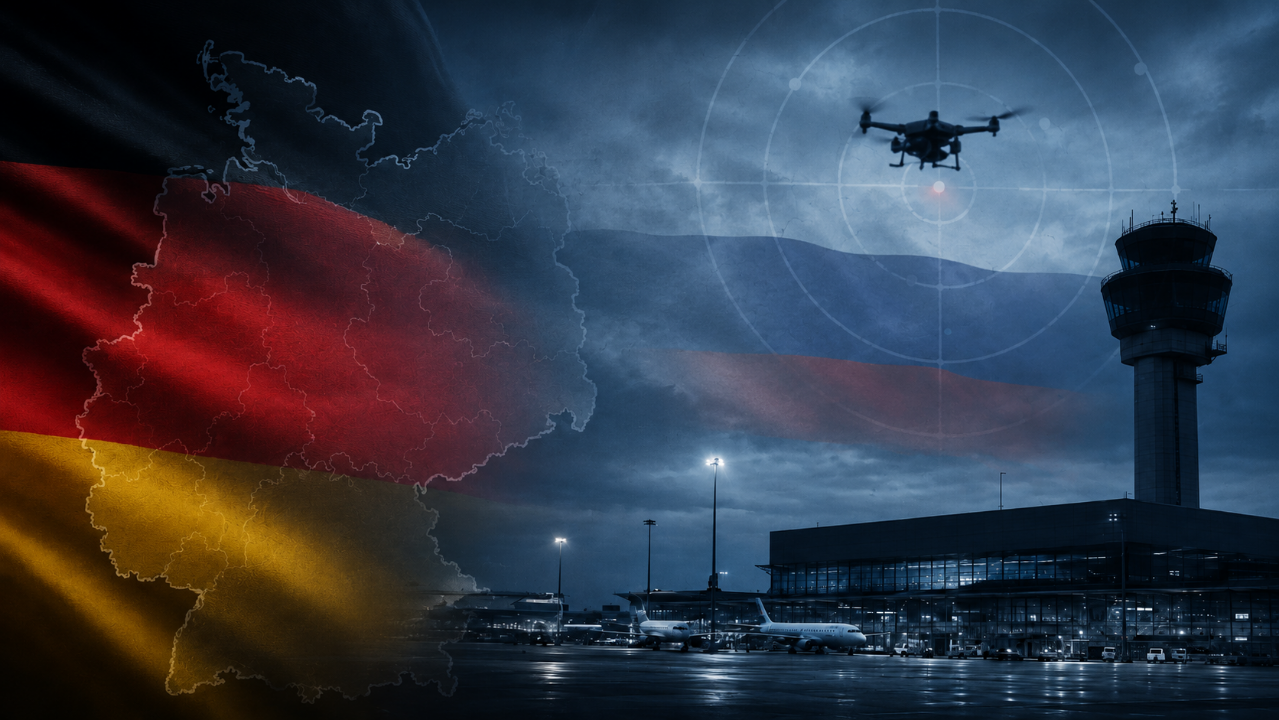
Germany’s attribution of an attempted drone attack at Leipzig Airport to Russia has drawn statements of support from Britain, Estonia and Finland, with allied leaders describing the incident as a dangerous escalation in Russian hybrid activity in Europe, according to public statements issued following the German announcement.
Germany has blamed Russia for the attempted attack and announced a series of measures in response, including summoning the Russian ambassador, closing the Russian consulate in Bonn and the Russian House in Berlin, alongside further sanctions and tighter entry restrictions for Russian citizens. The announcement prompted immediate statements of solidarity from several European allies, which linked the incident to what they described as a wider Russian effort to intimidate countries supporting Ukraine.
Andy Burnham said: “The United Kingdom stands in full solidarity with Germany following Russia’s egregious and reckless attack in Leipzig. Russian attempts to undermine our united resolve and our willingness to support Ukraine are futile and doomed to fail.
“As I made clear in Kyiv last week, our commitment to supporting Ukraine from Russia’s illegal invasion is ironclad. The strong measures taken by the German government show action against any attack of this nature will be met with a clear response. We will not waver in our resolve to deter attacks on our freedom and security.”
Estonian Prime Minister Kristen Michal also backed Germany following the attribution. He said: “Germany has Estonia’s full support following the attribution of the attempted drone attack at Leipzig Airport to Russia. We strongly condemn this reckless act.”
Michal continued: “Russia has taken its hybrid attacks in Europe to a new and dangerous level. Its aim is to intimidate us and weaken our support for Ukraine. It will not work. Our response must be the opposite: more support for Ukraine and more pressure on Russia.”
He added: “We support Germany’s response and further measures against those responsible. Estonia is ready to take the next steps together with Germany and our Allies.”
Estonia’s Ministry of Defence separately echoed the Prime Minister’s language, saying: “Russia has taken its hybrid attacks in Europe to a new and dangerous level. Its aim is to intimidate us and weaken our support for Ukraine. It will not work. Our response must be the opposite: more support for Ukraine and more pressure on Russia.” The ministry said Estonia fully supported Germany.
Finnish President Alexander Stubb likewise described the incident as a Russian hybrid attack and said Helsinki stood with Berlin. He said: “Finland stands in full solidarity with its ally Germany after the Russian hybrid attack in Leipzig.
“We know the Russian playbook. It attempts to intimidate us, to undermine our resolve and our willingness to support Ukraine in its defense against Russia’s invasion. It will not succeed.
“We will stand united and deter anyone from attacking our freedom and security.”
Stubb also pointed to the measures announced by Berlin, saying: “As the strong measures announced by the German government show, any action against any one of us will be met with a clear response.”
He added: “Our commitment to supporting Ukraine in its defense against Russia’s aggression is unwavering. I continue to be in close touch with Chancellor Merz and other Allies.”
The allied statements centre on the same argument: that the Leipzig incident should not result in reduced support for Ukraine. Estonia and Finland both framed the alleged attack as an attempt by Moscow to influence European policy through intimidation, while Burnham said British support for Ukraine remained “ironclad”.
Germany’s response includes diplomatic and administrative measures against Russian interests as well as plans for further sanctions. Estonia has said it is prepared to take additional steps alongside Germany and other allies, while Finland has stressed that actions directed against one allied country should receive a collective and visible response.







Any other Countries say anything, or is there only the soundlessness of tumbleweed. Meanwhile Bessent welcomes the Russian trade rep to the G20 like he is a close friend while attacking erstwhile allies. It’s a mad, mad, mad, mad World too right.
Well we all know who Trump works for so hardly a surprise.
‘Andy Burnham said: “The United Kingdom stands in full solidarity with Germany…’
We do not, obviously, stand in full solidarity with Germany in any meaningful practical sense.
We cannot deploy and sustain for any useful period any more than one armoured brigade (arguably not even that) on extended operations on Continental Europe.
Willing the mission but not the means by yet another in a long line of delusional (or deceitful) political leaders.
Full enough that we have been discussing the UK’s backup umbrella with Germany, just in case the American one fails to open. However this is Leipzig and no doubt Putin thinks it’s part of Russia, because someone promised someone that NATO would never go East of Brunswick.
What evidence do you have that such a promise was made, may I ask?
Who made such a promise and to whom?
It wasn’t. It’s just the sort of thing Putin claims when he’s twisting the truth. Actually when Gorbachev agreed to East Germany joining NATO as part of unification, it was on the condition that non-German NATO troops wouldn’t be stationed in the former East German territory, nor any nukes. To be honest, I can’t think of any NATO bases there to this day. Not that it makes any difference, because of Poland.
Spot on. Will the new Chancellor of the Exchequer do much to enhance our defence capabilities in order to live up to our Prime Minister’s bluster, I wonder?
He’s under a lot of pressure to say something on the 3% for obvious reasons, but I’m not too hopeful on hearing anything soon. All I think he’s said is he will outline a clear path to 3.5% in 2035. So he’s promised nothing new yet. Starmer/Reeves left a Defence budget hole and I’d guess the PM will insist that he fills that before he can add any more. There’s a lot of work to do. That’s why I think we may have to wait for the budget. Also, he’s an old-fashioned kind of politician and we might get a real purdah. Parliament being told before the press! Traditionally, secrecy was applied this far ahead, it just hasn’t been since Gordon Brown. I wonder if Healey will do it because it suits him.
I’d rather he did nothing though than fiddle the figures even more. If he’s going to do something, it has to be real. Even bringing forward the Foreign Aid money by six months would be welcome, if a little difficult.
By the way I mean purdah on the Defence spending. We know he’s already running tax changes up the media flagpole.
It all sounds a bit mid 1970s, the decade that taste forgot! I have (net) zero confidence that any increase in defence capability enhancements, mass, will emerge from this government. Oh! hang on! Apparently they are planning to put the Royal Navy back into flared trousers…
Meanwhile a German frigate fires an Israeli 400km LORA ballistic missile in a test in North Atlantic.