

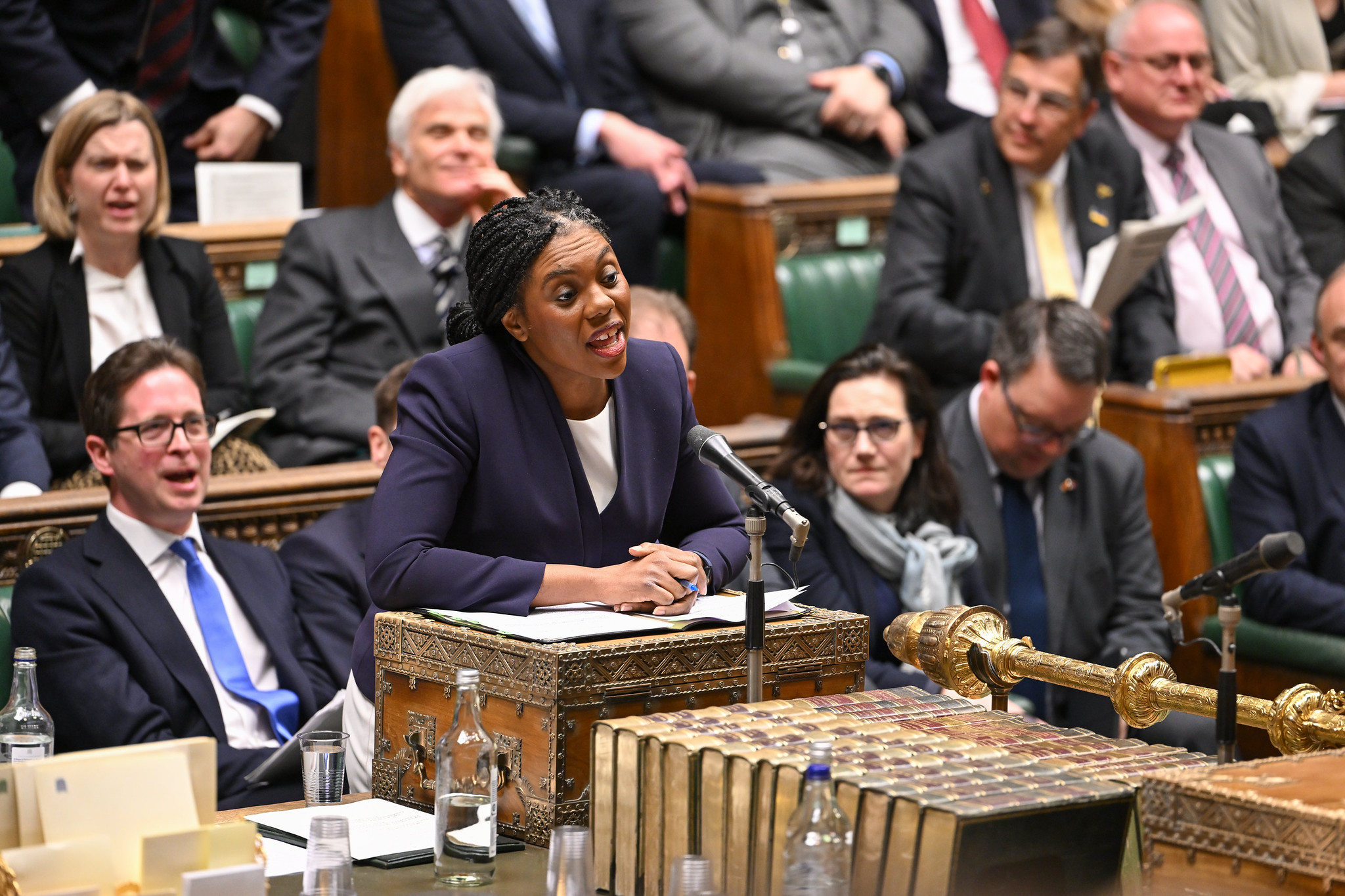
The leader of the Conservative Party, Kemi Badenoch, has written to the Prime Minister and the contenders to succeed him offering Conservative votes to cut welfare spending and redirect the savings into defence, telling Sir Keir Starmer it is time to get serious about funding the armed forces in the wake of the resignations of his Defence Secretary and Armed Forces Minister.
The letter, sent over the weekend and copied to a string of senior Labour figures including Andy Burnham, Wes Streeting, Al Carns, Catherine West, Darren Jones and Ed Miliband, requests an urgent meeting with the Prime Minister to discuss defence funding and renews a standing Conservative offer to help the government push welfare reform through the Commons.
The mechanics of that offer are worth setting out, since an opposition party cannot set the government’s budget or move money between departments, something only ministers can do. What Badenoch is offering instead is Conservative votes in the division lobbies. Her argument rests on the parliamentary arithmetic exposed last summer, when Starmer’s own attempt at welfare reform was defeated by a rebellion on the Labour benches.
The premise is that the Prime Minister cannot pass meaningful cuts to the benefits bill relying on his own MPs, and that Conservative support could supply a majority for measures his backbenchers would otherwise sink. “Since the Parliamentary defeat of your modest attempt at welfare reform in the summer of last year, it is obvious that your left-wing MPs will not support any real attempt to cut the welfare bills,” she writes. “Therefore the support of the Conservatives will be critical to delivering substantive reforms that will reduce the benefits bill.” It is an offer of votes rather than money, and one that would require the government to bring forward welfare cuts of the kind the Conservatives favour in order to take it up.
Badenoch places the intervention around the events of the past week, in which both the Defence Secretary John Healey and the Armed Forces Minister Al Carns resigned over the funding behind the Defence Investment Plan. In her letter, she tells Starmer that “today’s world is more dangerous and threatening than we have known in our lifetimes”, and that “in the space of 12 hours your Defence Secretary, Armed Forces Minister and two key Defence Department aides resigned from your Government”. She quotes Healey’s warning that intelligence assessments point to a possible Russian attack on NATO “as soon as 2030”, and tells the Prime Minister that “the first duty of every Government must be to protect our security”, a duty she says Healey has set out the government’s failure to discharge.
The Conservative leader sets the two departed ministers’ own words against the government’s account. She notes that in a Friday interview Starmer said he had made “hard-edged decisions” on defence spending, and places that against Healey’s verdict that the funding falls “well short of what is required for defence and the country at this dangerous time” and would reduce “the readiness of our Forces” while increasing “the risk to personnel on operations”. These, she writes, are “very serious criticisms, perhaps the most serious that could be made of any prime minister, especially in the context of the risk of a Russian attack on NATO”.
She also raises the Prime Minister’s own account at Prime Minister’s Questions on Wednesday, where he told Parliament the delayed plan would be published in “just a few weeks time” and that his ministers “have been working through the details to make sure that we get this right”. That assurance, Badenoch writes, sits against Carns having told the Prime Minister he “had no hand in the Defence Investment Plan”, that it is “not built for the threat we face” and is not “transformative enough”. She returns to the funding gap, recalling that she had asked Starmer about the reported £15 billion shortfall between what the Treasury was offering and what military leaders argue is the minimum required, and that he had replied his government was “investing in this great nation” and had “increased defence spending”, while Carns has said the investment on offer is “inadequate to the task” and that “commanders will be asked to do more with less”.
Badenoch argues defence spending must rise to three per cent of GDP, and says the Conservatives have set out how to find the money, including by reinstating the two-child benefit cap and creating what she calls a sovereign defence fund. “It is time to get serious,” she writes. “We cannot have our military inadequately funded at a time of growing threats,” adding that the funding “must also not be backloaded, when the pressures are urgent”, an echo of Healey’s own complaint about the shape of the settlement.
The letter closes with a set of specific requests, including that the Defence Investment Plan be published as soon as possible, that her shadow Defence Secretary work with the new Defence Secretary to address what she calls the plan’s shortcomings, and that her shadow Defence Secretary and shadow Minister for the Cabinet Office be briefed urgently on Privy Council terms about both the contents of the plan and the risk of a Russian attack on NATO within four years. She frames the offer as being made “in the national interest given the overwhelming imperative of defending our country”.
Badenoch’s case leans on figures from the Office for Budget Responsibility showing welfare spending up £19.8 billion on last year and set to reach £210 billion by the end of this Parliament, and on a growing body of senior voices making a similar argument. Lord Robertson, co-author of the government’s own Strategic Defence Review, has warned that Britain cannot defend itself “with an ever-expanding welfare budget”, while the former Labour prime minister Sir Tony Blair has questioned how the government can justify “adding to the welfare bill when it is already ballooning, taxes are high and getting higher, and we’re told we have to increase defence spending to prepare for the possibility of war”.











I’ve gained $17,240 only within four weeks by comfortably working part-time from home. Immediately when I had lost my last business, I was very troubled and thankfully I’ve located this project now in this way I’m in a position to receive thousand USD directly from home. Each individual certainly can do this easy work & make more greenbacks online by visiting
following website—.,.,.,.,.—>>> JobatHome1.Com
He’ll see it as a trap, but if he means what he says on defence, he needs to take up the iffer.
Isn’t Starmer is alrready “trapped” by some on his own side. And “trap” or not it’s quite generous, sensible and mature of Badenoch to offer her support in the “national interest” on defence. It would be a win for her and maybe a diminished win for him but hopefully they can then share credit for it as a unified effort. Not sure how the general UK population might appreciate the cooperation though?
Both Conservative & Labour have historically projected a strong position on defence. This disappeared with Corbyn. We should not forget that ‘Conservative’ voters staying at home caused the flip to Labour.
We are now in the position where the Conservatives are inviting back their voters plus all the vaguely sensible Labour voters who believe defence is a core requirement and principle of any Government.
Defence is the first priority of any Government.
I’ve gained $17,240 only within four weeks by comfortably working part-time from home. Immediately when I had lost my last business, I was very troubled and thankfully I’ve located this project now in this way I’m in a position to receive thousand USD directly from home. Each individual certainly can do this easy work & make more greenbacks online by visiting
following website—.,,…..,.,,.—>> LIVEJOB1.COM
It requires a cross party concensus and a formal end to treating defence as a cash cow, citing the ‘peace dividend ‘ that never was as an excuse to slash the budget
Draw a line under under the whos to blame for what slanging match, grow up ( they are all to blame), realise the seriousness of the bloody situation, get the Labour government, Tory and the Lib Dem parties to agree to a rapid rise to 3.5% and to legislate and vote accordingly, and agree ‘never’ to use defence as a football again.
It has to come from welfare, some £20 billion in additional funding needs to be reallocated to Defence ASAP.
Stop dishing out PIP to every man and his dog for one, do something about the vast fleet of mobility cars and million lazy little sods, spending their days as XBox Warriors while guzzling McDonald’s, etc, etc, Starmer needs to take a firm hand and shove it through, let the pink haired ‘vegan option’ benefit bonza Labour MP’s rant and rave and bulldoze them out of the bloody way.
Time is of the essence!!
The Peace Dividend delusion has allowed politicians to safeguard their electoral prospects by shifting Defence spending to social provision and even war in Europe hasn’t enabled them to pivot back to Defence.
The The Defence Investors’ Advisory Group (DIAG) is a logical step having realised that public funding can’t cover the Defence Investment Plan so private investment is required.
We bailed out the bankers in 2008 and now its their turn to invest in Defence since their business depends on peace and stability. Lower risk means lower cost for Defence Investment Bonds than standard Gilts used for spending.
Thus the 3.5% GDP Defence spending target for 2030, and 2.75% GDP for 2027 are affordable without tax increases. A long term investment plan for national security.
A requirement for a banking licence, so a mandatory duty, not optional opportunity. Ethical investment means defending people that you expect to profit from.
Over to UK & European Defence and Finance Ministers to make it happen. All Banks must do their Duty or face Windfall Taxes. All European citizens must be defended.
Precisely so. But in any case, whether he accepts it or not then serves as a clear indicator of whether he takes national security seriously or not. Not bothering to defend the country is not a good look. Needing opposition votes in order to do so is also not a good look.
Is she prepared to vote on cancelling the triple lock, me thinks not.
Why should the pensioners – who have paid into the system all their working lives – have to suffer for the Conservative party’s profigate printing of money 2010 – 2024? What an idiot
But the triple lock wasn’t there for all of their working lives, was it? It only started in 2010, one of the main policies of what you describe as ‘profligate printing of money’. Nobody under the age of 35 in this country expects to receive as generous a state pension as you and those your age do, simply because you have demonstrated why an open-ended commitment to increasing spending on a particular demographic is not good for the country.
The triple lock was brought in by Cameron and was never meant to be permanent. By definition its unafordable in the long term as it always uses the highest of the three measures. Whether or not people have paid into the system is irrelevent. I’ve paid into the system for 30 years already and i won’t see a pension till im 70, if at all.
Perhaps because the triple lock has done its job.
I’d say means testing pensions would be more logical – say no State Pension payable where income is over £100k.
That alone would cut the welfare budget by more than 10 billion.
The means testing already is operated in the income tax system so no, National Insurance is not a political football rather the government debt to working people that must be repaid to cover living costs despite their money devaluation approach.
Since the full state pension for 35 years worked is now taxable due to fiscal drag, it’s obvious that the government is already trying to claw back the very limited reward for working..
Growth?! I don’t think so..
@David Lloyd
So you’ve been put back in your box.
Who’s the idiot now?
Nope, the idiots are those who believe that Welfare or Warfare is the argument.
Ethical investment means defending people that you expect to profit from. Banks have a duty to invest in Defence, not an option, a mandatory duty. Government must put that in law throughout Europe so all citizens are defended.
Banks must do their Defence Investment duty or face Windfall Taxes..
Fair enough, kemi could support ending triple lock. Country before parties on this one, is kemi just sticking the knife in?
I don’t think KemiKaze is a serious politician.
The Tories have failed to recognise why the voters gave them their worst defeat for a century, and put them firmly in the dustbin of history.
Kemi is currently a cosplay Farage doing a pantomime on the end of Clacton Peer.
She needs to sort herself out.
Nobody on this forum needs convincing that Britain’s defence spending must increase significantly. We’ve been callibg for it for over a decade.
The warnings have been coming for years from serving military officers, former Chiefs of the Defence Staff, ex-generals, former Defence Secretaries, defence analysts, NATO allies and Members of Parliament from all sides. The consensus is clear. Britain faces the most dangerous security environment since the Cold War, yet our Armed Forces have been asked to do more with less for decades. The debate is no longer whether defence spending should increase. The debate is whether the Government has the political will to increase it to the level required. Around 2.56% of GDP is simply not enough if Britain is serious about deterring Russia, protecting NATO’s eastern flank, defending our overseas territories, rebuilding stockpiles, modernising equipment and protecting critical national infrastructure. Russia does not need to launch an overt conventional attack on Britain to cause immense damage. Our economy and daily lives depend upon undersea communications cables, energy pipelines, data networks, satellites and power infrastructure. Any future conflict will be fought across multiple domains, land, sea, air, cyber and space. The threats are real and they are growing.
Something has to give. Its either Starmer doing what’s required, or he resigns and the government falls! Either the Prime Minister instructs the Treasury to properly fund the Defence Investment Plan and move rapidly towards at least 3.5% of GDP on defence, or he accepts that Britain’s military capability will continue to decline relative to the threats we face. The Treasury’s job is to balance the books. The Prime Minister’s first duty is the defence of the nation. When those two priorities collide, national security must come first.
Badenoch’s offer of Conservative votes to support welfare reforms in exchange for increased defence spending highlights the reality facing the Government. There is no shortage of people identifying the problem. There is no shortage of solutions being proposed. What is lacking is the political courage to make difficult decisions? Instead, it’s increase benefits at the risk of a calamity should our forces have to fight. Realistically, how long will 134 Typhoons, 15 fighting ships, one fighting brigade and 148 tanks last in a war with a military the size of Russia’s who are rearing with modern equipment as we speak?
The resignations and public criticisms from senior defence figures should be setting alarm bells ringing throughout Westminster. When Defence Secretaries, Armed Forces Ministers and military leaders warn that funding is inadequate, commanders are being asked to do more with less, and readiness is being reduced, those warnings should not be dismissed as departmental lobbying. They should be treated as matters of national importance. Every government has choices. It can spend more on welfare, more on public services, more on debt interest, or more on defence. It cannot spend the same pound twice. The question now is simple. Does Britain intend to remain a serious military power capable of defending itself and fulfilling its NATO commitments, or does it continue hoping that deteriorating global security will somehow resolve itself?
Hope has never been a defence policy.
Well said, very well said and indeed, hope is not a strategy.
Ex-RM,
Very well stated, and a credit to the legacy of the RM. Though entirely too few in numbers, the RM performs very well in developing leaders, including motivated and involved veterans. BZ. 👍👍
The Peace Dividend delusion has allowed politicians to safeguard their electoral prospects by shifting Defence spending to social provision and even war in Europe hasn’t enabled them to pivot back to Defence.
The The Defence Investors’ Advisory Group (DIAG) is a logical step having realised that public funding can’t cover the Defence Investment Plan so private investment is required.
We bailed out the bankers in 2008 and now its their turn to invest in Defence since their business depends on peace and stability. Lower risk means lower cost for Defence Investment Bonds than standard Gilts.
Thus the 3.5% GDP Defence spending target for 2030, and 2.75% GDP for 2027 are affordable without tax increases. A long term investment plan for national security.
A requirement for a banking licence, a duty, not optional. Ethical investment means defending people that you expect to profit from.
Over to UK & European Defence and Finance Ministers to make it happen. Banks must do their Duty or face Windfall Taxes. Every European citizen must be defended.
Banks will hate this at first but come to realise that it is a fair cost of doing business with lower cost than enabling conflict and chaos. They can still take higher risk in other continents if they want to..
We are as good as in a war situation, and have been for some time. A national government comprised of the major parties would be appropriate.
If the two main parties cooperate on this it might take away some of the focus on all the others snapping at their heals!
I was hoping that this labour govt would be the pragmatic social democrat centre that the country needs. Indeed I still think most of the cabinet is of this ilk. But the whole thing has been screwed by the left wing recidivist trots who won’t bend on benefits, the fanatical green zealot Milliband and external forces :Trump, Iran, Putin, Brexit etc. People want miracles and don’t have the patience and willingness to accept the sacrifices needed to get out of the hole we are in so they jump to snake oil merchants like Polanski and Farage. Shakespearean tragedy. RIP UK.
Yet you get a member of that cabinet McFadden saying all they talk about is how to get more tax to spend on welfare! As has been said they can now find £4.5b for walking and cycle routes yet won’t finance defence🤬
Yeh, rubs salt into the wound. Not saying there’s anything wrong with more walking and cycle routes, mind. McFadden’s whatsapp let the cat out of the bag: the issue is the 80 or so left wing MPs. Tail wagging the dog. From what I read I think Milliband was the problem. He has more support within the labour party than Healey – decent guy in the right who was the victim.
Welcome to the perverse UK govt where if you are being screwed you are probably doing something right.
Investments such as that one, which is an improvement but still minimal, have very high returns in terms of preventing future expenditure on the health service and similar.
The centre ground has been in power since 1997. They are the ones that have.ruined everything, incuding defence. All the main parties have been signed up for net zero, all have supported open border policies. Real change is coming from elsewhere.
I do believe that the country does prosper better in the long term if you keep to the ‘centre’ economically and socially instead of oscillating violently from one extreme to another. In European terms that means the spectrum between Social Democrats and Christian democrats. Sadly, both Christianity and democracy are struggling – hence the woes of the Conservative party, which were largely self inflicted: they lost their ‘moral compass’. In general I agree with that diagnosis of our economic problems which blames ‘Thatcherism’ i.e. incentives tfor short term profit taking and ‘rent seeking’ behaviour. So I think we need to give Reeves’ policies a fair chance of at least one parliament before we ditch them. I also support other policies which are ‘inclusive’ e.g. Phillipson’s proposed education changes to the provision for special educational needs.
That said, Suella Braverman and Kemi Badenoch are concerned about the workings of the equalities legislation. They argue that it is being interpreted and applied by many organisation so as to favour ethnic minorities to the disadvantage of sic ‘white working class males’. There are many people whose perception is that that the immigrant cuckoos are throwing the white working class chicks out of their nest. I think they have a point.
‘Open borders’ have a long history stretching back to the Empire. All members of the British Empire enjoyed ‘freedom of movement’ based on empire membership, regardless of culture or ethnicity. It is ironic that the UK population rejects freedom of movement with the EU, whose citizens, being Christian, have culturally much more in common with England and Britain and integrate very easily. Ditto Caribbean and Nigerian immigrants. You don’t see many French, German, Irish or Polish grooming gangs.
In my view, the real issue is that the English have forgotten who we are. We have no parliament and unlike Scotland and Wales our sports teams have no English national anthem ( I favour Jerusalem :-)) . We need to recapture our sense of English national identity and self esteem. Everything flows from that. The clue is in the shirt. England’s heart is a Plantagenet heart.
Hardly, the two main parties are the ones that have ruined the country the last 30 years.
As always, the left of Labour sabotage and the PM is too weak to lead.
Truly the enemy within for me.
Though Kemi is right, it’s always easy when in opposition, isn’t it Kemi. You did sod all when in power….
The Conservatives and Labour are different cheeks of the same arse. No real difference whatsoever. Agreed on open borders, net zero, DEI bullshit, Useless on defence etc etc. The only change will come when the Uniparty is out of power.
Yep. Which is why I won’t vote for either.
I’m always amused when people don’t get that and expect you to vote for the same old failures or spoil my vote.
Change is here, like it or not, people have had enough.
I certainly have.
And it’s all courtesy of HMG, as at heart, I’m a Tory. Where are they?? Not seen one in many a year.
Im a standard Conservative from 25 years ago. Theres nothing conservative about the Conservative party indeed. Yes Daniele, thanfully change is on the way.
£6 billion for two aircraft carriers but £100 billion for a choo choo train.
But they want to cut benefits…………
The UK is one effed up country.
Yes. Start by restoring the child benefit earning threshold to the level prior to the increase by the last Conservative government. The ability for one or more family members to earn up to £80,000 per year and still claim a government handout for their children, is obscene and decedent. That money could be used instead to fund the cash strapped military.
Child benefits are for the children, equal members of one nation, not about their parents who are already means tested in the income tax system.
There are so few mechanisms for one nation that universal child benefit must be protected and gormless Osborne already damaged it already by telling the hardest working people that their children don’t matter.
No, that money isn’t material to the needs of Defence that only Defence Investment Bonds can cover.
All European banking licences must include the duty to invest in Defence. Ethical investment means defending people that you expect to profit from.
Although the PM is correct in the fact it’s going to require hard decisions, he’s got a relatively easy job here, it’s already committed 3,5% GDP so he’s got to get the chancellor to map out the path to get there – no negotiation on 3.5% in 2035. This kinda implies 3‰ in the 2030/31 time frame therefore minimum of 2.8% in 28/29 to be credible that on track. Currently I don’t see the PM committed to the pledge, it seems an empty pledge that the hope peace will break out before 2035.
You’ve got your funding figures, it’s working out where it’s coming from now, hard but not impossible.
We are spending £9.4B on carbon capture, which to date the technology has yet to be proven. A further £70B is being allocated to grid upgrade to 2031, that could be looked at! There is a lot of money that could be looked at but the current government have no appetite.
Well, rather than sticking it to the poor, sick, and disabled, we could always tax the multi-millionaires a bit more. You remember, all those wealth-creating job-creating tech bros who needed the “mates rates tax breaks” because they were “entrepreneurs” and who are now replacing their workers with AI and relocating to Thailand…
I mean if Kemi is serious and “we’re all in this together” then those best able to pay should pay. Or is this just about creating a group of people we can hate and blame for everything?