

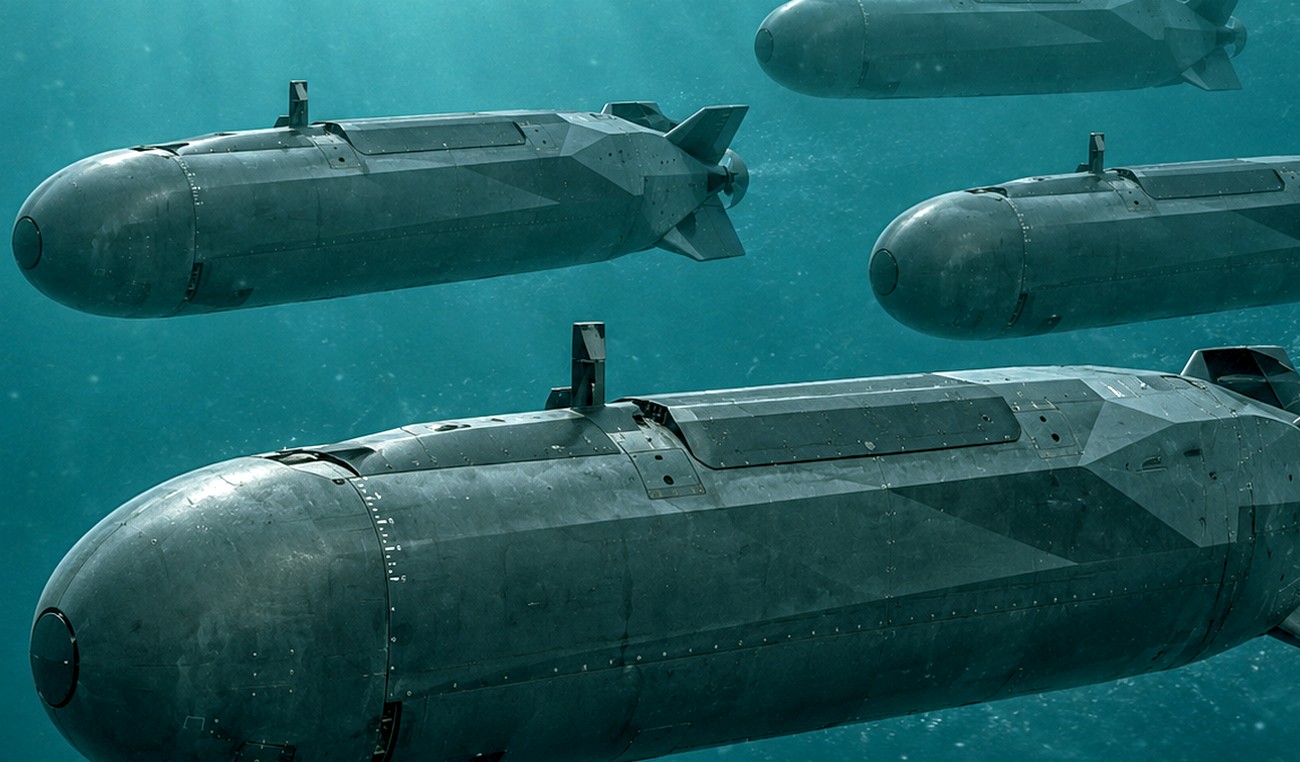
The Royal Navy has opened preliminary market engagement for the Type 93 extra-large uncrewed underwater vehicle and the AUKUS Signature Payload Programme, inviting companies to register interest before any requirement is set, according to a notice published on Find a Tender at ten past twelve on Monday.
“The Royal Navy seeks to improve its understanding of the market and wider ecosystem for Extra-Large Uncrewed Underwater Vehicle (XLUUV) platforms, associated payloads, and enabling functions,” it says. “This activity supports the development of the Type 93 capability and the Royal Navy’s commitments under the AUKUS Pillar II Signature Project.”
Registrations are sought from “XLUUV platform providers, payload providers, relevant technology and software suppliers including Autonomy, AI and Mission Management Systems, integrators, through-life support providers, and other relevant suppliers.” Those who come forward may be invited to collaborative workshops, one to one meetings, industry days and written requests for information, and small and medium-sized enterprises are flagged as particularly suitable.
“The Royal Navy is initially considering platforms approximately 2 metres in diameter and 12 metres in length, however organisations offering platforms of other dimensions are also encouraged to register,” the notice says, adding that it “should not be considered as a commitment from the Royal Navy to progress with any future procurement activities.”
XV Excalibur, the uncrewed submarine Britain already operates, is twelve metres long, two metres across and displaces nineteen tonnes. It was unveiled at Devonport in May last year, as this publication reported at the time, having been built by MSubs of Plymouth under the three-year Project Cetus, for which the Ministry of Defence awarded a £15.4 million contract in December 2022. It joined the Fleet Experimentation Squadron as a demonstrator with no operational role.
The Royal Navy controlled Excalibur in home waters from an operating centre in Australia during Talisman Sabre in July 2025, the first British and Australian demonstration of XLUUV interoperability under AUKUS Pillar II. It carried out the first underwater operation of a quantum optical atomic clock that November and transferred to Royal Navy ownership in December. In June the Submarine Delivery Agency awarded MSubs a further £6.7 million for trials and evaluation running to May 2028, work intended to move the programme towards functional payloads.
On 13 September, Excalibur fired an American Mark 48 exercise torpedo at the British Underwater Test and Evaluation Centre in Scotland. Britain and the United States described it as the first time either country had launched a heavyweight torpedo from an uncrewed vessel, carried out under Project Broadsword and Trial Iron, both part of AUKUS Pillar II.
The Type 93 designation first appeared in February last year, in Project CABOT documents setting out a persistent wide area anti-submarine search capability built around the Type 92 Sloop, an uncrewed surface vessel, and the Type 93 Chariot, described then as a drone submarine. Luke Pollard, the Minister for Defence Readiness and Industry, confirmed in July that the Defence Investment Plan had announced Type 92 uncrewed underwater sensing platforms and Type 93 extra-large uncrewed underwater vessels as part of the Atlantic Bastion programme, adding that the number of platforms to be procured and their construction schedules had not yet been determined.
He has also told Parliament that the Hybrid Navy will take at least £1.5 billion over four years, and that by 2030 the aim is to have the first large autonomous vessels in service, among them a prototype uncrewed missile platform and extra-large uncrewed underwater vessels carrying payloads developed through AUKUS.
The notice states that the programme “directly aligns with the Strategic Defence Review (SDR), Defence Investment Plan (DIP) and AUKUS Pillar II priorities, supporting the transition to a Hybrid Navy through the integration of autonomous and uncrewed maritime capabilities.”







I’m probably being too cynical perhaps but having produced this demonstrator and doesn’t Bae have one too, why are we looking to potentially re invent the wheel by the sounds of it. Don’t tell me, we need to delay matters so as to give us time to check the sofa for loose coins? Let’s hope Vance hasn’t got there first 🫣.
I think you’re spot on. It’s a way to look like they are doing something, without actually doing anything that requires a concrete spend. I think the whole drone thing are all different versions of the same principal, especially the Hybrid Navy. None of it exists but it’s an excuse to cancel and cut real spending now with the pretense of “oh look what we are going to do!” “Going to do” of course ends up 5, 10 years down the line by which time I am sure we will have the next brand new shiny “going to do”. Unless we are pancaked by Russia first of course then it’s immaterial.
Yep, spot on, ‘ looks what we are doing, more investment than anytime since the end of the cold war’ and other assorted bollox, without actually ordering anything.
All the defence secretary can do is create smoke and mirrors and look busy until someone writes a cheque to cover it.
Nobody is and they won’t until the next parliament.
Until then, it’s just the usual managed decline.
This is in reality an area where potentially a few commercial off the shelf options may come up, it’s common sense to have a market engagement event to be honest.. we would do it all the time if we we were procuring a service, it allows you to understand the level of competition in the market and if your going to end up with one provider who’s going to try and screw you… the worst thing you can do is launch a procurement in which you have not checked the market and only one company is able to fulfill the requirements you set.. best to understand if you need to tone something down before hand.
Just for once can we please crack on and order something, and a fleet doesn’t mean three. It means thirty or forty or more. If the intent is to deny sea access to the Russian navy then lets get it right.
Lets hope all these drones all work well in reality and surface ship numbers are kept up and well armed.
One has to ask if AUKUS is worth the effort of designing crewed submarines if (as I’m sure) these vessels are the future and possibly in greater numbers than current manned fleets.
SSNs are incredibly powerful and flexible units. Very fast, hard to detect, capable of shadowing attacking surface ships, other submarines, attacking land targets, possibly attacking high value air targets in future, coastal reconnaissance and covert troop deployment. It’s really hard to imagine an unmanned unit that can do all this, presumably this is why we’ve found money for more and not much else. It’s hard to imagine an unmanned unit that could keep up with an SSN if it also wasn’t nuclear powered. Then there’s the whole issue of communications with underwater unmanned units and kill chain. I can see an underwater drone operating like a mobile mine in restricted waters. I can imagine an intelligence gathering role but if detected it would be captured or destroyed by the enemy as it wouldn’t have the speed to evade. I’m struggling to think of much else, although maybe that’s just my lack of imagination…
Mike, I feel you may be correct, but we are only on the first step in terms of remote subs and finding new submariners is, like other services, getting harder. The remote sub won’t replace manned subs in the medium term, yet we can not leave robotics out of this new field. Within 15 years, it may be possible to have remote-crewed vessels with 100% robotic crews that can stay at sea for months on end.
If we can buuild them at more than a snails pace, if they can be afforded at £1.5 to £2 billion each and if we can find crews for them. Unless the U.K. invests in defence properly we are on a downward spiral.
We can hope my friend, but with all the delays and postponements I’m not holding my breath.
This is a whole new capability requirement and it feels right to open it up to industry competition. There may be better solutions, whether in overall design concept or in the many different propulsion, sensor, AI, control, armament etc elements, at more competitive prices, than M-Subs or BAES have come up with so far. Four years to having a finished XLUUV in the water is fair enough.
It is necessarily slower than some might like in a perfect world. In the real world of stretched budgets, the RN has to balance what it can afford to run fast with. It is currently committed to building 24 new subs and vessels, including Dreadnought, T26, T31, FSSS and MHC OSVs, followed by close on two dozen more in the shape of AUKUS SSNs, the CCV frigate, the ATS replacement for the Bays and whatever replaces Scott and Protector. That is a major increase in British naval construction and there isn’t the budget to rush all these vessels plus the Project Bastion additions into service at a wartime pace.
Yep, don’t do your market engagement before putting out your procurement and you just may miss the product that does 80% of what you wanted at 20% of the cost.
At the end of the day, however, m subs is an experienced builder of such things as is BAE.
Granted there might be other improvements in various departments, but are there loads of sme’s out there sub ready…from a time point of view?
Surely the bulk of the sub is proven, and no doubt m subs has applied serious thought to the development of it.
What seems to be missing, in my capacity as an armchair admiral, is the mod actually writing a specification to inform any submission..barring it should be about the same size as what we already have.?. Excalibur has demonstrated proficiency in various areas, now its time to bung the sonar on it, wrap it with acoustic tiles and gaffa tape some Sting missiles to it and take it to war…ok…exercises to prove a more fighty or whatever platform.
I believe Excaliber has a “mission” space…perhaps the smes should be asked to fill this up?
Otherwise, yes, can kicking.
AA
That’s really the point, there are a shed load of autonomous underwater vehicle manufacturing companies out there who many have an idea or option that does not quite fit the Excalibur concept.. you just put out your procurement based on what BAE says it can build and you may miss something 20% of the price for 80% of the capability.. you engage the whole industry you can modify your procurement to allow more bids and competition means you don’t get pork barrelled by BAE.
This is just common sense market engagement as there are potentially a few commercial off the shelf options may come up and it allows you to modify your specification before going out to tender/procurement.
We would do it all the time if we we were procuring a service. it allows you to understand the level of competition in the market and if your going to end up with one provider who’s going to try and screw you… the worst thing you can do is launch a procurement in which you have not checked the market and only one company is able to fulfill the requirements you set.. best to understand if you need to tone something down before hand. Take a bit of time before hand can mean the difference between money hundreds of millions down the toilet on a gold plated specification only BAE can build at a rate of 1 every 2 years and a sensible almost of the shelf option that’s cheap cheerful and any number of companies can provide.
It’s pretty obvious that BAE and MSubs are the standout competitors. My main concern is that 12m UUVs are neither tactically mobile nor carry a large enough payload to be useful in open ocean ASW, and we already have Herne and Excalibur as operational test beds in that category.
What this suggests is that T93 will be the submarine equivalent of our minehunting USVs when China even now are building UUVs more in the category of small SSKs, 45m long and 500T. That’s more like an oceangoing vessel.
But in reality what are you looking for
If you want a loitering sensor platform.. more smaller units are better and that’s really what the navy want. They are not looking for a kinetic effect platform.
The problem isn’t weapons capacity. Excalibur, designed with a pretty big flooding payload bay, can only just take the Kraitline towed array. SEA offer that as a containerised torpedo defence/LWT fit on surface vessels, which gives you an idea of its detection radius. It also has a maximum speed of about 7 knots, and will tank its endurance significantly if it runs that fast for any length of time.
A larger UUV able to run faster for longer would be much more useful in the Atlantic and would also be able to carry much larger towed and flank arrays e.g. a full set of S76Nano.
Hi Jonathan,
May I also suggest that production tech is playing a role here.
I have seen a lot of stuff about the developing drone cluster in Swindon and 3D printing gets an occasional mention. As most people, including reporters, tend to be more interested in the product rather than how the stuff is built which rarely gets mentioned my guess is that these ‘dynamic’ companies are exploiting 3D printing techniques to the max. May be they benefit from not having loads of legacy machinery knocking around..?
There is also something of a 3D ecosystem in the South West led by Renishaw’s in Wooton-under-Edge which might also partially explain why the drone cluster is developing in Swindon – that and the vacated Honda site.
Despite the understandable prevailing gloom at moment there are some bright spots up and down the country.
If the RN can exploit these dynamic companies then I think we could see stuff entering service by 2030, but I would expect it to be subject to spiral development given the pace at which technology is developing at the moment. That also goes for the production tech as well.
Cheers CR
For what?
MOD thinks drones can easily replace manned vessels …. crazy
I have no issue with the arguments of widening the field and bringing in as much expertise from outside the normal channels as possible. All that is true, but what is a problem is that we are canning existing and future platforms for something that does not yet exist. We are presuming capabilities that haven’t even reached the fag packet stage in real life. Someone please convince me that is a good plan! TBH we are in such a state it might be worth while the Govt admitting we can’t afford a surface fleet and can it entirely. Put our money in subs to sink the Russian Navy when it comes our way, it almost worked twice for the Germans. Any savings can be put into GBAD.