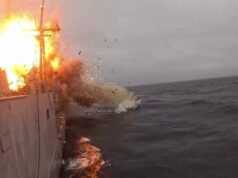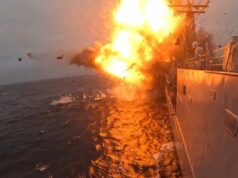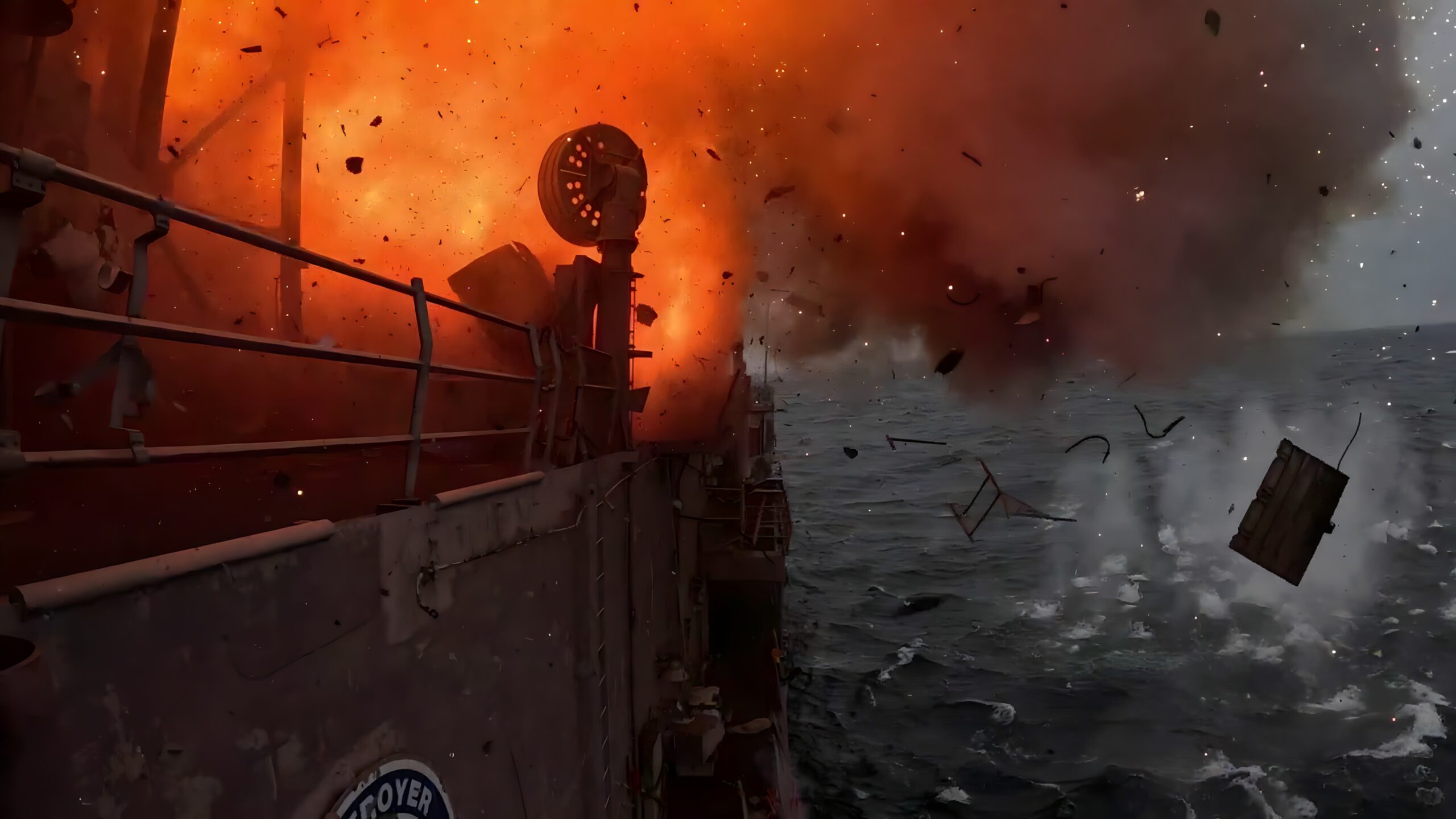
Ships, aircraft and a submarine from the United States and the United Kingdom have concluded Exercise Atlantic Thunder 2026 in the North Atlantic, a multi-domain sinking exercise that ended with the destruction of the decommissioned guided missile frigate ex-USS Klakring, according to United States Sixth Fleet, which led it.
Captain Kelechi Ndukwe, commander of Task Force 65, told the UK Defence Journal that the exercise ran from 14 to 25 September, with the sinking itself carried out on 21 September some 150 nautical miles offshore of the Hebrides range. Forces assigned to five American task forces took part, numbered 65, 67, 68, 69 and 1060, alongside the Royal Navy and the United States Air Force.
Asked by this publication what the objectives behind the joint targeting had been, whether they were met, and what an exercise of this kind signals to those who might be watching, Ndukwe said: “We used national technical means to be able to put this together, and I think what it really highlights is the strong bond between the U.S. and the U.K. Our ability to trust each other, to share information, and to show that we are a joint and strong and united force. Peace through strength is really what it shows. Our ability to reach out and touch at the longest distance possible is what we displayed, and you know I think it just shows our ability to be able to work together and interact and really push the limits here.”
In his formal statement on the exercise he put the same argument more bluntly. “Atlantic Thunder demonstrates the unmatched lethality and interoperability of the United States and United Kingdom,” he said. “This sinking exercise not only validated the power behind U.S.-UK offensive weapons but delivers a clear message to adversaries that the U.S. Navy and Royal Navy remain a ready allied force.”
Asked by the UK Defence Journal how much had changed since the previous Atlantic Thunder, held off the same range in 2022, the captain identified reach as the difference. “In past iterations of Atlantic Thunder, we weren’t able to test at the longest range, and I think that’s the biggest change from previous exercises,” he said. “This one, we really were able to test the multi-domain, multi-axis, incorporating the Air Force into it, and really test the boundaries of range for this one, and the new technologies over the past four years that we’re able to bring into play here.”
The guided missile destroyer USS Paul Ignatius demonstrated what Sixth Fleet called the maximum damage and range capability of an anti-surface variant of the Standard Missile 6, and the submarine USS Massachusetts then engaged the target with the Mark 48 Advanced Capability Torpedo, which Sixth Fleet said resulted in the final hit and ultimately sank the frigate. Ndukwe said the sequence had been worked out in advance so the sensors recorded each impact in turn. “We started with the longest range ordnance, which is why we were going with SM-6 first, and then moved in to shorter range,” he said, adding that the SM-6 shot was testing the surface-to-surface engagement at the furthest range available, a figure he said could not be shared.
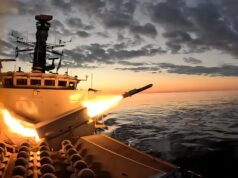
Britain confirmed both of its newest ship-busting missiles during the same serial, firing the Naval Strike Missile from HMS Portland and Sea Venom from a Wildcat helicopter of 815 Naval Air Squadron. Ndukwe confirmed at the briefing that the Sea Venom shot was the missile’s first live firing since it reached initial operating capability, and that it hit the target.
Lieutenant Commander Louise Kirkaldy, Portland’s principal warfare officer, said: “The successful firing of NSM marks a significant milestone for the Royal Navy, demonstrating our ability to deliver credible, modern maritime strike capability. This achievement reflects the professionalism, dedication and teamwork of all those involved, whose hard work has ensured we remain ready to meet the challenges of today and tomorrow.” Petty Officer James Kenyon, the above water warfare specialist who fired it, called it “the culmination of over a year’s effort in planning and bringing the drills into service.”
No uncrewed systems took part at any stage, the captain confirmed when the question was put to him directly, which sets the exercise apart from much of the trials work now running in British waters.
Four years went into the preparation, involving serving personnel alongside civilian counterparts. On the American side Ndukwe named the portfolio acquisition executive organisation, the Navy Information Warfare Command and the Naval Surface Warfare Center as having worked jointly on it, “ensuring that sensors were properly installed on the frigate to be able to take that data back, inform future capabilities, and really push the envelope on what we’re able to do with future weapons designs.” Sixth Fleet has since said the sensors were placed by Naval Surface Warfare Center Carderock and Naval Information Warfare Center Pacific, and that the data will be used to identify system failures rapidly, determine repair needs and strengthen the navy’s response in a real engagement.
Communications were the part the commander said he was proudest of, and the link architecture was built out by United States Sixth Fleet and run from its headquarters, then shared with HMS Portland, and he said there were no difficulties with it during the exercise. “We were really proud of the ability to communicate throughout the entirety of the exercise,” he said, adding that shared battle damage assessment “will ensure that the Navy and our navies will continue to be capable and lethal fighting forces.”
The units involved covered Paul Ignatius, Massachusetts, HMS Portland, P-8 maritime patrol aircraft flown by both the United States Navy and the Royal Air Force, a Royal Navy Wildcat helicopter, United States Air Force F-15E Strike Eagles, and personnel from Explosive Ordnance Disposal Mobile Unit 8.
On why an American hull was brought across the Atlantic rather than a British one used, Ndukwe described a cost-sharing arrangement between the two governments. “That was part of the agreement between the two navies and the departments of defense, was that we would pay for the tow of the ship across, and then the Royal Navy or the UK would pay for the range,” he said. Klakring entered service on 20 August 1983 and was decommissioned on 22 March 2013, and was named for Rear Admiral Thomas B. Klakring, who won three Navy Crosses commanding the submarine USS Guardfish in the Second World War, as we reported.
What remains of her will stay on the seabed off the Hebrides. “For the environmental side, it was all done during the course of the planning. It was approved by the EPA in advance, and it’ll become a natural reef. It’s sunk in a deep, deep valley there, right off the Hebrides,” the captain said. Sixth Fleet added that in line with Ministry of Defence environmental policy, monitoring was carried out above and below the surface by trained personnel to reduce the risk of harm to the marine environment and to marine mammals.
North Atlantic weather presented obstacles during the serial, Ndukwe said, though all the primary objectives were met and nothing the team had wanted to test failed. Asked by the UK Defence Journal whether work had begun on a follow-on, he confirmed that it had. “Planning has started with the goal of execution in 2028,” he said.