

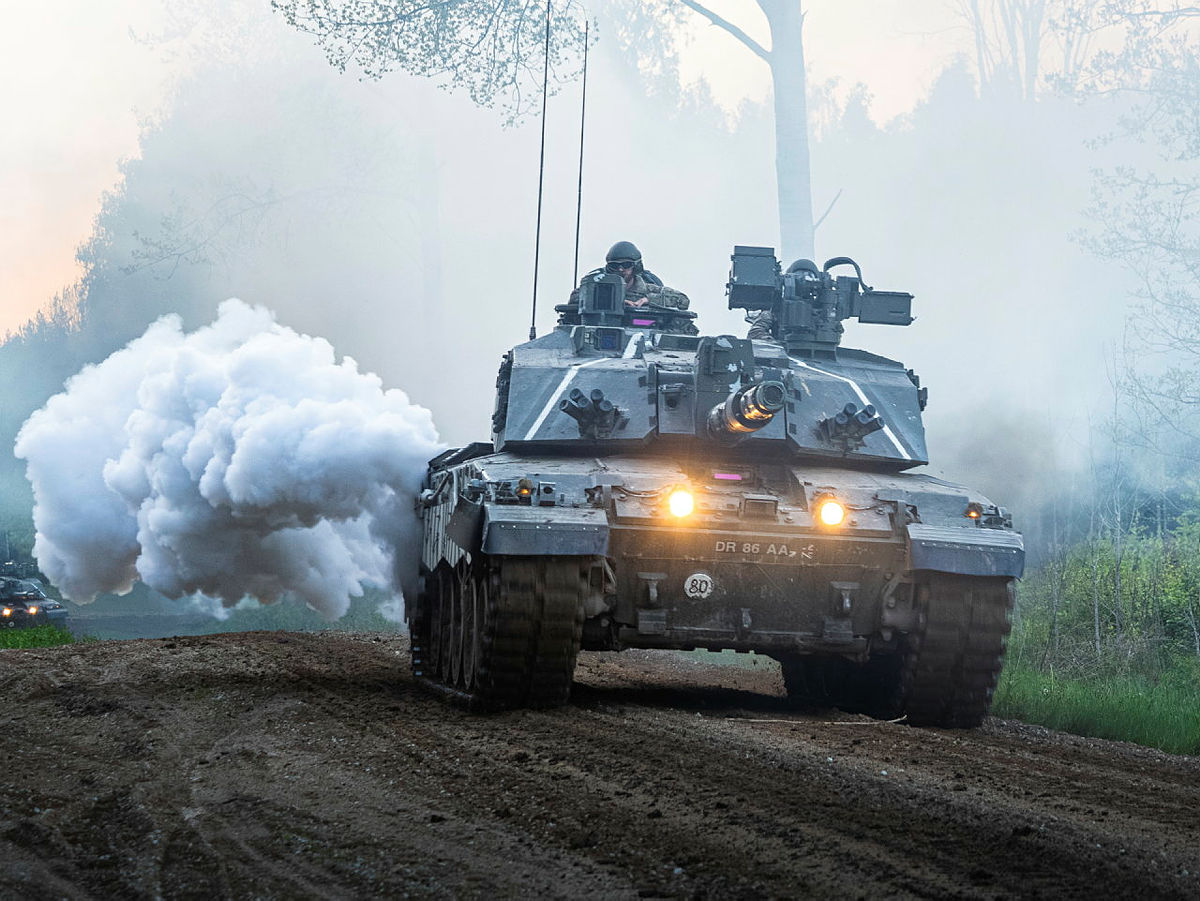
Some 1,500 British troops from 4 Brigade have deployed to Estonia for Exercise Spring Storm, training alongside NATO members and partners within 25km of the Russian border.
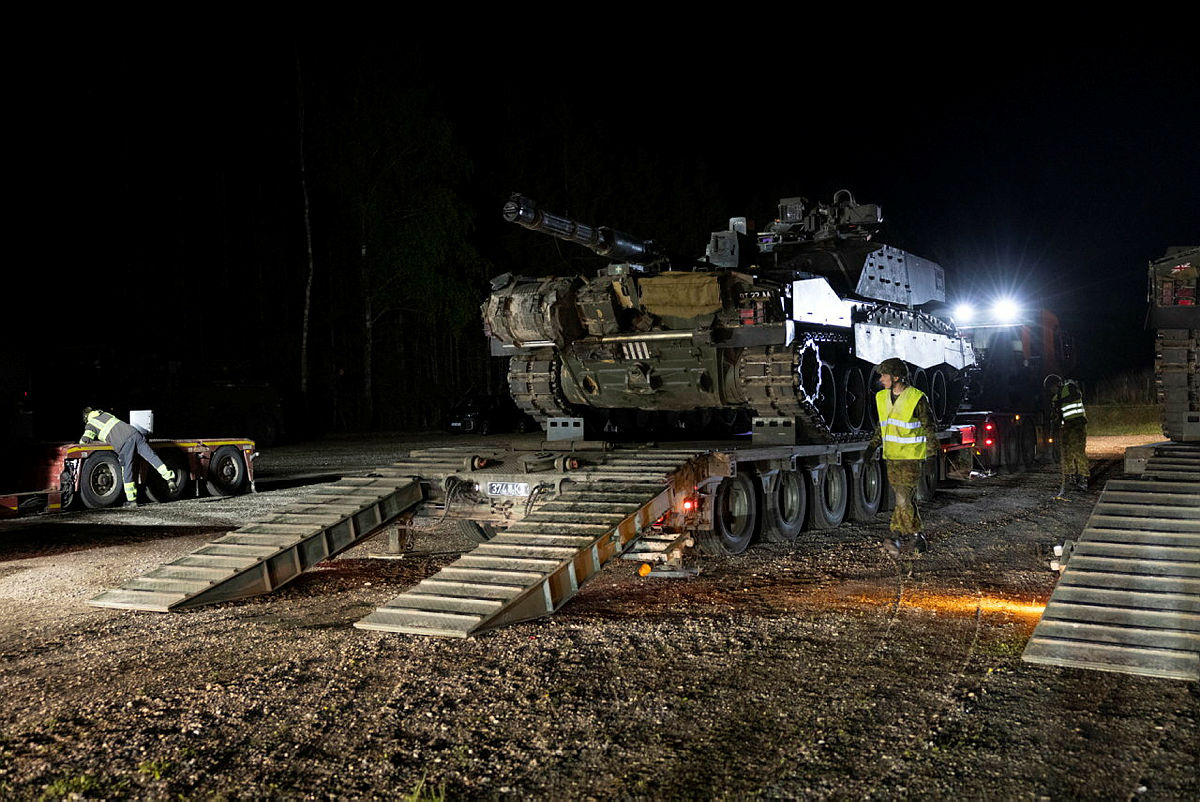
The exercise, supported by Challenger 2 main battle tanks moved into theatre on heavy equipment transporters, was built around a battlegroup formed on the 2nd Battalion, the Royal Regiment of Scotland.
The battlegroup, we understand, was tasked with defending against an incursion by an aggressive neighbouring state across the border, operating in the south-easternmost part of Estonia where the training scenarios were conducted close to Russian territory.
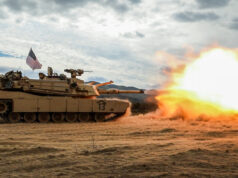
The Ministry of Defence said the exercise demonstrated the deployment of NATO’s Forward Land Force, the framework under which the alliance stations multinational combat formations on its northern and eastern flanks. Imagery released from the exercise showed Challenger 2s being unloaded and manoeuvring under smoke during the training, conducted through the second half of May.
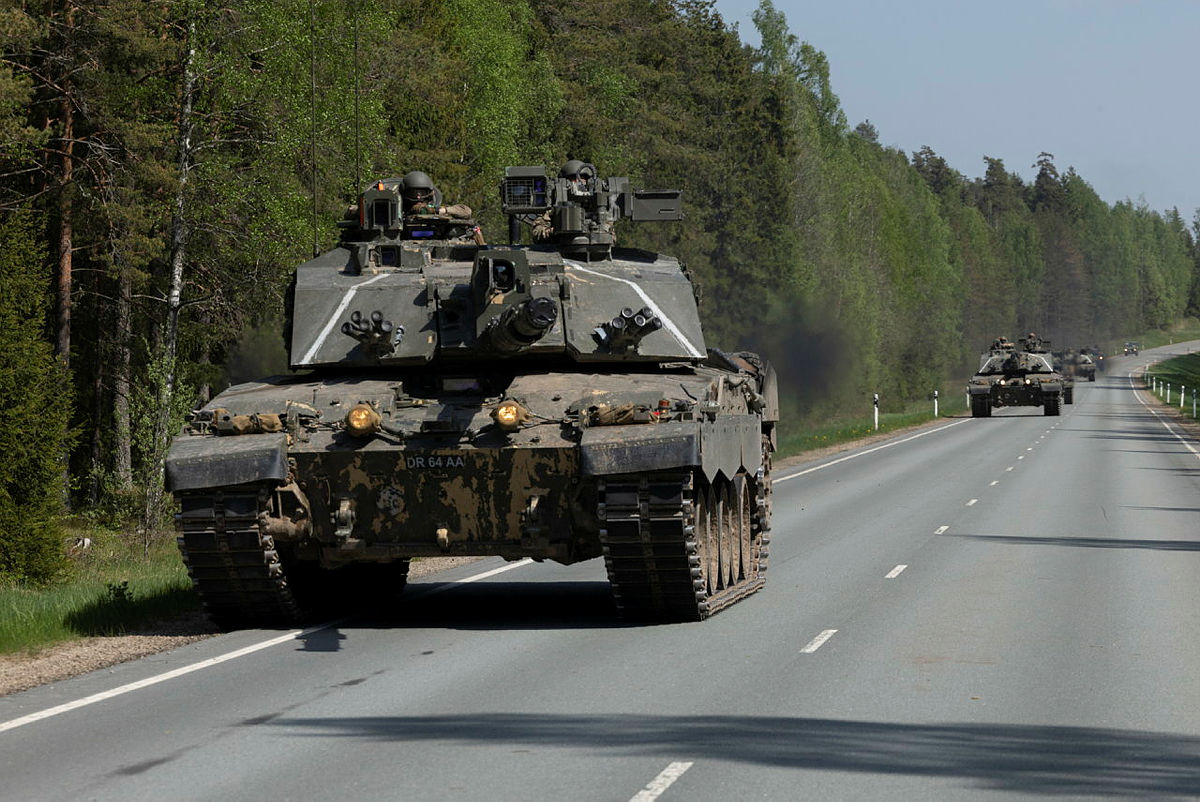
British troops have been deployed to Estonia since 2017 under Operation Cabrit, the UK’s contribution to NATO’s enhanced Forward Presence, which was established after Russia’s annexation of Crimea in 2014 to reassure allies on the alliance’s eastern edge. The UK leads the multinational battlegroup based at Tapa, and Estonia is among the Baltic states that share a land border with Russia and have pressed consistently for a visible allied military presence.
The Forward Land Force concept is really more of an evolution of that presence, following Russia’s full-scale invasion of Ukraine in 2022, NATO agreed to scale its eastern battlegroups up toward brigade strength where required, with framework nations committing additional forces held at readiness to reinforce them. For the United Kingdom, that has meant maintaining a standing presence in Estonia while earmarking a larger formation that can deploy to reinforce the country at speed, an arrangement that exercises such as Spring Storm are designed to rehearse.
Exercise Spring Storm, known in Estonian as Kevadtorm, is the Estonian Defence Forces’ principal annual field exercise, drawing in allied units alongside Estonian regulars, reservists and conscripts. Holding the training in the south-east of the country, close to the border, places it in the terrain that a defending force would have to hold in the event of an incursion, and tests the movement of heavy armour and the establishment of command posts under field conditions.






Wouldn’t it be good to get another 50+ CR3 tanks in the shed for 200+ as buffer stock to back up tank deployments and our allies on any North-South Eastern front and to follow up in force after all the drones have gone into action? Previous posts quoted at £5million each?
148 is little better than pointless, just another politically mandated MIC jobs for the boys procurement.
We should have decided if we actually required a MBT capability.
If the answer is yes, then its Abrams, Leppard or the South Korean tank, pick one and assemble it, so you have a scalable build.
CH3 is a cul de sac, a dead end with limited hull availability and zero possibly to scale up the fleet.
I think that part of the problem with DIP being published is exactly that point you make – war has changed totally and we need to decide what we want, and we just can’t decide.
The other problem is rachel from accounts.
I’ve gained $17,240 only within four weeks by comfortably working part-time from home. Immediately when I had lost my last business, I was very troubled and thankfully I’ve located this project now in this way I’m in a position to receive thousand USD directly from home. Each individual certainly can do this easy work & make more greenbacks online by visiting
following website—.,.,.,.,.—>>> JobatHome1.Com
It would cost two or three time as much to go with Abrams or Lepoard tanks produced in the UK for tanks which are inferior in their current available generation to CH3.
CH3 is a good idea to derive an affordable interim capability. We need an interim capability because it’s unlikely main battle tanks will be around for ever and the cost and t8me associated with a new design are probably not worth it.
If CR3 is a Cul De Sac,it is a Financial one,not a Physical one .
Various pundits have been declaring the age of the tank to be over for decades. The trouble is they may now (finally) be right. Or they may not. Unfortunately, trying to hedge by procuring a token force is not a useful response to that uncertainty.
It’s not a token force, rather tanks are a niche capability, the force reflects the size of the overall army, its larger in number than almost any other platform we operate SPG’s, Attack helicopters, utility helicopters, air defence systems etc.
Jim lives in a different world than the rest of us. He’s living in time long long ago. The UK is just not a relevant player.
large tank force for the uk is pointless, to expemsive and we lack the other kit to build the regts around it. Its about time we woke up and accepted we are not a world power and we can not have it all. A arge Army is no good to us as we have no where to house them, we can not afford all the new kit or man power increases.
Deluded people who think any government will cut welfare etc to fund defence need to see reality, we must be good at some things, not below to average are every thing. Best we can do is have good navy, verygood GBAD, good Air force and small but very moden Army, increae the Army ok where will you put all the troops and kit? / how will you pay for it?
Let other do the land battle we should do war at sea and defence of the nation, whislt backiong up Allies with specail roles.
That sounds too sensible, pity some idiots on here legit think we should have a large land presence in Europe when there are more than enough land powers in NATO to fill that gap.
Be smart like Japan, throw the majority of the funding into the air force and navy even if that means letting the army wither on the vine
Make it a,smaller Army but very well eequpt. Others have the land forces masses we can never have again
Tempo – how you win wars. Tempo, generated by training, good processes (drills and SOPs), logistics and mass.
All wars are won on land. Fact. They can be lost at sea, in the air and in cyberspace. But they are won on land.
A small army is a false economy in a state on state war, even one fought in the context of an alliance. That’s why the four times we have done that (7 years war, Napoleonic, WW1 and WW2), we have moved to a large Army in order to win. And only those with a large Army ever get a place at the peace negotiations.
Wellington did not field a large Army.
WW1 was territorials.
Heavens, WW2 was a citizen’s army and it was national service bods in Korea.
Wellington did field a large Army compared to what we’d had before.
WW1 was volunteer then conscription – a large citizen Army. Same as WW2…
So you agree – we had to go with a large Army in both of those cases then. The fact it wasn’t volunteer is irrelevant to the point – in order to win, we rapidly expanded the Army.
Martin, the army has been cut once or twice each and every decade since 1953 (not a typo). It is so small now that we could not deploy a brigade group on an enduring operation without unacceptable tour intervals and also having an impact on other commitments.
Our regular army at actual strength of c.72,000 is smaller than that of European countries of broadly similar size/population. [The French Army currently has approximately 118,600 active personnel. The Italian Army is approximately 98,310 personnel. The Spanish Army currently has approximately 122,000 active personnel as of 2026, and 80,000 members in the Civil Guard, contributing to the overall military strength.]
Healey aspires to increase the army by at least 2,000 but lacks the funding to do so.
Certainly the army today is not universally well-equipped.
We can not afford to equp a bigger Army. So growing it a bit is good may not enough for s long term repayment i agree. It’s a simple fact we can not house a bigger Army in the Uk. Let a lobe fully equip it.
I guess it had to be either keep it small abd bettefcequp ut or make it big and get by. Hard choice to make. Before most of the Army, at least BAOR was housed in Germany. We gave most of the camps back and built some more in the UK but to honest wd have no where to put a bigger Arny the rate MODl land is being sold iff or handed over to the home office.
Agree, but I’d never go so far as that with the Army.
I agree with you to a point Martin…
Those in the know ( like Graham), make a clear case for an MBT capability in the British Army. if we accept that’s the case and we also accept the British Army needs to retain well rounded capabilities, then it needs to sized and funded accordingly.
The government simply won’t do that, so they order penny packet fleets.
The Army that wins the wars of the next 20 years, will be the one that goes into bat with hundreds of thousands of attack drones and loitering munitions of all types, short and long range.
Look at Ukraine now, the Russians are increasingly on the backfoot as the Ukrainians are increasingly striking assets 30 plus miles in the rear, tube artillery is becoming second fiddle to attack drones.
You could argue that the British Army should be concentrating on building up tens of thousands of attack drones of all types to be relevant, we seem to equipping ourselves to fight yesterday’s wars.
The RN and the RAF are embracing an unmanned / manned hybrid future, why does the Army seem more reluctant?
We have play to our strengths, that helps us and our allies we are never going to be the does all nation again we can afford it nor should we try to be it
When Labour lose power in the coming months the welfare budget will definitely be cut one way or another – the welfare budget is unsustainable and causing horrendous damage to families and to the economy along with environmental taxes.
Once the welfare budget and environmental taxes are slashed a portion of that money will be reallocated to defence.
We cannot continue to ignore defence – the legacy parties have absolutely vandalised the British military and put every British citizen – the homeland our overseas territories and national interests at unnecessary risk.
Are you sure that’s going to happen? You may be disappointed
That increase at the expense of welfare etc will never happen. Under any government. We may get to 3% but simply by saying more is covered by defence rather increasing spending that is how it been for a,while. A paper work accounting exercise that looks like more when its ither the same or less.
I think it will Martin, our next government will likely be a Reform Tory coalition, if things continue as they are.
Welfare will be absolutely slashed, it has to be, its litteraly killing the countries spirit and churning out an apathetic generation that believes the country should look after them, many feel they have right not work…
There needs to be a new Welfare to work scheme, a YTS for the 21st century, arses off sofas and into training schemes…
Love to see it happened but what will get in the way of it all Unions and left leaning civil service. What and see
The blob and their left wing minions will never see that happen.
Also, Reform loathe the Tories, I don’t think they would join with them. They want to destroy them for letting in several million people.
I predict industry prioritised in the DIP, as always, and the Army getting slashed again.
Drones, AI, autonomous, there’s the excuse, we don’t need so many Soldiers.
They won’t fund GCAP, AUKUS, and the expansion needed all at once.
Welfare will not be touched by a Reform Tory coalition, the vast majority of the welfare budget is going to people voting Reform and Conservative now (Pension, NHS, Disability,PIP) all overwhelmingly older voters, all overwhelmingly conservative and Reform voters.
Reform has already scrapped its plans to get rid of the triple lock which is a Troy policy that they now want to quadruple lock.
The UK needs a proper right wing party that actually cares about cutting spending and debt. Not a populists coalition of people cosplaying as Margaret Thatcher.
You make it sound like young people are unemployed because Labour is giving them welfare. The peak youth unemployment over the last 20 years was in the Cameron austerity years (post financial crash, of course), 22% as opposed to 16% right now. It was also higher for a couple of years under John Major than now. Do you think that was because Gen X were lazy and propped up by Tory welfare? I have my doubts.
I believe currently there are 1.1 million 18 to 25 year olds ( growing by thousands each and every month) not in training, work or education.
That’s the size of the Chinese Army for christs sake, but being paid considerably more!!!
A good proposition of these claiming mental health as the reason.
That’s absolutely bloody horrifying, it sounds like you are trying to make excuses for the situation Jon, by saying ‘its been worse before’ ??
Nothing helps mental health like getting up at 7:30 each morning and setting off for work, or training towards work.
Nothing makes mental health worse that laying in bed until 10AM and playing XBox all day.
A little common sense needs to be applied by someone, Labour sure as hell won’t change a bloody thing, they have proven that by running scared of their own back benches and watering down welfare reforms to the point of ineffectiveness.
Someone needs to grab the bull by the horns and get them into active employment or proper training, before we have a whole generation of house bound cabbages.
You are a little misguided. Even if all unemployment benefits were cut it wouldn’t make a dent to the welfare budget. Which should really be renamed the pension budget.
Pensions: £146.1 Billion
The state pension takes up nearly 44% of the entire welfare budget. Because the demographic curve is shifting upward and the Triple Lock guarantees consistent annual increases, pension spending grew by roughly £21 billion over the post-pandemic cycle alone.
Youth Unemployment: ~£4 Billion to £8 Billion
Direct unemployment benefits (like Jobseeker’s Allowance or the unemployment element of Universal Credit) for young people are surprisingly small compared to the headline budget.
Total benefit support for all young people (aged 18–24, including those who are out-of-work, sicker, or NEET—Not in Education, Employment, or Training) sits at around £8.1 billion a year.
Thank you, it’s sometimes worth digging into the numbers. And also the percentages- as you have done.
Last time I checked, Pensions and NHS combined make up well over half of the welfare budget- with unemployment and other benefits relatively small percentage compared to them.
I’m still in favour of reforms, no system is perfect. But the idea that the young and “foreigners” are financially bleeding us dry is not all that accurate.
Morning Grant,
I hear what you are saying, but, if I may, you are being a little misguided yourself.
Lets circle back to the 1.1 million NEET figure, you are missing a huge aspect to this, not only do you have over a million people doing the square root of fu*k all and being paid pretty well by the taxpayer (living on the dole in the 70’s and 80’s was scraping by), they are also economically inactive, they aren’t contributing to the economy with their labour or indeed contributing to pot.
Thats a ‘massive’ amount of lost direct and indirect national income on top of the direct cost of being connected to the umbilical cord of state reliance, lost because young Tommy just sits there playing XBox all day on antidepressants, prescribed because he doesn’t work!
To add to this, a huge number of working age households are net takers from the pot and not contributors, due to the benefits system.
The whole system requires scrapping and radical reform, a sea change in people’s attitude if you will.
We have become lethargic and far too reliant on the state for financial support, there used to be some shame regarding accepting handouts, many today just simply see it as their right not to work and grab all the PIP and everything else going with glee.
So what you are talking about here is a lost opportunity cost from these 1.1 million people not working and being economically active. Yes I would agree we as a whole would be better if we capitalized on more of the population working and this would bring in more tax revenue, help with social cohesion and benefit the poor areas. This however would require some type of job creation or requirement to perform council or government jobs to receive their “benefits”.
Note this wont affect or apply to the child benefit costs unless for example these government jobs are created as part of government funded childcare. Something I would be in favour. Two birds one stone.
However the idea that even we scrapped all youth benefits we could fund the military or eliminate the national debt is just fundamentally flawed. The only way we could do that is by tackling the huge state pension problem and eliminate the politically unpopular tripple lock.
Generally I think we would be better off eventually phasing out state pension entirely and NI with it. It’s an outdated system that no longer works for the country or the majority.
The idea however that the majority of our problems come from the 1.6% of the population of 1.1M on NEET just doesn’t add up. Let’s instead tackle the housing crisis ban foreign nationals or companies from owning residential real estate and force selling within a 5 year horizon.
Too many properties are purchases as hedge investments as a safe asset whilst they sit empty contributing nothing to the economy. If you want to talk about lost opportunity cost this would be several orders of magnitude higher. The downstream impacts and reducing housing costs would be huge with flood of disposable income being availble to folks who no longer have to pay over 40% of their paycheck just to rent.
Absolutely 100%
The UK has been accepting it’s not a world power on land since the 12th century 😀
Any evidence of that, like an empire in 1800/1900s, you must know a diffrent history to others then. Please enlighten me with facts.
Do we need tanks? How much money does our tank force cost each year?
The push to Drones is irriversable now – hopefully they don’t prove to be the new Maginot Line .
I’m sure we will see drones evolve, a cycle of advancement, counter drone warfare and counter advancement will kick in, they are the new Dreadnought or tank moment in warfare, a turning point that happens every 50 years or so.
Will MBT’s survive as they are currently configured remain to be seen…
Perhaps they will evolve into drone launches too??
FYI Maginot Line worked. Germany had to go around via Belgium.
Leh, we need tanks. Our NATO remit is to deliver two divisions to the ARRC (plus Corps HQ and Corps Troops), one of which is an ‘armoured division’. We have also used tanks in other operations since the Cold War ended (two Gulf Wars and numerous deployments to FRY).
Okay, I can see the logic in having a force designed for immediate expeditionary operations such as those in the Middle East.
However, our force posture is reversing into one geared for a collaborative defence of Europe, in which the British tank fleet is overshadowed by many larger, and more capable tank fleets across the Eastern Flank. At the same time, the political will to engage in overseas military intervention abroad (like those taken on in the 90s and 2000s) is now in retreat.
Our force of 150 tanks isn’t moving the needle in a European war. The conflicts were it might be needed are now being actively avoided by the UK.
If the UK wants to maintain its tank fleet, then it needs to move away from bespoke British designs and purchase German or American vehicles. Funds saved can be diverted into growing the overall fleet size.
If the UK no longer intends to engage in those overseas interventions, or more realistically, to prosecute those interventions from standoff distance, then real thought should be given to the utility of maintaining the tanks in comparison to greater investment in air or maritime power.
The tanks aren’t the only example. The Apache fleet, for instance, is also something that should be subject to extensive inquiry as to its future utility in an modern conflict. Several large powers are already trending away from the attack helicopter as a system.
Unfortunately for the attack helicopters, too many parallels are being derived from the Ukraine-Russia war. From Russia’s perspective they started the war with over 150 Mil24/35s, over 80 Mil-28s and over 130 Ka50/52s. Whereas Ukraine had around 40 to 50 Mil-24s in various states of availability. Basically Russia had at least a 9:1 advantage/overmatch in attack helicopters. Not to mention the availability of over 300 dual role Mil-8/17s used for “softening up” areas using unguided rockets. However, from Day one of the invasion, Russian helicopters have had a battering from Ukrainian MANPADS (not to mention a few air to air shoot downs and from other SAM systems).
Looking at the shoot down evidence of crashed Russian helicopters, the troop transports do not have an automated defensive aid system (DAS) countermeasures, if fitted were manually released. DAS fitted to the newer Mil-28s and KA-50/52s, were according to Russia, on par with any of the Western systems. Yet against infrared guided MANPADS, there successes at countering them are very poor. Plus they have no specific answer to the RBS-70 or Starstreak/Martlet. Other than launching guided weapons from beyond their engagement ranges.
By comparison, the AH-64E the UK is getting is the same as the the latest US Army version. It is fitted with the latest in defensive aids, which should also include directed infrared countermeasures (DIRCM), which is used to blind IR seekers. I can’t speak for our Russian counterparts, but I definitely know that the UK in particular trains against various MANPAD threats. But also uses intelligence to keeps abreast of any changes or new introduction of MANPAD, which is then feed back into the training, but also the design of the countermeasures, for example the heat signature of an expendable flare.
However, as both Ukraine and Russia have proven, a new threat has emerged in the shape of first person view (FPV) drones, that are manually targeting helicopters. Initially these drones could get a lucky intercept by being in the right place and the right time, as their speed pretty much matched the helicopter’s. But this has now changed where both sides are using faster drones to actively hunt helicopters.
The AH-64 has always been a slow aircraft. It won’t be able to outpace a FPV drone. Therefore, it must be capable of dealing with the threat. The AH-64 has the means to detect these types of drone, through the use of its Longbow radar and optical sensors. Where it has a number of ways to kinetically deal with them, through Hellfire/JAGM, APKWS and its 30mm autocannon. But the recent trials where a loyal wingman has been operated from the AH-64, might also prove to be another means of detecting and taking out these threats. I’m pretty certain we will see a Russian loyal wingman operating with their attack helicopters. As not only can it be used as an attritable asset to protect the manned helicopter. But it will act as a force multiplier for both detecting targets/threats and dealing with them.
The attack helicopter, much like the MBT still has a place in today’s battlefield. For the helicopter, the key asset it brings to the table, is mobility. It can cover a lot of ground fairly quickly and either be used as an Intelligence, Surveillance, Target Acquisition, and Reconnaissance (ISTAR) asset. Whilst deciding to take out targets when operated offensively or defensively. You can use a drone for some of these tasks, but it doesn’t have the magazine persistence, or sensors of the Apache.
British tanks on the Border ,somehow I don’t think this will worry the Russians has our numbers are shameful .
Like I commented on a previous article about this, nobody else has commented on 4 Brigade and what it contains,and more importantly what it doesn’t.
It’s like we’re headed for one set of kit for a Brigade, and manpower is rotated in and out and paired up with it.
Brigades without CS CSS, who cares.
Tanks have generally had fairly short lives on the battlefield with high levels of losses accepted as normal.
The exceptions were when they were used in conjunction with air dominance to achieve blitzkrieg effects- gulf wars 1 and 2 for example.
In the Yom Kippur war, Israel initially lost large numbers to ATGMs before changing tactics with better coordinated use of airpower.
Whilst it would be wrong to infer that the Ukraine war has shown tanks to be obsolete, because Russian use of armour has been so inept, modern top attack PGMs and drones have certainly increased their vulnerability especially in semi static warfare.
Adding self defence systems to each tank is expensive and uparmouring has reached its practical limits with Ch3 likely to reach 80 tons making it hard to move long distances. An armoured BCT in Estonia would be difficult to reinforce ( even if we had numbers to deploy). So what should Britain do now that a brand new MBT is likely to cost £12m+ apiece?
148 is somewhat lower than the current MBT forces of France, Italy and Germany. But all 4 countries have reduced their numbers to broadly similar levels. Only Germany has open production. Even if it is reasonable to have 2 rather than 3 armoured BCTs, a reserve would be wise- we cannot build new replacements.
Everyone assumes, unlike other European countries, that Britain would be fighting on someone else’s territory and that we do not need MBTs for home defence. But we are committed to collective NATO defence and to do that we need a sustainment reserve. Upgrading another 50 Ch2s would give us that at a reasonable cost.
For the future it would make sense for European countries to develop a common MBT design that could be built locally.
Germany and the US already tried that with the MBT 70 and such, it kinda worked, and it would likely be easier now as most tanks use the same RHM gun or variations of it, but the problem is what the tanks will be built for, the CH’ are heavily armoured, the leos armed, the leclerc is like the middle child, and the abrams kinda does a bit of everything at once, each country has built tanks to fit the country’s purpose, if anything, excluding Britain from the project would be a better idea, like a modern europanzer, as the UK has never really fought proper land wars on home ground (post 10th century)
Interesting that Japan which
* has never been invaded
* has terrain mostly unsuitable for large scale armoured warfare
* has a self defence force with no expeditionary commitment
currently has @ 480 MBTs in service. It has also ordered 255 8×8 fire support vehicles similar to the Italian Centauro.
Re a possible Euro tank, it looks more possible now. Italy will buy a German design in a joint venture with Rheinmetall and assemble locally, Sweden builds Leopard2 under licence, KMW and Nexter merged into KNDS and Rheinmetall owns 51% of RBSL.
Also the Japanese armed forces haven’t seen combat action since 1945.
There is a great deal of excellent research going into combined arms manoeuvre warfare in today’s contested air environment:
‘…rather than eliminating the need for movement and shock, drone warfare has strengthened the find-and-fix functions of the kill chain. Armoured and mechanised forces remain essential for breaching, exploitation, and control of terrain. What has changed is the requirement for dispersion, deception, and integration of armoured capabilities with counter-UAS and electronic warfare (EW). Ukrainian and Russian forces have both adapted by reducing formation density, improving camouflage and concealment, and synchronising manoeuvre with EW and fires to disrupt enemy drone reconnaissance.
…the Russia-Ukraine War demonstrates that battlefield dominance fluctuates with the balance between sensors and countermeasures. Periods in which drones have appeared decisive on the battlefield have often been followed by phases in which jamming, physical obstacles, and air defence have reduced their effectiveness, enabling renewed manoeuvre. The introduction of fibre-optic drones, terrain-masking flight profiles, and decoys reflects an ongoing contest between reconnaissance and concealment rather than the permanent triumph of one over the other.
…armoured warfare has adapted rather than disappeared. Tanks and infantry fighting vehicles continue to play critical roles in assault and defence, but with modified tactics: operating in smaller packets, using extensive engineer support, and coordinating closely with ISR and fires. Ukrainian counteroffensives and Russian defensive operations alike have shown that, while armoured breakthroughs are harder to achieve, they remain operationally necessary for exploiting tactical success and achieving decision at scale.
Finally, historical patterns caution against premature claims of obsolescence. Consider, for example, previous technological shocks – machine guns, precision-guided munitions, and airpower – were each declared the ‘end’ of manoeuvre warfare. Yet all were ultimately absorbed into evolving combined arms concepts. Drone-enabled surveillance represents a further increase in battlefield lethality, but it does not negate the enduring requirement for manoeuvre to dislocate the enemy, seize ground, and impose operational dilemmas.
In operational reality, manoeuvre warfare is not obsolete. Instead, it is being reshaped by a new balance between detection and denial. The contest is shifting toward who can better integrate drones, EW, deception, and armour within combined arms formations. Events on the battlefield in Ukraine suggest that advantage will accrue to forces capable of suppressing enemy sensors long enough to enable movement and mass effects at decisive points. While drones have raised the cost of manoeuvre, they have not eliminated its necessity.’
Dr Oleksandro Molloy March 2026
Britain is committed to providing a two division Army Corps to NATO, including one armoured division (-) as set out in SDR 2025. Nothing that is happening on the Russo-Ukrainian battlefield gives any cause to revise that commitment. On the contrary, Ukrainians have recently achieved very local battlefield air superiority and have once more commenced (small scale) manoeuvre operations.
148 tanks won’t last 5 minutes in combat. Look at rates of losses in Ukraine the last five years. Like everything else we are scaled for a deployment on paper but not for an actual war. Our tank force won’t last in a peer war and we have zero coming behind, literally zero.
We need to get real here.
An aside but a similar situation, the US has used one third of their precision weapons IE Tomahawk in the short war with Iran. 1000 used out of 3000 total. Its going to take FIVE YEARS to rebuild that stock!
The entire West is not geared and provisioned for war.
Luke, How many CR2s have been lost in combat? None..when manned by Brits; possibly only 2 when in Ukrainian hands (Ukraine MoD stats but Russia claims 4). That is after nearly 3 years of operations in an intense drone-rich battlespace. So how do you conclude that 148 even better protected tanks (CR3) will last for less than 5 minutes?
[Being pedantic, those 148 tanks are not all in 3(UK) Div – probably there will be three Type 44 regiments ie 132, the remainder (Qty 16) being split between the Repair Pool, Trg Org and Attrition Reserve].
Certainly the entire West is not geared and provisioned for general war, especially the UK. Political will to rearm is weak. Contrast this with Nov 1933-Sep 1939 when the rearmament effort was intense, especially in the last 3.5 years of that period.
How many did we send? 12?
That makes up a tiny fraction of the Ukrainian armoured force, less than 1%. You can’t go off that Graham. What we do know is the Ukrainians and Russuans have burned through a huge portion ofbthrur vehicle stocks. The Russians have lost 10s of thousands! Our entire force is nothing more than a token effort. Its not sized for any sort of warfighting at all. Patriotism isn’t pretending things are going to be ok, we need to speak put at our utterly woeful state.
Being pedantic a little a CR2 was lost in combat in Iraq aswell. EFP fired upwards into the underside and took the drivers legs off. Vehicle written off.
Great! Let’s wind up the Russians even more when everyone knows that the UK is a paper tiger!
was this defending against an incursion done with realistic FPV drones on the opposing side if not they really need to get with modern warfare
Well, drone kill chain systems under Project Asgard were trialled in exercises last year- and the intention was to test a more mature version during exercises in Estonia in May this year (according to MoD reporting from last summer). I don’t know for sure if this was the exercise where that happened, but the dates line up.
more western provocation, the west should never have reneged on its assurances to russia nato wouldn’t be allowed to spread eastwards, see ‘nsarchive, what gorbachev heard’
And which former President Gorbachev ( who I thought a great man ) confirmed in 2016 never happened.
it really doesn’t matter what gorbachev said about it, it only matters what actually was said, the documents referred to clearly show those assurances were given by multiple people, at multiple stages during the end of the cold war!
do you understand now ?
It’s all very well saying we need to enlarge the UK tank fleet and talking about the cost per vehicle. You also need to factor in the cost of training the crews – due to the gutting of the army by Goverments of both persuasions starting with Options for Change in the late 80s/early 90s due to the “Peace Dividend” following the fall of the Berlin wall and reunification of Germany, and continuing ever since – we no longer have those. Then there is the cost of a comprehensive spares package for each vehicle, ammunition, etc.
I will be very curious to see Putin’s response to that new escalation/debacle… Because don’t be fooled into thinking that it is… Only a training exercise… It’s not.
Not only, as aforementioned above by other people, we don’t have the means to get involved in a war that has nothing to do with us in the first place BUT we have a vast array of problems at home to sort out already… No… We need more problems…
Clearly, the saying “Don’t be part of a problem… Be the whole problem” applies here perfectly.
Putin is a lot of things but he’s far from being stupid and underestimating him might be the last mistake the West makes.
How do you think this all look on his side of the fence… It looks like an impending invasion.
Now, remind me please, how many times in recent history Russia has been successfully invaded? Any reason why…
Because they have one of the world’s biggest army AND the biggest nuclear arsenal… And yet, you’ve got Starmer and the rest of the gang of absolute cretins in Brussels gathering tanks all along the border as if they were setting up for a big NATO carboot sale.
You wait and see. And good luck with the radioactive reality afterwards. See you all on the flip side.
i hope their practising a dunkirk style evacuation as well
BAXAXAXAXAXAXAXAXAXAXAXAXAXAXAXAXAXAXAXAXAXAXAXAXAXAXAXAXAXAXA
UK are the biggest clowns XAXAXAXAZAZAXAXAXA
Trolls out in force, I see