

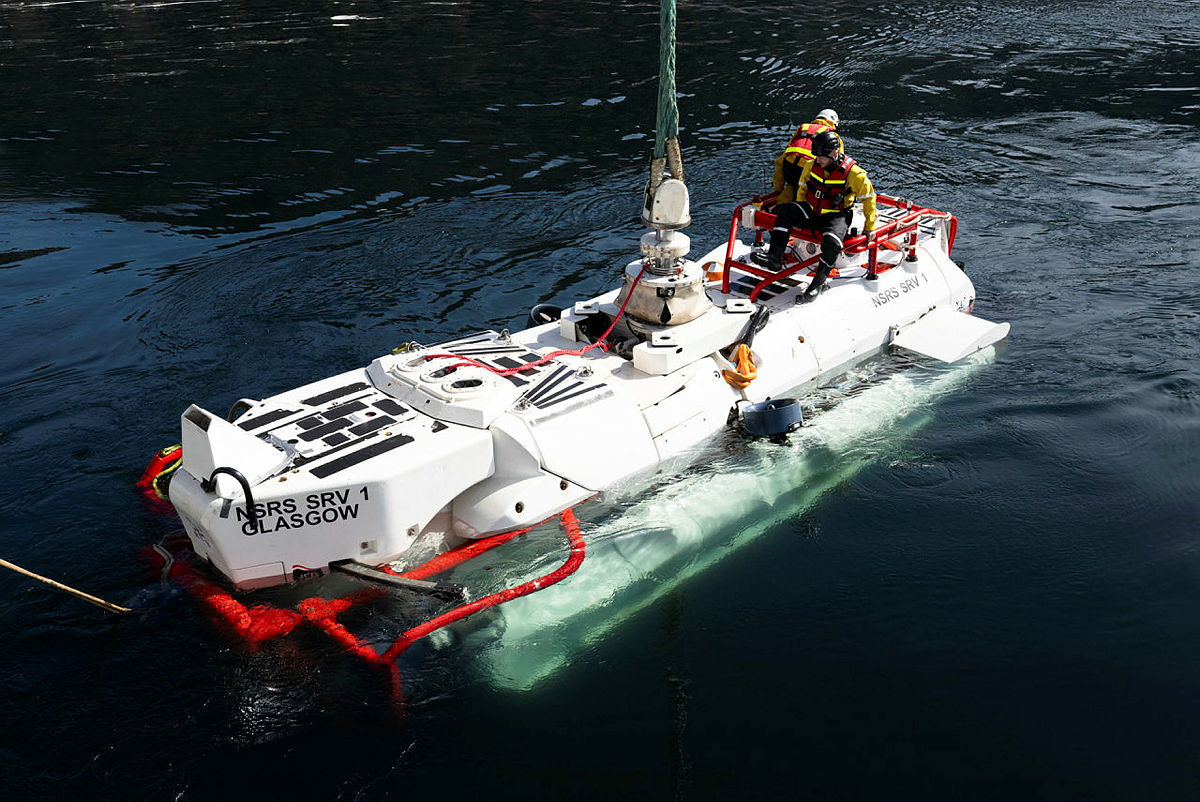
The NATO Submarine Rescue System has completed an exercise testing how its 350 tonnes of specialist equipment could be moved rapidly by road and Royal Air Force transport aircraft to respond to a submarine emergency anywhere in the world, the UK Defence Journal understands.
Exercise Flying Fish involved moving elements of the tri-national rescue system from Glasgow to RAF Brize Norton before practising loading the Submarine Rescue Vehicle and associated equipment for air transport.
The NATO Submarine Rescue System, known as NSRS, is jointly owned by the United Kingdom, France and Norway and is designed to rescue personnel from a disabled submarine resting on the seabed at depths of up to 610 metres. Mobilising the complete system requires around 350 tonnes of equipment, 27 lorries and several aircraft, according to the Ministry of Defence. During the exercise, the road convoy carrying the equipment travelled from Glasgow to RAF Brize Norton under police escort. Every police force along the route was involved in maintaining what the MOD described as a continuous blue-light escort.
At Brize Norton, the Submarine Rescue Vehicle, effectively a small rescue submarine capable of docking with a disabled vessel, was loaded onto a simulator replicating the dimensions and deck arrangement of a C-17A Globemaster III transport aircraft. Some of the heavier supporting equipment was separately loaded onto an A400M Atlas simulator by personnel from the RAF’s Joint Air Delivery Test and Evaluation Unit. The exercise marked the first time the A400M had been used in testing for the transportation of NSRS equipment. The MOD said completion of the work means the aircraft can now be used by the UK and NATO partner air forces during future mobilisation of the rescue system.
Minister for Defence Readiness and Industry Luke Pollard said: “This is a piece of specialist equipment we hope never to have to use, but the ability to mobilise the NATO Submarine Rescue System at short notice to anywhere in the world is reassuring for the UK and our allies.”
He added: “If a submarine is in trouble we will need to respond fast. Ensuring we have a tried and tested response is how we can be ready for any eventuality.”
The NSRS is designed around rapid mobilisation following notification of a submarine accident. Its equipment must first be transported from its normal location to a suitable airport before being flown to a receiving country and moved onwards to a vessel capable of supporting the rescue operation. At the centre of the system is the Submarine Rescue Vehicle, which can descend to a disabled submarine, mate with its escape hatch and transfer personnel to the surface support vessel.
Captain Lyons RN, Operating Duty Holder for the NSRS, said: “Rescue of the crew from a stricken submarine will require numerous agencies to operate efficiently as one team, and this loading exercise on to a military aircraft is a vital aspect to maintain training and currency for our RAF colleagues.”
He added: “I was delighted to see them maintain efficient and close control of this unique vehicle that is relied upon by so many nations.”
The system is maintained as a joint capability for the Royal Navy, French Marine Nationale and Royal Norwegian Navy. It is delivered through the Defence Nuclear Enterprise’s Submarine Delivery Group, with JFD Global acting as the service contractor. Regular exercises cover different stages of a potential rescue operation, including mobilisation, transport, launch and recovery of the rescue vehicle and coordination between military, civilian and emergency organisations.
Exercise Flying Fish concentrated on the transport phase, including movement by road and preparation for strategic airlift, while also giving RAF personnel experience handling equipment they would be required to move during a real submarine emergency. With the A400M loading work completed, both that aircraft and the C-17A can be incorporated into future NSRS mobilisation planning for moving the system from the UK to an overseas response location.


To add, and not forgetting SPAG, which could also deploy given the circumstances.
Yet another rare transport aircraft needed on standby for that, leaving other areas of Defence having no asset available as some idiot thought that reducing RAF AT fleet by 25% was a good idea. 😒 Grrrrr.
The Herc cut still annoys me more than any other, the sheer utility of the transport force and the demands placed on it for Defence.
On JADTEU, was no actual C17 available?
Also, why move to Brize? Rather than forward deploy aircraft to Prestwick? Would that not be faster?
On Air Transport fleet numbers, got to agree. We need more with flexibility of utilities such as airborne refueling and firefighting.
The article mentions simulators for both the C17 and A400 loading so got to assume they are not transferable to Prestwick. Used to practice vehicle loading etc in a controlled environment possibly?
Hi Novice.
Yes, i appreciate that, I noted that simulators were used and they probably are fixed, and quite useful for the job in hand.
I was questioning whether beneath the headlines that was due to a lack of real world assets that would surely be a greater realistic trial.
In real life, assume aircraft would fly north as suggested.
Also can be deployed by SD Northern River
I think that is the standard method and ship used, yes.
However once this has been completed the MOD has been instructed to find a cheaper, more efficient and UK manufactured system, which will ensure 500 jobs are maintained in its support and production line. A Labour Government statement stated “The system will ensure a smoother, more rapid extraction for submariners, in any situation, with a world beating system, designed, built and delivered on budget and on time by a number of consortiums. This will be introduced in service by 2035, as rigorous testing is required as the safety of UK military personal with a budget of 500 million UK pound”. However an insider “off the record” did say there are two main issues which need to be resolved, firstly the joining of the ropes to a total of 610 metres and the fact the 24kg kettle bells keep untying and falling off the end!!!!
We are so lucky to have such an understanding man of the people as our dear leader with such a fair and caring cabinet and back benchers, all who love this country so much and only want the best for us all. Cant wait to be dragged into the new “troubles on steroids bill” a future Afghan version, cant wait for more covert and overt tax rises, cant wait to watch UK military be defeated in any and all future conflicts, cant wait to see even more illegal immigrants bussed into Colchester to spend fee cash and leer at the girls, cant wait to see more business go under due to Racheal from accounts plans, cant wait to see more expensive property never be valued over 1.95 million, cant wait to see more people in rented accommodation being turfed out, and in a similar vein the same landlords no longer renting, so reducing available stock, and cant wait to see those (I know I’ve missed lots) poor feckless no hopers who vote labour get some well deserved benefit raises at the expense of the working person! Makes me want to tie a Union flag to my nearest lamppost in celebrating our English and British culture……..oh wait?
Couple of issues for me here, firstly going in a submarine, not normal, secondly going in a very small submarine to rescue people from a very big submarine, sorry still very not normal!!!!! However not a very big hatch on the Submarine rescue vehicle to get the submariners balls in, may need to be bigger!!!!! Respect for all these rather crazy people.
Yes, we don’t see Deep32 around as much.
Not sure who was madder, you jumping from an aircraft or him entombing himself in the depthless depths.
Humans can swim but they can’t fly.. so definitely the one jumping out of an aircraft lol
Don’t be mad! I get a reserve parachute and can breathe on the way down, no matter how fast it is! Cant breath at 600 metres deep mate lol Cheers.
Lol… True.
See him on occasion, his knowledge is missed mate. Nah he is worse, at least I had a reserve parachute if needed, not sure you get a second chance in a submarine! Another area of the navy where there are serious manning and recruitment issues. There’s a lad who goes on tik tok (or whatever platform its on) scouse lad, while not telling any operational info, really does say it how it was on long patrols, 4 on 4 off etc, tells it in a way which makes you realise its not all its cracked up to be. Cheers mate.