

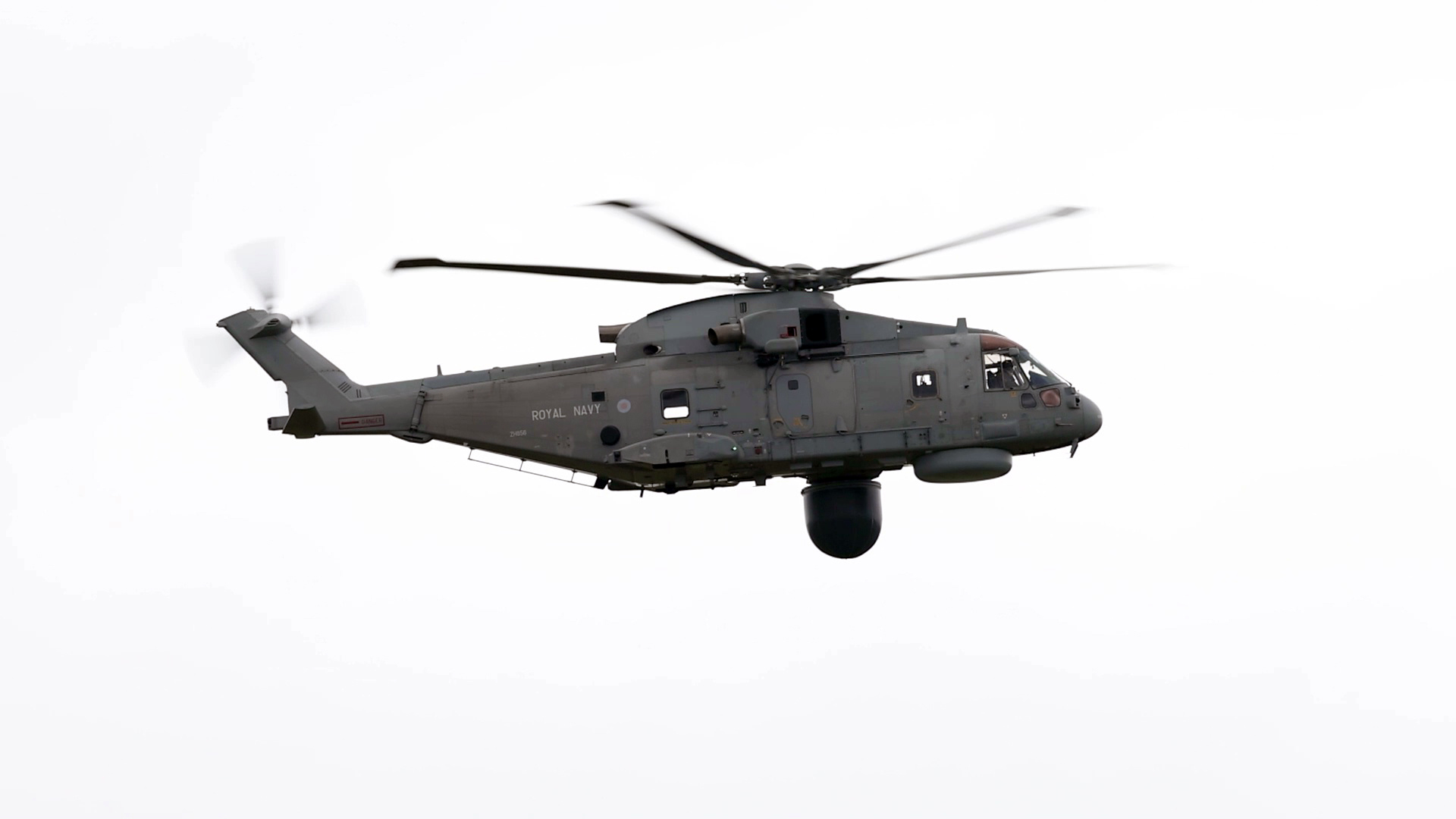
The Royal Navy still has no firm plan to replace its Crowsnest airborne early warning system, with options remaining at the investigation stage and a decision held up by the Defence Investment Plan that has yet to be published, the Ministry of Defence has confirmed to Parliament.
Asked by the Conservative MP for Huntingdon, Ben Obese-Jecty, what progress had been made in procuring a replacement, the Minister for Defence Readiness and Industry, Luke Pollard, offered no timeline, no chosen system and no commitment, saying only that the Royal Navy was “investigating successor systems for the Crowsnest Airborne Early Warning system, including the potential use of Uncrewed Air Systems”. The work, he said, was “consistent with the development of Hybrid Air Wing as set out in the Strategic Defence Review”, and was “subject to the Defence Investment Plan”.
Crowsnest is due to leave service towards the end of the decade, and with the replacement still being investigated rather than procured, the Royal Navy faces the prospect of a gap in one of the most important capabilities protecting its aircraft carriers.
Crowsnest is the airborne early warning system carried by the Royal Navy’s Merlin Mk2 helicopters, providing the radar eyes of the Queen Elizabeth-class carriers by detecting aircraft and missiles at long range and buying the carrier group time to react. The capability has had a difficult history, with its introduction running years late and its performance repeatedly criticised by the National Audit Office and the Commons Public Accounts Committee, and the question of what comes after it has been live for some time without resolution.
The reference to uncrewed aircraft reflects the Royal Navy’s stated intention to move towards a Hybrid Air Wing, set out in the Strategic Defence Review, in which crewed F-35B jets and Merlins fly alongside uncrewed aircraft, and the carriers have already been used to trial fixed-wing drones designed to operate from their decks. Moving the early warning role onto an uncrewed platform would fit that direction, but the minister’s answer makes clear no such decision has been taken.
The deferral places Crowsnest on a growing list of capability decisions the government has parked pending the Defence Investment Plan, alongside recent answers on the future of the Type 45 destroyers and the wider shape of the fleet. The plan has become the single document on which a long line of procurement choices now hangs, and its repeated delay has drawn sustained criticism, with a techUK survey of defence technology suppliers finding the vast majority reassessing investment as a direct result.




Fair enougth. No rush obviously. There won’t be any money for it any way. Maybe sell the carriers to Russia in exchange for oil?
I’ve gained $17,240 only within four weeks by comfortably working part-time from home. Immediately when I had lost my last business, I was very troubled and thankfully I’ve located this project now in this way I’m in a position to receive thousand USD directly from home. Each individual certainly can do this easy work & make more greenbacks online by visiting
following website—.,.,.,..,.,.,.,.,.—>> LIVEJOB1.COM
We have to live with crows nest. Short catapults being mentioned to launch drones. If we are the only navy doing this, then again we are going down a niche way of doing carrier operations. Rightly we questioned emerging emal catapults at time of QE carrier build.
If the u. K. Won’t pay for such an important piece of equipment then it proves that the wrong people are running the shambles in theMOD
Whatever happened to the initiative to fit a ‘drone’ catapult to QE? Despite all the recent progress in lightweight drones, isn’t it the case that if you want a really significant and practical step up from Crowsnest you need to accept that means E-2 Hawkeye?
No idea.
And yes, Davey B here has explained the issues with just plonking a Radar on a Drone many times.
Ark Royal was abandoned as too expensive and has been replaced by project Vanquish for a fast STOL UCAV.
There’s a big margin between E-2D and Crowsnest and we don’t necessarily have to go all of the way up to what is one of the most capable AEW aircraft anywhere never mind carrier AEW. Crowsnest’s range is supposedly around 160km, while MQ9B AEW is rumoured to have about a 300km range and E-2D does 650km. So we can get a good step up in altitude, endurance and radar performance without needing CATOBAR, and I think that’s good enough without vast expenditure on the carriers.
Plus with the endurance of the MQ9B we can have several airborne simultaneously. IF it all works as advertised, then drone AEW is a no-brainer.
That all depends on what you can detect at those ranges. Operating in the UHF range, the Haweye’s radar is better suited to detect stealth targets and can track dozens of targets simultaneously. And, can detect and track ballistic missile and hypersonic threats as well. Plus, with a crew on board, the Hawkeye can command and control the battle hundreds of miles from the carrier.
Yes, E-2D is pretty much an AWACS rather than just AEW. But we’re never going to be able to improve on Crowsnest at reasonable cost with a manned platform so an AEW only UAV it is.
The LoyalEye radar on MQ9B is based on the Globaleye system so it has a good lineage.
I think you’re right. Those MQ-9Bs, even with the wings folded, take up a lot of deckspace. Six to eight Reapers for AEW and ASW seems reasonable (yes, they have longer endurance, but not every Reaper will be available all the time), but does that mean carrying 6-8 fewer F-35Bs?
The overlapped folding is quite compact, unfortunately GA don’t put F35s in their concept art alongside the drones so it’s hard to make a direct comparison but by eye they look about the same footprint as an F35B with similar wingspan (no folding on the jet) but the drone is shorter.
My ideal air wing with MQ9B would be 4 AEW, 8 MPA/strike and 12 F35s, plus a couple of helicopters. That’s well within the limits of the carrier and in a more strike-ey role they could surge to 24 F35s and drop down to 4 MPAs with no issues. As the MQ9Bs carry the same anti ship missile as the lightning (JSM) they can take over a lot of the maritime strike role with much longer mission range.
that seems like a sensible balanced force- nice!
UHF based radars also have their problems, firstly due to the physical size of the required antenna, you need a large aircraft to carry it. Due to the much longer wavelength they also detect a lot of clutter, which requires a large amount of costly signal processing to get a decent image of an object of interest. Again due to the much longer wavelength, they’re pretty crap for radar imagery.
However, UHF radars have the benefit of being able to transmit for a very long range without needing a huge amount of power, as the frequency is less affected by atmospheric attenuation. But also benefit from a phenomena called resonance. Which is where an object’s physical size is roughly equal to the wavelength of the emitted radar. This causes cavities within the object to reradiate. But also if straight edges match this criteria, these edges act like antenna to reradiate. This is great at detecting aircraft, but does bring into question the ability to detect really small drones.
In some respects the Saab Globaleye is a better AEW compromise. As the Erieye ER radar fitted above the fuselage operates in the S-band, giving it a detection range over 450km, against a fighter sized target (which could be anything from a huge Mig-31 to the much smaller Gripen, Saab won’t say anymore than that!). But perhaps crucially, the aircraft is also fitted with a Seaspray AESA radar, that operates in the X-band, mounted underneath the aircraft. This radar is then looking towards the horizon and underneath the aircraft. X-band radar are particular good a seeing objects close to the sea, as their wavelength detects significantly less clutter. You will still need signal processing to get a clearer image of the object. But nowhere near the same amount you’d need for UHF returns. Another benefit, is X-band radars are also pretty good at detecting small drones.
There’s the MQ-9B AEWC payload. There’s the ASW, EW potential, etc.
Plus the STOL wings, the Carriers could have something that works for their needs, without a catapult.
Sadly even with the Saab radar fitted to the MQ-9B, as I mentioned before the aircraft will still provide a good enough solution for the carrier and not what the carrier really needs. Yes in some respects it will provide a better capability than Crowsnest, as in duration on station and overall detection range. But it will not be in the same class as the Hawkeye, nor even Saab’s Globaleye.
Between E7 and the F35’s radar we have an abundance of additional assets. Crowsnest is fine for just now. We are also in the position where General Atomics and SAAB are pretty much about to role an off the shelf solution out with MQ9B STOVL.
If the navy is given a budget to develop a new helicopter borne AEW asset it will spend a couple of billion and take ten years. They spent the best part of a billion and ten years to get CORWSNET on which was only the transfer of an existing radar to an existing helicopter.
It’s not hard to see why the Treasury treats the MoD like children.
Complete bollox – Crowsnest has never worked properly despite £billions invested in it. Why don’t you EVER check the facts before you post bullshit like this?
The whole-life cost of Crowsnest is around £500m and the radar works, it just isn’t very powerful.
He’s from Labour Party central so facts are never relevant. Just party dogma.
Well I support just buying OTS whenever possible anyway, so hopefully a solution comes on the market soon.
Otherwise, yes, the military have the image of squandering money, sometimes fairly, sometimes not.
The land domains Boxer comes to mind, with a Serpens radar variant planned.
Just why is that level of gold plating necessary, for such an expensive vehicle? Can a radar not be placed on a flatbed truck?
All vehicles are extinct anyway, listening to the Drone threat doom merchants, so might as well save money.
There is a decision to be made. Does the RN go for a good enough solution, or do they go for something that actually meets the requirement?
As Is – Crowsnest is a development of the Searchwater 2000 radar used by the ASaC Sea King. This was originally fitted to Nimrod, where it was used to successfully detect submarine periscopes amongst waves. As an urgent requirement, the radar was fitted to Sea King and given additional air to air modes. This was in response to the Argentine Exocet threat. Where a high frequency radar would be needed to detect sea skimming missiles against the clutter picked up by choppy seas. During trials with Nimrod, the radar proved to be more than adequate. Due to the Invincible Class and Hermes sizes, only a VTOL (helicopter) aircraft could be used. Hermes no longer had her steam catapults, nor was their time to refit them.
The principle aircraft for fleet defence during the Falkland’s War, was the Sea Harrier FRS1, which only had a within visual range capability, as its radar the Blue Fox was pretty crap and had issues detecting objects in a look down mode. Plus the aircraft could only be fitted with Sidewinders, which at the time had a effective range of less than 10km max. Sadly the Sea King wasn’t ready for the war, so arrived after Argentina surrendered. It would have made a massive difference, as even though the radar had a detection range of about 100km, it would have been enough to vector Sea Harriers on to threats in a more coordinated way. The attacks on the ships in San Carlos would have been significantly less.
Roll forward a few years the FAA got the Sea Harrier FRS2, fitted with the Blue Vixen radar. This gave the aircraft the ability to detect and track threats beyond visual range. But as importantly allowed it to detect and track threats looking down. This also allowed the aircraft to be fitted with up to 4 AMRAAMs, giving it a beyond visual range interception capability. Also at the time the Searchwater radar got a number of improvements which allowed it to detect objects much further (I won’t say by how much, as its relevant to the current Crownest). But it allowed the Sea King to coordinate interceptions much better a greater distances.
Today Searchwater is used within Crowsnest, but with a lot of back end modifications. Which further enhances its detection range. However, it is still based on a mechanically scanning pulse doppler radar. Which although good, is still at least two generations behind the F35’s APG-81 AESA radar. The main problem is that the APG-81 can detect threats a lot further away. So when the F35 operates passively it can’t operate too far from Crowsnest. Therefore, is distance from the carrier on combat air patrols (CAP) will be compromised.
The MQ9 fitted with Saab’s S-band radar, should provide around double the detection range provided by Crowsnest, which should address some of the CAP issues. However, due to the small size of the MQ-9, the radar size will also be compromised. Meaning it won’t have the same capabilities as a standard Erieye. So in this instance the MQ9/radar combination will be good enough to match some of the needs of the F35B. But it won’t really allow the F35B to operate at its full potential (even when carrying AMRAAMs instead of Meteor).
To exploit the F35, you really need a radar that has significantly better range, in the ball park of 500km or more would be needed. A S-band radar could reach this distance. But it would need a much larger antenna, even than the one Erieye uses. Which no matter how you package it, will need a much larger aircraft to carry it. Which is where I believe the MoD’s STOL aircraft request for information (RFI) was leading. There isn’t an aircraft that could carry this size of antenna and have the necessary STOL capabilities to land on the QE’s deck. Arrested recovery will be required along with an angled deck. Otherwise you will be facing the same problems WW2 carriers had, when aircraft overshoot or veer off by skidding.
It is possible to design a new laminar control wing for a STOL cargo aircraft, that would enable it to land in a 200m distance. But you would still need arrested recovery to make sure it stops where you want it to.
Perhaps a silly question, but would you be able to fit and power a suitable radar on something akin to the V-22? I know the endurance wouldn’t be comparable to a MQ9, but if the detection range is further, would that make up for the shorter time airborne? I know Leonardo are working on a tilt rotor, and could theoretically be built at Yeovil, making it a British built option.
There’s no silly questions on this forum. The Osprey does seem like an obvious choice, being VTOL and a large aircraft. The engines should be capable of providing sufficient electricity to power a decent radar. However, the aircraft does have a number of other issues that would stop it from being used for a crewed AEW.
The first issue is that the cabin is unpressurized. Meaning the crew has to be on a forced air system, wearing face masks. Which on a 4 hour plus mission will be very fatiguing. Not to mention you’ll need some form of cabin heating. I’m not sure the Osprey has that? Speaking of duration the Osprey can be mid-air refueled. Also the aircraft can be fitted with extended range (fat tanks), which significantly extends the range and duration.
The second issue is vibration. A trial was done in the 90’s where a S3 Viking’s radar was fitted on a mechanism mounted to the ramp. During flight, this lowered the radar much like the ASaC Sea King’s to give a clear view below the aircraft. It didn’t work very well, as the radar used mechanically scanning. The vibration and bouncing caused it to fail.
Today we’d be using an AESA based radar, which shouldn’t be so affected by the vibration. There are a number of options of where it could be fitted. Above the fuselage as per the proposed EV-22. The other option would be panels mounted along either side of the fuselage.
But the main issue stopping the Osprey from being used is its unit cost and high maintenance requirements. An off the shelf Osprey is about $72M, whilst a standard Chinook is $40M. It’s also the operating costs that are eye watering. As the Osprey typically costs between $11,000 to $24,000 per flight hour to run, whereas the Chinook is around $4,600 to $5,000 per flight hour (Ref wiki).
The US Army’s new MV75 could be the answer, although it could be judged as a bit small. The US DoD stated that the Blackhawk replacement must have a similar unit and maintenance cost. Bell have stated that the 2nd generation tiltrotor will be a lot cheaper to operate. We will see!
I think it’s probably more feasible to modify the MV75 than the Osprey. Bell have shown a number of models of a marinised version, complete with Osprey like swing wing and folding prop-rotors. The production aircraft is getting the more powerful Osprey turboprops, so there should be plenty of electrical power. Sadly it doesn’t have a pressurized cabin. This will need to be the main modification, unless the aircraft is operated without a crew. But the aircraft should be able to operate over 20,000ft, especially if operated crew less or modified with a pressurized cabin.
Another option could be the AW609. It has a pressurized cabin. However it is classed as a 1st generation tilt-rotor. As like the Osprey the engines and prop-rotor gearboxes rotate on the end of the wing, unlike the MV75. So it will likely suffer the same issues as the Osprey. Additionally, an agreement between Bell and Leonardo, precludes the AW609 being used for military use.
So yes the Osprey could be used as an AEW platform. But There are a number of significant hurdles that need to be overcome first.
Thank you for your excellent explanation, I really appreciate it. Sounds like the amount of money it would cost would be too prohibitive compared to a modern replacement for Crowsnest, although a development of the AW609 could be an export opportunity if it was to be developed.
The Haweye’s have an 80 foot wingspan, which is about 1/3rd the width of the flight deck. As the say in LA (Lower Alabama), “That dog don’t hunt,”
What is the point of the post? E2 can fold its wings if your point is the elevator size. The issue is lack of a catapult.
The lack of AEW and of urgency to get one, is why i never rated the QE carriers program as a serious effort. French, Chinese and obviously US have. Those are the serious players.
Just that even outfitted with a cat and traps, i don’t think there’s enough room starboard of the ramp to safely launch a Hawkeye or even a Reaper.
Ok, and i agree with that point, they will need a substantial modification: angled flight deck.
A “drone” is the obvious answer….or sell/scrap the carriers and invest in more useful kit like submarines and frigates. Mass is needed, nor gin palaces with Farce 35’s that cannot do the job they were intended to do.
Love and hugs
🤡
Thanks Richard 💙
You’re the one being a dick/ vatnik 🤷🏻♂️
What I don’t understand is the constant excuse to wait for the DIP.
The military still carries on looking, studying, and considering, and can still have made a choice on what it wants.
Whether then that is funded by HMG or the requirement is deleted or pushed to the right has no baring on that, surely?
The choices should have been made, but cannot be revealed yet as it isn’t decided which survive.
Mate we know the reasons. They sit in Parliament like the…….. they truly are. Fabian communists destroying a country and culture.
The shortfall in DIP versus the SDR means difficult choices, time consuming arguments about priorities and possibly renegotiation of industrial commitments. It takes more effort to spend less 😂
Meanwhile, we’ve raised taxes by £70 Billion in two budgets and they’re still eying up more taxes now… Oh and did I forget, that the HMG Budget per annum is like £1.4 Trillion… Before Borrowing, and this lot loves to Borrow.
The Crowsnest needs to be extended.
Lack of AEW cover cost us big-time during the Falklands War
I think we ought to be asking General Atomics about putting the AEWC payload on a STOL Mojave variant of the MQ9B and seeing what the range/endurance/feasibility of having that work.
I know it’s High End Drones, but it’s the sort of Drone you might want depth to for when you deploy 8 of them to a single Carrier and use them for ASW with the Frigates, AEWC for the Fleet and general ISR for strikes and plotting routes ahead. Plus it gives them visual BVR with it’s comms and cameras.
One obvious advantage of replacing Crowsnest with a fixed wing UAV is that it frees up Merlins for ASW operation. By 2030, new frigates will be coming into service so an increase in Merlin numbers will be useful.
If a GA product works and can operate without cats and traps from the QEs, it is the best option- no major alterations to the carriers.
The ambition for UCCAVs is a potential mess. Pairing a CTOL UCCAV with a STOVL F35B could be an operational nightmare and require expensive modifications to the carriers.
And if they even think about adding Catapults to the Carriers to make the UCCAVS work, then we ought to just be very serious about the commitment to the F-35B and perhaps, perhaps go in with getting the F-35C.
Nah. No one will convert an AEW Merlin to an ASW one. It will be a utility(including for testing, training) one or cannibalised.
Crowsnest is a kit that can be rotated between the Merlins, all 30 of them received the modifications to be able to carry it but we only have 10 radar sets.
Converting back to ASW would be as simple as removing the kits.
Ok, that is different than what i know, i thought they had substantial differences like more consoles, fighter direction, some extra ELINT, IFF capabilities.
The consoles and extra comms equipment are also modular, the Navy Lookout article “First Crowsnest-equipped airborne surveillance and control helicopter goes into service with the Royal Navy” has a description and a series of pictures of the re-roleing process.
Thanks, will check.
Correct, apart from the fact that not all Mk2 Merlin were fitted for but not with. That was the original plan but stopped at (approx, please don’t quote) 2/3 of the active fleet. Confirm – Crowsnest is a role fit and can be returned to ASW but takes about a week. Spares from THALES is also an issue I’m afraid but that’s across the board with all Merlin, not just THALES kit. Crowsnest was a bolt-on solution for an ageing airframe, the MoD were offered other much newer solutions but opted to go with ‘The Devil They Knew’. Probably due to the Sea King MK7’s success in Afghan. There were manifold problems adapting Crowsnest to the Merlin airframe which were both predicted and unforeseen which added to the final cost. To be fair, it’s not bad,,,,,,,,,,,,but it could have been so much better with smart procurement and top-level Service Officers with the balls to stand up to the high ranking Civil Servants with the purse.
Amongst a catalogue of waste, delays, bad planning and general incompetence Crowsnest is up there with the MODs best!
Choices Were made to Support Britain’s Role in the F-35b Programme that led to the QECs that led us to Crowsnest…! An Economic Decision that has had Ramifications for our Military Ever Since..!
F35b, Crowsnest and QEC have All in their Own Ways Proven Unsatisfactory ..!
I’ve gained $17,240 only within four weeks by comfortably working part-time from home. Immediately when I had lost my last business, I was very troubled and thankfully I’ve located this project now in this way I’m in a position to receive thousand USD directly from home. Each individual certainly can do this easy work & make more greenbacks online by visiting
following website—.,.,.,.,.—>>> JobatHome1.Com
Whatever they do, it’ll be costly because it will require a new development specifically tailored for the carriers. There is no off the shelf solution that anyone can buy right now. And purchasing something that the US aren’t using themselves (and puchase a great number) will be even costlier.
The options are:
– Crowsnest Mk 2 upgraded with a more capable AESA radar
– Osprey conversion: very costly unless Italy and Japan participate (they all operate STOVL platforms)
– Drones like MQ-9B STOL: they’re still only a proof of concept and it’ll be many years before they can actually be deployed reliably from carriers for the AEW role. They will always be less capable than a Hawkeye due to power generation, payload capacity and cooling constraints to fit a large radar on them.
Oh and of course adding a catapult next to the ski jump to operate heavier drones than the MQ-9B is also an option. But then you have 2 problems: only one catapult means no redundancy which isn’t ideal and secondly you’d need arresting gear and angled deck for recovery. And the area next to the ski jump isn’t that wide, you’d be limited in the size of the drones that you can operate from that catapult unless you get rid of the ski jump. For example an MQ-9B STOL is wider than 2 F-35 together, even the Mojave is large. That would certainly change a few things for deck operations.
Not to mention the fact that adding a catapult would be extremely costly.
The Leonardo Augusta-Westland Next Generation Tiltrotor craft is the best suited manned AWAC/AEW platform for the UK carriers. This aircraft, a follow-on to the AW609, is currently in the early stages of development and flight testing. UK should partner Italy and draw Japan in to develop this aircraft for their VTOL carriers (GCAP type partnership) and other military and commercial applications. Best existing lightweight radar to carry on this platform is probably the SAAB LoyalEye in tandem with a variant Leonardo’s own Gabbiano surface search radar.
Here is a link on the testing of the prototype currently taking place https://aerospaceglobalnews.com/news/leonardo-civil-ngctr-tiltrotor-first-fligh/
As a fallback we should look at long distance non-organic alternatives, flying from roads and allied runways, with in-air refuelling.
It occurs to me that the Italians & Japanese are operating F35B from carriers. A collaboration perhaps to produce a suitable solution?
It won’t be AWACs but maybe something better than Crowsnest but with real endurance would be a good fix.
It occurs to me that the Italians & Japanese are operating F35B from carriers. A collaboration perhaps to produce a suitable solution?
It won’t be AWACs but maybe something better than Crowsnest but with real endurance would be a good fix.
Depends I Suppose in What Role you See for your Carrier…? A Strike Role or a Support Role…?
Only us Brits Seem to have Gone for the Full fat Strike idea..!.. ITALY, JAPAN…And the US MARINES Seem Happy to View them Diffrently Hence the Problems in The Developing of the F35B…! Little Intrest State side…! CROWSNEST Maybe Similar..!
NOT Sure Why we Don’t Consider a V-22 OSPREY Type Option..?
Osprey only has a flight time of about 4 hours & maximum ceiling of 20,000 feet
Drones can do maybe 50,000 feet
Looks a better bet
Crowsnest has been a good example of why defence spending is in such a mess and why there needs to be a radical review of procurement within the MOD. Late, over budget, not ready for service etc. That said, it also shows that systems can be made to work even if they are not the idea answer. This is pretty much the way that the SeaKing baggers had a last minute design to cover the gap left with the last real carrier leaving service (HMS Ark Royal – the one of the 50s, 60s and 70s) when the Gannets paid off into history. The answer to the next generation of AEW is drones and several with down links to the carrier and Air defence ships to control the aerial threat. To do hid the treasury needs to stump up the cost and the RN needs a plan!!
My idea is aew drones. Six, flying a ractrack pattern would provide great 360 degree aew. Each drone would be small enough to launch without a catapault. Their endurance and ceiling would be far superior to the Merlin Crowsnest. Drones large enough to carry suitable radar already exist. This doesn’t seem like a far-fetched idea to me.