

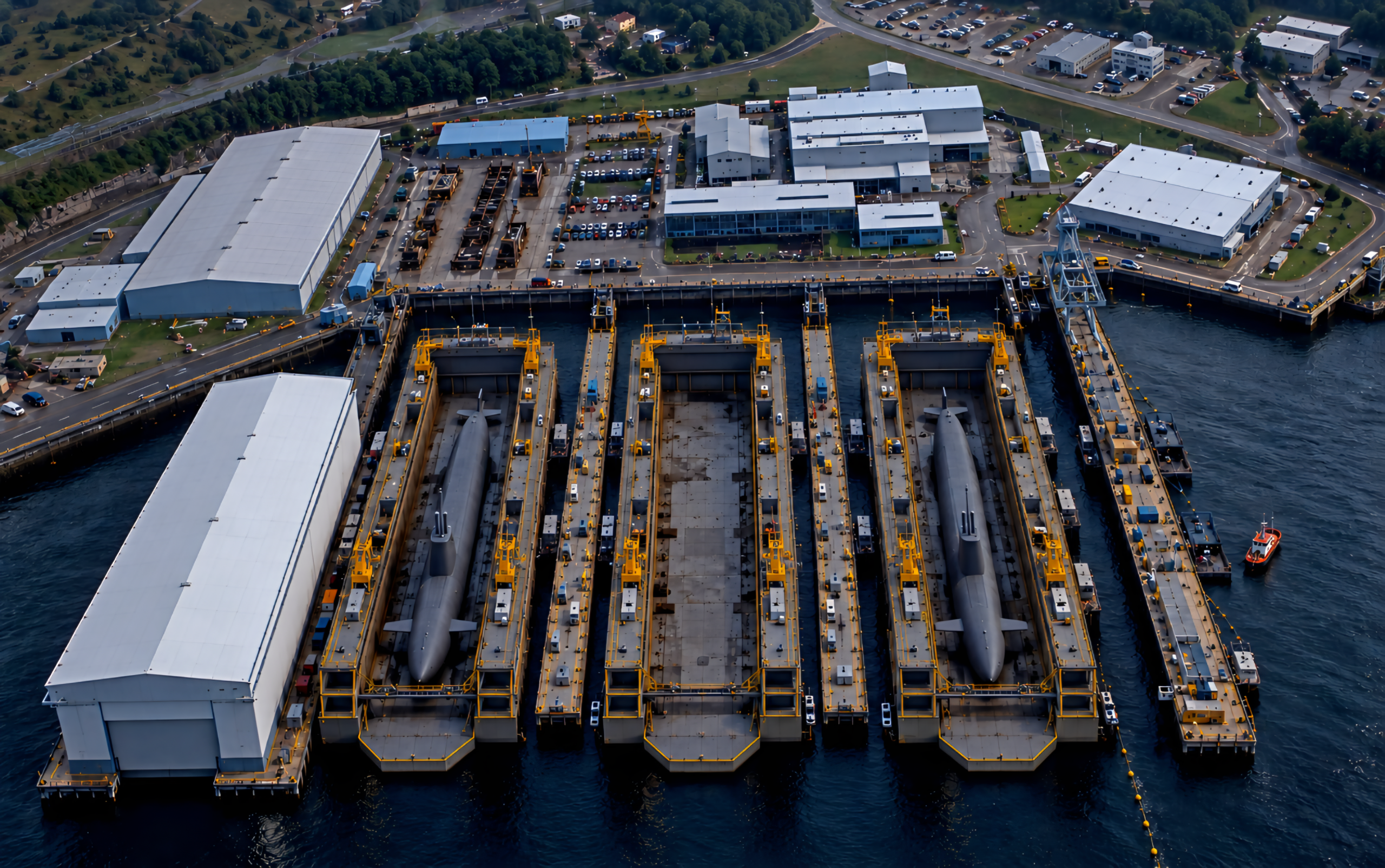
Three new floating docks for the Royal Navy’s submarine service at HM Naval Base Clyde will be built in Britain, with the work competed under a UK-only tender on the grounds of national security and sovereign industrial capability, according to the Treasury.
The commitment covers Programme Euston, the element of the wider transformation of the Faslane base that will deliver out of water engineering for submarines. The department says the new facilities will provide maintenance for the current and future fleet of nuclear boats, allowing essential inspections, upgrades and repairs to be carried out.
John Healey, the Chancellor of the Exchequer, will confirm the decision in his speech to the Labour Party conference, alongside a second commitment of at least £115 million for a new marine research vessel. The Treasury describes the projects as worth billions of pounds in combination and says both will be delivered by British companies as part of a greater focus on how government spends taxpayers’ money.
Healey is expected to tell delegates: “My politics were shaped by the industrial heartlands of South Yorkshire. Today, on the site of the Orgreave pit, is Rotherham’s Advanced Manufacturing Park. Our coal mines are not coming back. But this is how Britain’s industrial past is being remade now for the modern world. This is the new age of industrialisation. A new confidence in Britain.”
“Britain has a proud shipbuilding heritage, and every pound of this strategic investment in a critical sector is backing British jobs on the Clyde and businesses across the UK, supporting growth in every postcode,” the Chancellor said of the two commitments, adding that backing British yards boosts national security while “securing resilience in the industries that will drive growth today while building the capabilities the country needs for the future.”
Wes Streeting, the Defence Secretary, said defence spending should make Britain stronger in every sense, and “that means backing British by buying British wherever our industry can deliver.” He added: “HM Naval Base Clyde is at the heart of our submarine service. Programme Euston will modernise it for decades to come, while backing British shipyards, workers and engineering. That is defence driving the reindustrialisation of Britain and strengthening our sovereign capability.”
GMB, one of the largest unions in British shipbuilding, has campaigned for Euston to be awarded to Navantia’s yards at Methil and Belfast and welcomed the UK-only tender. Robert Deavy, GMB Scotland senior organiser in engineering, said defence procurement must help create and protect skilled jobs and apprenticeships in the United Kingdom while underpinning local economies.
He said: “For far too long, huge UK contracts have been sent around the world to fund good jobs everywhere but here.
“The world has changed though and it is good to see a UK Government ready to invest in our sovereign industrial capability. It is beyond time.
“Programme Euston is a potentially transformative contract and promising it will remain in the UK will create optimism not only in Methil but in yards around the country.
“We urge the Scottish Government to work with UK ministers to deliver the investment needed to support the necessary apprenticeships and training to secure this contract.”
The research vessel is to be operational in the early 2030s and replaces a ship nearing the end of its life. According to the Treasury, the evidence it gathers will help secure British waters, support sustainable fishing and give coastal communities confidence that fish stocks are being managed for the future.
Euston has been part of departmental planning for some time, and the most recent annual update on the Defence Nuclear Enterprise set it within a multi-decade Clyde Transformation Programme, alongside the Clyde Infrastructure Programme and new programmes covering berthing, ammunitioning, logistics and engineering, with the base intended to operate current and future capabilities safely, efficiently and sustainably. Faslane is home to the ballistic missile submarines that carry the deterrent and, since 2020, to the Astute-class attack boats as well, so out of water access for inspection and repair is a constraint on the whole flotilla.
The announcement comes alongside a visit by the Prime Minister and the Chancellor to Merseyside, where on Saturday the pair joined a sea trial aboard the Royal Daffodil, the first new Mersey Ferry built in more than sixty years. The £26 million vessel was constructed at Cammell Laird in Birkenhead, one of the yards that would be expected to take an interest in surface work of the kind the research vessel represents.








This is in the bag for Methil now, not really worth conducting a competition.
It’s been 3 years since drydocks and AFTDC were initiated.
It’s been over 120 days since an operational Astute class went to sea.
Stop faffing around and build. Speed is critical so build them wherever is fastest.
If we Assume Contract, Tender,Due diligence and signed by 2028?.. 6″yrs build and Commission..
First by 2034? Last by 2040..?
‘Marine research vessel’?
Is that for the RN, or is it more of a RRS Sir David Attenborough?
Maybe the HMS Scott replacement.
No, see the article posted on Navy Lookout
No it’s a replacement for RV Cefas Endeavour for Centre for Environment, Fisheries and Aquaculture Science (Cefas) it’s a ocean going fisheries research ship
Seems that MROSS 2 is another cut on the Labour roster, perhaps someone should remind Mr Streeting.
Have we ordered them or started any building work? No, can they hurry the fuck up now. Enough with the tea and biscuits and endless meetings.
Spoken like another armchair expert.
He’s right though isn’t he? Years this has been going on, and the only news here is that the project has been reannounced for the umpteenth time as is typical for the MoD
Robert, there is a fair and reasonable debate to be had as to whether this represents a good use of the defence budget as opposed to ordering them from SK or Japan.
There is a reasonable argument that spending less and ordering them for much faster delivery is the best use of funds as getting the service rhythm of Astute to what it should be is the goal.
The spend should be on Astute spares and engineers to remove that bottleneck.
Procuring in the UK preserves a bottleneck as these docks will be a lot of years away.
SB,
Or perhaps some logical form of teaming relationship, as per FSS Programme?
Actually, FSS may not be an entirely apt comparison, but the point remains intact.
Morning Robert, its a simple fact that limiting this procurement to UK only will make these considerably more expensive and take a lot longer. They are (relatively speaking), simple platforms, used the world over and built to a commercial standard, the National security aspect is a load of horse shit.
They should be put to international tender and ordered this year, as they are required ‘right now’, international ship builders would probably start delivering them by 2030.
The real reason for this is the government can of course defer investment well into the next parliament, I doubt anything will be delivered at this glacial pace before 2035.
They were needed yesterday, years ago.
This was I recall first reported in 2023.
Three years later still nothing.
Meanwhile, tens of billions of pounds of SSN sit idle, skills atrophy, and French and US SSN are trying to cover gaps.
The leisurely pace astounds me. In this instance, despite the desire for jobs and home based skills, these things should be built where they will be built fastest.
This is just another case of the MIC taking priority over the military need.
As ever mate, we are in lock step on this….
It has been said on Navy lookout, that UK build and also design is required due to security clearance. Also there is a five year maintenance cycle ( in a dry dock) again would need to be in the UK.
If true then, we’re scuppered.
INCHGREEN Dock has been in the Spotlight by the MOD..!
It’s Big Enough and close Enough for the job…
And it’s not Nuclear Certified, needs a complete refit, has zero facilities, no security and and is only 75m await from a housing estate.
But it is logically the only drydock that you can assemble a large floating drydock in and then use for maintenance of those docks. Fact is the work on the docks at Devonport are going to be ready way sooner
If they were carry out maintenance on the floating dock, would the they need to be Nuclear Certified ? I am guessing for assembly, you would need the security/ Nuclear clearance due to access to the design
Next we need a long term building programme and strategy… you know, the kind where we are continually building ships at a yard at a quicker pace so that ships are replaced before they go out of service… and ideally they go out of service on schedule, not before or after a due date. No crews? So build a reserve. Costs too much? More than having to start from scratch because the workforce has gone?
But that requires sustained investment Rob, there simply isn’t any.
When the government is dragged kicking and screaming towards 3.5%, there is a chance of of that, perhaps…
The current 2.4% maintains a state of slow managed decline right across the spectrum of defence spending.
I agree. We need a major increase in spending and rational decisions made as far as production and maintainance go – we don’t have it. Quite simply, we need sellable products and the ability to better meet our defence needs. Russia, China and America are all threats to our national security – governments need to realise that defence is the most important job of a government. Sadly, unilateral disarmament or insufficient defence spending are not ‘safe’ – one reason I could never vote for the Greens, for example, is that their defence posture is a disaster – zero defence spending is fine if everybody does it, until then balance of terror reigns supreme.
Once capacity established Parliament should pass law that makes it a legal requirement for future Govts to maintain workflow.
You can’t go back to a situation where no warship orders are made for a decade thought 3 or 4 different PMs because it just means a cycle of yards opening and dying
Strategic infrastructure.
Agreed. Never going to happen.
Seconded Rob, sadly……
EUSTON we have a lift off….Of intrest USNavy will be bringing into service ‘AFDM 15’ a Floating Dry Dock for its Surface fleet of 12,000 t (18000t Capacity) 212×47mts next year…! Built by Austel USA For
£100m ($130m) from contract to Service 5.5 yrs..!
Royal Navy Dry Docks will be Smaller in Dimensions
Some 150/170mtrs × 38/40mts but higher Capacity ..!.The fact they will need Nuclear Certification makes their Design and build a lot more Complicated..
( I would Hope Emergency Docking of USN Columbia Class Vessels which are slightly longer and heavier will be taken into consideration..! )
the nuclear requirement is a massive price hike on conventional
We don’t Know ..Until the Specifications for the floating Drydocks and Tendering Process is Complete their cost is Unknown..@
I Think £6bn Announcement is a bit “Politically’ misleading…!’
The only comparison we have is ‘AFDM 15’ a larger (Surface Ship) Floating DryDock for the US Navy (Which is likely Simpler) And only cost £100m…!!
@Nig e
“… And only cost £100m…!!”
Might be longer, wider, but the lifting capacity is about the same, plus, the singular, non-nuclear floating dock cost about £278 million all up installed, and Austal USA took an internal loss of roughly £85.5 million on the build.
While the US AFDM 15 is longer in overall length; 212 metres versus the Royal Navy’s estimated 150–170 metres, it is structurally a much smaller and lighter engineering project than what the UK is building. The differences in physical volume and complexity explain why the AFDM 15 is the “smaller” project
Lifting a surface ship versus lifting a submarine requires a completely different amount of steel and internal volume, the AFDM 15 is built to lift surface destroyers, which sit high and flat in the water, the bottom pontoon floor of the AFDM 15 is relatively thin and shallow. The Royal Navy docks will submerge deep enough to let a dense, deep-draft submarine float inside. The bottom pontoon floor of the UK docks must be incredibly thick and deep. The physical volume of steel and the internal ballast tank capacity required to push a submarine out of the water means the UK docks will have a significantly larger total structural mass and volume.
The physical width of the docks is also highly constrained by their environments. The AFDM 15 is 48 metres wide because it operates in the wide, open waters of San Diego harbor. The Royal Navy docks must be narrower 38 to 40 metres to physically fit through the tight access channels and congested waters of the Gare Loch at Faslane. To pack the exact same 18,000-tonne lifting capacity into a shorter, narrower frame, the UK docks have to expand vertically and structurally, making them much denser, heavier, and more complex blocks of engineering than the long, shallow American design.
AFDM 15 wins on lengthwise dimensions, but the Royal Navy docks are “larger” and far more complex when it comes to total steel weight, vertical height, internal volume, and nuclear engineering density.
The £6bn announcement isn’t “Politically’ misleading” its the cost of a whole programme, not just three docks.
Ii did mention AFDM 15 WAS FOR Surface Vessels and thst it was Simpler..!.. But your other points are intresting ..I Nuclear Certification is going to take a lot of Designing..I was thinking 38-40mts to be About what INCHGREEN Dock could safely handle…! AS For £6bn ..I think some had the Impression just the 3 Docks would cost £2bn Each ..! What do you think..Who Nows we haven’t had the Tendering Process yet…!!
There is also one very large physical difference between a surface ship and submarine drydock, for any given tonnage a submarine has roughly 60% greater draft. Which means the drydock is narrower but also has much higher sides so that it can submerge further so the sub can be floated into it.
And it needs a greater depth of water beneath it, which requires lots of dredging.
Infrastructure would Appear to take quite a bit of the cost of the Program…!
Just get on with it. Too much procrastination.
I’m confused, who exactly is getting the contract? and what has that got to do with coal mines?
Good Day,
According to the BBC the floating docks quote:Orders for three floating dry docks, worth £6bn, to maintain the Royal Navy’s nuclear-powered submarine fleet at Faslane will go to a UK-based shipbuilder, the chancellor has confirmed.: unquote
Are they gold plated?
Nick
The Program is £6bn , The floating Docks are only Part of that Program I hope..@
The race for the marine research vessel will between Ferguson Marine and Balaena Group, them two are really the only shipyards big enough and interested in commercial shipbuilding, I think it quite obvious that Navantia UK is much more interested in building the floating drydocks and military shipbuilding the same with Babcock
The race for the floating drydocks will be between Navantia UK and Balaena Group and Babcock international, don’t think BAE systems will be in the race to much work for Type 26 and lack of space
The obvious “Fly in the Ointment”, is we haven’t actually designed nor built a single Floating Drydock since the AFD60 in 1966.
So we are practically starting from scratch and there will have to be a competition for the contract and that will probably end up with Navantia vs Baleana. Then there is the thorny problem of where to assemble them ? The obvious solution is to build sections in various west coast yards and then assemble them in the Inchgreen Drydock, which just happens to be where the Faslane floating jetties were built and the prime candidate for their periodical inspection / refit.
Then things get interesting because MOD / HMT are not exactly famous for spending a penny more than the bare minimum, and they are spending a hell of a lot.
When you do the Math, that’s 3 Floating Drydocks and a Synchro lift at Faslane, plus docks 9, 10, 15 at Devonport for refits / maintenance and 14 for defueling. So so that’s 7 docks available for refits / maintenance and at present we have 4 SSBN and 6(7 from 2029) SSN buiit or building, that’s a lot of docks.
So I do have to wonder if this is an early insight into how AUKUS is going to actually operate and one of these Docks may end up in the Southern Hemisphere. It’s the one thing no one is mentions, how does a non Nuclear State refit / maintain / repair a U.K. built Submarine PWR without either sending it back to U.K. or breach NPT. If you had a U.K floating Drydock down south with British Engineers then as it’s being carried out on UK sovereign territory its NPT compliant.
Also just a thought but even with 6 in UK we are going to look damn silly if we don’t actually increase the numbers of SSNS to 10 or 12 to fill them.
As the Docks have to be certified every 5/10 yrs one Wonders how long they’ll be out of Action for..??
Probably not too long, floating drydocks are very well built and last for many decades, they are basically a bunch of big steel box buoyancy tanks welded together with side walls that contain the machinery, control room and quite often offices, workshops and even accommodation for a ships crew. It’s nothing fancy, control corrosion and refit the pumps, valves and control systems so it to much different to an oil rig or semi submersible barge, it is fairly straightforward.
Fancy the Nuclear bit will make them a lot more than normal Floating Dry Docks..But I agree with you it’s Shoul not make them mastermind stuff…!
Because the MoD has wrapped the entire Programme Euston budget into a single procurement headline, they have not released a line-by-line breakdown separating the raw steel manufacturing costs from the local civil engineering costs. There seems to be a conflation of unit cost versus total program cost. When people see the headline “£6 Billion for three floating docks”, they instinctively do the basic math and assume each physical steel dock costs an astronomical £2 billion. Based on that flawed assumption, they look at a hyper-efficient commercial yard in Japan or South Korea, which can churn out a “standard commercial” floating dock hull for under £100 million, and conclude that the UK government is wasting billions just to protect domestic jobs.
When you look at the true math, the actual “premium” the UK is paying to build the docks domestically at yards like Belfast or Methil is the difference between building the docks in Japan £600M–£800M versus building them in the UK £1 billion.
The UK is essentially spending an extra £200 million to £400 million to ensure the entire program remains sovereign, a relatively small price to pay in a £6 billion enterprise to keep highly classified submarine hull profiles inside a UK-only supply chain and inject life back into British shipbuilding.
What is missing in people’s equations is the two most expensive realities of the defence nuclear enterprise. The actual physical fabrication of the three “custom, nuclear-certified steel structures” estimated to account for about £1 billion of that budget and the immense infrastructure surounding them that makes up the bulk of the costs.
If the UK had bought those raw hulls from Japan, they would have saved a few hundred million pounds on the steel work, but they would still have been left with a £5 billion civil engineering problem waiting for them back home in Scotland.
You can’t externalise local geography, a Japanese shipyard can build the finest floating dock in the world, but they cannot dredge the Gare Loch from across the Pacific. They cannot lay thousands of tonnes of nuclear-certified concrete pilings into the Scottish seabed to anchor the docks against Atlantic gales. And they cannot build the high-voltage electrical substations or automated reactor-cooling loops on the Faslane shore.
No matter who builds the steel, those massive, multi-billion-pound infrastructure costs have to be paid locally in the UK. That £6 Billion is distributed across an incredibly complex matrix of shoreside, underwater, and long-term support infrastructure required to make the docks actually function in a nuclear environment. You cannot simply tie a nuclear submarine floating dock to a standard pier. A huge portion of the budget is dedicated to transforming the physical landscape of HMNB Clyde.
Building heavy-duty, blast-proof concrete piles and specialised anchoring jetties capable of securely pinning three massive floating structures in place against severe Scottish winter storms. Extensively dredging the seabed of the Gare Loch, to submerge a floating dock low enough to let a 7,400-tonne Astute-class or a 17,200-tonne Dreadnought-class submarine float inside, the water beneath the dock must be exceptionally deep, requiring thousands of tonnes of mud and rock to be excavated.
A nuclear submarine lifted out of the water, becomes entirely dependent on the shore for survival. £6 billion pays for the construction of highly secure, redundant shoreside infrastructure like building dedicated electrical substations to feed huge amounts of power to the docks. Installing highly advanced, nuclear-certified water piping systems that must continuously pump high-pressure cooling water from the shore, through the dock, and into the submarine’s reactor to prevent a catastrophic core meltdown while it sits out of the water.
Programme Euston is defined within the MoD as an all-encompassing “out of water engineering” ecosystem. The funding covers building new, secure radiological and mechanical workshops right next to the docks so workers can service components the moment they are stripped from the submarines. Upgrading local logistics, cyber-security perimeters, and physical protection systems to safeguard the submarines while they are at their most vulnerable structural points.
Military procurement budgets normally bundle in the first 10 to 20 years of maintenance, spare parts, and engineering support into the initial headline figure. £6 billion ensures that they are contracted to maintain, inspect, and repair the docks’ complex ballast pumps, valves, and structures for decades to come.
Thus, while a Japanese yard could have built the raw steel hulls for a fraction of the cost, the UK would still have had to spend billions on the Clyde to build the nuclear-certified berths, shore utilities, and workshops required to plug those docks into the base.
Programme Euston is a complete, multi-billion-pound nuclear engineering hub, not just a simple, bog standard floating dock order.