

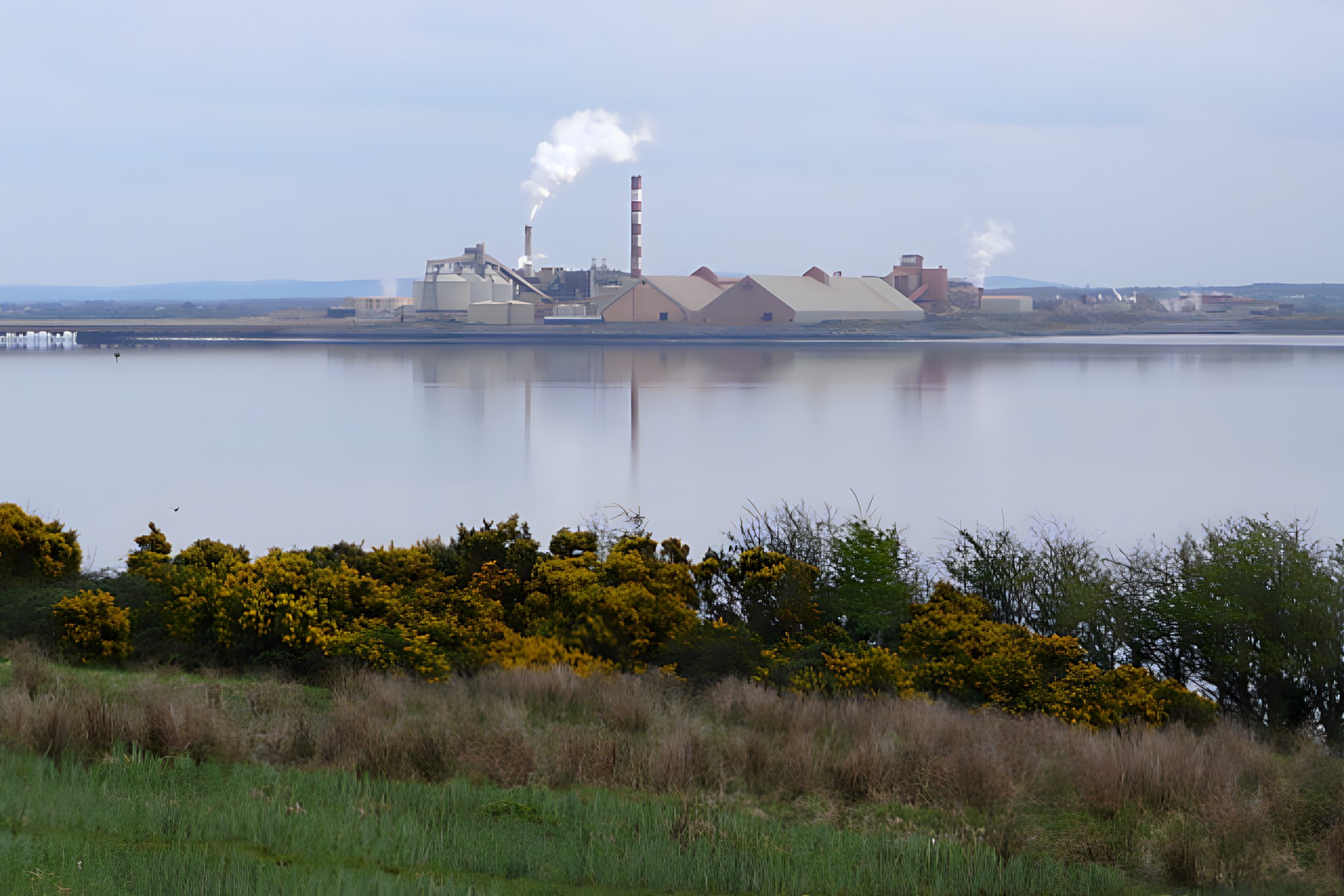
Aughinish Alumina, Europe’s largest alumina refinery, has become the focus of mounting political pressure in Dublin, Brussels and Kyiv after an investigation linked material from the County Limerick plant to the supply chain feeding Russia’s arms industry.
The plant sits on the Shannon estuary, a 40-minute drive west of Limerick city, an industrial giant ringed somewhat incongruously by a butterfly reserve on one side and a forest walk on the other. Twice a day ships dock at its private jetty beside the port of Foynes, bringing in bauxite from mines in Guinea and Brazil and carrying out the finished alumina, the white powder from which aluminium is made and which the company is at pains to describe as a basic raw material feeding everything from cars and aircraft to food packaging.
For more than four decades the refinery has been one of the region’s largest employers and, by most measures, a genuine success story of Irish industry, sustaining hundreds of jobs directly and many more across the local economy. It is also owned by a Russian conglomerate, however, and that single fact has placed it at the centre of an increasingly awkward argument now stretching from the mid-west of Ireland to Brussels and Kyiv.
According to an investigation published on 24 March by the Irish Times Investigations Unit, carried out with the Organised Crime and Corruption Reporting Project (OCCRP) alongside the Russian outlet iStories and the Guardian, much of the alumina produced at Aughinish is shipped to Russian smelters and ends up in the supply chain of Moscow’s weapons manufacturers. Alumina itself is not a sanctioned product under EU law, and the company maintains it is a basic commodity destined for civilian use, but reporting raised the prospect that an Irish plant has become a steady source of raw material for the Russian defence sector.
Tracing the route
The reporters traced the material’s journey using customs data, shipping records, satellite imagery and leaked financial documents. Irish alumina, they found, is carried by sea to Novy Port near St Petersburg, then loaded onto trains for a journey of almost 5,000km east to Rusal-owned smelters in Siberia. The two largest recipients are the plants at Krasnoyarsk and Sayanogorsk.
Krasnoyarsk, among the biggest aluminium works anywhere in the world, took roughly 480,000 tonnes of Irish alumina in 2024, about two-thirds of its entire supply, according to the investigation. The smelter states on its own website that it is the only facility in Russia capable of producing the high-purity aluminium used in fighter jets and missiles.
From the smelters, the finished metal is sold to a Moscow trading company, Aluminium Sales Company, known as ASK, which the investigation describes as one of the main aluminium suppliers to the Russian military. The reporters identified 107 defence firms among ASK’s customers, of which 40 are under EU sanctions. The list includes Votkinsk Machine Building Plant, maker of the Iskander-M ballistic missile, Uraltransmash, which produces howitzers, and NPK Uralvagonzavod, which builds the T-72 tank that spearheaded the 2022 invasion. Other named customers manufacture gyroscopes for the Kh-101 cruise missile and engines for Sukhoi combat aircraft.
Crucially, the investigation was careful about the limits of its evidence as the leaked records detail financial transactions and cannot prove that any specific batch of Aughinish alumina ends up in any specific Russian weapon. Smelters blend alumina from several sources, and there is no public record of where each consignment of finished metal eventually goes.
A metallurgy expert quoted in the reporting, Kristian Etienne Einarsrud, said he had never come across the practice of matching particular alumina batches to particular metal, telling the Irish Times there is no industrial practice of assigning specific “batches”. On that basis, the investigation concluded it was highly likely that Irish material is being used to make the basic stock for Russian military equipment.
A trade that has surged
What is not in dispute is how sharply the trade has grown as Russian imports of Irish alumina climbed from about 394,000 tonnes in 2020 to more than 826,000 tonnes in 2024, according to Central Statistics Office data cited in the investigation, before easing slightly. Russia’s share of Aughinish’s output rose over the same period from 23 per cent to 68 per cent. While most EU states cut their exports to Russia after the full-scale invasion, Ireland was one of only three that did not, with the total value of Irish goods sold to Russia reaching a record €836 million in 2024.
According to figures obtained by the Irish Times from the CSO, 83 per cent of Irish alumina exports, some 200,619 tonnes, went to Russia in the first quarter of 2026, against just 0.6 per cent to the EU. Ministers quickly disputed the numbers, with Minister for Enterprise Peter Burke saying the true share was closer to 45 per cent and describing the data submitted to the CSO as inaccurate. Aughinish then attributed the discrepancy to a clerical error in its EU statistics, telling the Irish Times that 51 per cent of its first-quarter exports had gone to Russia and that the figure for 2025 was 45 per cent.
Why Dublin holds back
The plant’s ownership runs through a sprawling corporate structure. Aughinish is wholly owned by Limerick Alumina Refining, which is itself owned by United Company Rusal, the largest aluminium producer outside China. Rusal sits within the EN+ Group, founded by the Russian oligarch Oleg Deripaska, once described in leaked US diplomatic cables as among the handful of businessmen Vladimir Putin turned to regularly. Deripaska, still EN+’s largest individual shareholder, has been under EU sanctions since 2022, and was sanctioned by the United States in 2018 before an Irish-led lobbying effort helped secure relief for Rusal.
That history helps explain Dublin’s caution. Aughinish employs around 400 people directly and a further 500 contractors, with perhaps another 1,000 jobs in firms that support it, according to Seán Golden, chief economist at Limerick Chamber, who estimates the plant is worth roughly €150 million a year to the local economy. He argued that despite the Russian parent, the operation is run and staffed by Irish people and pays Irish tax, telling the Irish Times that if you scratch the surface, “it’s very much an Irish company”. There is an environmental dimension too. The site holds an estimated 50 million tonnes of caustic “red mud” waste, and former officials have warned that closure could leave the State facing a clean-up bill running into the hundreds of millions of euro.
Successive Irish governments have stood behind the plant for well over a decade. The Lobbying Register records company representatives meeting officials on 64 occasions since 2016, 18 of them since the full-scale invasion, according to the investigation. Dan Mulhall, Ireland’s former ambassador to Washington, who led the campaign to win Rusal sanctions relief in 2018, acknowledged the discomfort of the position, telling the Irish Times that Russian ownership had “obviously become more problematic” but that “we are where we are”.
Brussels stays its hand
For now, the European Commission has chosen not to act. RTÉ reported that Brussels decided against recommending sanctions on either the company or the product in its latest package, with sources pointing to the disruption that would follow for European industry, given that Aughinish supplies a large share of the EU’s alumina.
Taoiseach Micheál Martin has made the same case in blunter terms, calling restrictions “self-defeating” and warning they would harm Europe more than they would the Kremlin. The bind is a real one, since the same Aughinish alumina feeds Western manufacturers.
Mounting protest
The Ukrainian Embassy in Dublin expressed “serious concern”, saying the alumina is “extensively used by Russia’s military-industrial complex”, according to RTÉ. Belgian foreign minister Maxime Prévot called the findings “extremely disturbing”.
Thirty-nine MEPs from 12 countries wrote to EU foreign policy chief Kaja Kallas and trade commissioner Maroš Šefčovič urging an end to the exports, while four Fine Gael MEPs, among them Seán Kelly, issued a statement saying they were “deeply concerned” that material from the plant might be supporting Russia’s war against Ukraine.
Aughinish has firmly rejected the central allegation. In its response to the investigation, the company described both alumina and aluminium as a “basic commodity” that is “vital for countless civilian industries”, said it operates in “strict compliance” with EU law and sanctions, and reserved the right to take legal action over what it called a biased narrative.
In a separate letter to Minister Burke reported by RTÉ, managing director Ciaran Kelleher argued that sanctions would “have no material impact on Russia” while stoking inflation in European commodity markets. Neither that letter nor the company’s public statements have directly addressed the investigation’s core finding, that the metal made from its alumina is reaching Russian weapons plants. The government’s review, which Martin has said will “work beyond the company”, remains underway, with its conclusions due to be put to the European Commission.
Image ‘View towards Aughinish’ by Graham Horn, CC BY-SA 2.0, via Wikimedia Commons.




I suppose the good thing is that people around the world are finally waking up to Irish hypocrisy.
A nation that for decades has tried to paint itself as having a moral position on the international stage but the reality is it’s a nation that has enjoyed the success of free riding for a century while also being a political and economic opportunist, always eager to take advantage of others misfortune while trying to dress it up as taking a high moral positing. A nation that makes its living by aiding US tech oligarchs to dodge tax it’s hardly unsurprising they would be reluctant to do anything about their own companies directly supplying the Russian war machine.
The Irish people have often acted very differently with 70,000 volunteering to fight against the Nazis despite their own governments position.
Irish Hypocrisy??
They don’t supply the Ukrainian Nazi regime and Ireland isn’t at war with Russia? And the plant is doing what it has done for decades.
Now our UK government along with the EU governments. They consistently deny being at war with Russia while European weapons are used daily against Russia but at the same time tell us The UK and Europe must prepare for war as the dastardly Russians might attack us. That’s proper Hypocrisy!!
Can’t Agree With Sanctions and then Ignore Them..!..
The Irish Republic has a Collective Responsibility With its EU Allies Whatever the Rights or Wrongs…!
I’ve gained $17,240 only within four weeks by comfortably working part-time from home. Immediately when I had lost my last business, I was very troubled and thankfully I’ve located this project now in this way I’m in a position to receive thousand USD directly from home. Each individual certainly can do this easy work & make more greenbacks online by visiting
following website—.,.,.,.,.—>>> JobatHome1.Com
Putin has far more in common with the Nazis than the current Ukrainian government.
This site is regularly used by the FSB, Chinese PWOs and their useful idiots in Reform to spread your lies.
Irish hypocrisy of supplying, according to this article, a big proportion of Russia’s military aluminium feedstock while asking for British help to keep their waters clear of Russian submarines and buying French sonar for the same purpose.
Are Russia not using Iranian weapons and probably Chinese as well, so it’s a big rumble with Russia looking for more land to fuck about with.
Nazi Ukraine!? It is Ireland that is full of anti-Semites and they have a history of it.
When Russia started killing political dissidents on UK soil, in such a way that killed British Nationals as “collateral damage”, Russia opened themselves up to reciprocal actions by the British government to manage the clear threat they pose. Russia made itself a threat to the UK directly before the UK started providing assistance to Ukraine, so your argument is hypocritical in its own right.
Afternoon Vlad, how’s life in Moscow?
Is it really surprising that Ireland freely trade with Russia when they won’t invest in a common share of European defence spending expecting others to cover them in the event of an escalation of hostilities.
AlexS.. ALLEDGEDLY…!
There were ‘Alledged’ Contacts Between The National Socialists of Germany and The Irish Republic During WWII…!
Indeed Some in the Early SNP Were Also Alledgedly in Discussions…!
To What Depth, ‘IF ANY’ Remains Unclear..!
Question !…Why was Rudolf Hess in Scotland ???
Didn’t Ireland send a note condolences to the Nazi Germany after Hitler’s death?
The Prime Minister: Taoiseach Éamon de Valera personally visited Eduard Hempel, the German envoy in Dublin, to express condolences. He defended the visit as a diplomatic formality and a matter of strict neutrality, stating he did not want to “add to his humiliation in the hour of defeat”.
The President: Newly declassified records later revealed that Ireland’s President, Douglas Hyde, also sent an official note of condolence to the German representative shortly after Hitler’s death
—-
Hess story always felt very strange to me.
Why Did HESS Chose Scotland for his Flight? We’ll Probably Never Know….!
Perhaps he was looking for a Second Hand Camper Van…!!!
Maybe he expected less air defences there and less chances his flight be intercepted?
I think he had a mental collapse, still a strange story.
Who knew they were only sold in Scotland 🤔
“
UK Defence Journal
Home Sea Irish alumina factory accused of supplying Russia’s war
SEA
Irish alumina factory accused of supplying Russia’s war
By Craig Langford – June 7, 2026 8
Share
Aughinish Alumina, Europe’s largest alumina refinery, has become the focus of mounting political pressure in Dublin, Brussels and Kyiv after an investigation linked material from the County Limerick plant to the supply chain feeding Russia’s arms industry.
The plant sits on the Shannon estuary, a 40-minute drive west of Limerick city, an industrial giant ringed somewhat incongruously by a butterfly reserve on one side and a forest walk on the other. Twice a day ships dock at its private jetty beside the port of Foynes, bringing in bauxite from mines in Guinea and Brazil and carrying out the finished alumina, the white powder from which aluminium is made and which the company is at pains to describe as a basic raw material feeding everything from cars and aircraft to food packaging.
For more than four decades the refinery has been one of the region’s largest employers and, by most measures, a genuine success story of Irish industry, sustaining hundreds of jobs directly and many more across the local economy. It is also owned by a Russian conglomerate, however, and that single fact has placed it at the centre of an increasingly awkward argument now stretching from the mid-west of Ireland to Brussels and Kyiv.
According to an investigation published on 24 March by the Irish Times Investigations Unit, carried out with the Organised Crime and Corruption Reporting Project (OCCRP) alongside the Russian outlet iStories and the Guardian, much of the alumina produced at Aughinish is shipped to Russian smelters and ends up in the supply chain of Moscow’s weapons manufacturers. Alumina itself is not a sanctioned product under EU law, and the company maintains it is a basic commodity destined for civilian use, but reporting raised the prospect that an Irish plant has become a steady source of raw material for the Russian defence sector.
Tracing the route
The reporters traced the material’s journey using customs data, shipping records, satellite imagery and leaked financial documents. Irish alumina, they found, is carried by sea to Novy Port near St Petersburg, then loaded onto trains for a journey of almost 5,000km east to Rusal-owned smelters in Siberia. The two largest recipients are the plants at Krasnoyarsk and Sayanogorsk.
Krasnoyarsk, among the biggest aluminium works anywhere in the world, took roughly 480,000 tonnes of Irish alumina in 2024, about two-thirds of its entire supply, according to the investigation. The smelter states on its own website that it is the only facility in Russia capable of producing the high-purity aluminium used in fighter jets and missiles.
From the smelters, the finished metal is sold to a Moscow trading company, Aluminium Sales Company, known as ASK, which the investigation describes as one of the main aluminium suppliers to the Russian military. The reporters identified 107 defence firms among ASK’s customers, of which 40 are under EU sanctions. The list includes Votkinsk Machine Building Plant, maker of the Iskander-M ballistic missile, Uraltransmash, which produces howitzers, and NPK Uralvagonzavod, which builds the T-72 tank that spearheaded the 2022 invasion. Other named customers manufacture gyroscopes for the Kh-101 cruise missile and engines for Sukhoi combat aircraft.
Crucially, the investigation was careful about the limits of its evidence as the leaked records detail financial transactions and cannot prove that any specific batch of Aughinish alumina ends up in any specific Russian weapon. Smelters blend alumina from several sources, and there is no public record of where each consignment of finished metal eventually goes.
A metallurgy expert quoted in the reporting, Kristian Etienne Einarsrud, said he had never come across the practice of matching particular alumina batches to particular metal, telling the Irish Times there is no industrial practice of assigning specific “batches”. On that basis, the investigation concluded it was highly likely that Irish material is being used to make the basic stock for Russian military equipment.”
Hmmme well….maybe….actually not.
This will be a high purity feedstock that is produced in a state-of-the-art plant so will be excellent for producing high end alloys.
The Irish output will be preferred to Russian refining as standards will be much more consistent as they will have access to instrumentation and parts that are embargoed.
At those tonnages a whole smelter could be run from the output sent to Russia.
It’s great to see attention finally been drawn to the Irish hypocrisy on defence among many other things. They have been leeching off the UK and EU for a long time, benefiting hugely from immoral tax set-ups that allow them to cream off corporate profits generated across the entire continent, whilst simultaneously contributing next to nothing to our collective defence.
The answer us easy. Ukraine now know the supply line to Russia all they need to do is blow up the ships before they dock
Nice jetty you’ve got there Aughinish Alumina. It’d be a shame if it blew up unexpectedly.