

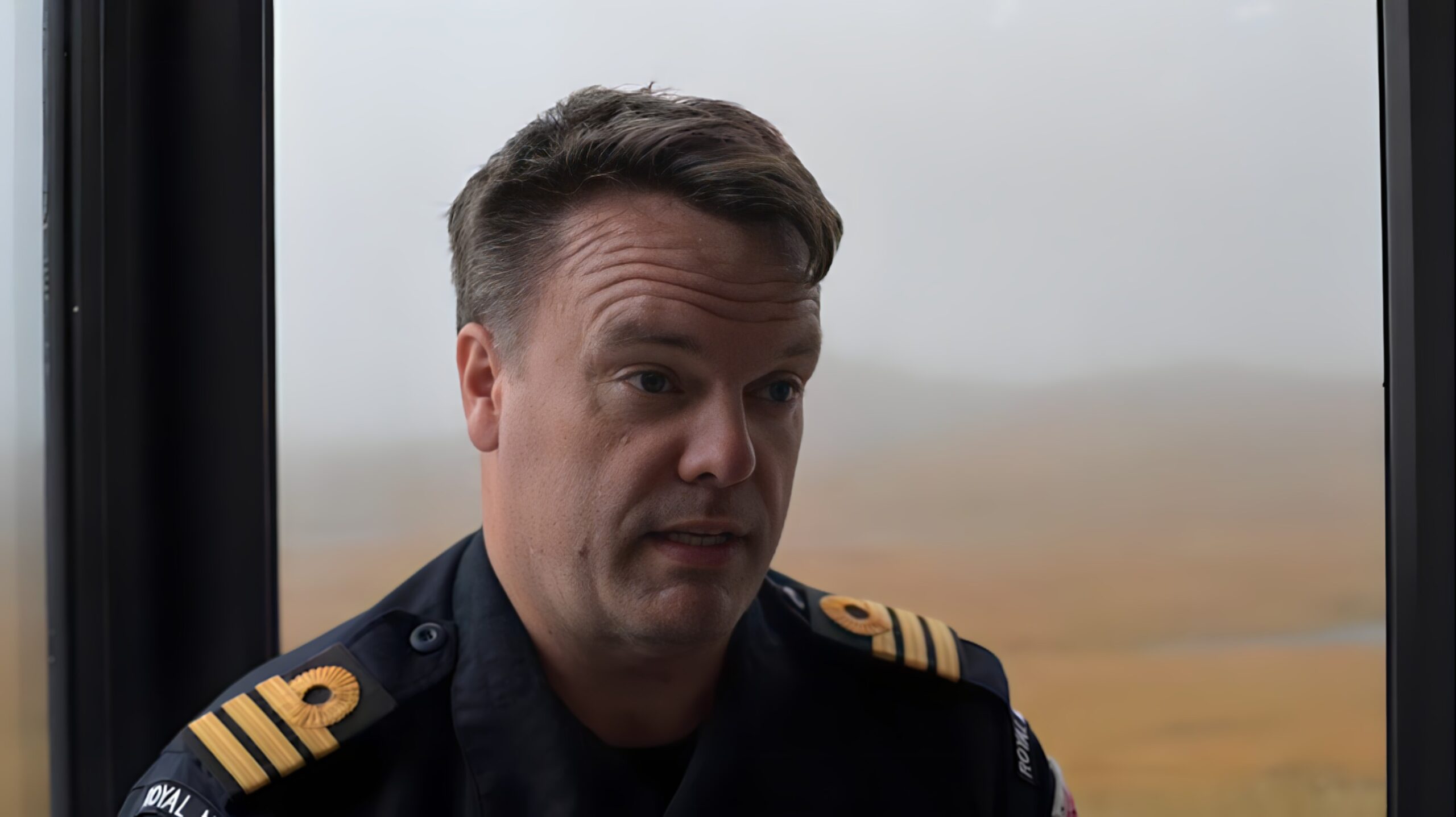
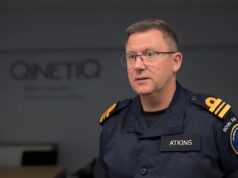
Most of what the Royal Navy and its allies practise is not live firing, which is what set apart the exercise that ended with the sinking of the decommissioned American frigate USS Klakring off the Outer Hebrides, according to Commander Peter Meigh, speaking from range control on South Uist.
Meigh described Atlantic Thunder as a bilateral exercise between Britain and the United States “designed to demonstrate and train our lethality against surface platforms in the North Atlantic theatre.” What distinguishes it, in his account, is that the weapons are real. “This activity is really different because it’s a live fire exercise. The vast majority of our training is not live fire due to the cost and complexity both of battle space and safety,” he said. “It’s that demonstration of really high end war fighting that hopefully we will never need to use, but invariably you need to be able to use it if the time comes, and making sure that our weapon systems work as we expect. We know how to use them, and we can employ them effectively.”
The range he operates from covers an area larger than England and Wales together. “Atlantic Thunder takes place off the north west coast of the United Kingdom in an area known as the Ministry of Defence Hebrides range, and it’s an area of around 75,000 square miles of air and sea space off the Outer Hebrides,” he said. “We are sat here in range control on South Uist, but the action is taking place 60 to 100 miles west of us in the North Atlantic, which is a challenging environment for air and maritime units to operate.”
Those conditions are the reason for holding it there rather than something to be put up with. “The seas are rough, the winds are strong. There’s no shelter. Clearly, that’s useful for a safety consideration, but it makes employing force difficult, and that’s partly why we do it, because this is potentially a battle space that we will need to fight in in the future, and we need to understand how we achieve that quickly and deliver force where necessary,” the commander said.
Reaching the moment of firing takes years of work before anyone puts to sea. “The planning timeline for Atlantic Thunder is over two years,” Meigh said, adding that he had held a meeting that day about Atlantic Thunder 28 and that it was not the first. “There is a huge amount of detail that needs to go in when you are delivering a live fire exercise as complicated as this, utilising a large number of weapon systems. There’s the logistics planning of how you get the people and equipment in the right place at the right time across thousands of miles, coming from the continental US for some elements of it, from Naples, from Rota, from Lakenheath, from Portsmouth.”
Safety and environmental work runs alongside all of that, and he described the planning as covering the safety of participants, the safety of maritime and air users in the vicinity who are not taking part, the environmental consequences of putting weapons into the water and the sky, and the sinking of a decommissioned warship “which has to be stripped of all sensitive materials so that it doesn’t pollute the environment.” Beyond that sits what he called safety trace planning, understanding where things can and cannot be in order to achieve the mission safely.
The data taken away afterwards is the reason for the whole undertaking. “It’s all about planning, executing, and debriefing,” Meigh said. “It’s about how you plan together, how you execute together, but then how you debrief, how you can gather high quality data, both from the weapon system, but also ground truth data, which this range up here we are very well set up for. So gathering a second point of view, not just what your weapon system says, but ground truth data that is calibrated so that you can analyse what you think happened and what actually happened in a large amount of detail, so that you can learn from it to make sure that systems are behaving as you believe they were. You can understand what command decisions were made, and then you can adjust as appropriate in the future.”
On the alliance the whole exercise rests on, the commander was unambiguous. “It positively reinforces the long-standing relationship that the UK and the US have across our armed services. It’s one of the closest partners I’ve worked with in my 20-plus years of being in the navy,” he said. “Our language helps, but equally, that closeness of how we can share information at the highest levels is really important. That’s something that’s unique about Atlantic Thunder, because we’re able to speak at a very classified level, and share that information.”
Atlantic Thunder is the largest exercise Meigh has run in his career, and he was previously on the staff running Joint Warrior, the multinational exercise led by Britain, and the Formidable Shield series of integrated air and missile defence exercises, which brings twelve nations together with the United States as the largest partner, both of which use the same waters off the north west of Scotland.
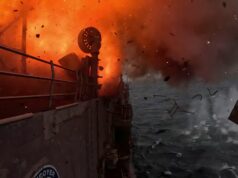
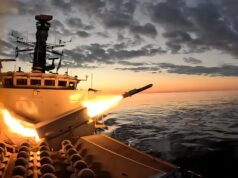
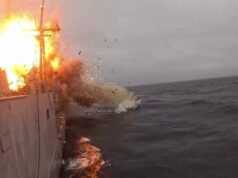
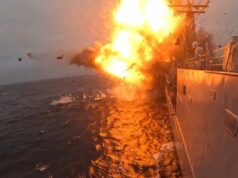
The weapons employed covered a wide range across different environments, surface to surface and air to surface, from both British and American units. Sixth Fleet has confirmed that the Naval Strike Missile was fired from HMS Portland and Sea Venom from a Wildcat helicopter, while USS Paul Ignatius fired an anti-surface variant of the Standard Missile 6 and the submarine USS Massachusetts finished the frigate with a Mark 48 Advanced Capability Torpedo, as we reported.
Meigh came back to the partnership when summing up what the exercise had shown. “Atlantic Thunder is a brilliant example of how the UK and US work together really well in delivering warfighting efficiencies and working together as partners. Be that on the range, be that in the mission planning, or out at sea.”


Is that really true?
The barges are used as targets…we used to use live rounds on the ranges.
Range safety staff would be getting very wet in the luminous vests!!!!
Translation: The RN has no money to go shooting at things