

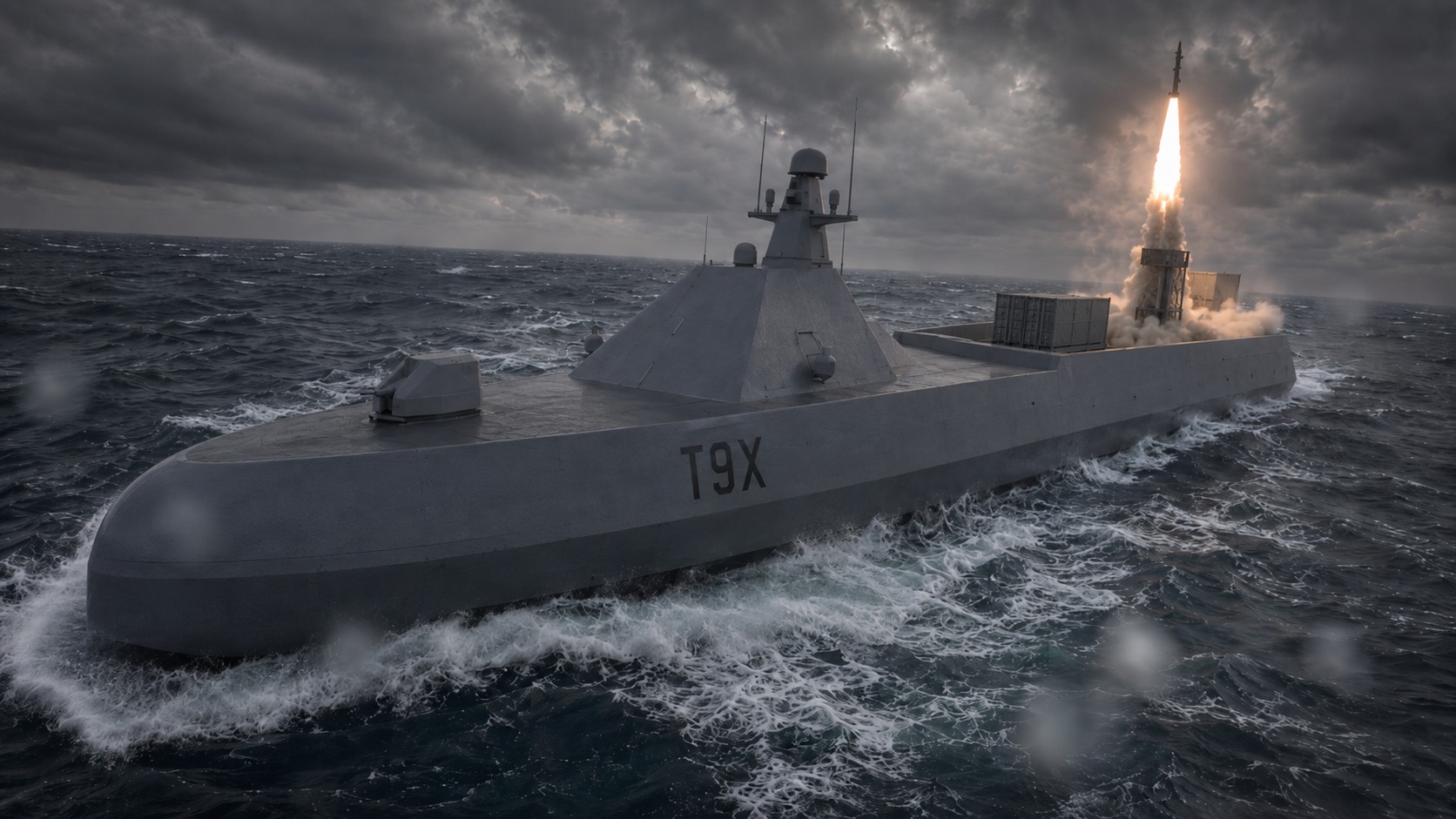
The Royal Navy has run a series of service-wide war games to test its planned hybrid fleet, and the answer has come back consistently that crewed warships remain necessary alongside the uncrewed systems, the First Sea Lord has said, in an interview for the Council on Geostrategy’s Defence Talks podcast.
General Sir Gwyn Jenkins, the first Royal Marine to lead the service, was asked whether the ease with which a surface ship can now be found and attacked calls into question the purpose of having one at all.
He said the transition does not make crewed warships irrelevant, but changes how they are used. “It just changes the way that you’re going to operate them, and it changes the way you achieve mass. It changes what their role is, in particular the command and control and coordination of the uncrewed systems that we’re going to need to field.”
On the testing itself, he said: “That’s why we have been running a series of navy-wide war games to test the hybrid fleet and rigorously test it in each environment as to how we’re going to operate and how this would work, where the challenges and the weaknesses are in the model at the moment. Time and again, the tests come back with you still need conventional warships in this mix. They’re just further back and have a slightly different role to the way that we would have fielded them in the past.”
That is a more reassuring answer than much of the surrounding debate has assumed, and it is being reached through structured testing rather than asserted. The Navy is examining where its own model breaks before committing to it, which is a considerably better position than discovering the weaknesses later.
General Jenkins also pushed back on reading the Black Sea across to British waters wholesale. “We do have to be careful applying the geography and the specific physical environment of the Black Sea or the Straits of Hormuz to some of our Atlantic space, and the big Atlantic is a very different proposition to some of those quite constrained and even reasonably benign waters.” He immediately added that this implies no complacency.
What Ukraine has achieved he described as a wake-up call for every Western navy, noting that a navy in name but not in being had neutralised one of the most advanced fleets in the world.
He set the change alongside earlier turning points in naval history, from sail to steam and wood to iron, through the dreadnought, the aircraft carrier and the submarine, observing that each had its detractors at the time, and that those arguing steam would never replace sail or that carriers were irrelevant were eventually answered by events.
Listen to the full interview
The conversation runs a good deal wider than the extracts covered here. Over the course of the episode the First Sea Lord also discusses reforming officer selection and training, how the Navy intends to unleash innovation at the front line, the three strands of the Atlantic programme in Bastion, Strike and Shield, the relationship with industry that the hybrid fleet depends on, and his own reading of how the strategic picture has changed since he joined the military at the end of the Cold War. Interviews with a serving First Sea Lord at this length are rare, and anyone with an interest in where the Royal Navy is heading over the next decade will get considerably more from listening to it in full than from any write-up.
General Sir Gwyn Jenkins was interviewed by Viktorija Starych-Samueliene and Paul Mason. The episode is available on YouTube, Spotify and Apple Podcasts.
Defence Talks is produced by the Council on Geostrategy, a London-based think tank founded in 2021 which focuses on British foreign, defence and trade policy, the Indo-Pacific and the geopolitics of technology, and which publishes the journal Britain’s World alongside its research output. The series is delivered in partnership with ADS Group, the trade association representing the British aerospace, defence, security and space industries, and is sponsored by BAE Systems.


No excrement Sherlock!
Exactly mate, who knew that pairing two different capabilities could result in a greater output than either of the two individual inputs 🤦♂️
Armies have been doing this since people jumped on the back of horses 😀
It’s basic maths
Yup. Its like all the new drone experts on social media saying we dont need tank or more troops just replace them with drones.
Drones are cheap, highly effective and we should absolute boost production and invest more in them but you still need all the other systems that have proven to work and you still need troops. Be be it a riflemen, medic, driver etc.
The sound bites we were getting a few months ago indicating a frantic rush to get sophisticated and heavily armed unmanned surface and underwater naval platforms in to operational service as soon as the end of this decade are starting to be tinged with some realisation about the scale of the task, the technical and regulatory challenges, and the cost.
Another balls up on the way! Build destroyers and get out of fantasy land.
Totally. Can’t they exercise a bit more common here. Drones will obviously have there place but they dont do port visits, fly the flag, do humanitarian relief, carry a helo and can’t yet be refuelled, repaired or rearmed in transit. And having a mothership surrounded by drone ships is surely creating a big target sayong here we are! And if one is knocked out doesn’t that affect the whole system and if the mothership is knocked out, then the whole lot is cactus. Not sure if they can operate effectively independently or remotely on default.
What gets me is the all the money and resources going into this when an incremental increase in actual crewed ships may give the RN a real world uplift and have a greater usefulness. An extra 1-3 T31s and maybe an additional T26. The former for spreading mid level presence and the latter additional ASW. And why not still 3-4 FAD T26 based T83s? They may then not need all the drone T91 and T94s. The T92 and T93s could be very useful, even paired with a small fleet of 4 SSKs and free up the Astutes for other duties.
Moving through dangerous times with forces based on what the treasury thinks is the bare minimum necessary for the safest peacetime force levels is a recipe for defeat & disaster. AI & drones are a new aspect of warfare to be employed, but if everything is framed as a pretext to skimp on investing in sufficient forces to survive, we’re cutting our own throats.
It’s worse than that, defence for decades now hasn’t been run on funding a spec but incremental reductions in spending and then a “well what can we spend that on” approach.
It’s a complete shambles and as a result of this approach the defence contractors have always used shifting specs and shortened production runs as an opportunity to gouge.
Once all the drones are shot up or lost then what are you left with? Screen operators with nothing to engage with. We should keep the numbers of real “crewed ” ships up for a high level resilience, engagement and taking any initiative. A fleet of just 19 ships sounds and looks too lean. Why can’t that be fixed first for some expanded real world presence before all the B2 Rivers are worn out? A few more T31s shouldn’t cost the earth and any additional ships can pair with drones if needed.
Makes you wonder if our allies and adversaries are also increasing their “crewed” ship fleets substantially and drones too but the UK seems overly fixated on drones.
Drones are both a major new threat to counter & acquire. Seems to me while the rest of Europe is seriously spending to re-arm & bulk out forces & ammo stocks to be able to withstand a hostile Russia & treacherous rogue USA, here in the UK we’re still deluding ourselves that drones/AI will allow us to continue to skimp on the forces we need to survive & play our part as strong, reliable allies. We still ned a manned fleet & one that is not way below the kindest peacetime levels. The chief beneficiaries of decades of cuts & austerity have been outstandingly the billionaires, the super rich, who have both continued to evade tax to fund adequately the state & profited massively from all the hare brained privatisations that put profit greed before duty & benefit to the nation. Our armament programs seem either catastrophically badly run or designed to reward investors beyond all reason while screwing the forces of vital funds. It serves neither the country nor our allies to be so wasteful of public funds.
How do you “rigorously test” something you don’t have? Asking for a friend!
Oh sure!
Next they’ll be telling us that packing Aster 30 onto a small poorly defended hull is a bad idea…
UK has a glorious naval history of innovation. Dreadnoughts and Aircraft carriers spring to mind there are many others. Not sure likely underfunded hybrids will continue the tradition. Time will tell.
The man is between the devil and the deep blue sea
How can you ‘war game’ a system that only exists on paper? War gaming is taking assets that you have and know their capabilities and testing those to the limits! The navies approach here is the same as declaring a fleet of starships and defending the moon! Fantasy fleets indeed.
Who was asking those questions? A cretin?
It’s obvious that Black Sea and Hormuz doesn’t apply to an ocean or blue water sea.
Also, the question is wrong, as we are getting eventually 19 crewed escorts. Again, what cretin suggests they’re not needed?The issue is that the LUSV T91 92 94 should have a skeleton crew and be optimally crewed as needed to cope with the inevitable issues.
That is what the RN and MoD should be confirming.
These proposed outcomes are driven by money, not capability.
Will be interesting to see how these drone fleets perform in high seas with 30ft swells
and how that will affect the data link to the CCV.
I still say the T83 should have gone ahead so that the RN has something functional while the drone fleet
tech is being developed and tested.
There are positives JEFF countries have a common purpose, shared ship projects with Norway and Holland. Some sense with caution that we can not rely solely on manned fighting ships when cheap effective drones exist.
I don’t think that will come as a surprise. We will be lucky if the first generation of LUSVs provide 80% of the capability of an equivalent manned platform. They may even spend the majority of their life manned with small crews, whose function is to monitor the automation & are only withdrawn for the most dangerous tasks
Then the question arises about the crew,for 24/7 watch keeping even if it’s just monitoring systems while the boat is at sea how big a crew do you need?
talking defensive there. all sorts can be done guard shores uncrewd torpeadeos sensors radar land to sea attack missles need a navy logistics to occupy nice to control the tech allies fine its understandable also tradition.
Personal view is that we need a third type -minimally crewed warships, basically unmanned but with a small 3-5 man ‘bridge’ crew, able to act independently, respond to on the spot circumstances, manage a small drone flotilla and generally act as a more flexible unit than pure drones but using far less manpower than fully crewed ships.
“I do not believe in the near future we should forget about the existence of the fleet in the classical form in which we are used to understanding it. But if we’re talking about rapid counteraction to the fleet, then drones are extremely strong here and significantly cheaper.”
– Ukrainian naval drone operator
Apples and Oranges. A 2-3000t oceanic drone with radars, sonars, necessary self protection missiles, guns and AAW is not a sub 100t Ukrainian drone.
That is not only physical differences, but huge command and control, doctrine, resources, price, integration difference.
Yo be fair Alex… No one knows what’s going on these large drone ships, but it’s doubtful that you’ll be getting that much equipment on all of them. At that point you have a decent sized corvette that you may as well put people on so that they can maintain everything because -and especially if the UK builds them- they’re going to break a lot.
You cannot have an Atlantic drone with less size than a River class.
I was not distinctive enough in my text, i was not implying that a drone will have (AreaAW) and ASW, still they need to be able to protect themselves: CAMM, torpedo warning and decoys. An Ukrainian sea drone is expendable, a 2000t drone for the Atlantic and with at least 4000nm range (or more if cannot be capable of being resupplied at the sea) is not. It will be a XXX million pounds drone that is not build in 2 weeks.