

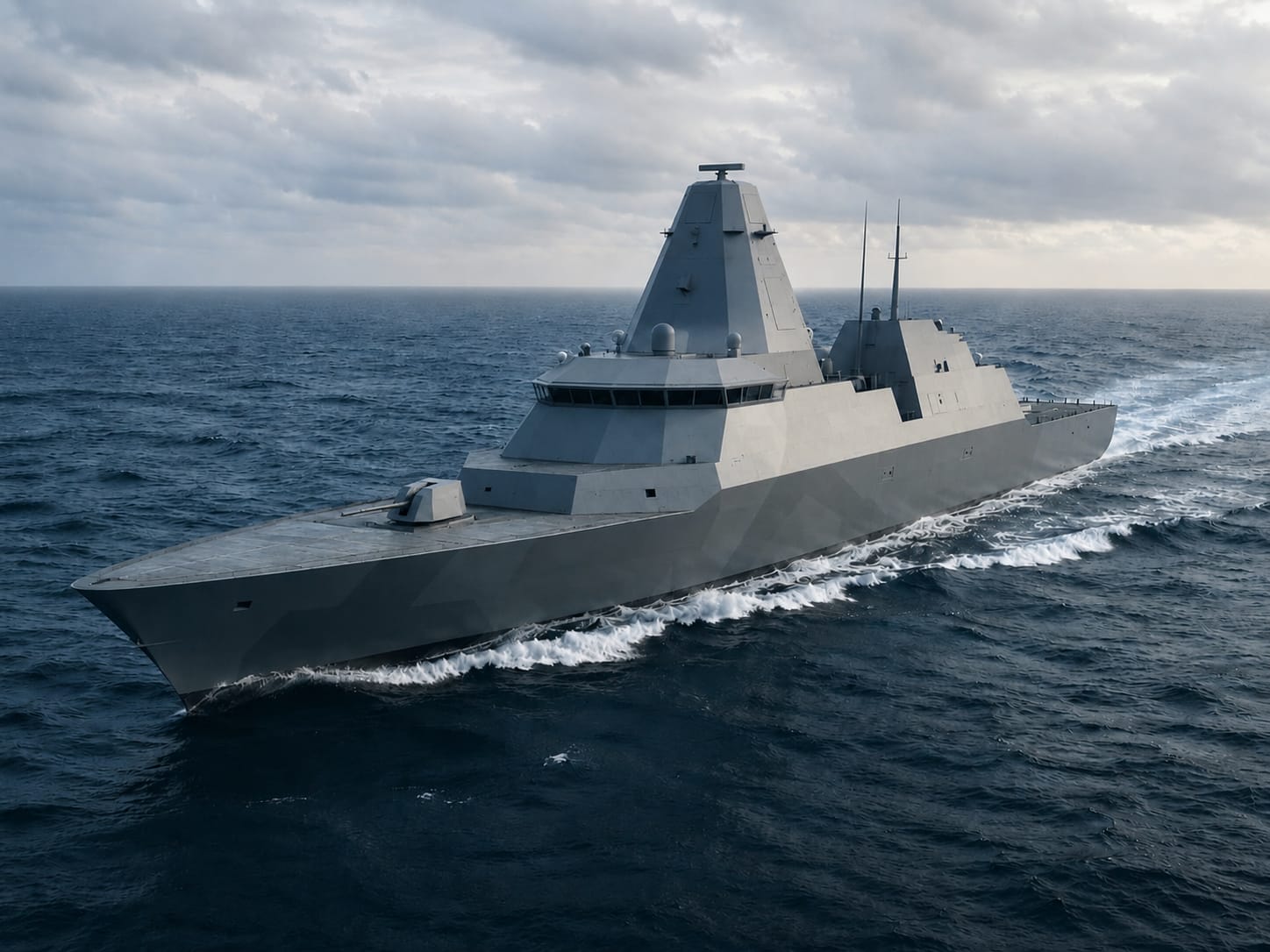
The Royal Navy’s Common Combat Vessel remains in the initial stages of design, and the aspiration is to sequence its arrival with the out-of-service dates of the Type 45 destroyers in the mid-2030s onwards, the Ministry of Defence has said.
The position was set out in a written answer to Ben Obese-Jecty, the Conservative MP for Huntingdon, who asked what the planning assumption for service entry was for the new class.
Minister Luke Pollard replied: “The Hybrid Navy Integrated Air and Missile Defence capability will replace the current fleet of six Type 45 destroyers. While the Common Combat Vessel (CCV) remains in the initial stages of design, the Royal Navy’s aspiration is to sequence the arrival of the CCV and wider Hybrid Navy Integrated Air and Missile Defence capability with the out of service dates of the Type 45s in the mid-2030s onwards.”
The answer is framed around the Type 45 retirement schedule rather than a fixed in-service date for the new class, and describes the intended sequencing as an aspiration.
When the programme was announced on 29 June, the department’s press release stated: “The Common Combat Vessel will replace the current fleet of six Type 45 destroyers, with delivery expected from the early 2030s.”
That release also said the funding announced in the Defence Investment Plan allowed the National Armaments Director Group to commence the design work underpinning the change in how air defence is delivered at and from the sea. Delivery of a warship from a shipyard and its entry into operational service are ordinarily separated by a period of trials and capability assurance.
Pollard’s reply also draws a distinction the June announcement did not. The answer attributes the replacement of the Type 45s to the wider Hybrid Navy Integrated Air and Missile Defence capability, with the CCV sequenced alongside it, rather than to the vessel alone. The press release described the CCVs as part of the system that will replace the current destroyers.
Under the Defence Investment Plan, at least six of the vessels are to be built, acting as control hubs coordinating uncrewed systems in the air, on the surface and under the sea. They are intended to work alongside eight Type 26 and five Type 31 frigates, together with Type 91 uncrewed missile platforms, Type 92 uncrewed underwater sensing platforms, Type 93 extra-large uncrewed underwater vehicles and Type 94 uncrewed sensor platforms. The programme replaced earlier plans for the Type 83 destroyer.
Dan Jarvis, who was Defence Secretary at the time of the announcement, said that the vessels would give sailors “hybrid ships that are designed and built for the increasing threats we face”, adding that they would be British-built and developed with British industry.



Given past experience fitting in the ISD of the new vessels with the phasing out of the 45’s is never going to happen.
Every day I become less confident that these are going to be anything more than six extra T31 frigates.
With a name change and T82 merged/dropped to save money.
I don’t see an issue with them being 6 X T31, seems like a sensible platform to use as it’s big, cheap and available. Ideally we want these ships being delivered well before the OSD of the T45 so if it’s doesn’t work then we can keep T45 going.
Do we know the number USVs that will be bought?
The T31 platform is fine, even superior to the other available platform, the T26.
My worry is that these will lack the advanced AAW sensors, tall mast, et cetera, required for the fleet air defence role.
I’m aware that these are planned for the T9X. However, if those don’t pan out, the RN is left with nothing.
A middle ground would be an Iver Huitfeldt or an FDI style ship.
From an operational perspective, if the plan is for many smaller radars, surely you’d also want to put those on as many hulls as available.
But they aren’t going to be designed as conventional fleet air defence destroyers like a T45.
I think the idea is the T94 will negate the need for a high mounted sensor as the radar will be mounted up threat and over the horizon from the ship, if the command ship is having a large radar then I think it needs to be more focused on ballistic targets looking up instead of high mounted looking down for sea skimming targets.
I agree with that, but my worry is that the RN won’t end up with that. Instead, they’ll receive six slightly modified frigates and a complex, expensive, incomplete and ultimately ineffective drone fleet.
We’ll then gap fleet air defence until a replacement ship can be found.
Ensuring the CCVs have decent sensors isn’t particularly more expensive and provides an insurance policy.
Having a big radar needs a big ship, that you then might as well have the crew and command facilities on. In my view T94 has a place carrying a frigate sized radar high up to act as a radar picket as you describe, but putting the CSG’s main radar on an unmanned vessel seems like unnecessary complexity relative to the simple arrangement with everything on one hull.
Add Both.
VTOL heavyweight drones in the air hoisting an aesa panel up there.
And once your global positioning is good enough you can start doing distributed radar stuff.
And we have that technology.
I just have to hope somebody there is smart enough to see the big flashing red arrows that scream, “Combine These Technologies Into One Platform”
Get that up high and you will see EVERYTHING, with an extremely high resolution too.
As for everything else, I hope they don’t forget a hi/lo mix of drones.
Cheap Expendables out front, specifically.
Genuinely exciting stuff and with Ukraine on our side, a wealth of real world combat experience and data.
Oh and make sure every node bristles with anti cheap one way attack drone machine guns.
They seem to be going in the right direction, as a conflict will now be all about saturation attacks and munition cost ratios.
I just got a mental picture of a big rotor drone carting up an underslung square radar panel.. sort of like the old Solvite wallpaper paste advert with the man wallpaper pasted to a big square and flown around under a helicopter…
What an advert that was. Understood the new ship comes in when the old ships retired but also need to keep an eye on shipbuilding flow.
Who knows what’s planned? It might be planned to have sensors deployed on uncrewed platforms to extend the coverage range out beyond what a radar fitted to the ships mast could see. Combined with uncrewed missile carriers the engagement range may extend way beyond what a single ship based system could offer. The ship is just the control hub in this concept, it’s a whole new approach.
It’s a whole new approach, and if it works out, it’ll be great.
In the more likely case that it doesn’t work out fully, giving the CCV a decent sensor set and small VLS-payload is a cheap insurance policy.
Superior in what way to a T26 exactly?
For an AAW role? Built in margins for 32-cell Mk41 VLS, multi-purpose radar and a large volume search radar. The annoying costly hullform from the T26 isn’t present either.
It’s the rafting and other quietening capabilities that cost – take these away and you still have a good ASW hull but the cost reduces significantly. Also, having a good level of quietening (rather than a sub hunter level) will still be critical for the CCV in high threat scenarios.
Why do they even have to be tied to the T45s retiring date? They’re just spending millions on upgrading these ship, how about using them first. Bring the CCV into service as you as possible. Just 19 main ships and god knows how many drone ships seems very out of balance. Why not another T31 GP, another T26 and these six CCV ships, gets a rule of three on all classes for 21 ships. And 3-4 B1 River replacement OPVs and add the 5 B2 Rivers, for a pretty decent fleet. As other posters have suggested a single hulled T83 requirement might actually reappear later which would be quite funny. Giving the T31s an search radar in addition to the NS110 could give them a AAW uplift as well as having the 4xMk41and CAMM farm hybrid mix, maybe repositioning the NSM launchers.
It’s a good question and I suspect more related to money than military need. What defines a CCV? As best as I understand, it the ability to control uncrewed ships. It needs to be able to do sensor fusion with the sensor pictures of other vessels and drone swarms as well as its own inbuilt sensors. It need to be able to control effectors physically based on other vessels and UAVs. It should be able to prioritise which effectors it fires based on geography, threat and price. It needs command and control.
None of this is particularly space intensive. Of course there the possibility, or even probability that CCV would work better if it also functions as a drone mothership, but that’s not core. There is no reason I can see that a T31 conversion should not have this level of command and control alongside the necessary communications infrastructure. Wasn’t the Absalon built as a command-oriented ship and didn’t the Iver Huitfeldts reuse the Absalon hulls? So why are we not ordering adapted T31s to follow the current batch?
I think the answer is simply money. Ship design is done out of sight and initially relatively cheaply. You can keep it in Per-Concept or Concept for as many years as you like, just as they did with the T32. The T83 was in Pre-Concept for years before cancellation, with FADS, the overarching system of system reaching Concept, where I believe it remains.
The only other logical possibility to explain the synchronisation has not been announced or even publicly discussed as far as I know, which is to convert T45s to CCVs first. It’s a terrible idea. Also taking T45s out of service even longer than they already have would not have a good look.
Why do they even have to be tied to the T45s retiring date? They’re just spending millions on upgrading these ship, how about using them first. Bring the CCV into service as you as possible. Just 19 main ships and god knows how many drone ships seems very out of balance. Why not another T31 GP, another T26 and these six CCV ships, gets a rule of three on all classes for 21 ships. And 3-4 B1 River replacement OPVs and add the 5 B2 Rivers, for a pretty decent fleet. As other posters have suggested a single hulled T83 requirement might actually reappear later which would be quite funny. Giving the T31s an search radar in addition to the NS110 could give them a AAW uplift as well as having the 4xMk41and CAMM farm hybrid mix, maybe repositioning the NSM launchers.
No idea why it doubled, sorry.
Wonder if these vessels will travel with the QEC to far off places or be Resticted to the North Atlantic..?
Even FAWCS is a more established concept than an AAW T31. MoD could just get the 150m version that was the minimum to carry the large radar and call it CCV with one of the VLS silos replaced with a container pit or mission bay.
The current position of T94 as the main sensor will only increase costs.
Iver Huitfeldt is an AAW T31, and it’s been around awhile longer than FADS and FAWCS. Absalon, the grandparent design with substantially the same hull, also gives it the command pedigree needed for CCV. CCV isn’t intrinsically AAW. It’s supposed to control T91s and T94s. The question will be, what will the Navy prioritise?
Iver Huitfeldt is an old design, its volume search array is a heavy rotating panel in a position a fixed mast won’t go. There are ways AH140 could be returned to a more credible AAW spec but as I said even BAE’s nebulous FAWCS family is more progressed in the public domain.
CCV absolutely needs to have inherent AAW capability. To do otherwise would be prohibitively expensive just to match the capability of a conventional destroyer.
What do you see a sovereign CSG looking like? Carrier, two T26s, two CCVs, four T91s and four T94s, AEW overhead, plus support ships? I have problems fixing it in my head, so figuring what would or would not be too expensive is hard to judge.
It depends on the context.
For the North Sea exercises the carriers do frequently I would say a T26, a pair of T91, pair of T92 and a T94, with the carrier and its AEW acting as the main radar sensor. Tide for RFAing.
For full on overseas CSG I would go a pair of T26, a single CCV, 4 T91, 3 T92, 2 T94 and an SSN. Tide and FSSS. This is in my scenario where CCV is a capable air defence combatant focussed on the CSGs; I would be willing to sacrifice numbers for that as the Hybrid Navy will allow smaller tasks groups their own unmanned AAW escorts.
Before this stupid plan, I’d have said
1 QEC
2 Type 83
1 Type 26
3 Type 91
2 Type 92
1 SSN
Given that the CCVs will have lower VLS counts and worse radars than a Type 83, maybe will have to increase that to 4 in a CSG.
I do wonder if the current Diesel generating power of the t31 is insufficient for the Role…!
Well the current type 31 has 3.6 mw of power, slightly more than the french fdi frigate. The polish arrowhead 140 however has 5.4 mw of power.
Nothing like enough – a future asset with directed energy weapons and a credible radar needs north of 20MW
Wouldn’t a T45 batch 2 fulfill the role nicely? A strong hull to take the radar mast and perhaps a reduced number of VLS will save space for the task of mother ship? It will save time and money in designing a new ship.
Question, who is responsible for the initial design. It used to be the DNC with the builders working out the detailed design, but as we no longer have a DNC who carries out initial requirements and design?
Also with the CCV would the types 91-94 not need to be designed first to understand communications, computer and mothership requirements of the CCV.
Naval Design Partnering (a mix of private companies and DE&S) does an initial reference design. The project is then put out to tender and the bidders each bid something completely different but meeting the general specification. It is a very wasteful process which leaves intellectual property in the private sector, so the MoD can’t put successive batches of the same design out to whichever builder offers the best price as used to be done. The last warship done the old sensible way was the Type 23.
Your points are well put…Cart and horse comes to mind….
Lots of ideas perhaps need to be trialed first..?
Are you suggesting using civil servants to actually design ships? How very dare you! Everyone knows that when a new Prime Minister takes office the first thing they do is pledge to cut the civil service. Andy Burnham knew and pledged it immediately. Repeat after me: “Civil servants bad, private sector good.”
Jon, surely MoD naval architects are still CS?
But bulk of the actually design and engineering study work isn’t done by the MoD – it’s contracted out to Frazer-Nash.
Still at the PowerPoint stage
Just keep building T26’s and T31’s till we have 12 of each in the fleet then sell off the older hull. Cuts down on design costs and logistical support for a new hull types. With the increase of frigate numbers along with the proposed un-crewed fleet you will be able to cover 100’s of square miles with the frigate in the middle of the box controlling the area of interest.
I agree, no need for any new multi billion pound warship designs just to keep multi billion pound warship designers in work. The T31 and T26 hulls should be fine for decades to come. Both already come in enlarged versions if we need something bigger. If the command ship and drones doesn’t work out then we should opt for a Canadian River Class destroyer on the T26 hull with enlarged radar for a more general purpose destroyer rather than a air warfare cruiser like the T45/T83.
The Australian hunter is better for AAW.
But no Type 26 is brilliant for it. The hull shape is designed for quiet running at slower speeds instead of efficient high cruise speeds and top speed like an AAW ship needs. It also has a low VLS count.
We’ve already got good ASW in the Type 26, once the Type 45 goes we’ll have nothing capable of fleet level defence meaning nothing to defend the carriers.
Conveniently ignored for Cost Reasons by Starmer ..A Carrier with no Paticular air defence of its own and totally Reliant on the Current t45 .. How will this Concept play out 8000miles Away…??
These should be built along with the T83.
Suspect these will be t83 in all but perhaps Name or the 160 version of the t31..Named the t32..?
Lots of discussion on AAW. If the T45s get radar and missile upgrades, isn’t the CCV function we need most urgently the ability of a T31 to control slave T92 ASW sloops? Could that be why the ISD of first tranche has been put back?
I don’t see how those two are mutually exclusive.
I’m not suggesting they are. The monaker CCV implies both. Just suggesting that since T31 has no passive ASW detection capability or hard kill, it might be a good idea to start with the ASW piece.
Yes I very much suspect the ASW T9xs will be the first out the box.. as you say that’s the kicker especially as Russia has built 6 Yasen and has 4 more on the blocks with a plan for a total of 12. T45s will have a fresh everything just as the 2030s start.. and Russian naval air power is not being regenerated in the way it’s Nuclear submarines are and reality we are going to have T45s for a very long time to come.. well into the 2040s if necessary.
Also, we know that there is no reason in principle, given some work, why Mk41 vls could not take Aster missiles. I think the Artisan on T26 could support this combo. Don’t know about the NS100 on Type 31, but the way to go I would have thought; and for missile barges too.
The design phase for the Common Combat Vessel (CCV) sounds ambitious, but the true bottleneck won’t be the steel hulls—it will be the software architecture. Trying to seamlessly coordinate uncrewed missile platforms (Type 91) and subsurface sensors (Type 92) from a crewed hub requires flawless, jam-resistant data links. If the MoD doesn’t lock down the digital infrastructure and AI combat management software during these initial design stages, we risk building incredibly expensive drone-command hubs that can’t reliably talk to their own offboard assets in a contested EW environment
Hopefully some of the software design for command will have been looked at for the Type 83 under FADS and can be ported.
There was no work beyond scoping a rough outline for T83 – all they have to show for it is some PowerPoints
Just Me is right. Relying on paper concepts or PowerPoint architectures from Type 83 is exactly how programs stall. The software for autonomous coordination needs dedicated, active development right now, not just ported outlines.
Just how many power point concepts have we seen in recent years…!
No sooner are these ides released to the Media they quietly Disappear..!
Too many to count, mate. It’s the classic procurement trap—announce a flashy concept for a good headline, then quietly shelf it when the funding gets tight. If the CCV is going to avoid becoming just another abandoned slide deck, they need to focus on practical, deliverable tech right now rather than chasing unachievable wishlists.
Whatever is built, let’s hope it can at least defend itself.
Make sure they are big, carry nearly two hundred cells, with some being horizontal or slightly elevated for quick response to low travelling hyper sonic missiles and make sure it is twelve, not six due to offset the blair wars, but twelve, that is twelve. Call them the T eight three if you like. Most important is government change. Were are not going to succeed, carrying on like this.
If these new concept ships go from yet to be designed to being a fully functional vessel in say 10 years it will be a first for today’s RN.
How many diffrent Concepts have we seen from the Navy over the last Dozen or so years..? For various Requirements with various Acronyms that never were..
We’ll probably come full circle when they finish their fantasy Designs and at some cost, and land up with a
T32 or a modified T83…!
These drone ships…they are ONLY of use in a group ? Would they be of any use showing the flag? Would they be of any use in more confined waters? Will they all have frigate level self defence ( 57mm, camm, ew and so on)?
Surely they need to have at least the ability to be very lean manned to be of use on their own?
The control ship will have to be a full fat warship I’m thinking…or will we get a mix of ships optimised for just one thing to the detriment of anything else?
AA
>…they are ONLY of use in a group
It would seem so. Basically instead of a large Type 82 destroyer of c.10,000 tonnes, we will have a smaller CCV command (core node) ship with probably four accompanying drone ships providing sensors (2 x T94) and missile silos (2 x T91). Although the individual platforms will be smaller than a T83, the total tonnage of the five platforms will be far higher assuming an ability to operate in the North Atlantic in winter is required, perhaps c.20,000 tonnes (1 x CCV @ 6000 + 2 x T94 @ 4000 + 2 x T91 @ 3000). Obviously each platform needs its own engines, generators, HVAC, radars, comms, point defence systems … so lots of extra cost there. But the problems in delivering the completely reliable and totally secure bleeding edge technology required to tie these 5 platforms together in to a single integrated combat system are just head wrecking to me as an IT Project Manager.
An overly complex solution with a widely optimistic “back of an envelope” initial budget – which inevitably means risk, delays, cost over runs – and an end result that doesn’t match up to the promises made. It was undoubtedly concocted by the DIP team (going far outside their remit) as a desperate attempt to find something cheaper than the £6.9bn T83 destroyer programme mandated in SDR. Admittedly that cost just includes the six warships, the full cost of FADS would undoubtedly have been nearer £10bn. But the Hybrid Navy Integrated Air and Missile Defence programme already has the whiff of being the next Nimrod MPA.4 or Watchkeeper WK450. I.e. finally cancelled after a decade of effort and £billions wasted because no one could still pretend that it would ever work, and all the original sponsors had safely retired with their knighthoods and gold plated pensions so not could not be held accountable for the fiasco.
Agreed t83 ditched on pure monetary grounds by Starmer…intresting to see if HEALEY finds the money to reverse that decision..!
How would this all work with a Carrier group in the South China Sea..?
It has the words ‘ Technical Problems’ written All over it…!
Britain spend years designing new military vessels at considerable taxpayer cist and then builds a mere handful. It almost seems pointless
What would we do if an adversary (Russia, China, Iran) seized or sank one of our UNCREWED vessels? What if they announced it was a ‘threat to navigation’ and towed it away? No British lives are immediately threatened but would we attack the adversary ship that is towing it away and put our adversary’s lives in danger risking further escalation?
Same if a Drone was Escorting a Russian ship in the channel and was sunk…Send a strongly worded letter to their Embassy…or invite the Ambassador to the F.O for tea and biscuits..!!
The MOD really like spending more money getting new designs for ships.
As far as I can make out, the MOD is hoping (or rather fantasising based on no analysis work) that it can replace the six Type 45’s with an equivalent number of CCV centred air and missile defence systems for £3 billion, less than half the £6.9 billion estimated for “up to eight” Type 83 destroyers. Desperate economy measures will be required to stop the required budget quickly exceeding that of the T83’s, e.g. building the T91/94 sloops to civilian standards in a Romanian shipyard using an adapted Damen design. I also wouldn’t be surprised if the sloops become “very lean crewed”, as the cost of the final 10% of automation clearly becomes both prohibitive and regulatory very challenging.
The only fans of the whole concept seem to be Babcock (a near cert for 6 CCV’s) and the owners (and paid advisors) of small UK shipyards (e.g. Navantia Appledore, Ferguson Marine. Balaena Mersey) who are hoping for lucrative cost+ MOD orders to build the 24 (?) unmanned sloops.
Another money wasting “design” project, which MAY enter service years late, over budget and in reduced numbers.