Category: Sea

  • Britain to speed up submarine maintenance with 3D printing

    Britain to speed up submarine maintenance with 3D printing

    QinetiQ is to install an additive manufacturing facility at HM Naval Base Clyde capable of producing submarine components on demand at the dockside, in a development that is intended to reduce the time boats spend alongside between operational patrols.

    The new capability has been delivered through two contracts with the Submarine Delivery Group’s Additive Manufacturing team, with the Additive Manufacturing All In One solution and its associated Market Access Cell together enabling submarine components to be manufactured to order on site by QinetiQ and Royal Navy submariners and delivered directly to the boats.

    According to QinetiQ, the All In One solution constitutes what the company describes as a UK sovereign point-of-need capability designed to reduce dependence on complex external supply chains and accelerate repair timelines on the Royal Navy’s submarine fleet.

    Interior of a mobile lab with black overhead cabinets, a Fortus 450mc 3D printer at the back, and clear plastic enclosures on a workbench toward the left.

    The arrangement combines two distinct strands, with the All In One containers handling routine on-site production while the Market Access Cell covers more complex components that fall outside what can be produced on site. The All In One containers were designed and manufactured by QinetiQ technicians and engineers at the company’s Cody Technology Park headquarters in Farnborough before being moved to Faslane, where one container will support reverse engineering tasks by scanning parts to produce a digital blueprint, with parts then re-engineered in the neighbouring workshop using polymer printing technology.

    The Market Access Cell, meanwhile, sees parts reverse engineered by QinetiQ at specialist facilities across the United Kingdom, with digital blueprints then shared with an accredited network of UK and Australian small and medium enterprises drawn from sectors including Formula 1.

    QinetiQ will operate the containers at Faslane with the support of Royal Navy submariners, before applying its engineering expertise and platform knowledge to support the Submarine Delivery Group in qualifying components produced through either route for reintroduction into the wider supply chain.

    Will Blamey, Chief Executive of UK Defence at QinetiQ, said the combined capability would address one of the longstanding constraints on submarine availability. “Our proven expertise in additive manufacturing combined with the latest technology being installed at HM Naval Base Clyde will see us print, scan and reverse engineer submarine parts on demand, at pace and at dockside, helping to get submarines back on operations more quickly,” he said, as quoted in the company’s release.

    First Sea Lord General Sir Gwyn Jenkins, who launched the Submarine Maintenance Recovery Plan in January, described the deployment as a meaningful step toward the plan’s goals. “The arrival of these deployable workshops marks a step forward in delivering the Submarine Maintenance Recovery Plan,” he said. “This new technology has the potential to change how we maintain our submarines, cutting time alongside and increasing availability. It represents the real, tangible, progress the Royal Navy is making to strengthen the underwater fleet.”

    The Submarine Maintenance Recovery Plan was established in response to longstanding concerns about the availability of the Royal Navy’s nuclear-powered submarine fleet and about the lengthening time the boats spend alongside undergoing maintenance rather than at sea on operations. The Astute class attack submarine fleet and the Vanguard class ballistic missile submarine fleet have both been affected, with maintenance cycles for the latter in particular running considerably longer than originally planned, and Faslane, as the home of both fleets, sits at the centre of the recovery effort.

    QinetiQ’s involvement in additive manufacturing for submarine maintenance has been building for some time, having most recently supported a routine maintenance period for HMS Anson, the fifth of class Astute submarine, when the boat visited Perth in Western Australia in March 2026. According to QinetiQ, the company rapidly designed and produced the required critical components and delivered replacements in around four weeks, well inside the lead times typical of the conventional submarine supply chain, with the experience having helped inform the design and operational concept of the All In One facility now being introduced at Faslane.

    Paul Duff, Associate Materials Scientist at QinetiQ, said the project had moved from concept to fielded capability rapidly. “Working in the Additive Manufacturing All-in-One facility alongside Royal Navy personnel will provide us with an incredible opportunity to show how additive manufacturing can transform routine submarine maintenance,” he said. “It’s been very rewarding to see the facility come together in Farnborough and even more exciting to see it now deployed at HMNB Clyde.”

    Commander Max, the SDG Additive Manufacturing Lead, said the on-site model offered direct benefits for the boats themselves, telling QinetiQ that “by enabling engineers to produce components on-site, we are reducing dependence on complex supply chains and accelerating repair timelines, ultimately improving the submarine’s material state and availability.”

    Additive manufacturing has steadily moved from prototype and research applications into mainstream defence engineering use over the past decade, with allied navies including the United States, Australia and the Netherlands all running parallel initiatives to bring the technology into the supply chains supporting their fleets, and the technology is particularly well suited to the production of low-volume, high-specification components for legacy platforms where conventional supply chains can be slow or where original equipment manufacturers may no longer offer parts.

  • Images show large warships being built in Glasgow

    Images show large warships being built in Glasgow

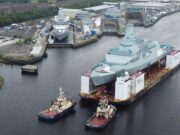
    New images have provided a fresh view of HMS Glasgow and HMS Cardiff, the Royal Navy’s first two Type 26 anti-submarine warfare frigates, with both ships now progressing in parallel through the fitting-out phase ahead of trials.

    HMS Glasgow, the lead ship of the eight-strong City class, has been at Scotstoun since being floated off at Glen Mallan in late 2022. The ship has spent the years since in a sustained programme of outfitting, with major equipment including the BAE Systems Mk 45 Mod 4A 127mm naval gun fitted forward, the foredeck prepared to receive the Sea Ceptor and Mk 41 vertical launch system modules, and the bow and towed array sonar systems installed. Internal cable termination, equipment commissioning and system integration work has dominated activity on board for the past year as the ship moves toward the start of sea trials.

    HMS Cardiff, the second of class, joined HMS Glasgow at Scotstoun in late 2024 after her own float-off and tow up the Clyde, and the two have since been pictured together on numerous occasions. Cardiff completed her first flood-up in May 2026, transitioning into wet dock and into the afloat fitting-out phase. Her programme remains some way behind that of Glasgow, with major equipment installations and system integration work continuing.

    The Type 26 build effort on the Clyde is a programme that has steadily expanded since first steel was cut for HMS Glasgow in July 2017. BAE Systems has invested heavily in the supporting infrastructure, including the Janet Harvey Hall at Govan that allows two Type 26 hulls to be constructed in parallel under cover. The investment is intended to reduce build duration from a first-of-class figure of around 96 months toward 60 months for the eighth ship of the class, with the interval between ships compressed from 18 months to 12.

    HMS Glasgow is scheduled to begin contractor sea trials before the end of 2026, with reporting earlier this year indicating that the start of trials had slipped from earlier in the year toward December 2026 or early 2027. Following completion of trials and handover to the Royal Navy, the ship will undertake a period of Royal Navy-led work-up and live weapon trials, with full operational capability anticipated in 2028. The eight ships of the class are expected to enter service between 2028 and 2035, with each replacing one of the in-service Type 23 anti-submarine warfare frigates currently delivering the role.

    The remaining six ships of the class, HMS Belfast, HMS Birmingham, HMS Sheffield, HMS Newcastle, HMS Edinburgh and HMS London, are at varying stages of construction at BAE Systems’ Govan and Scotstoun yards. HMS Belfast, HMS Birmingham and HMS Sheffield are at Govan, with long-lead procurement under way for HMS Newcastle.

    Earlier this week, Minister for Defence Readiness and Industry Luke Pollard told Parliament that the programme remained on track to meet all user requirements and to deliver all eight ships, with vessels entering service from the late 2020s.

    The Type 26 design has also become the platform of choice for a growing number of allied navies. Norway selected the British design last year under a £10 billion agreement covering at least five hulls, with Australia building six ships of the Hunter class variant and Canada planning fifteen of the River class destroyer variant. Combined with the eight Royal Navy ships, the international Type 26 user community now totals around 34 hulls planned or under construction, placing the design at the centre of allied surface combatant procurement for the coming decades.

    The ships’ primary role is anti-submarine warfare, with a quiet hull form, advanced sonar suite and a low acoustic signature engineered around the demanding requirements of detecting modern submarines. The class will operate primarily in protection of the United Kingdom’s continuous at-sea nuclear deterrent and the carrier strike group, alongside contributions to NATO standing maritime task groups and to the joint UK-Norway force structure agreed under the new Lunna House Agreement. The mission bay located amidships will allow the ships to deploy uncrewed surface and undersea systems, embarked Royal Marines, and a wide range of other mission loads alongside their core anti-submarine equipment.

    The images were taken by me onboard a flight coming into Glasgow Airport, not by a drone, as many will likely be curious about.

  • UK should lead Europe as US looks east, think tank says

    UK should lead Europe as US looks east, think tank says

    The United Kingdom should assume primary strategic leadership over Euro-Atlantic security as the United States rebalances its resources toward the Indo-Pacific, with the historical sentiment underpinning the so-called special relationship no longer sufficient to deter the coordinated activity of China, Russia, Iran and North Korea, according to a new report by the Council on Geostrategy.

    The report, titled Burden sharing: Preparing Britain and America for a multifront crisis, was published by the London-based think tank and argues that decades of globalisation have systematically hollowed out the productive forces of both nations, the organisation stated. The analysis introduces the term machinepolitik to describe the systematised industrial power the authors say allowed Britain and America to prevail in the major conflicts of the 20th century, contending that the combined industrial strength of the two allies may now be weaker than that of their most powerful systemic rivals.

    The report frames the threat as emanating from what it terms the CRINK axis, comprising the People’s Republic of China, Russia, Iran and North Korea, and argues that the active collusion between those states demands a level-headed shift away from real-time diplomacy in favour of integrated industrial capacity and structured theatre division.

    According to the Council on Geostrategy, the United States under the second Trump administration is rapidly rebalancing toward the Indo-Pacific and the Western Hemisphere, with the 2025 US National Security Strategy expecting European allies, and the United Kingdom in particular, to assume primary conventional responsibility for deterring Russian opportunism in the Euro-Atlantic. The report concludes that Britain can no longer rely on nostalgia and must drop what it describes as rigid legalism in favour of assertive realism.

    The analysis points to recent friction at the political level as a warning of what can happen when strategic alignment is absent between London and Washington, citing the opening stages of Operation Epic Fury as a case in which structural damage was inflicted on the special relationship. To prevent what the authors describe as dangerous command paralysis, the report argues that critical global staging nodes including the Sovereign Base Areas on Cyprus and the military facility on Diego Garcia should be operationally insulated and pre-cleared for allied force projection before any conflict ignites.

    The report sets out seven recommendations. The first calls on the British government to “identify areas of overlap within the Venn diagram of the Trump administration’s strategic objectives and British national interests to present clear opportunities for mutual cooperation to the White House,” as the authors put it. The second is the establishment of a shared understanding of multifront crises through what the report describes as “a sprint of joint wargames and significantly closer synchronisation between Euro-Atlantic and Indo-Pacific military exercises, drawing on the 1980s’ US-led ‘new maritime strategy’ as a historical baseline.”

    The third recommendation calls for formal theatre coordination across three tracks: “integration in the North Atlantic and Wider North; cross-pollination in the Middle East, Africa, the Indian Ocean, and the Mediterranean; and a progressive delineation of responsibility where the US leads in the Western Hemisphere and Western Pacific, and the UK assumes greater leadership in Eastern Europe and the South Atlantic,” according to the report.

    A fourth recommendation centres on what the report calls a Five Eyes Critical Minerals Alliance, with the authors urging both governments to “address critical mineral vulnerabilities by launching a joint multilateral fund, modelled on the US$250 million Pax Silica initiative, to subsidise cross-border prospecting, extraction, and refining while harmonising national security exemptions and export controls against economic coercion.” A fifth recommendation proposes a Strategic Friendshoring Task Force, described in the report as “a temporary joint mechanism inviting NATO and Indo-Pacific partners to map multitier supply chain bottlenecks and determine where participating nations can rely on shared, friendshored networks rather than fragmented national onshoring.”

    The sixth recommendation calls for elevation of AUKUS Pillar Two within national defence planning, “aligning increased funding against concrete, joint technology development projects to serve as a baseline for future co-development,” according to the report. AUKUS Pillar Two covers the advanced technology and capability work that sits alongside the Pillar One submarine programme, including artificial intelligence, autonomy, undersea capability, hypersonics and quantum technology.

    The seventh and final recommendation calls for deeper defence industrial integration through what the report describes as “a permanent joint working group to identify and action opportunities for the co-development and co-production of military capabilities.” The authors add that the arrangement “will support more seamless cross-theatre cooperation and allow for greater scalability, but will require Washington to ease its remaining regulatory and export restrictions and for London to accept compromises on domestic industrial sovereignty.”

    The report sets out a strategic outlook in which the United Kingdom and the United States need one another, with the authors noting that the United States “looks set to remain the world’s foremost power, with a growing lead over the European Union (EU) and Japan in next-generation technologies.” The analysis projects that “by the late 2030s, the British economy is projected to leap over Japan and reach parity with Germany to sit alongside the US, the PRC, and India, meaning its utility to Washington may even grow, especially given Britain’s position as an island citadel on America’s eastern flank.”

    The authors are clear, however, that a deep change in the United Kingdom’s national mindset will be required to make the case. “Attempting purely national, autarkic onshoring is economically unsustainable in a globalised world,” the authors write, as quoted in the report. “If the UK is unprepared to invest in the British Armed Forces at a level commensurate with a cold war, it cannot expect to be taken seriously in Washington. True multifront preparation requires turning vital global staging nodes into undisputed, pre-cleared launchpads of allied power.”

    The report adds that London “needs more realism in a geopolitical age,” and must “invest further in credible, scaled combat power to ensure that the CRINK fear British decisions in theatres where the UK will lead, and that Britain remains indispensable to America and the small handful of countries that are prepared to uphold defences sufficient to deter aggression across key theatres.”

  • New British attack sub set to leave Barrow by end of year

    New British attack sub set to leave Barrow by end of year

    The Royal Navy’s sixth Astute-class attack submarine, HMS Agamemnon, is in the final stages of commissioning and is expected to depart Barrow-in-Furness to begin sea trials by the end of 2026, the Ministry of Defence stated in a written answer to a parliamentary question.

    Liberal Democrat MP James MacCleary had asked the Secretary of State for Defence when HMS Agamemnon was expected to be fully operational.

    Minister for Defence Readiness and Industry Luke Pollard replied: “HMS Agamemnon is in the final stages of commissioning, and we continue to work closely with industry partners to deliver the submarine by the end of 2026, at which point she is expected to depart Barrow and commence sea trials.” He continued: “For security reasons, we do not disclose specific timelines for full operational capability, which will be dependent on the successful completion of these trials.”

    The reluctance to set out a date for full operational capability is consistent with longstanding MoD practice on the submarine fleet. The dates at which individual boats achieve operational status, the work-up patterns that precede them and the patrol patterns that follow are treated as classified information across the Royal Navy’s underwater enterprise.

    Pollard’s answer confirms only the broad sequencing from commissioning through departure to sea trials, leaving the period between trials and front-line tasking unstated.

    HMS Agamemnon is the sixth of seven Astute class submarines being built by BAE Systems at Barrow-in-Furness for the Royal Navy. The class, designed and built to replace the Trafalgar class boats, provides the Royal Navy’s nuclear-powered attack submarine capability and is configured to carry Spearfish heavyweight torpedoes and Tomahawk Land Attack Missiles. The first five boats, HMS Astute, HMS Ambush, HMS Artful, HMS Audacious and HMS Anson, are now in service, with HMS Achilles, the seventh and final boat of the class, in build behind HMS Agamemnon.

    HMS Agamemnon was launched at Barrow in October 2024. The boat’s transition from build through commissioning to sea trials will, on the timeline set out in Pollard’s answer, see it leave the Devonshire Dock Hall by the end of 2026 to begin the long process of trials and work-up that traditionally precedes acceptance into front-line service. For previous boats of the class that process has taken several years.

    The Astute class, alongside the four Vanguard class ballistic missile submarines, constitutes the totality of the Royal Navy’s nuclear-powered submarine force. The boats operate from HM Naval Base Clyde at Faslane, alongside the Vanguard force, and are tasked across roles ranging from the protection of the continuous at-sea nuclear deterrent to intelligence collection, strike operations and maritime interdiction.

  • New British destroyer ‘underdeveloped concept’

    New British destroyer ‘underdeveloped concept’

    Only around GBP 1 million has been spent on platform-specific design work for the Royal Navy’s planned Type 83 destroyer over the past three financial years, with the Ministry of Defence admitting it inherited the programme as an underdeveloped concept on entering office, the department stated in a written answer to a parliamentary question.

    Conservative MP Sir Alec Shelbrooke had asked the Secretary of State for Defence to set out the total spend to date on the Type 83 project, including pre-concept and early concept phases. Minister for Defence Readiness and Industry Luke Pollard’s response indicated that the figures are difficult to disaggregate because Type 83 sits within a wider capability framework.

    Pollard said: “We inherited an underdeveloped concept for Type 83 when we took office. The Type 83 Destroyer forms part of a wider Future Air Dominance System (FADS) capability concept, making specific costs for the Type 83 element hard to differentiate from the wider whole.” He continued: “Over the last three financial years, c.£1 million has been spent on platform-specific design for the Type 83. This forms part of c.£6.9 million which is the broader notional spend for Type 83 work as a part of FADS.”

    The figures show a programme still very much in its earliest stages, despite the Type 83 having been publicly identified as the future replacement for the Royal Navy’s Type 45 air defence destroyer fleet for several years. The Type 45s entered service from 2009 onward and currently provide the area air defence capability for the carrier strike group, with the class subject to its own significant modernisation programme through the Sea Viper Evolution and Power Improvement Project upgrades. The original timeline indicated Type 83 would begin replacing the six-ship Type 45 force in the late 2030s.

    The Future Air Dominance System framework under which Type 83 is being developed is intended to capture not just the next-generation surface combatant but the broader mix of sensors, weapons and command and control capabilities required to deliver fleet air defence in the 2040s and beyond.

    The strategic defence review published in June 2025 retained the requirement for a successor to Type 45 within the Royal Navy’s force structure but did not provide a detailed timeline for the Type 83. Royal Navy and industry sources have for some time expressed concern publicly about the pace at which Type 83 has been progressing through its early concept stages, with the relative scale of investment to date offering a measure of how much remains to be done before the programme can move into demonstration.

  • Babcock Arrowhead frigate eyes new export wins

    Babcock Arrowhead frigate eyes new export wins

    Babcock has set out an expanding international maritime portfolio anchored by its Arrowhead 140 frigate design and submarine support work, the company stated in its full-year results for the twelve months to 31 March 2026.

    The centrepiece of that effort is a Maritime Partnership Programme framework agreement signed in November with the Indonesian Government, worth up to £4 billion. Babcock said Indonesia has since signed a Letter of Intent for two further Arrowhead 140 frigate licences, expected in the coming months, while negotiations continue on the contract structures for the broader programme covering maritime defence, security and modernisation. The company described the agreement as reinforcing its position as a trusted government delivery partner on what it characterised as strategically important international programmes.

    The Arrowhead 140 design, which forms the basis of the Royal Navy’s Type 31 Inspiration Class frigates being built at Rosyth, is also under consideration in Denmark, where Babcock said it is awaiting an announcement from the Danish Government on its preferred naval platform. In Sweden, the company confirmed it was not selected as preferred bidder for the Luleå Class surface combatant programme following a decision in late May 2026, where it had offered the smaller Arrowhead 120 design. In Poland, Babcock signed a strategic cooperation agreement with PGZ SA covering naval design, construction, maintenance, military aircraft sustainment and strategic asset management for the Polish armed forces.

    The submarine side of the business saw equally significant international movement. Babcock’s partnership with US shipbuilder HII expanded during the year to include authorisation to support the Virginia Class nuclear submarine build programme, with the company now cleared to manufacture complex submarine assemblies at its advanced manufacturing facility in Rosyth. Babcock said the initial engineering contract is under way and “could expand materially over time.” The two companies’ joint venture, H&B Defence, also secured its first contract under the Australian Submarine Supplier Qualification pilot programme, which Babcock described as Australia’s gateway into the US submarine supply chain. The first Australian supplier received a Request for Quotation for the Virginia Class programme through that route in August 2025.

    In Canada, Babcock signed a teaming agreement with Hanwha Ocean focused on in-service support for the Canadian Patrol Submarine Project, the procurement under which Canada intends to acquire its next-generation conventionally-powered submarines. Hanwha is one of two shortlisted suppliers. The company is also continuing work on the Extended Docking Work Period for HMCS Victoria under the Victoria In-Service Support Contract, and supports the Fleet Maintenance Facility Cape Scott where HMCS Windsor’s docking period is taking place.

    South Africa marked a new entry point as Babcock secured what it described as its first defence contract in the country, covering the survey and refit of two submarines at Simonstown Dockyard alongside spares and product supply contracts. The company called this a major strategic milestone and its entry into the South African defence sector.

    Domestic naval support work also saw movement at the year’s end as Babcock agreed a six-month bridging arrangement with the UK Ministry of Defence under the £3.5 billion Future Maritime Support Programme to maintain continuity of nuclear submarine fleet support and naval base management services. The MOD has signed a Letter of Intent to finalise the multi-year replacement contract, known as Gateway, by October 2026. Babcock also secured a two-year extension covering critical Royal Navy surface ship maintenance and infrastructure support. The Mission Systems business secured its third renewal contract supporting in-service Royal Navy submarine effector systems, worth £110 million over nine years.

    Looking further ahead, Babcock pointed to what it sees as significant long-term opportunities tied to the AUKUS partnership, including supply chain, training, infrastructure and support related to Australia’s developing nuclear submarine capability under Pillar I. The AUKUS partner nations signed the first Pillar II project in May, covering enabling systems for Uncrewed Undersea Vehicles. Babcock continues to deploy specialists to Australia to support Astute Class submarine maintenance ahead of Submarine Rotational Force-West activities from 2027.

    Chief executive David Lockwood, who is due to retire later this year, set the results against a shifting global environment. “Against an increasingly uncertain geopolitical backdrop, Babcock has delivered continued strategic and operational progress,” he said, as quoted in the press release, adding that the group had secured “important contract wins that further strengthen our position in defence and nuclear markets, where long-term demand is increasingly structural.”

    On the civil side of Marine, Babcock’s Liquid Gas Equipment business delivered 42 projects covering cargo handling and fuel gas supply systems for LPG, LNG, CO2 and ethane carriers during the year, including the cargo handling system for what the company described as a world-first CO2 carrier. The business booked its 150th ecoSMRT order for LNG reliquefaction technology and secured its first contracts for ammonia fuel gas supply systems using its ecoFGSS-FLEX technology.

    At group level, Babcock reported revenue of £5.18 billion, up 8 percent organically, with Marine sector revenue rising 2 percent at constant currency to £1.59 billion. The company’s contract backlog stood at £9.8 billion at year-end, down from £10.4 billion a year earlier, reflecting trading on large multi-year orders won in the prior year. Babcock also announced a further £200 million share buyback to be completed during the current financial year, following completion of an earlier £200 million programme in April.

  • British warship opens fire with main gun

    British warship opens fire with main gun

    The Royal Navy frigate HMS Sutherland has successfully fired her main gun during capability trials at sea, a key step in the warship’s return to front-line service, the Royal Navy has said.

    The Type 23 frigate, known by her ship’s company as the Fighting Clan, said she had spent the last two weeks busy at sea, continuing essential capability trials for operations with the successful firing of her 4.5-inch Mk8 gun, alongside her ceremonial saluting guns.

    The 4.5-inch Mk8 is the principal gun carried by the Type 23 class, a single-barrel naval gun used against surface, shore and, to a degree, air targets, and proving it can be fired safely and accurately is one of the milestones a ship must pass on her way back to operational readiness. The trials form part of a wider regeneration programme that has seen Sutherland working steadily back towards the front line.

    That programme has been under way for some weeks now, with the frigate having earlier completed final trials of her Magazine Torpedo Launching System after a port visit to Lisbon, where she also hosted the Deputy Commander of Striking Force NATO, Rear Admiral Wood, along with British and NATO defence attachés, before returning to sea to press on with regeneration trials.

    HMS Sutherland is one of the Royal Navy’s Type 23 frigates, a class displacing around 4,900 tonnes and optimised for anti-submarine warfare, armed with the Sea Ceptor air defence missile system, Sting Ray torpedoes and a embarked Wildcat or Merlin helicopter, and forming the backbone of the surface fleet’s submarine-hunting capability.

    The gunnery milestone comes only days after Sutherland was on the front line in a very different role, having been one of two warships supporting the Royal Marines as they boarded the sanctioned shadow fleet tanker Smyrtos in the English Channel, an operation that underlined the breadth of tasking now falling to the regenerating frigate as she works back towards full availability.

  • Euston to be among biggest Scottish investments in decades

    Euston to be among biggest Scottish investments in decades

    Programme Euston will be one of the most significant and sustained government investments in Scotland over the coming decades, the Ministry of Defence has said, with employment and training in the local area set to rise as the work gets under way.

    The assessment was set out by the Minister of State at the Ministry of Defence, Lord Coaker, in response to a written question from the Labour peer Lord Beamish, who had asked what assessment the government had made of the number of apprenticeships that would be created in Scotland and the north-east of England under the programme.

    Coaker said the programme would be “one of the most significant and sustained Government investments in Scotland over the coming decades”, and that employment and training in the local area would rise, with the investment driving “regional economic skills and social/environmental benefits further afield”.

    On the specific figures Beamish had asked about, the minister said the commercial approach for delivering the dock and shoreside elements of the programme would be finalised as part of the investment decision to be outlined following the publication of the Defence Investment Plan, and that the actual number of UK-based jobs and apprenticeships “can only be assessed following completion of the procurement process”.

    Programme Euston is the Royal Navy’s plan to build two floating dry docks to provide a resilient out-of-water engineering capability for its submarine fleet at HM Naval Base Clyde by the early 2030s, with a Programme Business Case due in the middle of this year and procurement decisions to follow. The scale of the investment, concentrated on the Clyde, is what underpins the minister’s billing of it as a decades-long boost for Scotland, even as the precise employment benefit remains tied to the still-undecided procurement.

    That investment decision, and with it the commercial model and the resulting jobs picture, is bound to the Defence Investment Plan, the spending document the government has committed to publishing before next month’s NATO summit, which has become the single point on which a long line of capability and industrial decisions now depends.

    Where the docks will actually be built remains the central unanswered question around the programme, with no contract award location yet chosen. Navantia UK’s Methil yard in Fife has openly positioned itself to build them, pointing to its transformation on the back of the Seahorse barge project, while unions have pressed for the work to stay in the United Kingdom, with GMB Scotland having warned the former Defence Secretary John Healey that building the docks abroad would amount to “national self-harming on a grand scale”.

    The minister’s remark on the scale of the Scottish investment is likely to feed directly into that debate over how much of the work, and how many of the jobs, actually land in the United Kingdom.

  • American Marines open fire in the South China Sea

    American Marines open fire in the South China Sea

    United States Marines have opened fire in a live-fire exercise to defend their amphibious task force aboard the warship USS Portland as it operated in the contested waters of the South China Sea, the US Marine Corps has said.

    The Marines, drawn from Battalion Landing Team 3/5 of the 11th Marine Expeditionary Unit, fired at a simulated target during what the Marine Corps described as a defence of the amphibious task force live-fire exercise aboard the San Antonio-class amphibious transport dock USS Portland on 12 June, a drill designed to rehearse the close-in defence of the ships that carry an amphibious force into a contested area.

    The 11th Marine Expeditionary Unit is embarked aboard the Boxer Amphibious Ready Group, which the Marine Corps describes as a persistent, combat-credible force contributing to deterrence and crisis response across the area of operations of the United States Seventh Fleet, the US Navy’s largest forward-deployed numbered fleet, which operates routinely alongside allies and partners in what Washington calls the preservation of a free and open Indo-Pacific.

    USS Portland, designated LPD-27 and named after the city in Oregon, was commissioned in 2018 and is one of the San Antonio-class amphibious transport docks that form the backbone of the United States’ ability to move Marines and their equipment by sea, carrying landing craft, MV-22 Osprey tilt-rotors and an embarked Marine force, and defended by 30mm Bushmaster cannons and Rolling Airframe Missile launchers. The ship is also notable for having carried a Laser Weapon System for testing, a directed-energy weapon trialled against aerial targets.

    The exercise took place in one of the most heavily disputed bodies of water in the world, where China claims roughly 90 per cent of the sea through its expansive nine-dash line, bringing it into direct conflict with Vietnam, the Philippines, Malaysia, Brunei and Taiwan, all of which hold competing claims over its islands, reefs and waters. The sea is also one of the globe’s most important trade arteries, with a large share of global commerce passing through it each year, which is part of why the United States and its allies treat freedom of navigation there as a strategic priority.

    Amphibious ready groups and their embarked Marine units are among the most visible instruments of American presence in the region, able to respond to crises ranging from combat to disaster relief.

  • British aircraft carrier launches fighter jets in Arctic

    British aircraft carrier launches fighter jets in Arctic

    British F-35B stealth fighters have embarked on the aircraft carrier HMS Prince of Wales and are flying from her deck as the fleet flagship conducts heightened vigilance in the North Atlantic under NATO’s Arctic Sentry mission, the Royal Navy has said.

    The Lightning jets, drawn from 617 Squadron and 809 Naval Air Squadron, embarked on the carrier from their home base at RAF Marham in Norfolk, and have been operating from her deck as she works alongside NATO allies in the High North. 617 Squadron, the Royal Air Force’s Dambusters, and 809 Naval Air Squadron, the Fleet Air Arm unit reformed to fly the jet, together provide the United Kingdom’s carrier-borne fifth-generation strike capability.

    The F-35B is a fifth-generation, multirole stealth fighter capable of air-to-air and air-to-ground missions as well as intelligence gathering and electronic warfare, and its short take-off and vertical landing design allows it to operate from the Queen Elizabeth-class carriers, which have no catapults or arrestor wires. Embarking the jets turns the carrier into a mobile airbase able to project that capability across the region.

    HMS Prince of Wales is conducting what the Royal Navy describes as extra vigilant activity, known as Arctic Sentry, in the North Atlantic, the NATO mission introduced earlier this year to step up watchfulness across the High North, the Norwegian Sea and the North Atlantic in response to increased Russian activity in the region. Operating in the High North and the wider Euro-Atlantic, the Royal Navy says, the United Kingdom is demonstrating its contribution to NATO’s deterrence and defence first hand.

    The carrier has been joined by the destroyer HMS Duncan and the tanker RFA Tidespring on Operation Firecrest, the United Kingdom’s deployment for the first quarter of 2026, intended to demonstrate the country’s commitment to delivering advanced warfighting capability to both NATO and the Joint Expeditionary Force. Working with NATO allies and JEF partners, the Royal Navy says, is business as usual for the United Kingdom and its commitment to security in the region.