

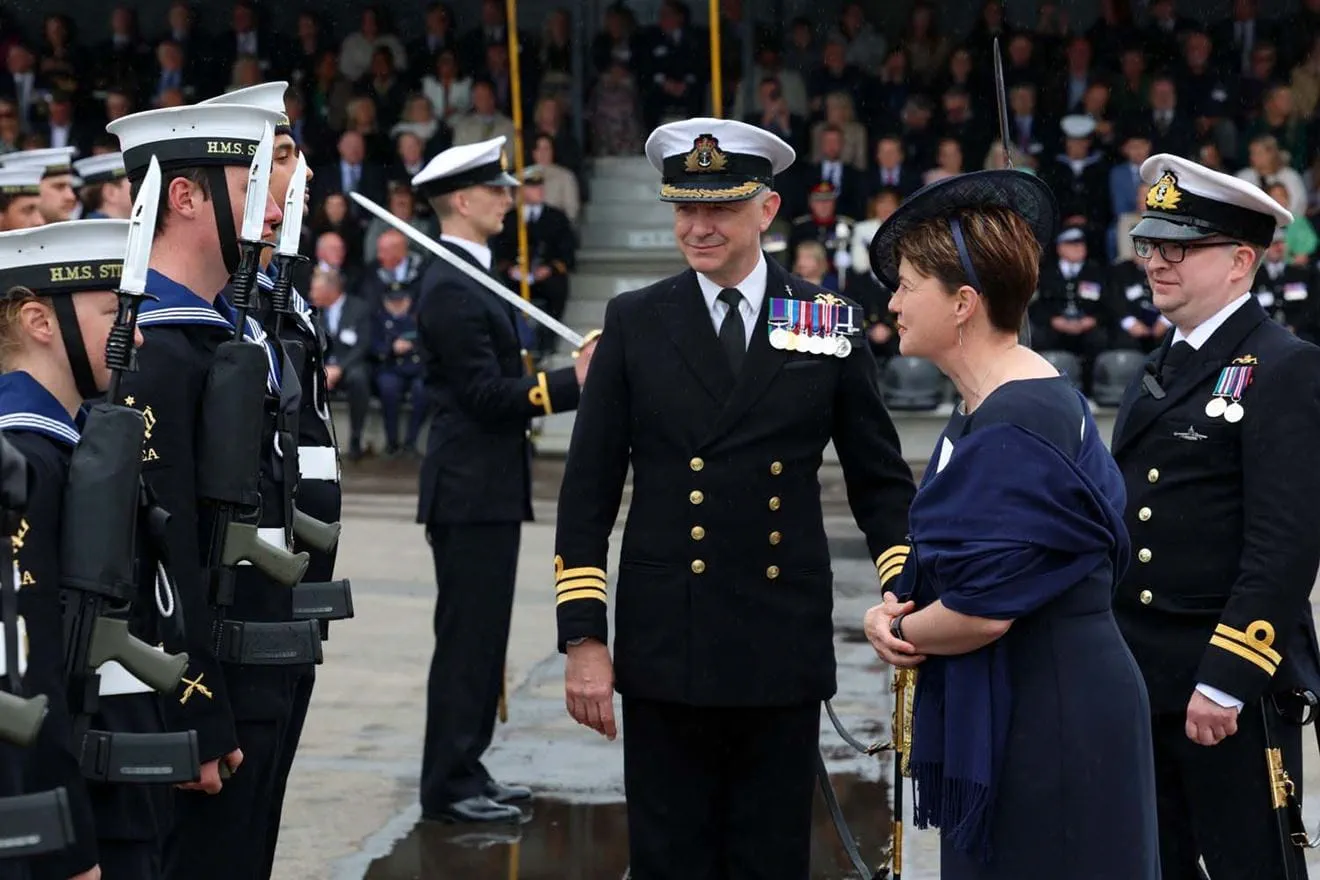
The Royal Navy has formally commissioned HMS Stirling Castle, Britain’s unique minehunting mothership, in a ceremony on the banks of the Firth of Forth that marked the start of the vessel’s operational life with the fleet, the Royal Navy has said.
The ship sailed as close as physically possible to her affiliated city of Stirling, berthing at the Port of Grangemouth, to mark the occasion. With her distinctive blue and white livery, she officially became a Royal Navy warship last July, hoisting the White Ensign at Birkenhead after spending her early service life as a Royal Fleet Auxiliary vessel, having been acquired in 2023.
The commissioning brought together the ship’s company, their families, affiliated organisations, former colleagues, senior officers and civic leaders, serenaded by the Royal Marines Band.
The commanding officer of HMS Stirling Castle, Commander Phil Harper, said a ship commissioning was “like a christening”, and that like the best christenings the crew were “surrounded by the friends and family that give meaning to our service.” The ship’s sponsor, Baroness Davidson of Lundin Link, alongside the Lord Provost of Stirling and a host of dignitaries, was blessing the ship with her presence, he said, with many of his crew’s families having made long journeys to attend. “Bless them all, and bless the ship.”
In her speech, Baroness Davidson set out the logic behind the vessel. “Without ships like Stirling Castle to deliver the embarked teams and equipment to the minefield, there is no way to deploy autonomy and uncrewed systems at range,” she said. With the ship informing the operation of future Royal Navy mine countermeasures support vessels, and with new uncrewed systems operated by experienced sailors, she said, “the future of mine countermeasures is bright.” It was the sailors who mattered most, she added, with the sailors of the future needing “more technical skills than their forebears” but no less fighting spirit.
The traditional cutting of the commissioning cake was shared between the commanding officer’s wife, Helen Harper, and the youngest sailor on board, Able Seaman Brinley Pollard, symbolising the continuity of generations within the naval service. A special service was presided over by the Chaplain of the Fleet, the Reverend Doctor Mark Davidson.
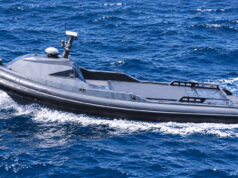
Based at His Majesty’s Naval Base Portsmouth and home to 45 sailors and officers, HMS Stirling Castle marks a deliberate move away from traditional minehunting, acting as a mothership for an array of remotely operated and autonomous systems that scour the water for mines in place of sending a crewed vessel into the danger area.
The approach extends the reach and effectiveness of Royal Navy minehunting while making the job safer for the sailors whose task is to locate and destroy mines, and it sits at the heart of the wider transition as the Royal Navy retires its traditional Hunt and Sandown-class minehunters in favour of autonomous systems delivered under the Mine Hunting Capability programme run with France.


This might be a daft question but why is this ship not sailing for the gulf. The pomp and ceremony is all very well but I thought there was a job to be done.
You’d have think it.
Clearly the Bay has something(s) this doesn’t?
Grey paint?!
Deck Chairs to lounge about in whilst Trump gets his latest deal #39
I’ve gained $17,240 only within four weeks by comfortably working part-time from home. Immediately when I had lost my last business, I was very troubled and thankfully I’ve located this project now in this way I’m in a position to receive thousand USD directly from home. Each individual certainly can do this easy work & make more greenbacks online by visiting
following website—.,..,.,,.—>> LIVEJOB1.COM
It doesn’t have a ruddy big target on the side saying “Sink Me!” Having checked Sterlin Castle, I think that it does have such a sign, “Sink me, attack me, put our Mine sweeping drones out of action.”
Guns
More likely DC and we’ll deck.
I’m not sure the 30mm are really the answer – good for slow moving drones but not a lot else.
Most of the threats are asymmetric to be honest.. a 30mm cannon at least gives you options when a group of nutters hiding in a fishing boat attack..
I’ve gained $17,240 only within four weeks by comfortably working part-time from home. Immediately when I had lost my last business, I was very troubled and thankfully I’ve located this project now in this way I’m in a position to receive thousand USD directly from home. Each individual certainly can do this easy work & make more greenbacks online by visiting
following website—.,.,.,.,.—>>> JobatHome1.Com
Yeah, them Brixham boys can get a little rowdy at times….
Well dock? Why crane the RNMBs over the side when they can just come in and out?
I tell my wife that all the time.
😆
I’ve gained $17,240 only within four weeks by comfortably working part-time from home. Immediately when I had lost my last business, I was very troubled and thankfully I’ve located this project now in this way I’m in a position to receive thousand USD directly from home. Each individual certainly can do this easy work & make more greenbacks online by visiting
following website—.,.,.,.,.—>>> JobatHome1.Com
You’re a very naughty man J. 😁😁😁
No CIWS either and also space. We tend to forget that Stirling Castle is the trials vessel so she tests the new kit coming on board and writes the books on how to employ it but she is almost certainly never going anywhere near a combat zone. What we need now are the two actual, built to survive a combat zone, MCM Motherships long promised but not ordered or even designed.
Yes, she’s the home waters mother vessel, that’s well established.
Yes, I’d resd they’re main gate 2026 so expecting it in the DIP. If not, RN MCM capability is shafted.
Saw a photo other day, think it was on here, showing the vast size difference between Stirling and a Bay.
Agreed.
She is a cheap trials ship for home waters.
So she can be cut about and modified.
We are still months off the RN and allies getting involved. First trump has to accept his lost and surrender to Iran, which doesn’t seem far off. The issue is also trump has to kiss up to Israel to get them to play ball, and then the mission can start. The problem is even though the US has massive ability to put isreal back in their box (by halting aid until they do) trump is too weak to use them. Amazing how weak the US has looked in recent years.
He’s not too weak, he is in the pocket of the Pro-Israel lobby. Take Miriam Adelson, she and her deceased husband donated huge sums to Trump’s re-election campaign. She gave him $106 million this time around and lobbied Trump for the US government to adopt pro-Israel policies, including supporting Israel’s annexation of the West Bank, moving its Embassy from Tel Aviv to Jerusalem.
It’s people like her he is in hock to for the 47th Presidency. He is not going to cross that lobby out of fear that they will turn on him. Come November, he will need all their help when the Democrats win Congress and the Senate. Trump’s arse is going to be impeached, and his cabal will be facing jail after he falls.
He could do something but daren’t. Sounds like a deeply weak position to me if your actions are so restricted by others. It’s how you define it I guess.
If you can’t understand why we wouldn’t sail a mine hunter (or any other ship) into an active war zone between two other countries, which we aren’t involved then, well I think that I will leave it there.
Thought the UK was involved in an international operation to sort out the strait of Hormuz. Mines are a problem and this ship is apparently part of the solution for dealing with mines. Whilst I can imagine the Iranians might be upset by this (although I’m sure Trump will have done a deal by the time the international community is ready to move) I’m sure you are not anticipating the US, Israel, etc. plan to attack the international community?
I think Trump Is working on Deal number 40 at this moment !
Give It time, his 2 day special Op has only been 100+ so far, Plenty of time to catch up with Putin yet. 🤦♂️
Weirdest comment I have read on here for a while ….
I think it’s because it’s not a warship. It’s a fully commercial ship so it’s not suited to deploy in war zones.
When you say “warship” ?
A Floating Castle.
Warship is a very very lose term in regards to capability or what it looks like but it have a very specific legal definition.
Under Article 29 of the United Nations Convention on the Law of the Sea (UNCLOS), a warship is defined as a ship belonging to the armed forces of a state that bears external marks distinguishing its nationality, is commanded by a commissioned officer, and is crewed by personnel under regular armed forces discipline.
Essentially if it’s a commissioned ship in a national navy it’s a warship..
So as an example the Bays even through they have 2 30mm cannons, 2 phalanx, 6 + HMGs, armed military helicopters have hundreds of heavily armed marines etc are NOT warships. Because they are not commissioned and are not commanded by a commissioned officer.. it means they legally cannot fulfill the role or responsibilities nor have the legal protections of a commissioned warship. Where as an archer class patrol boat or even HMS magpie an 18 meter unarmed launch is a warship under the legal definition has the legal powers to do things that a Bay cannot..so HMS anything can under international law initiate belligerent actions ( it could be used to launch an attack on another nations sovereign vessel etc) a Bay cannot legality initiate belligerent actions Because its not a warship and any nation it did that to would have the legal right to challenge the UK in the international court for a war crime and in the extreme if the got hold of them execute the captain and or other crew with no protection under the rules of war.. A prime historical example is British Captain Charles Fryatt of the armed merchant ship Brussels. In 1916, Germany executed him by firing squad for attempting to ram a German U-boat a year prior (an act Germany viewed as illegal because his vessel was an auxiliary rather than a recognised warship).
Its why having the Bays undertake such wide ranging military activities while not having a commissioned commanding officer is really a bit legally iffy….the RFA is for transportation not military ops.
Pretty simple: put the commissioned line of command on board.
Completely agree, its not very hard.. I honestly don’t know why they have not done so, with the roles the Bays have now taken they really should be commissioned warships under the command of a commissioned RN officer. They really should all be HMS. The RFA should be doing what they are meant to do, operate the stores ships and tankers.
Costs.
Crewing the Bays RN style would cost £££££ as the shift patterns and manning levels are a multiplier.
Also regenerating RFA would be much harder as Treasury would believe that co tracking out the tankers would be the way forwards.
But in the end the RN is going to be manning the MRSS as we know these 3-6 ships are going to be commissioned warships.. so they may as well start the transition process.. also the RFA will need to begin crewing the FSS as they come on line and even now it needs crews for Tide Race and Victoria when she is out of refit.
It’s actually something practical that they could do… have a path to commissioning the Bays.. even if at the start they just have one commissioned (the one playing actual war in the Middle East) .. move that RFA crew to Tiderace.. so the RN gets one more commissioned warship and the RFA are able to operate all four of the lovely replenishment tankers.
then when they need Victoria out again, commission another Bay and move the RFA crew to Victoria and when the first FSS commission the last bay and shift that last RFA crew over to the New FSS ship..
Then you would end up with 3 full RN crews who know how to run a multi role strike ship and can be moved from the bays as each MRSS is commissioned and the RFA have the crews they need to actually run 4 replenishment tankers and 3 FSS.
Yes it will cost some money but it will build the crews they need for the ships they have coming in the 2030s.. otherwise they have ships without plans for development of crews…
I wouldn’t be surprised if Fort Vic isn’t refitted given the DIP debacle that has overtaken STARMITE.
Planning was being carried out on the assumption of 2.75% and getting to 3% by 2030.
Now a less than 2.7% budget and not getting to 3% is going to mean more salami slicing.
It is very, very bad. Far worse than the number suggest given the extra pay and NI costs have eaten a lot of money already as well as the parody money that is actually intelligence budget.
Times are hard. I see HM govt has taken out 2 longterm contracts with CyanSentinel for 65m multipurpose offshore supply ships e.g Viking Sentinel. At a guess I think these are the replacements for the batch 1 Rivers.
I’ve gained $17,240 only within four weeks by comfortably working part-time from home. Immediately when I had lost my last business, I was very troubled and thankfully I’ve located this project now in this way I’m in a position to receive thousand USD directly from home. Each individual certainly can do this easy work & make more greenbacks online by visiting
following website—.,,…,,.—>>PayAtHome1.COM
I’ve gained $17,240 only within four weeks by comfortably working part-time from home. Immediately when I had lost my last business, I was very troubled and thankfully I’ve located this project now in this way I’m in a position to receive thousand USD directly from home. Each individual certainly can do this easy work & make more greenbacks online by visiting
following website—.,.,.,.,.—>>> JobatHome1.Com
Can’t something be done about blocking these spammers, especially this Atlas Bauer? How is it when I post anything my comment is held for vetting or moderating and they get to post with impunity?