

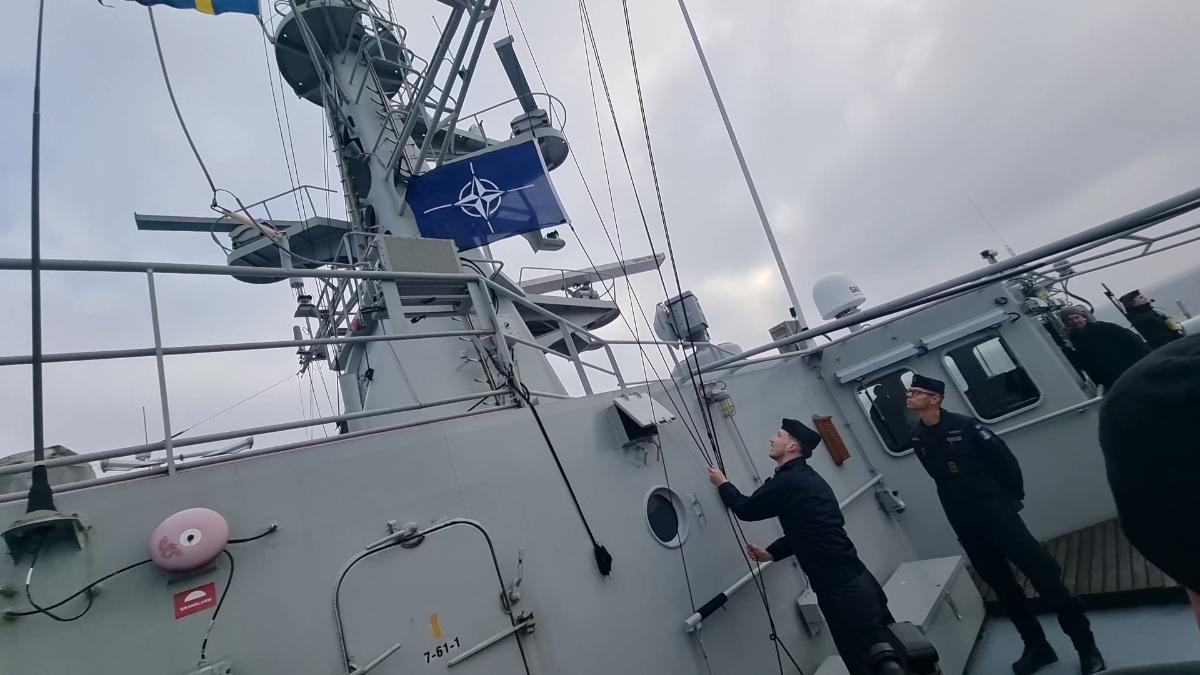
As we sailed through the misty waters of the Baltic Sea aboard Swedish warship HMS Carlskrona, a powerful broadcast echoed across the ship’s communication system.
“NATO is conducting Maritime Security activity “BALTIC SENTRY” maintaining a persistent military presence in the Baltic Sea region, in coordination with NATO Baltic nations to safeguard safety and security, freedom of navigation and the security of undersea infrastructure. To assist in this Maritime Security effort, please report immediately any observation of unusual maritime activity or behaviour activity over VHF channel 6. This is NATO Warship P04 monitoring channel 6 and 16, out.”
To most ears, it may have sounded like a routine maritime announcement. But aboard the ship, and in the broader context of the region’s shifting security dynamics, it carried a far deeper meaning.
For the first time, a Swedish warship was making that announcement under the NATO flag—a moment that signified Sweden’s transition from close partner to full-fledged ally. It was a statement of unity and a reminder that the Baltic Sea is now a shared responsibility.
The Baltic Sea is one of the busiest maritime regions in the world, with around 4,000 ships passing through its waters every 24 hours. For comparison, the English Channel, another key global chokepoint, sees around 1,000 vessels daily.
The Baltic connects northern Europe’s major economies and is essential for the flow of goods, energy, and data. Undersea cables crisscross the seabed, carrying critical internet and energy links that, if disrupted, could wreak havoc across Europe.

It is this infrastructure that has become a growing target. Hybrid warfare, including alleged sabotage, is the region’s biggest threat. The recent damage to the Finland-Germany undersea cable, allegedly caused by a ship dragging its anchor, has only heightened concerns. While some incidents have been ruled accidental, the pattern of suspicious activity has prompted NATO to increase its presence in the Baltic.
As part of this increased vigilance, NATO’s Operation Baltic Sentry brings together ships, aircraft, submarines, and cyber assets to monitor and protect the region. Sweden and Finland, having joined NATO in response to shifting security dynamics following Russia’s invasion of Ukraine, are now key contributors.
“The security situation in the Baltic has changed as much as elsewhere in Europe,” said a Swedish naval officer aboard HMS Carlskrona. “Being in NATO gives us additional stability in the region. We’re surrounded by allies.”
Sweden’s Warships Fly NATO’s Flag
Hearing a Swedish warship broadcasting as a NATO warship was a powerful reminder of this new reality. For decades, Sweden maintained a neutral stance, cooperating with NATO on specific missions but staying outside of formal alliance commitments.
That changed in 2023 when Sweden and Finland officially joined NATO, bringing their considerable regional expertise and maritime capabilities with them.
During my interview with Commodore Arjen Warnaar, Commander of NATO’s Standing Naval Group 1 (SNMG1), he emphasised how easily Sweden and Finland have integrated into NATO operations.
“The nice thing about both Finland and Sweden is that they’re basically the specialists here,” Warnaar said. “They’ve been here forever, very much longer than I’ve been here. So they actually know more about the area and know more about the situation than we do. In that perspective, they fit in very, very well, and we’re very glad to have them.”
However, Warnaar acknowledged that full integration takes time. “Within NATO, the issue is about interconnectivity, about working together, and that is improving at a very high rate. They are new members. It’ll take some time to integrate them completely, and we just have to take that time.”
But the broadcast we heard that day was a sign that Sweden has already taken a major step forward. Operating under NATO command, HMS Carlskrona was actively participating in the broader defence of the Baltic, a role that symbolises how quickly Sweden has adapted to its new reality.

A New Posture for a New Era
The Baltic Sea’s strategic importance has grown as tensions between NATO and Russia have escalated. Russia’s increased naval activity, coupled with incidents involving its so-called “shadow fleet” of auxiliary and civilian vessels, has created a heightened sense of urgency. The transition from cooperation to full NATO membership has given Sweden and Finland access to a broader defence network, but it has also come with new responsibilities.
As Warnaar noted, NATO’s approach to maritime security in the region is comprehensive, involving assets from multiple domains. “Anything that will help our aims, reaches our aims,” he said. “So that is going to be within the cyber domain, within the maritime domain, but also within the air and the space domains. We’ll use anything that can help us.”
This integrated approach ensures that any suspicious behaviour—whether it be a vessel dragging its anchor over an undersea cable or unusual radio communications—is detected and investigated. Sweden’s warships, now flying the NATO flag, are key to making that system work. The broadcast from HMS Carlskrona was more than just a warning to nearby vessels—it was a symbol of Sweden’s transformation.

To understand the depth of this transformation, one must see the Baltic Sea not just as a waterway but as what many now call a “NATO lake.” With the accession of Sweden and Finland, every coastal nation except for Russia and its small exclave, Kaliningrad, is part of the alliance. NATO warships, aircraft, and surveillance drones now dominate the region’s airspace and waters. From the Øresund Strait to the Gulf of Finland, the alliance’s footprint is everywhere—monitoring traffic, mapping potential threats, and ensuring that the vital arteries of commerce and communication remain open and secure.
For Russia, this shift has been seismic. The Baltic Fleet, once seen as a powerful lever of influence, now finds itself contained within what is effectively a fortified perimeter. With undersea sensors and NATO patrols crisscrossing the waters, even the smallest anomaly risks detection.
This perception isn’t just symbolic. It reflects NATO’s commitment to ensuring that no nation—whether through overt or covert means—can disrupt the fragile security architecture that keeps Europe connected. The Baltic, once a potential pressure point for European vulnerability, has instead become a testament to allied cohesion. The significance of Sweden’s role in this cannot be overstated. Once a neutral observer in the Baltic, Sweden is now a critical part of the region’s defence network, working alongside its allies to secure vital sea lanes and protect undersea infrastructure.










I like the Swedes, good meatballs!
Levity aside, I’m glad they (and Finland) have joined NATO.