

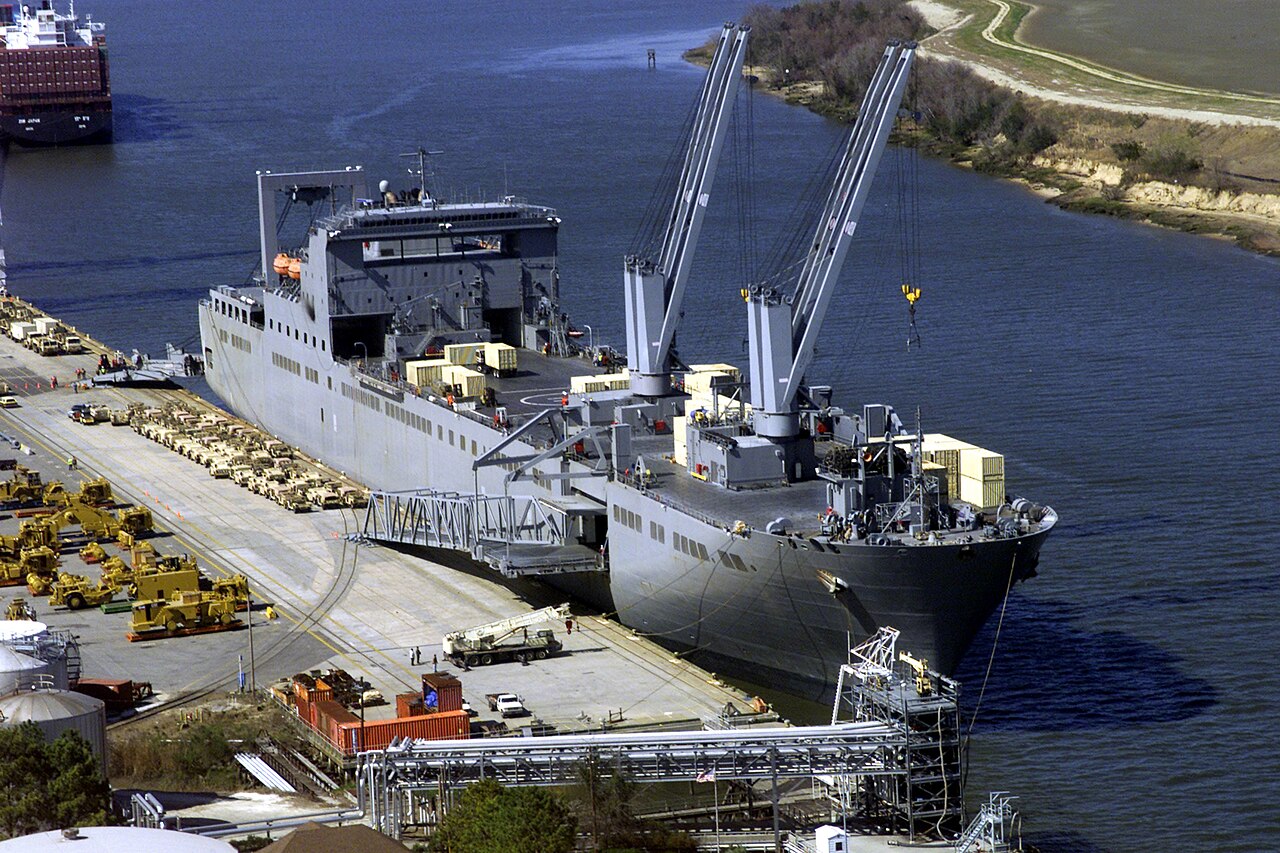
The United States guarantees access to 60 commercially operated ships and more than 2,400 trained mariners for an annual cost equivalent to fewer than five F-35A fighters, a model NATO should consider adopting more widely, according to the Council on Geostrategy.
The comparison appears in the Council’s new Primer on strategic sealift and maritime resilience, which argues that European NATO members should develop pre-negotiated agreements with commercial shipping companies rather than wait until a crisis before trying to secure transport capacity. Authors William Freer and Charlotte Kleberg point to the US Maritime Security Programme, or MSP, as an example of how governments can retain access to militarily useful commercial shipping without owning the vessels outright.
The MSP maintains a fleet of 60 privately owned, US-flagged and American-crewed commercial ships which remain in normal commercial operation but can be made available for defence requirements. The programme also supports more than 2,400 trained mariners and pays an annual readiness retainer of $6.5 million, around £4.8 million, for each participating vessel.
The total annual cost in 2026 is $390 million, or approximately £287.6 million. The report compares that with a stated F-35A flyaway cost of $83 million, around £61.2 million, saying the United States secures access to a global commercial sealift network for less than the cost of five aircraft.
Freer and Kleberg write that the arrangement provides capacity and flexibility without requiring the US government to maintain an equivalent wholly state-owned or permanently chartered merchant fleet. A related mechanism, the Voluntary Intermodal Sealift Agreement, gives participating American-flagged operators priority access to defence cargoes during peacetime in return for offering capacity when required.
The authors argue that no single European NATO country may generate enough routine military cargo to reproduce the American model independently, but say the economics are different when the alliance is considered collectively. NATO members have committed to ordering more than 3,000 F-35s, according to figures cited in the report, including almost 600 aircraft for European members of the alliance.
The Primer proposes consideration of a NATO Assured Sealift Access Programme, or NASAP, which could establish an alliance-wide pool of strategically useful commercial ships. Rather than describing a specific fleet size or setting a precise price for such a NATO programme, the authors use the existing American scheme to demonstrate the cost of maintaining assured access to commercial sealift.
Under their proposal, participating vessels could form a readiness pool integrated into NATO operational planning and regularly exercise alongside military forces. The programme could also give the alliance a common mechanism for deciding which commercial vessels satisfy military requirements and for coordinating their availability across member states.
The authors suggest pooled NATO funding may be necessary because many individual European countries would struggle to provide sufficient routine defence cargo to make national retainer schemes commercially attractive. They compare the concept with NATO’s collective approach to procuring and operating its Airborne Early Warning and Control aircraft.
The report says the broader requirement is to replace assumptions about commercial availability with contractual certainty established before a conflict begins. It argues that standing access arrangements would allow shipping companies to plan commercially while giving military commanders greater confidence that the ships and crews included in reinforcement plans would actually be available when required.







Something like $6M per ship per year. Seems quite expensive to me.
Would it not be better to build them and then simply rent them out unless needed.
STUFT – Ships Taken Up from Trade
The Falklands War proved we could just nab any Briths Flagged vessel and put it to work, sometimes in days while strapping helipads and weapons on. We don’t need to spend money on this, but we do need to have enough British Mariners who can operate the bloody things should the shit hit the fan.
Far cheaper to invest in merchant marines, navy cadets and reserve. If we needed to snap up 60 decently big hulls tomorrow, the hulls aren’t the issue, the people (or lack thereof) is)
STUFT is UK centric and … dead, it was replaced by the Foreland arrangement/contract. I imagine the UK would join an e-nato centric programme, as that would be sensible, reduce costs, and offer greater flexibility. However, they should retain its own shipping; under Uk control. It’s a very small cost spread across all e-nato membership, and … it comes with sailors.
Meanwhile the Jones Act is recognised as a commercial noose around US shipping that’s resulted in their merchant fleet being creaking out of date ships (average age 30-35 years) and halfling in the last decade as fewer large ships are built in US shipyards than being retired each year.
At the end of the day this is all about freeing up shipping should a US / China conflict eventuate. The paper is focused around European security and reinforcing NATO’s Eastern flank and intra-European shipping.
In the event of a war with Russia, NATO needs F35 it can get, the only need for ships is to get US forces across the Atlantic. Logistics in Europe will be by road and rail. I don’t see a need for European NATO to have such a capability. NATO is a defensive alliance designed to defend Europe and the North Atlantic.
It’s not Americans back up force for wars in Asia.
You still don’t understand how much more efficient sea travel is than land, even within Europe.
Trains are far more efficient for armoured vehicles movement – You can literally send Challengers on carts through Channel Tunnel and all the way to NATO’s Eastern Flank. NATO has standardised rapid on/off loaders (RAIL), the ERA has it mostly standardised for allowing armoured vehicle movements through and billions coming in upgrades to EU tracks. Soldiers would likely be air moved – inland European rivers aren’t exactly perfectly navigable for large logistics movements. So whilst sea travel would be far more preferable for Western flank operations, once on the Eurasia continental shelf, ground would be far more preferable and it has repeatedly been war gamed this way. As to which one is more vulnerable to Russian attacks, I would argue it is roughly similar.
I know you are a provincial Brit living on your dinky little island off the coast of Europe and are incredibly ignorant of the wider world, but this is a level of ignorance I didn’t expect. NATO is an alliance to safeguard the freedom and security of its member states through political and military means. Two member states, the US and Canada are American hemisphere and Pacific powers. One member, Turkey, is a Middle East and Asia power. Article 5 provisions of the NATO treaty have no geographic boundary.
I have spoken before on here of the power of the US Navy but also the scope of their shadow fleet. These vessels operate with their AIS switched of frequently. As do our point class from time to time. Notably on the FI resupply run. Now following Putin’s threat nearly permanently.. The point class is a microcosm of UK Defence Policy.
Six built four sold of. The four remaining vessels working non stop. FI, Sunny Point and the Baltic states for resupply runs being a huge part of the workload. Cypress and the Gulf until recently also get visits.
These vessels are all around the 25 year old mark. We today could employ two more. Whilst 25 years old is not old for a merchant ship we as a nation should be looking to think of replacements. This could be work for British yard’s. Two of the original ships were Belfast built. They absolutely should not be a shared NATO asset. Available to NATO yes on request. However wholly controlled crewed and owned by the UK. As they are now.
I agree Ken, Great ships and we should get 6 again, much better spending money on that than paying P&O £5 million a year to keep a British crew on a ransom merchant ship.
The 6 ship replacement should very much be a job for Harland and Wolf once the FSS are finished.
I can’t see a down side. Worst case scenario in the context of these ships. International peace breaks out and the military requirements slacken of. That being so we find them work on the Baltic Exchange. Retaining the ownership and flexibility. Work for Belfast as you say on completion of FSS.
Still loses the war though.
Makes you realise just how much the F35 costs, to purchase and then maintain.