

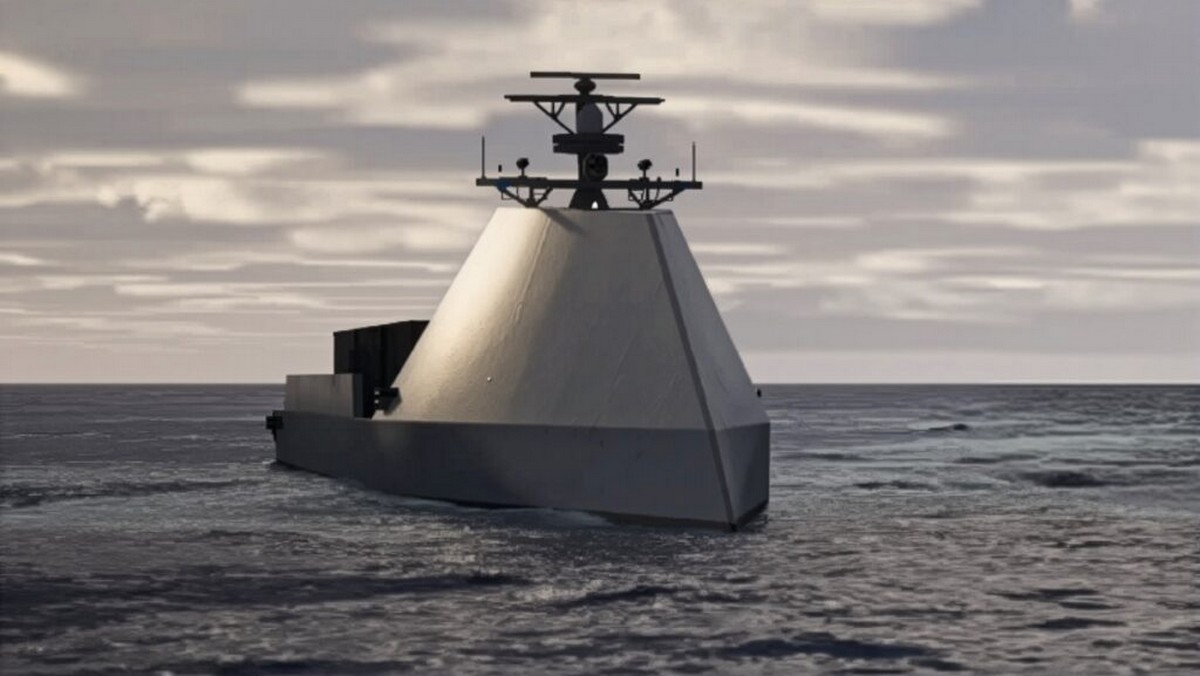
HII has outlined plans to expand its manufacturing approach for unmanned surface vessels, including a new assembly facility in Louisiana and a robotics-led production initiative aimed at increasing output and reducing build times, according to the company.
The proposed facility at Breaux Brothers Enterprises in New Iberia is intended to support serial production of the ROMULUS family of unmanned surface vessels, which range from roughly 20 feet to 190 feet in length. The site is being configured around automated processes, advanced tooling, and standardised workflows, with the aim of producing multiple vessel variants through a common manufacturing approach.
HII states that the shift reflects a broader move away from prototype-led construction towards repeatable, scalable production. The company expects this to reduce unit costs and shorten delivery timelines while enabling higher production rates aligned with demand for autonomous maritime systems.
“ROMULUS is engineered from the outset for scale,” said Andy Green, president of HII’s Mission Technologies division. “By pairing a purpose-built assembly line with automation and strong industry partnerships, we are driving predictable production outcomes and lowering the cost of unmanned surface vessels. This positions us to deliver capability faster and at volumes aligned with fleet needs.”
Alongside the facility expansion, HII has launched its High-Yield Production Robotics (HYPR) initiative, which focuses on integrating robotics and digital systems into the shipbuilding process. The programme is expected to incorporate robotic welding, automated material handling, and digitally enabled quality assurance into an assembly-line model tailored to ROMULUS production.
The company plans to carry out proof-of-concept demonstrations with partners during 2026, with a view to launching a pilot programme in early 2027. HYPR is expected to support concurrent hull construction and reduce labour hours, while maintaining consistent output across different vessel classes.
“HYPR applies next-generation industrial robotics to shipbuilding processes that have traditionally been labor-intensive and difficult to automate,” said Eric Chewning, executive vice president of maritime systems and corporate strategy at HII. “For ROMULUS, this means fewer labor hours per hull, greater schedule predictability, and a manufacturing model that can scale efficiently as volumes increase.”
HII is working with partners including Breaux Brothers Enterprises and Incat Crowther to align vessel design with production tooling and facility layout. The intention is to apply commercial manufacturing practices to the production of autonomous naval platforms.
The ROMULUS family itself is designed as a modular system capable of supporting a range of missions, including intelligence collection, mine countermeasures, strike operations, and the deployment of other unmanned systems. The vessels are built around HII’s Odyssey Autonomous Control System, which the company says enables sustained open-ocean operations and coordinated multi-vessel activity.
A prototype vessel is currently under construction at the Louisiana facility.




7 Advert sandwich.
It’s a massive mistake for the UK to get involved in any autonomous weapon program with HII or any US company. Parliament today reported that the UK can no longer guarantee access to F35 deliveries or Trident missile maintenance and they are questioning our involvement in the AUKUS program.
Autonomous weapons reliance would be even worse given the nature of software and the heavy reliance such platforms would have on it.
I also can’t think of a single example in the UK where a US defence contractor has been able to deliver a program in a reasonable manner.
No doubt about it in my mind either. We must get up on our own two feet and move on from reliance abroad, particularly from the U.S. Never happen, of course, but we can dream.
Agreed, at this point, we need to be very wary of creating yet more dependency on the US. They are actively hostile towards us now, and although that might ease in future, there’s absolutely no guarantee. Ideally we need to be ensuring that we buy as much as possible either domestically or from allies where not subject to ITAR etc… There will, of course, be areas we have no alternatives, just as happened with the French aircraft carrier, where they bought catapults, arrestor gear and even E-2 Hawkeyes, because there was no alternative.
It is you that are hostile to US. You even interfered into its elections.
But this is still one system out of many that we still rely on from America. However, maybe BMT Modus could be considered.
Spend the money on some extra T31s. At least as they’ll have multi use, longer range, have a helo and help fly the flag. Drone ships don’t do port visits well.