

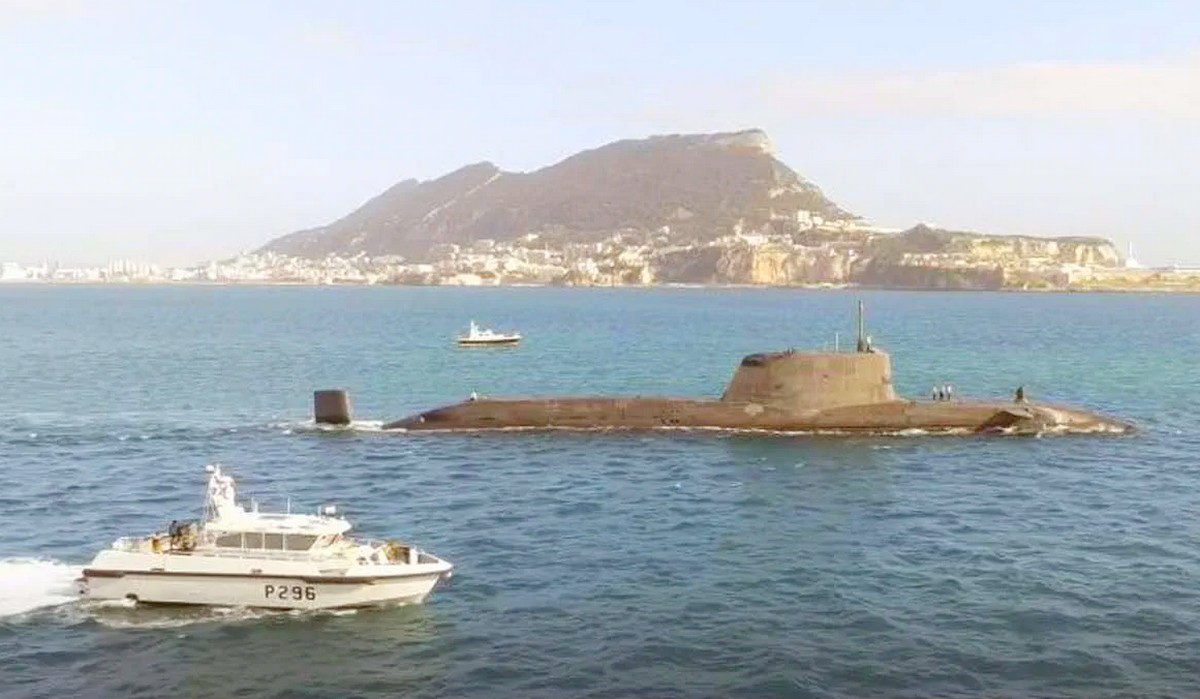
HMS Anson, a Royal Navy Astute-class nuclear-powered attack submarine, has arrived at Gibraltar, the UK Defence Journal understands.
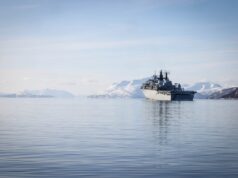
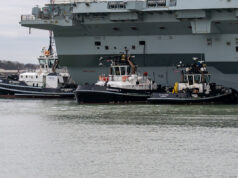
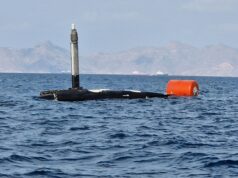
The photographs, taken by local observers, show the submarine being escorted into port by tugs beneath the Rock of Gibraltar.
The visit marks what appears to be a return leg of an extraordinary deployment that has taken Anson from Scotland to Australia and then into the Arabian Sea over the course of several months. The submarine departed HMNB Clyde on 10 January 2026, transiting via Gibraltar before making the roughly 8,000 nautical mile journey to HMAS Stirling in Western Australia, where she arrived on 22 February as part of the AUKUS trilateral partnership.
The visit was the first time a Royal Navy submarine had undergone maintenance on Australian soil, a milestone in building the industrial and workforce infrastructure Australia will need to operate its own nuclear-powered submarines later this decade.
Anson did not remain in Australia for long. The submarine departed Perth on 6 March 2026 and was subsequently reported to be operating in the northern Arabian Sea, taking up position in deep water as regional tensions mounted around the Strait of Hormuz. Armed with Tomahawk Block IV land-attack missiles with a range of 1,000 miles and Spearfish heavyweight torpedoes, the boat’s presence in the region gave Britain a covert long-range strike option at a moment when the conflict between the United States and Iran was at its height.
The Ministry of Defence declined to comment on her specific location or movements at the time, as is standard practice for submarine operations.
Her appearance at Gibraltar on 14 May, now that regional hostilities have reduced in intensity, suggests the boat is transiting back toward UK waters following what has been one of the most operationally significant deployments by a Royal Navy submarine in recent years.
The Astute class is the Royal Navy’s most capable attack submarine, displacing around 7,800 tonnes submerged and measuring 97 metres in length. Each boat is powered by a Rolls-Royce PWR2 nuclear reactor that requires no refuelling across its 25-year service life, giving effectively unlimited range constrained only by crew endurance and food supplies. The class carries up to 38 weapons across six 533mm torpedo tubes, with the loadout typically combining Spearfish heavyweight torpedoes and Tomahawk Block IV cruise missiles capable of striking targets at ranges exceeding 1,600 kilometres.
Astute-class submarines replace the traditional optical periscope with a high-definition optronic mast system and are designed with a very low acoustic signature to maximise survivability in contested environments.


It’s really goes to show just how powerful such platforms are when a vessel armed with nearly 40 long missiles or torpedoes can pop up anywhere across three oceans with in this space of a month.
A fleet of 12 SSN A will give the UK real reach both in the Atlantic or pacific if required.
Ha.
These 12 SSN’s ?
When will we get them, what names are they to have, how many DIP’s will they survive, will we all live that long ?
Im certainly planning to be alive when they get delivered 😀
I think we were all pretty adamant they should use the 1942 light fleet carrier naming convention. Failing that the Leanders.
Yes, I like the classical naming of assets.
Phoebe. Dryad. Centaur. Achilies. And so on.
More likely be named after Rainbow colours now 🤔
They could name it after yourself. HMS Gammon has a nice ring to it.
Cheers Bruce 😁😁😁.
Always great to see a brand new name turn up just to add Intellectual seasoning to this crackling joint.
He actually made me laugh, even though he was trying, and failing, to insult.
HMS Gammon! Lol!
The 7th & last Astute class has been renamed HMS Achillies. It was excellently named HMS Agincourt, but this was thought, by few, that it might annoy few French people….
So it’s said!
I was quite happy with Agincourt.
After all, we have a Waterloo station, abd the French have Austerlitz.
Too many getting offended by history again perhaps?
Whatever, Achillies is also a fine name.
“The visit was the first time a Royal Navy submarine had undergone maintenance on Australian soil”
Not quite true – Several Trafalgar class visited and had routine maintenance in Australia over the years – Anson might be the first Astute class to do this but she not the first RN submarine to do so.
Also this deployment has had so many changes since she sailed from Faslane on the 10th January